The Effects of Strength Training on Motor Control and Functional Performance in Older Adults: A Narrative Review
DOI:
https://doi.org/10.61838/kman.intjssh.8.1.2Keywords:
Strength Training, Motor Control, Functional Performance, Older Adults, neurophysiological adaptations, aging, fall preventionAbstract
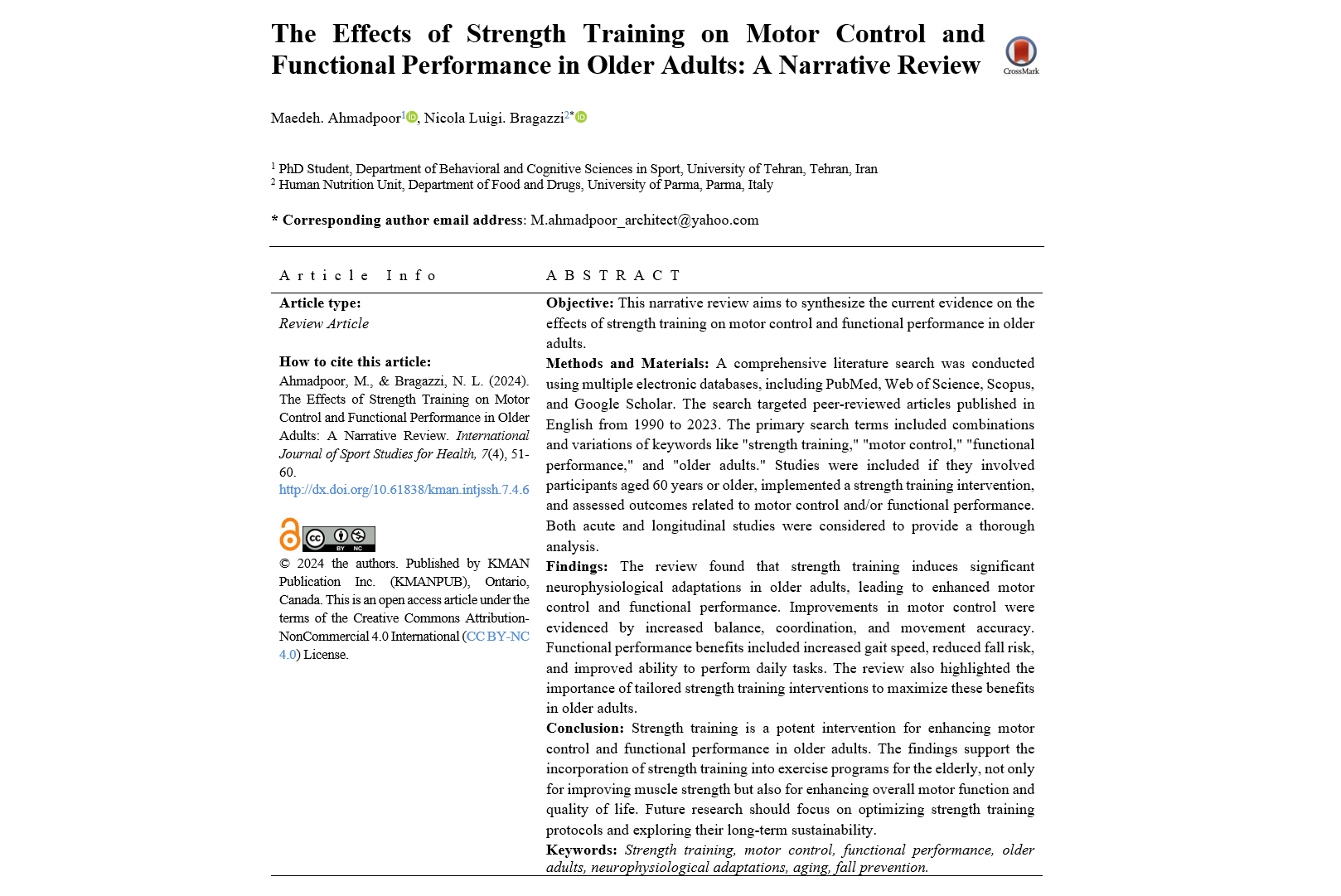
Objective: This narrative review aims to synthesize the current evidence on the effects of strength training on motor control and functional performance in older adults.
Methods and Materials: A comprehensive literature search was conducted using multiple electronic databases, including PubMed, Web of Science, Scopus, and Google Scholar. The search targeted peer-reviewed articles published in English from 1990 to 2023. The primary search terms included combinations and variations of keywords like "strength training," "motor control," "functional performance," and "older adults." Studies were included if they involved participants aged 60 years or older, implemented a strength training intervention, and assessed outcomes related to motor control and/or functional performance. Both acute and longitudinal studies were considered to provide a thorough analysis.
Findings: The review found that strength training induces significant neurophysiological adaptations in older adults, leading to enhanced motor control and functional performance. Improvements in motor control were evidenced by increased balance, coordination, and movement accuracy. Functional performance benefits included increased gait speed, reduced fall risk, and improved ability to perform daily tasks. The review also highlighted the importance of tailored strength training interventions to maximize these benefits in older adults.
Conclusion: Strength training is a potent intervention for enhancing motor control and functional performance in older adults. The findings support the incorporation of strength training into exercise programs for the elderly, not only for improving muscle strength but also for enhancing overall motor function and quality of life. Future research should focus on optimizing strength training protocols and exploring their long-term sustainability.
Downloads
References
1. Mayer F, Scharhag-Rosenberger F, Carlsohn A, Cassel
M, Müller S, Scharhag J. The intensity and effects of strength
training in the elderly. Deutsches Ärzteblatt International.
2011;108(21):359. [PMID: 21691559] [PMCID: PMC3117172]
[DOI]
2. Macaluso A, De Vito G. Muscle strength, power and
adaptations to resistance training in older people. European journal
of applied physiology. 2004;91:450-72. [PMID: 14639481] [DOI]
3. Aagaard P, Suetta C, Caserotti P, Magnusson SP, Kjær
M. Role of the nervous system in sarcopenia and muscle atrophy
with aging: strength training as a countermeasure. Scandinavian
journal of medicine & science in sports. 2010;20(1):49-64. [PMID:
20487503] [DOI]
4. Seidler RD, Bernard JA, Burutolu TB, Fling BW, Gordon
MT, Gwin JT, et al. Motor control and aging: links to age-related
brain structural, functional, and biochemical effects. Neuroscience
& Biobehavioral Reviews. 2010;34(5):721-33. [PMID: 19850077]
[PMCID: PMC2838968] [DOI]
5. Spirduso WW, MacRae PG. Motor performance and
aging. Handbook of the psychology of aging. 1990;3:183-200.
[DOI]
6. Holviala JH, Sallinen JM, Kraemer WJ, Alen MJ,
Häkkinen KK. Effects of strength training on muscle strength
characteristics, functional capabilities, and balance in middle-aged
and older women. The Journal of Strength & Conditioning
Research. 2006;20(2):336-44. [PMID: 16686561] [DOI]
7. Hurley BF, Roth SM. Strength training in the elderly:
effects on risk factors for age-related diseases. Sports medicine.
2000;30:249-68. [PMID: 11048773] [DOI]
8. McCartney N, Hicks AL, Martin J, Webber CE. Longterm resistance training in the elderly: effects on dynamic strength,
exercise capacity, muscle, and bone. The Journals of Gerontology
Series A: Biological Sciences and Medical Sciences.
1995;50(2):B97-B104. [PMID: 7874586] [DOI]
9. Barry BK, Carson RG. The consequences of resistance
training for movement control in older adults. The Journals of
Gerontology Series A: Biological Sciences and Medical Sciences.
2004;59(7):M730-M54. [PMID: 15304540] [DOI]
10. Hauer K, Becker C, Lindemann U, Beyer N.
Effectiveness of physical training on motor performance and fall
prevention in cognitively impaired older persons: a systematic
review. american Journal of Physical medicine & rehabilitation.
2006;85(10):847-57. [PMID: 16998433] [DOI]
11. Pinto RS, Correa CS, Radaelli R, Cadore EL, Brown LE,
Bottaro M. Short-term strength training improves muscle quality
and functional capacity of elderly women. Age. 2014;36:365-72.
[PMID: 23881608] [PMCID: PMC3889909] [DOI]
12. Holviala J, Kraemer W, Sillanpää E, Karppinen H, Avela
J, Kauhanen A, et al. Effects of strength, endurance and combined
training on muscle strength, walking speed and dynamic balance in
aging men. European journal of applied physiology.
2012;112:1335-47. [PMID: 21796409] [DOI]
13. Latham NK, Bennett DA, Stretton CM, Anderson CS.
Systematic review of progressive resistance strength training in
older adults. The Journals of Gerontology Series A: Biological
Sciences and Medical Sciences. 2004;59(1):M48-M61. [PMID:
14718486] [DOI]
14. Levin O, Netz Y, Ziv G. The beneficial effects of
different types of exercise interventions on motor and cognitive
functions in older age: a systematic review. European Review of
Aging and Physical Activity. 2017;14:1-23. [PMID: 29276545]
[PMCID: PMC5738846] [DOI]
15. Scaglioni G, Ferri A, Minetti AE, Martin A, Van Hoecke
J, Capodaglio P, et al. Plantar flexor activation capacity and H
reflex in older adults: adaptations to strength training. Journal of
Applied Physiology. 2002;92(6):2292-302. [PMID: 12015339]
[DOI]
16. Hakkinen K, Kallinen M, Izquierdo M, Jokelainen K,
Lassila H, Malkia E, et al. Changes in agonist-antagonist EMG,
muscle CSA, and force during strength training in middle-aged and
older people. Journal of applied physiology. 1998;84(4):1341-9.
[PMID: 9516202] [DOI]
17. Orssatto LB, Rodrigues P, Mackay K, Blazevich AJ,
Borg DN, Souza TRd, et al. Intrinsic motor neuron excitability is
increased after resistance training in older adults. Journal of
Neurophysiology. 2023;129(3):635-50. [PMID: 36752407] [DOI]
18. Watanabe K, Holobar A, Mita Y, Kouzaki M, Ogawa M,
Akima H, et al. Effect of resistance training and fish protein intake
on motor unit firing pattern and motor function of elderly. Frontiers
in physiology. 2018;9:1733. [PMID: 30564141] [PMCID:
PMC6288440] [DOI]
19. Knight C, Kamen G. Adaptations in muscular activation
of the knee extensor muscles with strength training in young and
older adults. Journal of electromyography and kinesiology.
2001;11(6):405-12. [PMID: 11738953] [DOI]
20. Steib S, Schoene D, Pfeifer K. Dose-response
relationship of resistance training in older adults: a meta-analysis.
Medicine & Science in Sports & Exercise. 2010;42(5):902-14.
[PMID: 19996996] [DOI]
21. Miszko TA, Cress ME, Slade JM, Covey CJ, Agrawal
SK, Doerr CE. Effect of strength and power training on physical
function in community-dwelling older adults. The Journals of
Gerontology Series A: Biological Sciences and Medical Sciences.
2003;58(2):M171-M5. [PMID: 12586856] [DOI]
22. Hruda KV, Hicks AL, McCartney N. Training for muscle
power in older adults: effects on functional abilities. Canadian
Journal of Applied Physiology. 2003;28(2):178-89. [PMID:
12825328] [DOI]
23. Berryman N, Bherer L, Nadeau S, Lauzière S, Lehr L,
Bobeuf F, et al. Multiple roads lead to Rome: combined highintensity aerobic and strength training vs. gross motor activities
leads to equivalent improvement in executive functions in a cohort
of healthy older adults. Age. 2014;36:1-19. [PMID: 25194940]
[PMCID: PMC4156938] [DOI]
24. Granacher U, Muehlbaue T, Zahner L, Gollhofer A,
Kressig RW. Comparison of traditional and recent approaches in
the promotion of balance and strength in older adults. Sports
medicine. 2011;41:377-400. [PMID: 21510715] [DOI]
25. Leung M, Rantalainen T, Teo W-P, Kidgell D. Motor
cortex excitability is not differentially modulated following skill
and strength training. Neuroscience. 2015;305:99-108. [PMID:
26259901] [DOI]
26. Hortobagyi T, Tunnel D, Moody J, Beam S, DeVita P.
Low-or high-intensity strength training partially restores impaired
quadriceps force accuracy and steadiness in aged adults. The
Journals of Gerontology Series A: Biological Sciences and Medical
Sciences. 2001;56(1):B38-B47. [PMID: 11193224] [DOI]
27. Shim JK, Hsu J, Karol S, Hurley BF. Strength training
increases training-specific multifinger coordination in humans.
Motor Control. 2008;12(4):311-29. [PMID: 18955741] [DOI]
28. Sipilä S, Multanen J, Kallinen M, Era P, Suominen H.
Effects of strength and endurance training on isometric muscle
strength and walking speed in elderly women. Acta Physiologica
Scandinavica. 1996;156(4):457-64. [PMID: 8732251] [DOI]
29. Voelcker‐Rehage C, Godde B, Staudinger UM. Physical
and motor fitness are both related to cognition in old age. European
Journal of Neuroscience. 2010;31(1):167-76. [PMID: 20092563]
[DOI]
30. Boiko Ferreira LH, Schoenfeld BJ, Smolarek AC,
McAnulty SR, Mascarenhas LPG, Souza Junior TP. Effect of 12
weeks of resistance training on motor coordination and dynamic
balance of older woman. Rejuvenation research. 2021;24(3):191-7.
[PMID: 33115319] [DOI]
31. Wolfson L, Whipple R, Derby C, Judge J, King M,
Amerman P, et al. Balance and strength training in older adults:
intervention gains and Tai Chi maintenance. Journal of the
American Geriatrics Society. 1996;44(5):498-506. [PMID:
8617896] [DOI]
32. Liu XJ, Ge S, Cordova A, Yaghi Z, Jiang BY, Yue GH,
et al. Elderly may benefit more from motor imagery training in
gaining muscle strength than young adults: A systematic review
and meta-analysis. Frontiers in Psychology. 2023;13:1052826.
[PMID: 36687842] [PMCID: PMC9845905] [DOI]
Downloads
Additional Files
Publication Timeline
Issue
Section
License
Copyright (c) 2024 Maedeh Ahmadpoor, Nicola Luigi Bragazzi (Author)

This work is licensed under a Creative Commons Attribution-NonCommercial 4.0 International License.