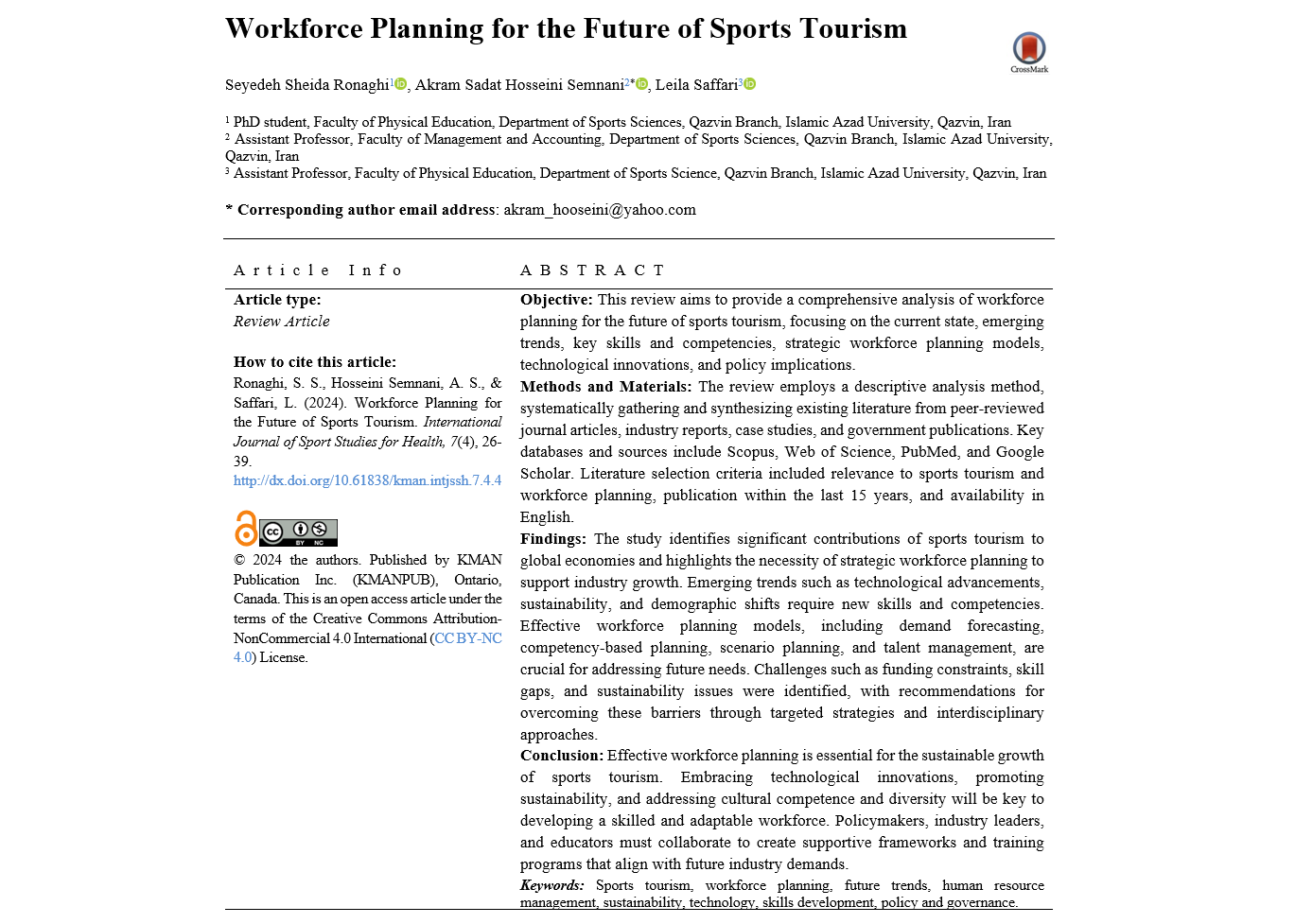
Workforce Planning for the Future of Sports Tourism
DOI:
https://doi.org/10.61838/kman.intjssh.7.4.4Keywords:
Sports tourism, workforce planning, future trends, human resource management, sustainability, technology, skills development, policy and governanceAbstract
Objective: This review aims to provide a comprehensive analysis of workforce planning for the future of sports tourism, focusing on the current state, emerging trends, key skills and competencies, strategic workforce planning models, technological innovations, and policy implications.
Methods and Materials: The review employs a descriptive analysis method, systematically gathering and synthesizing existing literature from peer-reviewed journal articles, industry reports, case studies, and government publications. Key databases and sources include Scopus, Web of Science, PubMed, and Google Scholar. Literature selection criteria included relevance to sports tourism and workforce planning, publication within the last 15 years, and availability in English.
Findings: The study identifies significant contributions of sports tourism to global economies and highlights the necessity of strategic workforce planning to support industry growth. Emerging trends such as technological advancements, sustainability, and demographic shifts require new skills and competencies. Effective workforce planning models, including demand forecasting, competency-based planning, scenario planning, and talent management, are crucial for addressing future needs. Challenges such as funding constraints, skill gaps, and sustainability issues were identified, with recommendations for overcoming these barriers through targeted strategies and interdisciplinary approaches.
Conclusion: Effective workforce planning is essential for the sustainable growth of sports tourism. Embracing technological innovations, promoting sustainability, and addressing cultural competence and diversity will be key to developing a skilled and adaptable workforce. Policymakers, industry leaders, and educators must collaborate to create supportive frameworks and training programs that align with future industry demands.
Downloads
References
1. Mukhopadhyay K. The Global Concept of Sports
Tourism With Emphasis on Indian Perspective. International
Journal for Modern Trends in Science and Technology.
2021(02):23-30. [DOI]
2. Bai Q. Research on the High-Quality Development of
Sports Tourism Industry in Guangxi. 2023. [DOI]
3. Batyrbekov N, Imangulova T, Gubarenko AV,
Abdikarimova M, Yessimova D. Promising Directions for the
Development of Sports Tourism in the Almaty Region Using the
Example of Rock Climbing. Geojournal of Tourism and Geosites.
2022;44(4):1418-26. [DOI]
4. Ferdian ME. Study on Governance of the
Implementation of the Jakarta Marathon (Case Study of the 2015-
2016 Implementation). JHSS (Journal of Humanities and Social
Studies). 2023;7(3):880-6. [DOI]
5. Hodžić A, Huremović T. The State of Sports and
Recreational Tourism in Sarajevo Canton in the Period From 2011
to 2021. Sport Scientific and Practical Aspects International
Scientific Journal of Kinesiology. 2022;19(1):23-35. [DOI]
6. Amado PJ. Stakeholder Analysis in Hospitality
Management: An Examination of Tourism Infrastructure Reform
and the Impact on the Workforce in Brazil. Journal of Hospitality
and Tourism Management. 2023;6(1):11-21. [DOI]
7. Kuchumov A, Печерица ЕВ, Gladskaya I, Chaikovskaya
A. Sports Tourism in Russia: Essential Aspects and Development
Problems. Bio Web of Conferences. 2021;29:01003. [DOI]
8. Li C, Lyu S. Machine Learning-Based Classification and
Evaluation of Regional Ethnic Traditional Sports Tourism
Resources. Mobile Information Systems. 2022;2022:1-9. [DOI]
9. Bangun SY. The Role of Recreational Sport Toward the
Development of Sport Tourism in Indonesia in Increasing the
Nations Quality of Life. Asian Social Science. 2014;10(5). [DOI]
10. Matušíková D, Švedová M, Vargová TD, Żegleń P. An
Analysis of the „European City of Sports” Project and Its Impact
on the Development of Tourist Activity: The Example of Selected
Slovakian Cities. Turyzm/Tourism. 2020;30(1):61-70. [DOI]
11. Jaksic-Stojanovic A, Janković M, Šerić N, Business P.
Montenegro as High-Quality Sports Tourism Destination- Trends
and Perspectives. Sport Mont. 2019;17(1):93-5. [DOI]
12. Watanabe Y, Gilbert C, Aman MS, Zhang JJ. Attracting
International Spectators to a Sport Event Held in Asia. International
Journal of Sports Marketing and Sponsorship. 2018;19(2):194-216.
[DOI]
13. Chaloupsky D. Contemporary Top European
Destinations to Push Forward the Frontiers of Sport Climbing.
2018. [DOI]
14. Booth E, Kokkranikal J, Burukina OA. Russian Artistic
Gymnastics as a Sports Tourism Product: Some Observations and
a Research Agenda. 2015:81-96. [DOI]
15. Holden M, Shipway R, Lamont MJ. Bridging the Divide.
International Journal of Event and Festival Management.
2019;10(3):284-303. [DOI]
16. Burlacu AG. Sports-Recreational Activities Within
Sports Tourism. Știința Și Arta Mișcării. 2022;15(2):97. [DOI]
17. Pavlović M. Possibilities of Sustainable Development of
Sports Tourism in Serbia. SMB. 2023;1(1):251-64. [DOI]
18. Qian F. Factors Influencing Female Participation in
Sports Tourism Based on Logistic Model. Pacific International
Journal. 2022;5(3):31-40. [DOI]
19. Guan Z. The Study for the Analysis of the Development
Trend of Sports Tourism. Academic Journal of Science and
Technology. 2024;9(1):263-5. [DOI]
20. Gu P. Study on the Value of Asian Games Heritage in
Promoting High-Quality Development of Sports Tourism.
Advances in Education Humanities and Social Science Research.
2023;7(1):69. [DOI]
21. Liu C. Development of Sports Tourism Resources Based
on Spatial Analysis Perspective. Applied Mathematics and
Nonlinear Sciences. 2023;9(1). [DOI]
22. Milenković J. Basics of Development of Adventure
Tourism on Suva Planina. Zbornik Radova - Geografski Fakultet
Univerziteta U Beogradu. 2018(66-2):85-103. [DOI]
23. Kiani MS. Sport Tourism and Sustainable Local
Development for Host Cities for Sporting Events. American
Journal of Sports Science. 2019;7(1):7. [DOI]
Downloads
Additional Files
Publication Timeline
Issue
Section
License

This work is licensed under a Creative Commons Attribution-NonCommercial 4.0 International License.