Athlete Experiences of Transitioning from Amateur to Professional Sports: A Grounded Theory Approach
DOI:
https://doi.org/10.61838/kman.intjssh.7.3.9Keywords:
Athlete transition, professional sports, grounded theory, psychological adjustment, financial struggles, support systems, personal growth, external influencesAbstract
Objective: The current study aims to explore the experiences of athletes transitioning from amateur to professional sports.
Methods and Materials: A qualitative research design was employed, utilizing a grounded theory approach. Data were collected through semi-structured interviews with 22 athletes residing in Ontario, Canada, who had transitioned to professional sports within the past three years. Participants were selected using purposive sampling to ensure diverse representation across sports disciplines. Interviews were conducted in person or via video conferencing, lasting between 60 to 90 minutes, and were audio-recorded with consent. Data analysis involved open, axial, and selective coding to identify themes and develop a substantive theory.
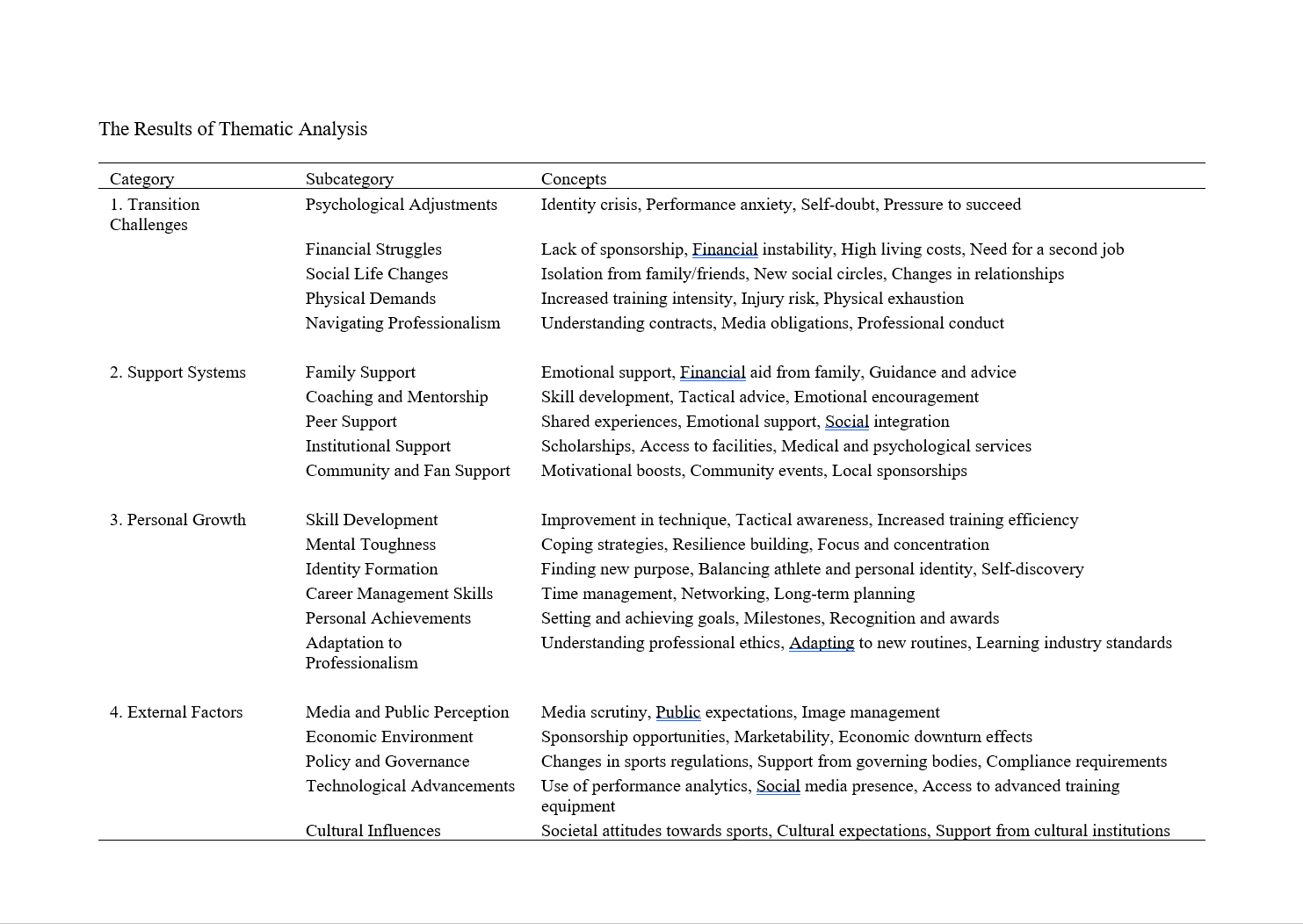
Findings: The study identified four main themes: transition challenges, support systems, personal growth, and external influences. Athletes reported significant psychological adjustments, including identity crises and performance anxiety. Financial struggles due to lack of sponsorship and high living costs were prevalent. Social life changes, such as isolation from family and friends, and increased physical demands were notable challenges. Effective support systems involving family, coaches, peers, and institutions were crucial for navigating these challenges. The transition also facilitated personal growth in skill development, mental toughness, and career management. External factors, including media scrutiny and cultural influences, significantly impacted athletes' experiences.
Conclusion: The transition from amateur to professional sports involves multifaceted challenges that require comprehensive support systems. Psychological, financial, social, and physical adjustments are significant, and robust support from family, coaches, peers, and institutions is essential. Addressing these challenges through tailored interventions and support mechanisms can enhance athletes' well-being and success in professional sports.
Downloads
References
1. Aston P, Brewer MA, Kieschnick DW, Allen MC,
Roessel PJv, Lavallee D, et al. Identity Gripping or Identity Flight?
Two Distinct Experiences Correlated With Self-Reported
Depression in Retired Professional Ice Hockey Players.
International Journal of Sport and Exercise Psychology.
2022;22(1):70-91. [DOI]
2. Buckley PA, Bishop ME, Kane P, Ciccotti MC, Selverian
S, Exume D, et al. Early Single-Sport Specialization: A Survey of
3090 High School, Collegiate, and Professional Athletes.
Orthopaedic Journal of Sports Medicine.
2017;5(7):232596711770394. [PMID: 28812031] [PMCID:
PMC5536378] [DOI]
3. Chang CJ, Putukian M, Aerni G, Diamond AB, Hong G,
Ingram YM, et al. Mental Health Issues and Psychological Factors
in Athletes: Detection, Management, Effect on Performance and
Prevention: American Medical Society for Sports Medicine
Position Statement—Executive Summary. British Journal of Sports
Medicine. 2019;54(4):216-20. [PMID: 31810972] [DOI]
4. Pilkington V. Athlete Mental Health and Wellbeing
During the Transition Into Elite Sport: Strategies to Prepare the
System. Sports Medicine - Open. 2024;10(1). [PMID: 38460048]
[PMCID: PMC10924853] [DOI]
5. DeFreese JD, Weight EA, DeCicco JP, Nedimyer AK,
Kerr ZY, Carneiro K, et al. Transition Experiences of Former
Collegiate Women’s Soccer Athletes. Journal of Intercollegiate
Sport. 2021;14(2). [DOI]
6. Economou P, Glascock T, Louie ME. The Impact of
COVID-19 and the NCAA’s (National Collegiate Athletic
Association) Season Cancellation on Sport Support Professionals.
F1000research. 2021;10:775. [DOI]
7. Smith A, Hardin R. Female Student-Athletes’ Transition
Out of Collegiate Competition. Journal of Amateur Sport.
2019;4(2):61-86. [DOI]
8. Smith A, Whiteside E. From Taped Up to Mic’d Up:
Experiences of Former Athletes and the Meaning of Athletic
Identity in Sports Media Spaces. Communication & Sport.
2019;9(2):220-42. [DOI]
9. Lavallee D. Engagement in Sport Career Transition
Planning Enhances Performance. Journal of Loss and Trauma.
2018;24(1):1-8. [DOI]
10. Saxe K, Hardin R, Taylor EA, Pate JR. Transition Blues:
The Experience of Female Collegiate Student-Athletes. Journal of
Higher Education Athletics & Innovation. 2017(2):25-48. [DOI]
11. Burnett C. The Rationale for the Multifaceted
Development of the Athlete-Student in the African Context. South
African Journal for Research in Sport Physical Education and
Recreation. 2004;25(2). [DOI]
12. Gaston L. The Quad-Lemma: How the Rugby Players
Association Benevolent Fund Was Establish to Address the
Welfare Needs in the Professional Format of Rugby Union. Sport
in Society. 2018;22(3):462-75. [DOI]
13. Wylleman P, Alfermann D, Lavallee D. Career
Transitions in Sport: European Perspectives. Psychology of Sport
and Exercise. 2004;5(1):7-20. [DOI]
14. Karanauskienė D, Kardelis K, Kardelienė L. Athletic
Identification of Would-Be Specialists of Physical Education and
Sports at the Institution of Higher Education. Baltic Journal of
Sport and Health Sciences. 2018;3(66). [DOI]
15. Zhu Z. Career Transition, Prospects, and Challenges
Faced by Chinese Elite Female Athletes in Competitive Sports.
Frontiers in Management Science. 2023;2(1):61-80. [DOI]
16. Light R, Evans JR, Lavallee D. The Cultural Transition
of Indigenous Australian Athletes’ Into Professional Sport. Sport
Education and Society. 2017;24(4):415-26. [DOI]
17. Wagstaff C, Quartiroli A. Psychology and Psychologists
in Search of an Identity: What and Who Are We, and Why Does It
Matter? Journal of Sport Psychology in Action. 2020;11(4):254-65.
[DOI]
18. Capin JJ. Midlife Health Crisis of Former Competitive
Athletes: Dissecting Their Experiences via Qualitative Study. BMJ
Open Sport & Exercise Medicine. 2024;10(2):e001956. [PMID:
38736641] [PMCID: PMC11086499] [DOI]
19. Nuryadi N, Hidayat Y, Budiana D, Kn JD. Career
Development Model and Awarding System for Athletes and
Former Athletes in Indonesia. 2020. [DOI]
20. Driller MW, Dunican IC, Omond SET, Boukhris O,
Stevenson S, Lambing K, et al. Pyjamas, Polysomnography and
Professional Athletes: The Role of Sleep Tracking Technology in
Sport. Sports. 2023;11(1):14. [PMID: 36668718] [PMCID:
PMC9861232] [DOI]
21. Ellis D, Kennedy T, Pasupuleti V, Williams A, Ye Y.
Strive. 2013. [DOI]
22. Keung S, Enari D. The Professional Athlete Career
Lifespan: Through an Indigenous Lens. International Journal of the
Sociology of Leisure. 2022;5(4):409-23. [DOI]
Downloads
Additional Files
Publication Timeline
Issue
Section
License
Copyright (c) 2024 Yoko Wong , Haixin Qiu , Sarah Turner (Author)

This work is licensed under a Creative Commons Attribution-NonCommercial 4.0 International License.