Perceived Barriers and Facilitators to Physical Activity Among Individuals with Disabilities: A Qualitative Study
DOI:
https://doi.org/10.61838/kman.intjssh.7.3.2Keywords:
Physical activity, disabilities, barriers, facilitators, qualitative research, accessibility, social support, professional guidance, technological aidsAbstract
Objective: This study aimed to explore the perceived barriers and facilitators to physical activity among individuals with disabilities.
Methods and Materials: A qualitative phenomenological approach was employed to capture the experiences of individuals with disabilities. Participants were recruited from visitors of York Rehab Clinic in Canada, meeting the criteria of being aged 18 and above, having a physical disability, and being capable of providing informed consent. Data were collected through semi-structured interviews with 23 participants until theoretical saturation was reached. Interviews were transcribed verbatim and analyzed using thematic analysis, supported by NVivo software, to identify key themes and subthemes.
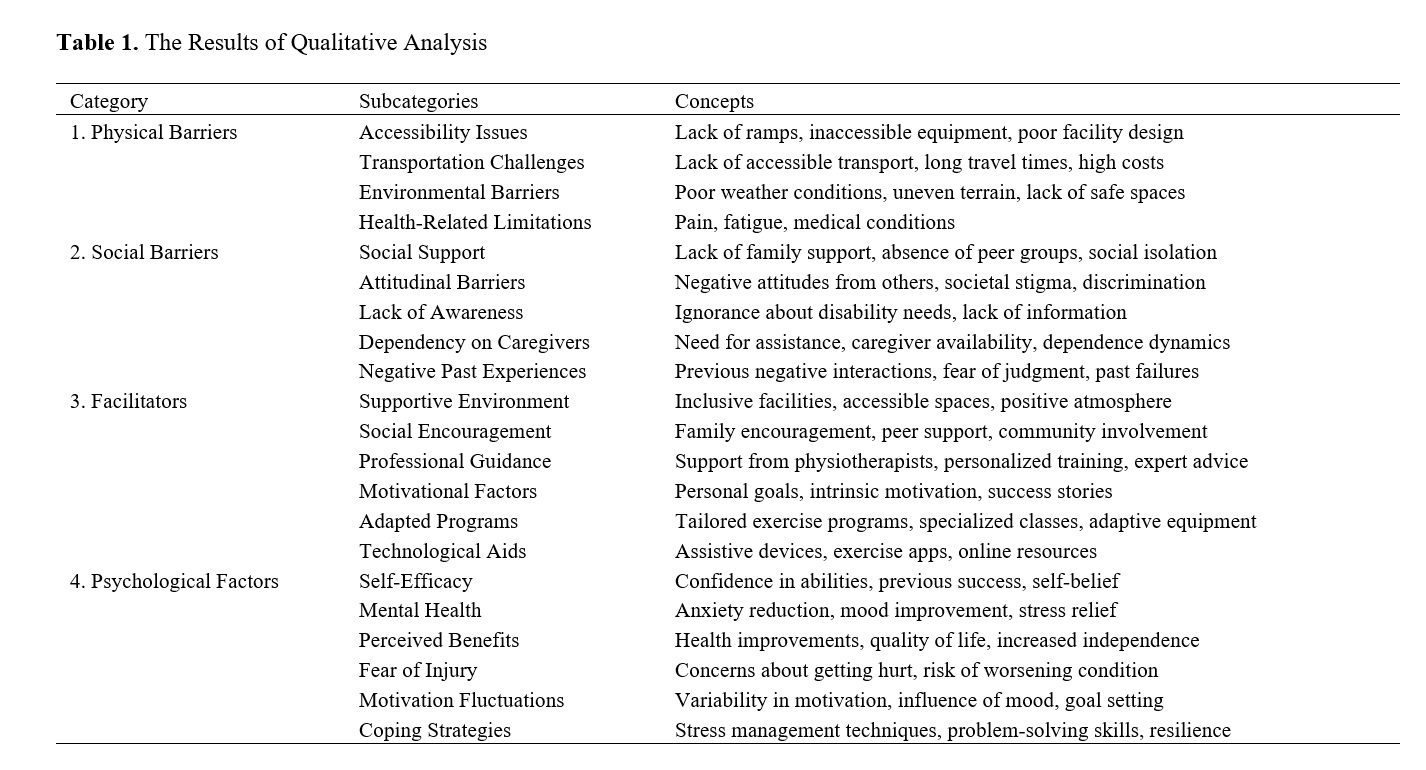
Findings: The study identified several barriers and facilitators to physical activity. Physical barriers included accessibility issues, transportation challenges, environmental barriers, and health-related limitations. Social barriers encompassed lack of social support, attitudinal barriers, lack of awareness, dependency on caregivers, and negative past experiences. Facilitators included supportive environments, social encouragement, professional guidance, motivational factors, adapted programs, and technological aids. Psychological factors such as self-efficacy, mental health benefits, perceived benefits, fear of injury, motivation fluctuations, and coping strategies also played significant roles in influencing physical activity participation.
Conclusion: The findings underscore the multifaceted nature of barriers and facilitators to physical activity among individuals with disabilities. Addressing physical accessibility, fostering supportive social environments, providing professional guidance, and leveraging technological aids are crucial for promoting physical activity participation. Future research should incorporate larger, diverse samples and explore tailored strategies for different types of disabilities. Practical recommendations include improving facility accessibility, enhancing social support, and integrating technology to facilitate physical activity.
Downloads
References
1. Aaltonen S, Leskinen T, Morris T, Alén M, Kaprio J,
Liukkonen J, et al. Motives for and Barriers to Physical Activity in
Twin Pairs Discordant for Leisure Time Physical Activity for 30
Years. International Journal of Sports Medicine. 2012;33(02):157-
63. [PMID: 22318531] [DOI]
2. Ginis KAM, Latimer-Cheung AE, Rimmer JH. A
Systematic Review of Review Articles Addressing Factors Related
to Physical Activity Participation Among Children and Adults With
Physical Disabilities. Health Psychology Review. 2016;10(4):478-
94. [PMID: 27265062] [DOI]
3. Ascondo J, Martín-López A, Iturricastillo A, Granados
C, Garate I, Romaratezabala E, et al. Analysis of the Barriers and
Motives for Practicing Physical Activity and Sport for People With
a Disability: Differences According to Gender and Type of
Disability. International Journal of Environmental Research and
Public Health. 2023;20(2):1320. [PMID: 36674077] [PMCID:
PMC9858731] [DOI]
4. Garrett N, Schluter PJ, Schofield G. Physical Activity
Profiles and Perceived Environmental Determinants in New
Zealand: A National Cross-Sectional Study. Journal of Physical
Activity and Health. 2012;9(3):367-77. [PMID: 21934152] [DOI]
5. Hassett L, Shields N, Cole J, Owen K, Sherrington C.
Comparisons of Leisure-Time Physical Activity Participation by
Adults With and Without a Disability: Results of an Australian
Cross-Sectional National Survey. BMJ Open Sport & Exercise
Medicine. 2021;7(1):e000991. [PMID: 33489311] [PMCID:
PMC7797250] [DOI]
6. Atchison CL, Libarkin JC. Professionally Held
Perceptions About the Accessibility of the Geosciences.
Geosphere. 2016;12(4):1154-65. [DOI]
7. Carmo JFd, Morelato RL. Functional Disability and
Associated Factors in Elderly Stroke Survivors in Vitória, Brazil.
Revista Brasileira De Geriatria E Gerontologia. 2016;19(5):809-
18. [DOI]
8. Dagnachew N, Meshesha SG, Mekonen ZT. A
Qualitative Exploration of Barriers in Accessing Community
Pharmacy Services for Persons With Disability in Addis Ababa,
Ethiopia: A Cross Sectional Phenomenological Study. BMC Health
Services Research. 2021;21(1). [PMID: 34001129] [PMCID:
PMC8130159] [DOI]
9. Chenary R, Noroozi A, Tavafian SS, Firoozabadi MS.
Effective Factors on Health-Promoting Lifestyle Among Iranian
Chemical Veterans in 2014 Based on Health Promotion Model: A
Path Analysis. Iranian Red Crescent Medical Journal. 2016;18(8).
[PMID: 27781120] [PMCID: PMC5065710] [DOI]
10. Shields N, Synnot A, Barr M. Perceived Barriers and
Facilitators to Physical Activity for Children With Disability: A
Systematic Review. British Journal of Sports Medicine.
2011;46(14):989-97. [PMID: 21948121] [DOI]
11. Courtney-Long EA, Stevens A, Carroll DD, GriffinBlake S, Omura JD, Carlson SA. Primary Care Providers’ Level of
Preparedness for Recommending Physical Activity to Adults With
Disabilities. Preventing Chronic Disease. 2017;14. [PMID:
29144893] [PMCID: PMC5695639] [DOI]
12. Clarke P, Twardzik E, Meade MA, Peterson MD, Tate
DG. Social Participation Among Adults Aging With Long-Term
Physical Disability: The Role of Socioenvironmental Factors.
Journal of Aging and Health. 2019;31(10_suppl):145S-68S.
[PMID: 31718412] [DOI]
13. Bédard J. Physical Activity Is for Everyone: A Call to
Action for Education and Knowledge Mobilisation to Optimise the
Continuum of Services for People With Mobility Disabilities in
Québec, Canada. BMJ Open Sport & Exercise Medicine.
2023;9(4):e001664. [PMID: 37901751] [PMCID: PMC10603344]
[DOI]
14. Keegan J, Brooks J, Blake J, Müller VR, Fitzgerald S,
Chan F. Perceived Barriers to Physical Activity and Exercise for
Individuals With Spinal Cord Injury. Australian Journal of
Rehabilitation Counselling. 2014;20(2):69-80. [DOI]
15. Hilgenkamp TI, Baynard T. Do Individuals With
Intellectual Disability Have a Lower Peak Heart Rate and Maximal
Oxygen Uptake? Journal of Applied Research in Intellectual
Disabilities. 2017;31(5):785-91. [PMID: 29231277] [DOI]
16. Hong PYP, Stokar H, Choi S. Psychological and
Economic Self-Sufficiency Among Low-Income Jobseekers With
Physical Disability Barriers. Environment and Social Psychology.
2016;1(1). [DOI]
17. Hawkins A, Look R. Levels of Engagement and Barriers
to Physical Activity in a Population of Adults With Learning
Disabilities. British Journal of Learning Disabilities.
2006;34(4):220-6. [DOI]
18. Jacinto M, Vitorino A, Palmeira D, Antunes R, Matos R,
Ferreira JP, et al. Perceived Barriers of Physical Activity
Participation in Individuals With Intellectual Disability—A
Systematic Review. Healthcare. 2021;9(11):1521. [PMID:
34828567] [PMCID: PMC8625076] [DOI]
19. Idowu OA, Adeniyi AF, Ogwumike OO, Fawole HO,
Akinrolie O. Perceived Barriers to Physical Activity Among
Nigerian Stroke Survivors. Pan African Medical Journal. 2015;21.
[PMID: 26587124] [PMCID: PMC4634025] [DOI]
20. Mohamed M, Nur Amirah Binti Che H. Sports for the
Disabled: Preferences and Perceived Barriers. 2019. [DOI]
21. McLean R. Employment Status Six Months After
Discharge From Inpatient Rehabilitation for a Mild-to-Moderate
Physical Disability. Annals of the Academy of Medicine
Singapore. 2007;36(1):18-21. [PMID: 17285182] [DOI]
22. Melville C, Hamilton S, Miller SA, Boyle S, Robinson
N, Pert C, et al. Carer Knowledge and Perceptions of Healthy
Lifestyles for Adults With Intellectual Disabilities. Journal of
Applied Research in Intellectual Disabilities. 2009;22(3):298-306.
[DOI]
23. Meshesha SG, Dagnachew N, Mekonen ZT. A
Qualitative Exploration of Barriers in Accessing Community
Pharmacy Services for Persons With Disability in Addis Ababa,
Ethiopia: A Phenomenological Study. 2021. [DOI]
24. Ruiz D. The Pursuit of Intimacy: Intimate Relationship
Development for Women With Physical Disabilities. Frontiers in
Rehabilitation Sciences. 2023;4. [PMID: 37608805] [PMCID:
PMC10441775] [DOI]
Downloads
Additional Files
Publication Timeline
Issue
Section
License
Copyright (c) 2024 Abbie Wilson, Veronica Longo, James Ma, Solmaz Bulut (Author)

This work is licensed under a Creative Commons Attribution-NonCommercial 4.0 International License.