Moving for Better Sleep: A Narrative Review of Exercise and Sleep Quality
DOI:
https://doi.org/10.61838/kman.intjssh.7.3.4Keywords:
Aerobic exercise, resistance training, high-intensity interval training, sleep quality, sleep latency, sleep efficiency, insomniaAbstract
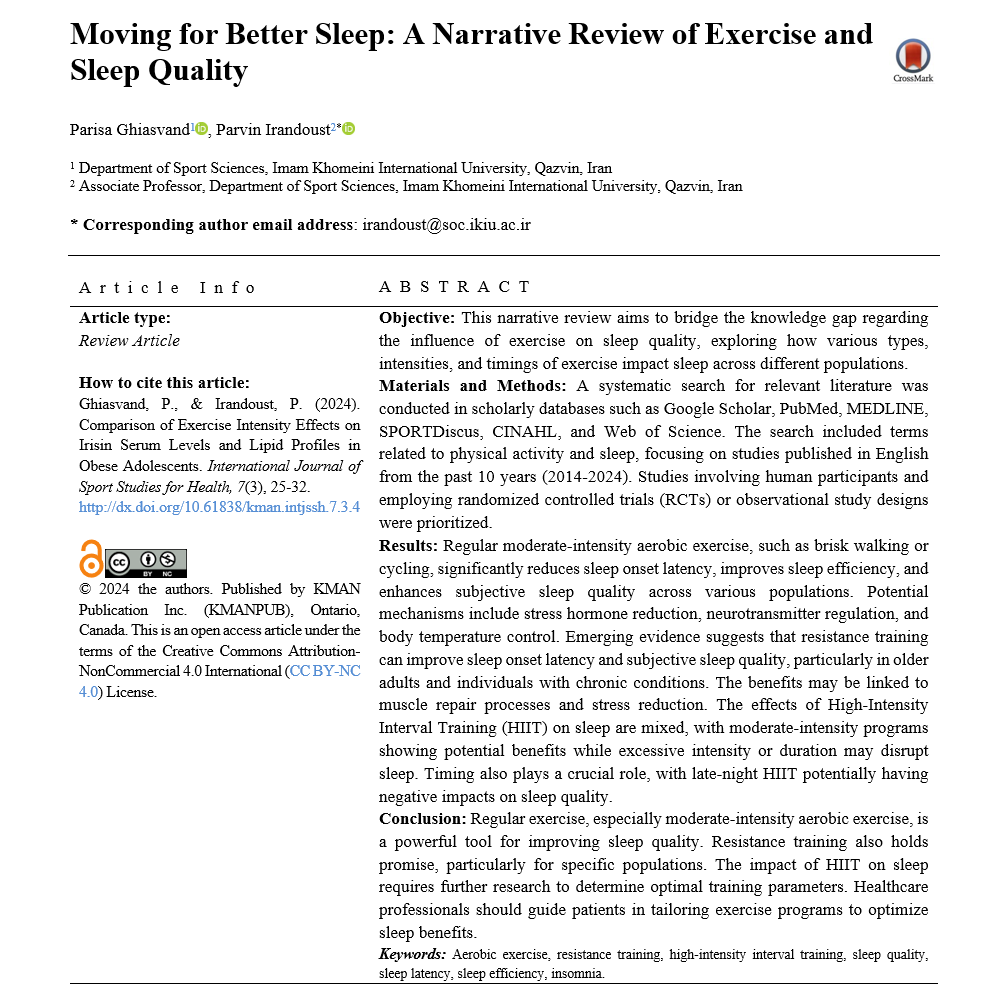
Objective: This narrative review aims to bridge the knowledge gap regarding the influence of exercise on sleep quality, exploring how various types, intensities, and timings of exercise impact sleep across different populations.
Materials and Methods: A systematic search for relevant literature was conducted in scholarly databases such as Google Scholar, PubMed, MEDLINE, SPORTDiscus, CINAHL, and Web of Science. The search included terms related to physical activity and sleep, focusing on studies published in English from the past 10 years (2014-2024). Studies involving human participants and employing randomized controlled trials (RCTs) or observational study designs were prioritized.
Results: Regular moderate-intensity aerobic exercise, such as brisk walking or cycling, significantly reduces sleep onset latency, improves sleep efficiency, and enhances subjective sleep quality across various populations. Potential mechanisms include stress hormone reduction, neurotransmitter regulation, and body temperature control. Emerging evidence suggests that resistance training can improve sleep onset latency and subjective sleep quality, particularly in older adults and individuals with chronic conditions. The benefits may be linked to muscle repair processes and stress reduction. The effects of High-Intensity Interval Training (HIIT) on sleep are mixed, with moderate-intensity programs showing potential benefits while excessive intensity or duration may disrupt sleep. Timing also plays a crucial role, with late-night HIIT potentially having negative impacts on sleep quality.
Conclusion: Regular exercise, especially moderate-intensity aerobic exercise, is a powerful tool for improving sleep quality. Resistance training also holds promise, particularly for specific populations. The impact of HIIT on sleep requires further research to determine optimal training parameters. Healthcare professionals should guide patients in tailoring exercise programs to optimize sleep benefits.
Downloads
References
1. Desjardins S, Tanguay-Labonté M. The Effects of
Physical Activity on Sleep among Adolescents and Adults: A
Narrative Review. Journal of Sleep and Sleep Disorder Research.
2018;1(2):42-59. [DOI]
2. Singh NA, Clements KM, Fiatarone MA. A Randomized
Controlled Trial of the Effect of Exercise on Sleep. Sleep.
1997;20(2):95-101. [PMID: 9143068] [DOI]
3. Lederman O, Ward PB, Firth J, Maloney C, Carney R,
Vancampfort D, et al. Does exercise improve sleep quality in
individuals with mental illness? A systematic review and metaanalysis. Journal of Psychiatric Research. 2019;109:96-106.
[PMID: 30513490] [DOI]
4. Taylor SR. The influence of exercise on sleep quality.
International SportMed Journal. 2001;2(3):1-10.
5. Xie Y, Liu S, Chen X-J, Yu H-H, Yang Y, Wang W.
Effects of Exercise on Sleep Quality and Insomnia in Adults: A
Systematic Review and Meta-Analysis of Randomized Controlled
Trials. Frontiers in Psychiatry. 2021;12. [PMID: 34163383]
[PMCID: PMC8215288] [DOI]
6. Banno M, Harada Y, Taniguchi M, Tobita R, Tsujimoto
H, Tsujimoto Y, et al. Exercise can improve sleep quality: a
systematic review and meta-analysis. PeerJ. 2018;6:e5172. [PMID:
30018855] [PMCID: PMC6045928] [DOI]
7. Youngstedt SD. Effects of Exercise on Sleep. Clinics in
Sports Medicine. 2005;24(2):355-65. [PMID: 15892929] [DOI]
8. Myllymaki T, KYRÖLÄINEN H, SAVOLAINEN K,
HOKKA L, JAKONEN R, JUUTI T, et al. Effects of vigorous latenight exercise on sleep quality and cardiac autonomic activity.
Journal of Sleep Research. 2011;20(1pt2):146-53. [PMID:
20673290] [DOI]
9. Uchida S, Shioda K, Morita Y, Kubota C, Ganeko M,
Takeda N. Exercise Effects on Sleep Physiology. Frontiers in
Neurology. 2012;3. [PMID: 22485106] [PMCID: PMC3317043]
[DOI]
10. Driver HS, Taylor SR. Exercise and sleep. Sleep
Medicine Reviews. 2000;4(4):387-402. [PMID: 12531177] [DOI]
11. Ferris LT, Williams JS, Shen CL, O'Keefe KA, Hale KB.
Resistance training improves sleep quality in older adults a pilot
study. Journal of sports science & medicine. 2005;4(3):354.
12. Alarcón-Gómez J, Chulvi-Medrano I, Martin-Rivera F,
Calatayud J. Effect of High-Intensity Interval Training on Quality
of Life, Sleep Quality, Exercise Motivation and Enjoyment in
Sedentary People with Type 1 Diabetes Mellitus. International
Journal of Environmental Research and Public Health.
2021;18(23):12612. [PMID: 34886337] [PMCID: PMC8656786]
[DOI]
13. Thomas C, Jones H, Whitworth-Turner C, Louis J. Highintensity exercise in the evening does not disrupt sleep in endurance
runners. European Journal of Applied Physiology.
2020;120(2):359-68. [PMID: 31813044] [PMCID: PMC6989626]
[DOI]
14. Irandoust K, Taheri M. Effect of a high intensity interval
training (HIIT) on serotonin and cortisol levels in obese women
with sleep disorders. Women’s Health Bulletin. 2019;6(1):1-5.
[DOI]
15. Horne JA, Staff LHE. Exercise and Sleep: Body-Heating
Effects. Sleep. 1983;6(1):36-46. [PMID: 6844796] [DOI]
16. Ezati M, Keshavarz M, Barandouzi ZA, Montazeri A.
The effect of regular aerobic exercise on sleep quality and fatigue
among female student dormitory residents. BMC Sports Science,
Medicine and Rehabilitation. 2020;12(1):44. [PMID: 32774864]
[PMCID: PMC7405354] [DOI]
17. King AC, Pruitt LA, Woo S, Castro CM, Ahn DK,
Vitiello MV, et al. Effects of Moderate-Intensity Exercise on
Polysomnographic and Subjective Sleep Quality in Older Adults
With Mild to Moderate Sleep Complaints. The Journals of
Gerontology: Series A. 2008;63(9):997-1004. [PMID: 18840807]
[PMCID: PMC7182081] [DOI]
18. Reid KJ, Baron KG, Lu B, Naylor E, Wolfe L, Zee PC.
Aerobic exercise improves self-reported sleep and quality of life in
older adults with insomnia. Sleep Medicine. 2010;11(9):934-40.
[PMID: 20813580] [PMCID: PMC2992829] [DOI]
19. Wang X, Youngstedt SD. Sleep quality improved
following a single session of moderate-intensity aerobic exercise in
older women: Results from a pilot study. Journal of Sport and
Health Science. 2014;3(4):338-42. [PMID: 25685605] [PMCID:
PMC4326238] [DOI]
20. Kovacevic A, Mavros Y, Heisz JJ, Fiatarone Singh MA.
The effect of resistance exercise on sleep: A systematic review of
randomized controlled trials. Sleep Medicine Reviews.
2018;39:52-68. [PMID: 28919335] [DOI]
21. Silva-Batista C, de Brito LC, Corcos DM, Roschel H, de
Mello MT, Piemonte MEP, et al. Resistance Training Improves
Sleep Quality in Subjects With Moderate Parkinson's Disease. The
Journal of Strength & Conditioning Research. 2017;31(8):2270-7.
[PMID: 27787472] [DOI]
22. Faria APd, Cavagnolli DA, Ferreira SE, Bittencourt
LRA, Tufik S, Mello MTd. Effects of resistance exercise on the
sleep patterns of sedentary individuals. Sleep science.
2009;2(3):141-6.
23. Alley JR, Mazzochi JW, Smith CJ, Morris DM, Collier
SR. Effects of Resistance Exercise Timing on Sleep Architecture
and Nocturnal Blood Pressure. The Journal of Strength &
Conditioning Research. 2015;29(5):1378-85. [PMID: 25426516]
[DOI]
24. Min L, Wang D, You Y, Fu Y, Ma X. Effects of HighIntensity Interval Training on Sleep: A Systematic Review and
Meta-Analysis. International Journal of Environmental Research
and Public Health. 2021;18(20):10973. [PMID: 34682718]
[PMCID: PMC8535574] [DOI]
25. Bullock A, Kovacevic A, Kuhn T, Heisz JJ. Optimizing
Sleep in Older Adults: Where Does High-Intensity Interval
Training Fit? Frontiers in Psychology. 2020;11. [PMID: 33192886]
[PMCID: PMC7609693] [DOI]
26. Jahrami H, BaHammam AS, Stubbs B, Sabah A, Saif Z,
Bragazzi NL, et al. Eight-week high-intensity interval training is
associated with improved sleep quality and cardiorespiratory
fitness in patients with depressive disorders. Sleep and Breathing.
2022;26(1):397-406. [PMID: 34046817] [DOI]
Downloads
Additional Files
Publication Timeline
Issue
Section
License

This work is licensed under a Creative Commons Attribution-NonCommercial 4.0 International License.