Effect of High-Intensity Interval Training and High-Fat Diet on Nrg-1 and Pgc-1α in Aging Rats’ Heart Tissue
DOI:
https://doi.org/10.61838/kman.intjssh.7.1.10Keywords:
Neuregulin-1, PGC-1α, high intensity interval training, , fat diet, heart tissueAbstract
Objective: Neuregulin is activated by exercise and has been implicated as a mediator of the beneficial effects of exercise training on metabolism. The aim of this study was to effect of high-intensity interval training and high-fat diet on NRG-1 and PGC-1α in aging rats’ heart tissue.
Materials and Methods: 20 male Wistar rats aged 48 to 52 weeks were purchased and kept inside standard cages at a temperature of 22±2 degrees Celsius. After one week of acclimatization to the laboratory environment, the animals were divided into four groups (normal diet, normal diet+training, high-fat diet, and high-fat diet+ training). According to the research design, the training group underwent 8 weeks of training. This was followed by high-intensity interval training at an intensity of 85% to 90% of VO2max. Two-way ANOVA (DIET×HIIT) were used to examine (P<0.05).
Results: The findings indicated a High-fat diet had a significant and decreasing effect on NRG-1 (p=0.004, F=11.17). Exercise did not have a significant effect (p=0.039, F=5.04) on NRG-1, although it increased NRG-1 levels. The interactive effect of diet and exercise on NRG-1 was not statistically significant (p=0.93, F=0.008). The findings indicate that diet reduced and exercise increased NRG-1 levels. In fact, the effect of exercise in the high-fat diet group reduced the differences and led to non-significant results statistically.
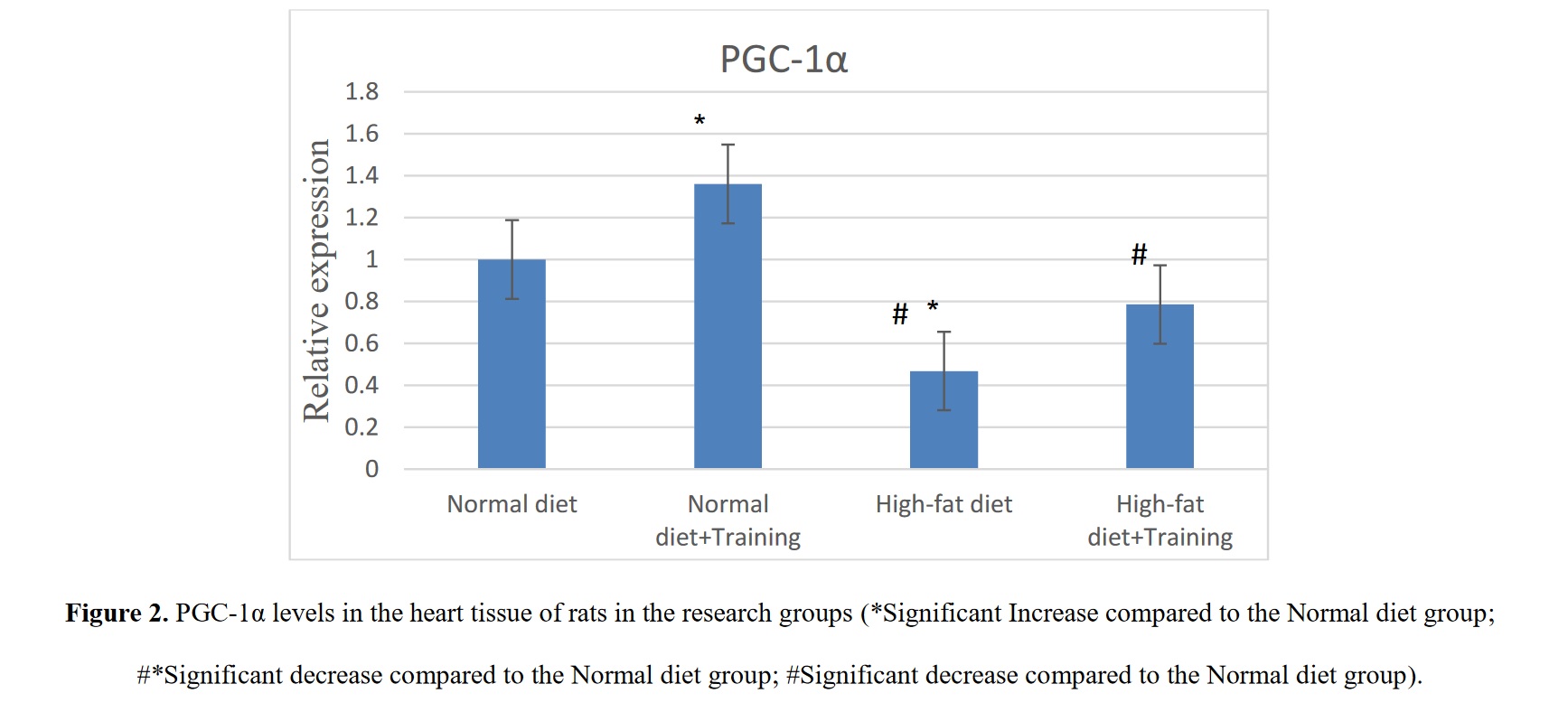
Conclusion: Eight weeks of HIIT training, along with a normal diet, led to an increase in the expression of neuregulin in the heart tissue of aged mice. The expression of PGC-1α also increased following the HIIT. This increase can be attributed to the increased neuregulin expression, leading to improved mitochondrial biogenesis.
Downloads
References
1. Gumà A, Martínez-Redondo V, López-Soldado I, Cantó
C, Zorzano A. Emerging role of neuregulin as a modulator of
muscle metabolism. American Journal of PhysiologyEndocrinology and Metabolism. 2010;298(4):E742-E50. [PMID:
20028964] [DOI]
2. Alieva AM, Teplova NV, Reznik EV, Strangul EI,
Baikova IE, Kotikova IA, et al. Diagnostic and therapeutic aspects
of neuregulin-1: A review. Russian Medicine. 2023;29(2):127-40.
[DOI]
3. Wang Y, Wei J, Zhang P, Zhang X, Wang Y, Chen W, et
al. Neuregulin-1, a potential therapeutic target for cardiac repair.
Frontiers in Pharmacology. 2022;13:945206. [PMID: 36120374]
[PMCID: PMC9471952] [DOI]
4. Sárközy M, Watzinger S, Kovács ZZ, Acar E,
Márványkövi F, Szűcs G, et al. Neuregulin-1β improves uremic
cardiomyopathy and renal dysfunction in rats. Basic to
Translational Science. 2023;8(9):1160-76. [PMID: 37791301]
[PMCID: PMC10543921] [DOI]
5. Rohrbach S, Niemann B, Abushouk AM, Holtz J. Caloric
restriction and mitochondrial function in the ageing myocardium.
Experimental gerontology. 2006;41(5):525-31. [PMID: 16564664]
[DOI]
6. Lin J, Handschin C, Spiegelman BM. Metabolic control
through the PGC-1 family of transcription coactivators. Cell
metabolism. 2005;1(6):361-70. [PMID: 16054085] [DOI]
7. Canto C, Pich S, Paz JC, Sanches R, Martínez V, Orpinell
M, et al. Neuregulins increase mitochondrial oxidative capacity and
insulin sensitivity in skeletal muscle cells. Diabetes.
2007;56(9):2185-93. [PMID: 17563068] [DOI]
8. Cheng C-F, Ku H-C, Lin H. PGC-1α as a pivotal factor
in lipid and metabolic regulation. International journal of molecular
sciences. 2018;19(11):3447. [PMID: 30400212] [PMCID:
PMC6274980] [DOI]
9. Wang J, Wei L, Tian K, Xu M, Chen X, Chen F, et al.
NRG1/ErbB2 axis regulated mitochondrial function and
antioxidant enzymes of neural stem cells in the cochlear nucleus
partially through PGC-1α. Neuroscience Letters.
2023;792:136942. [PMID: 36328292] [DOI]
10. Baar K, Wende AR, Jones TE, Marison M, Nolte LA,
Chen M, et al. Adaptations of skeletal muscle to exercise: rapid
increase in the transcriptional coactivator PGC‐1. The FASEB
journal. 2002;16(14):1879-86. [PMID: 12468452] [DOI]
11. Ramadhan AY, Soetikno V. Molecular Adaptation of
Cardiac Remodeling in Metabolic Syndrome: Focus on AMPK,
SIRT1 and PGC-1a. Molecular and Cellular Biomedical Sciences.
2024;8(1):15-22. [DOI]
12. Ghanbari-Niaki A. Neuregulins response to exercise: a
mini review. Annals of Applied Sport Science. 2016;4(1):3-7.
[DOI]
13. Miller TA, Icli B, Cote GM, LeBrasseur NK, Borkan SC,
Pimentel DR, et al. Palmitate alters neuregulin signaling and
biology in cardiac myocytes. Biochemical and biophysical research
communications. 2009;379(1):32-7. [PMID: 19070592] [PMCID:
PMC2654183] [DOI]
14. Cantó C, Chibalin AV, Barnes BR, Glund S, Suárez E,
Ryder JW, et al. Neuregulins mediate calcium-induced glucose
transport during muscle contraction. Journal of Biological
Chemistry. 2006;281(31):21690-7. [PMID: 16740635] [DOI]
15. Little JP, Gillen JB, Percival ME, Safdar A, Tarnopolsky
MA, Punthakee Z, et al. Low-volume high-intensity interval
training reduces hyperglycemia and increases muscle
mitochondrial capacity in patients with type 2 diabetes. Journal of
applied physiology. 2011;111(6):1554-60. [PMID: 21868679]
[PMCID: 10.1152/japplphysiol.00921.2011]
16. Tjønna AE, Lee SJ, Rognmo Ø, Stølen TO, Bye A,
Haram PM, et al. Aerobic interval training versus continuous
moderate exercise as a treatment for the metabolic syndrome: a
pilot study. Circulation. 2008;118(4):346-54. [PMID: 18606913]
[PMCID: PMC2777731] [DOI]
17. Hood MS, Little JP, Tarnopolsky MA, Myslik F, Gibala
MJ. Low-volume interval training improves muscle oxidative
capacity in sedentary adults. Medicine and science in sports and
exercise. 2011;43(10):1849-56. [PMID: 21448086] [DOI]
18. Wright DC, Geiger PC, Han D-H, Jones TE, Holloszy
JO. Calcium induces increases in peroxisome proliferator-activated
receptor γ coactivator-1α and mitochondrial biogenesis by a
pathway leading to p38 mitogen-activated protein kinase
activation. Journal of Biological Chemistry. 2007;282(26):18793-
9. [PMID: 17488713] [DOI]
19. Cartoni R, Léger B, Hock MB, Praz M, Crettenand A,
Pich S, et al. Mitofusins 1/2 and ERRα expression are increased in
human skeletal muscle after physical exercise. The Journal of
physiology. 2005;567(1):349-58. [PMID: 15961417] [PMCID:
PMC1474174] [DOI]
20. Handschin C, Spiegelman BM. Peroxisome proliferatoractivated receptor γ coactivator 1 coactivators, energy homeostasis,
and metabolism. Endocrine reviews. 2006;27(7):728-35. [PMID:
17018837] [DOI]
21. Gibala MJ, McGee SL, Garnham AP, Howlett KF, Snow
RJ, Hargreaves M. Brief intense interval exercise activates AMPK
and p38 MAPK signaling and increases the expression of PGC-1α
in human skeletal muscle. Journal of applied physiology.
2009;106(3):929-34. [PMID: 19112161] [DOI]
22. Waring CD, Vicinanza C, Papalamprou A, Smith AJ,
Purushothaman S, Goldspink DF, et al. The adult heart responds to
increased workload with physiologic hypertrophy, cardiac stem cell
activation, and new myocyte formation. European heart journal.
2014;35(39):2722-31. [PMID: 23100284] [PMCID:
PMC4196078] [DOI]
23. Jacobs RA, Flück D, Bonne TC, Bürgi S, Christensen
PM, Toigo M, et al. Improvements in exercise performance with
high-intensity interval training coincide with an increase in skeletal
muscle mitochondrial content and function. Journal of applied
physiology. 2013;115(6):785-93. [PMID: 23788574] [DOI]
24. Li F-H, Sun L, Zhu M, Li T, Gao H-E, Wu D-S, et al.
Beneficial alterations in body composition, physical performance,
oxidative stress, inflammatory markers, and adipocytokines
induced by long-term high-intensity interval training in an aged rat
model. Experimental gerontology. 2018;113:150-62. [PMID:
30308288] [DOI]
25. Cantó C, Suárez E, Lizcano JM, Grinó E, Shepherd PR,
Fryer LG, et al. Neuregulin signaling on glucose transport in
muscle cells. Journal of Biological Chemistry.
2004;279(13):12260-8. [PMID: 14711829] [DOI]
26. Ennequin G, Boisseau N, Caillaud K, Chavanelle V,
Gerbaix M, Metz L, et al. Exercise training and return to a well‐
balanced diet activate the neuregulin 1/ErbB pathway in skeletal
muscle of obese rats. The Journal of physiology.
2015;593(12):2665-77. [PMID: 25820551] [PMCID:
PMC4500351] [DOI]
27. Laddu D, Dow C, Hingle M, Thomson C, Going S. A
review of evidence‐based strategies to treat obesity in adults.
Nutrition in Clinical Practice. 2011;26(5):512-25. [PMID:
21947634] [DOI]
28. Alizadeh AG-Nnrnr. The effect of different Intensities of
circuit resistance training on plasma neuregulin and leptin
concentrations in young men. Sport and Exercise Physiology. 2019;
11:1-12.
29. Horiuchi K, Zhou H-M, Kelly K, Manova K, Blobel CP.
Evaluation of the contributions of ADAMs 9, 12, 15, 17, and 19 to
heart development and ectodomain shedding of neuregulins β1 and
β2. Developmental biology. 2005;283(2):459-71. [PMID:
15936750] [DOI]
30. Junyent M, Parnell LD, Lai C-Q, Arnett DK, Tsai MY,
Kabagambe EK, et al. ADAM17_i33708A> G polymorphism
interacts with dietary n-6 polyunsaturated fatty acids to modulate
obesity risk in the Genetics of Lipid Lowering Drugs and Diet
Network study. Nutrition, Metabolism and Cardiovascular
Diseases. 2010;20(10):698-705. [PMID: 19819120] [PMCID:
PMC4361226] [DOI]
31. LeBrasseur NK, Mizer KC, Parkington JD, Sawyer DB,
Fielding RA. The expression of neuregulin and erbB receptors in
human skeletal muscle: effects of progressive resistance training.
European journal of applied physiology. 2005;94:371-5. [PMID:
15875210] [DOI]
32. Kim D, Chi S, Lee KH, Rhee S, Kwon YK, Chung CH,
et al. Neuregulin stimulates myogenic differentiation in an
autocrine manner. Journal of Biological Chemistry.
1999;274(22):15395-400. [PMID: 10336427] [DOI]
33. Gassmann M, Casagranda F, Orioli D, Simon H, Lai C,
Klein R, et al. Aberrant neural and cardiac development in mice
lacking the ErbB4 neuregulin receptor. Nature.
1995;378(6555):390-4. [PMID: 7477376] [DOI]
34. Vincent G, Lamon S, Gant N, Vincent PJ, MacDonald
JR, Markworth JF, et al. Changes in mitochondrial function and
mitochondria associated protein expression in response to 2-weeks
of high intensity interval training. Frontiers in physiology.
2015;6:51. [DOI]
Downloads
Additional Files
Publication Timeline
Issue
Section
License
Copyright (c) 2024 Mahsa Mobaseri, Parvaneh Nazarali, Najmeh Rezaeinezhad (Author)

This work is licensed under a Creative Commons Attribution-NonCommercial 4.0 International License.