Comparison of Exercise Intensity Effects on Irisin Serum Levels and Lipid Profiles in Obese Adolescents
DOI:
https://doi.org/10.61838/kman.intjssh.7.3.3Keywords:
Exercise intensity, Irisin, Lipid profile, Obese adolescentsAbstract
Objective: Irisin is a myokine that has a beneficial effect on obesity by increasing energy expenditure. The aim of this study was to compare the effect of exercise intensity on serum irisin levels and lipid profile in obese adolescents.
Materials and Methods: Forty-six male students with an average age of 13.43 ± 0.77 years; height 163.18 ± 23 cm, weight 85.84 ± 8.46 kg, body fat percentage 37.001 ± 4.508 were randomly assigned to three groups: low-intensity activity (experimental 1), high-intensity activity (experimental 2), and control. The training program in experimental group 1 included running at 45-60% heart rate reserve intensity, and in experimental group 2, it was similar to group 1 along with combined exercises at 60-75% heart rate reserve intensity, performed 4 sessions per week for 10 weeks. A paired t-test was used to examine within-group differences, and Mixed ANOVA was used to examine between-group differences. All tests were conducted at a significance level of 0.05 using SPSS22 software.
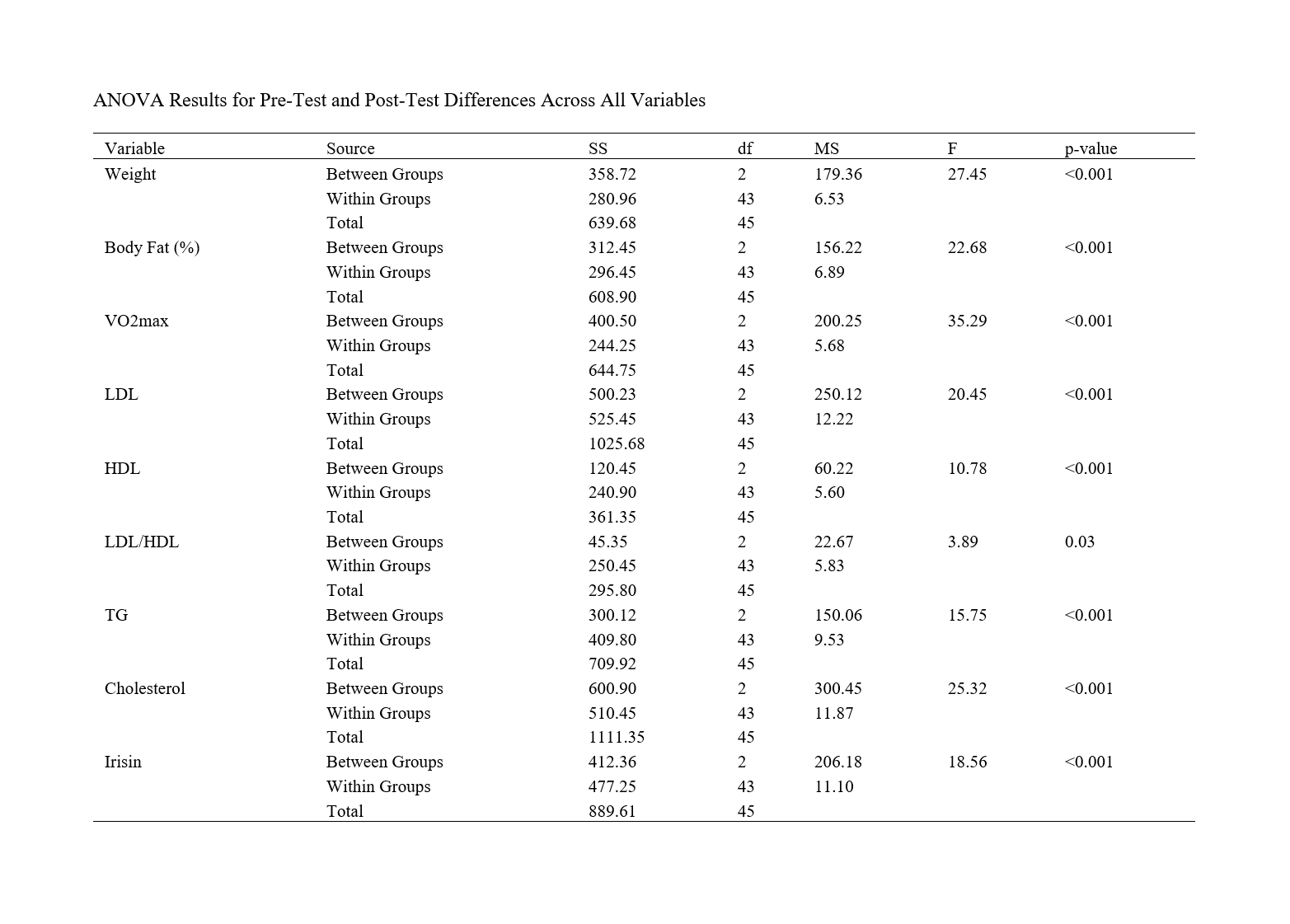
Results: The findings indicated a significant decrease in serum irisin levels in both experimental groups 1 and 2 (p < 0.001). Additionally, weight, body fat percentage, and low-density lipoprotein significantly decreased in both experimental groups. Cholesterol and LDL/HDL ratio only significantly decreased in the high-intensity group.
Conclusion: Considering the impact of exercise at both intensities on weight, body fat percentage, and irisin levels, regular physical activity is recommended for adolescents.
Downloads
References
1. Enteshary M, Esfarjani F, Reisi J. Comparison of the
effects of two different intensities of combined training on irisin,
betatrophin, and insulin levels in women with type 2 diabetes.
Asian journal of sports medicine. 2019;10(2). [DOI]
2. Chooi YC, Ding C, Magkos F. The epidemiology of
obesity. Metabolism. 2019;92:6-10. [PMID: 30253139] [DOI]
3. Barzegari A, Asad MR, Dashti KhavIdaki MH, Eri E.
The effect of high-Intensity interval training and moderateintensity continuous training on serum irisin levels and insulin
resistance in overweight men. Journal of Practical Studies of
Biosciences in Sport. 2023;11(27):34-46. [DOI]
4. Eslami R. Effects of concurrent training on chemerin,
irisin, insulin resistance and lipid profile in children girls with
overweight. Journal of Practical Studies of Biosciences in Sport.
2019;7(14):117-27. [DOI]
5. D’Amuri A, Raparelli V, Sanz JM, Capatti E, Di Vece F,
Vaccari F, et al. Biological Response of Irisin Induced by Different
Types of Exercise in Obese Subjects: A Non-Inferiority Controlled
Randomized Study. Biology. 2022;11(3):392. [PMID: 35336766]
[PMCID: PMC8945525] [DOI]
6. Hosseini SRA, Fathi M, Ziaaldini MM, Hejazi K. The
effect of eight weeks of aerobic exercise with moderate and high
intensities on serum irisin and PGC-1α protein levels in obese male
Wistar rats. Journal of Shahrekord University of Medical Sciences.
2021;23(1):14-9. [DOI]
7. Islam H, Hood DA, Gurd BJ. Looking beyond PGC-1α:
emerging regulators of exercise-induced skeletal muscle
mitochondrial biogenesis and their activation by dietary
compounds. Applied Physiology, Nutrition, and Metabolism.
2020;45(1):11-23. [PMID: 31158323] [DOI]
8. Pesta DH, Goncalves RL, Madiraju AK, Strasser B,
Sparks LM. Resistance training to improve type 2 diabetes:
working toward a prescription for the future. Nutrition &
metabolism. 2017;14(1):1-10. [PMID: 28270856] [PMCID:
PMC5335813] [DOI]
9. Löffler D, Müller U, Scheuermann K, Friebe D, Gesing
J, Bielitz J, et al. Serum irisin levels are regulated by acute
strenuous exercise. The Journal of Clinical Endocrinology &
Metabolism. 2015;100(4):1289-99. [PMID: 25625801] [DOI]
10. Boström P, Wu J, Jedrychowski M, Korde A. Irisin
induces brown fat of white adipose tissue in vivo and protects
against diet-induced obesity and diabetes. Nature. 2012;481:463-8.
11. Norheim F, Langleite TM, Hjorth M, Holen T, Kielland
A, Stadheim HK, et al. The effects of acute and chronic exercise on
PGC‐1α, irisin and browning of subcutaneous adipose tissue in
humans. The FEBS journal. 2014;281(3):739-49. [PMID:
24237962] [DOI]
12. Tsuchiya Y, Ando D, Goto K, Kiuchi M, Yamakita M,
Koyama K. High-intensity exercise causes greater irisin response
compared with low-intensity exercise under similar energy
consumption. The Tohoku journal of experimental medicine.
2014;233(2):135-40. [PMID: 24910199] [DOI]
13. Pekkala S, Wiklund PK, Hulmi JJ, Ahtiainen JP,
Horttanainen M, Pöllänen E, et al. Are skeletal muscle FNDC5
gene expression and irisin release regulated by exercise and related
to health? The Journal of physiology. 2013;591(21):5393-400.
[PMID: 24000180] [PMCID: PMC3936375] [DOI]
14. Rashid FA, Abbas HJ, Naser NA, Ali A. Effect of longterm moderate physical exercise on irisin between normal weight
and obese men. The Scientific World Journal. 2020;2020. [PMID:
32952453] [PMCID: PMC7481929] [DOI]
15. Kurdiova T, Balaz M, Vician M, Maderova D, Vlcek M,
Valkovic L, et al. Effects of obesity, diabetes and exercise on Fndc5
gene expression and irisin release in human skeletal muscle and
adipose tissue: in vivo and in vitro studies. The Journal of
physiology. 2014;592(5):1091-107. [PMID: 24297848] [PMCID:
PMC3948565] [DOI]
16. Stengel A, Hofmann T, Goebel-Stengel M, Elbelt U,
Kobelt P, Klapp BF. Circulating levels of irisin in patients with
anorexia nervosa and different stages of obesity–correlation with
body mass index. Peptides. 2013;39:125-30. [PMID: 23219488]
[DOI]
17. Ramezankhani A, Sori R. The Effect of 16 Weeks of Low
Calorie Diet on Irisin Serum Levels and Insulin Resistance Index
in Obese Sedentary Women. Journal of Food Technology and
Nutrition. 2017;14(2):99-106.
18. Heydari M, Tadibi V, Hoseini R. Effect of different rest
interval between sets of resistance exercise on serum irisin and
blood lactate levels in obese male children. Journal of Applied
Exercise Physiology. 2019;14(28):125-37. [DOI]
19. Hakimi M, Attarzade Hosseini S. The Changes of Irisin
Serum Levels and Lipid Profile of Overweight Male Students after
Eight Weeks of Aerobic Training. The Journal of Shahid Sadoughi
University of Medical Sciences. 2016;23(12):1189-201.
20. Baradaran H, Rahmaninia F, Elmieh A. Effects of 8-
week combined training (aerobic and resistance) on serum levels of
irisin and leptin in overweight men. Daneshvar Medicine.
2020;28(4):10-22.
21. Hajinia M, Haghighi A, Asgari R. The effect of highintensity resistance training on Irisin and Fibroblast growth factor
21 levels in overweight men. Journal of Sabzevar University of
Medical Sciences. 2021;28(3):457-65.
22. Parada-Sánchez SG, Macias-Cervantes MH, PérezVázquez V, Vargas-Ortiz K. The Effects of Different Types of
Exercise on Circulating Irisin Levels in Healthy Individuals and in
People With Overweight, Metabolic Syndrome and Type 2
Diabetes. Physiological Research. 2022;71(4). [PMID: 35770469]
[PMCID: PMC9616589] [DOI]
Downloads
Additional Files
Publication Timeline
Issue
Section
License

This work is licensed under a Creative Commons Attribution-NonCommercial 4.0 International License.