We should not keep drawing-in the abdominal wall during the core training
DOI:
https://doi.org/10.61838/kman.intjssh.7.1.4Keywords:
Core Training, Abdominal Drawing-in Maneuver, Low Load Tasks, High Load Tasks.Abstract
Objective: The goal of this article is to compile relevant literature that proposes that perhaps the abdominal drawing-in maneuver (ADIM), also known as the “abdominal hollowing maneuver” (AHM), should not be applied as a general rule during the core training.
Methods and Materials: Based on current evidence, this paper evaluates whether general use of this ADIM is beneficial for the core training. In this regard, we have searched for related scientific evidence in PubMed and Google Scholar. The keywords used were: abdominal hollowing maneuver, abdominal drawing-in maneuver, lumbo-pelvic stability, core stability.
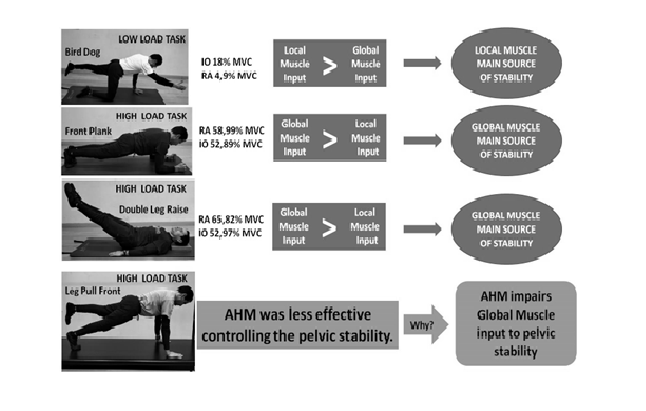
Results: The literature shows us that the application of ADIM during core strengthening exercises does not meet the requirements for isolated TrA-specific retraining, can increase Inter-Rectus Distance, may be incompatible with postural stability goals, and could interfere the Rectus Abdominis input impairing the lumbo-pelvic stability during high-load exercises.
Conclusion: It can be concluded that if the goal is to train core stability and strength with high-load scenarios we should not use the ADIM.
Downloads
References
1. Hodges PW, Richardson CA. Inefficient muscular
stabilization of the lumbar spine associated with low back pain: a
motor control evaluation of transversus abdominis. Spine.
1996;21(22):2640-50. [PMID: 8961451] [DOI]
2. Hides J, Richardson C, Hodges P. Local segmental
control. 2004. [DOI]
3. Brown SH, Vera-Garcia FJ, McGill SM. Effects of
abdominal muscle coactivation on the externally preloaded trunk:
variations in motor control and its effect on spine stability. Spine.
2006;31(13):E387-E93. [PMID: 16741438] [DOI]
4. Lederman E. The myth of core stability. Journal of
bodywork and movement therapies. 2010;14(1):84-98. [PMID:
20006294] [DOI]
5. Hodges PW, Richardson CA. Delayed postural
contraction of transversus abdominis in low back pain associated
with movement of the lower limb. Clinical Spine Surgery.
1998;11(1):46-56. [PMID: 9493770] [DOI]
6. Comerford MJ, Mottram SL. Movement and stability
dysfunction–contemporary developments. Manual therapy.
2001;6(1):15-26. [PMID: 11243905] [DOI]
7. Brumitt J, Matheson J, Meira EP. Core stabilization
exercise prescription, part I: current concepts in assessment and
intervention. Sports Health. 2013;5(6):504-9. [PMID: 24427424]
[PMCID: PMC3806181] [DOI]
8. Suehiro T, Mizutani M, Watanabe S, Ishida H, Kobara K,
Osaka H. Comparison of spine motion and trunk muscle activity
between abdominal hollowing and abdominal bracing maneuvers
during prone hip extension. Journal of bodywork and movement
therapies. 2014;18(3):482-8. [PMID: 25042326] [DOI]
9. Lynders C. The critical role of development of the
transversus abdominis in the prevention and treatment of low back
pain. HSS Journal®. 2019;15(3):214-20. [PMID: 31624475]
[PMCID: PMC6778169] [DOI]
10. Caplan N, Gibbon K, Hibbs A, Evetts S, Debuse D.
Phasic-to-tonic shift in trunk muscle activity relative to walking
during low-impact weight bearing exercise. Acta astronautica.
2014;104(1):388-95. [DOI]
11. Richardson C, Jull G, Toppenberg R, Comerford M.
Techniques for active lumbar stabilisation for spinal protection: a
pilot study. Australian Journal of Physiotherapy. 1992;38(2):105-
12. [PMID: 25025642] [DOI]
12. Comerford M. Core stability: priorities in rehabilitation
of the athlete. SportEX Medicine. 2004;22(7):15-22.
13. Mottram S, Comerford M. A new perspective on risk
assessment. Physical Therapy in sport. 2008;9(1):40-51. [PMID:
19083703] [DOI]
14. Teyhen DS, Miltenberger CE, Deiters HM, Del Toro
YM, Pulliam JN, Childs JD, et al. The use of ultrasound imaging
of the abdominal drawing-in maneuver in subjects with low back
pain. Journal of Orthopaedic & Sports Physical Therapy.
2005;35(6):346-55. [PMID: 16001906] [DOI]
15. Henry SM, Westervelt KC. The use of real-time
ultrasound feedback in teaching abdominal hollowing exercises to
healthy subjects. Journal of Orthopaedic & Sports Physical
Therapy. 2005;35(6):338-45. [PMID: 16001905] [DOI]
16. Oshikawa T, Adachi G, Akuzawa H, Okubo Y, Kaneoka
K. Electromyographic analysis of abdominal muscles during
abdominal bracing and hollowing among six different positions.
The Journal of Physical Fitness and Sports Medicine.
2020;9(4):157-63. [DOI]
17. Hodges P. Abdominal mechanism and support of the
lumbar spine and pelvis. Therapeutic Exercise for lumbopelvic
stabilization. 2004. [DOI]
18. Bergmark A. Stability of the lumbar spine: a study in
mechanical engineering. Acta Orthopaedica Scandinavica.
1989;60(sup230):1-54. [PMID: 2658468] [DOI]
19. Theodorsen N, Strand L, Bø K. Effect of pelvic floor and
transversus abdominis muscle contraction on inter-rectus distance
in postpartum women: a cross-sectional experimental study.
Physiotherapy. 2019;105(3):315-20. [PMID: 30808514] [DOI]
20. Lee D, Hodges PW. Behavior of the linea alba during a
curl-up task in diastasis rectus abdominis: an observational study.
journal of orthopaedic & sports physical therapy. 2016;46(7):580-
9. [PMID: 27363572] [DOI]
21. Pascoal AG, Dionisio S, Cordeiro F, Mota P. Inter-rectus
distance in postpartum women can be reduced by isometric
contraction of the abdominal muscles: a preliminary case–control
study. Physiotherapy. 2014;100(4):344-8. [PMID: 24559692]
[DOI]
22. Hasegawa T, Katsuhira J, Oka H, Fujii T, Matsudaira K.
Association of low back load with low back pain during static
standing. PLoS One. 2018;13(12):e0208877. [PMID: 30562374]
[PMCID: PMC6298701] [DOI]
23. van Dieën JH, Cholewicki J, Radebold A. Trunk muscle
recruitment patterns in patients with low back pain enhance the
stability of the lumbar spine. Spine. 2003;28(8):834-41. [PMID:
12698129] [DOI]
24. Lee J, Muzio MR. Neuroanatomy, extrapyramidal
system. 2020.
25. Armesilla C, Chapinal Andrés A. Hypopressive
abdominal gymnastics: A theoretical analysis and a review. Apunts
Sports Medicine. 2014;49(182):59-66. [DOI]
26. Richardson C. Chapter 7 - The deload model of injury.
In: Richardson C, Hodges PW, Hides J, editors. Therapeutic
Exercise for Lumbopelvic Stabilization (Second Edition).
Edinburgh: Churchill Livingstone; 2004. p. 105-17. [DOI]
27. Johansson H, Sjölander P, Sojka P. A sensory role for the
cruciate ligaments. Clinical Orthopaedics and Related Research®.
1991;268:161-78.
28. Richardson C, Hodges P, Hides J. Therapeutic Exercise
for Lumbopelvic Stabilization: A Motor Control Approach for the
Treatment and Prevention of Low Back Pain. Churchill
Livingstone. 2004.
29. McGill S. Low back disorders: evidence-based
prevention and rehabilitation: Human Kinetics; 2015.
30. Hodges PW, Cholewicki J, van Dieen JH. Spinal Control:
The Rehabilitation of Back Pain: State of the art and science:
Elsevier Health Sciences; 2013.
31. Hodges P. Lumbopelvic stability: a functional model of
the biomechanics and motor control. Therapeutic exercise for
lumbopelvic stabilization. 2004:13-28. [PMID: 15246688] [DOI]
32. Neumann DA. Kinesiology of the Musculoskeletal
System: Foundations for Rehabilitation: Mosby/Elsevier; 2010.
33. Kendall HO, Kendall FP. Muscles. Testing And
Function. LWW; 1949. [DOI]
34. Kapandji IA, Owerko C, Anderson A. The Physiology of
the Joints - Volume 3: The Spinal Column, Pelvic Girdle and Head:
Jessica Kingsley Publishers; 2019.
35. Cholewicki J, Ivancic PC, Radebold A. Can increased
intra-abdominal pressure in humans be decoupled from trunk
muscle co-contraction during steady state isometric exertions?
European journal of applied physiology. 2002;87:127-33. [PMID:
12070622] [DOI]
36. Stokes IA, Gardner-Morse MG, Henry SM. Intraabdominal pressure and abdominal wall muscular function: Spinal
unloading mechanism. Clinical biomechanics. 2010;25(9):859-66.
[PMID: 20655636] [PMCID: PMC2949466] [DOI]
37. O'Sullivan PB, Twomey L, Allison GT. Altered
abdominal muscle recruitment in patients with chronic back pain
following a specific exercise intervention. Journal of Orthopaedic
& Sports Physical Therapy. 1998;27(2):114-24. [PMID: 9475135]
[DOI]
38. Biscarini A, Contemori S, Grolla G. Activation of
scapular and lumbopelvic muscles during core exercises executed
on a whole-body wobble board. Journal of Sport Rehabilitation.
2019;28(6):623-34. [PMID: 30222492] [DOI]
39. Park D-J, Park S-Y. Which trunk exercise most
effectively activates abdominal muscles? A comparative study of
plank and isometric bilateral leg raise exercises. Journal of back
and musculoskeletal rehabilitation. 2019;32(5):797-802. [PMID:
30856100] [DOI]
40. Topçu H, Arabaci R, Güngör AK, Birinci YZ, Pancar S,
Şekir U. Muscle activity of core muscles during plank exercise on
different surfaces. Turkish Journal of Sport and Exercise.
2022;24(3):298-305.
41. Kim M-H, Oh J-S. Effects of performing an abdominal
hollowing exercise on trunk muscle activity during curl-up exercise
on an unstable surface. Journal of physical therapy science.
2015;27(2):501-3. [PMID: 25729202] [PMCID: PMC4339172]
[DOI]
42. Vera-Garcia FJ, Elvira JL, Brown SH, McGill SM.
Effects of abdominal stabilization maneuvers on the control of
spine motion and stability against sudden trunk perturbations.
Journal of electromyography and kinesiology. 2007;17(5):556-67.
[PMID: 16996278] [DOI]
43. Montes AM, Baptista J, Crasto C, de Melo CA, Santos R,
Vilas-Boas JP. Abdominal muscle activity during breathing with
and without inspiratory and expiratory loads in healthy subjects.
Journal of Electromyography and Kinesiology. 2016;30:143-50.
[PMID: 27434376] [DOI]
44. Oh S, Son J, Kim M, Suh DW, Lee SH, Yoon B.
Influence of anterior-posterior external surface perturbation on
trunk stability during abdominal stabilization strategies while
sitting. Medical Science Monitor: International Medical Journal of
Experimental and Clinical Research. 2021;27:e934022-1. [PMID:
34811344] [PMCID: PMC8626986] [DOI]
45. Stevens VK, Bouche KG, Mahieu NN, Coorevits PL,
Vanderstraeten GG, Danneels LA. Trunk muscle activity in healthy
subjects during bridging stabilization exercises. BMC
musculoskeletal disorders. 2006;7:1-8. [PMID: 16987410]
[PMCID: PMC1599724] [DOI]
46. Lee K. The relationship of trunk muscle activation and
core stability: a biomechanical analysis of pilates-based
stabilization exercise. International journal of environmental
research and public health. 2021;18(23):12804. [PMID: 34886530]
[PMCID: PMC8657451] [DOI]
47. Jung E, Sung J, Uh I, Oh J. The effects of abdominal
hollowing and bracing on abdominal muscle thicknesses and pelvic
rotation during active straight leg raise. Isokinetics and Exercise
Science. 2022;30(1):1-6. [DOI]
48. Jung E-J, Oh J-S, editors. The effects of abdominal
hollowing and bracing maneuvers on trunk muscle activity and
pelvic rotation angle during leg pull front pilates exercise.
Healthcare; 2022: MDPI. [PMID: 36611520] [PMCID:
PMC9818814] [DOI]
Downloads
Publication Timeline
Issue
Section
License
Copyright (c) 2024 Julio Cesar Aragón Salamanca (Author)

This work is licensed under a Creative Commons Attribution-NonCommercial 4.0 International License.