A Single-Session Eye Movement Desensitization and Reprocessing (EMDR) Therapy Reduces Anxiety and Improves Self-confidence in Athletes with Post-traumatic Stress Associated with Injury
DOI:
https://doi.org/10.61838/kman.intjssh.5.2.2Keywords:
Psychological Intervention, Posttraumatic Stress Disorder, Psychophysiological Responses, Heart Rate Variability, Sport Injury, Sport Performance, EMDRAbstract
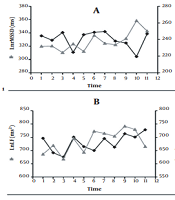
Background: Stress and anxiety related to post-injury trauma in athletes is a latent problem in sport. The use of eye movement desensitization and reprocessing (EMDR) allows sports psychologists to intervene with their athletes more effectively to help them into their recovery and achieve peak sport performance. Objectives: Analyze the EMDR therapy effect in the psychophysiological responses of four athletes with stress related to a traumatic event during sports practice. Methods: Four athletes (22.25 ± 1.71 years; 11.5 ± 2.65 years of experience) participated an idiographic single-case, multiple-probe study. The Sport Psychology Department of the institution approved the study for its application, which also followed the statement of the declaration of Helsinki. The participants had been medically cleared to practice their sport after sustaining a severe injury, but they expressed significant difficulty in performing optimally yet. The Competitive State Anxiety Inventory-2RD was applied to measure the anxiety and self-confidence levels before, after and two weeks later EMDR therapy intervention. Eye movement desensitization and reprocessing standard protocol therapy was carried out to identify the dysfunctional memories to be reprocessed, address the abnormal behaviors as trauma consequences, and develop the behavioral changes to manage the trauma. Heart rate variability parameters used as biofeedback were monitored during the EMDR protocol to associate with moments of stress and relief. Data analysis was performed using the smallest worthwhile change (SWC) of Hopkins to compare the results in the different moments of the protocol and study. Results: All four athletes reported likely and most likely beneficial changes (according to the SWC) in their levels of anxiety and self-confidence after the intervention with the EMRD therapy as well as at two weeks afterward. Heart rate variability (HRV) parameters linked with parasympathetic activity were reduced and the sympathetic parameters increased their levels when the intervention protocol induced stressor memories, observing an opposite behavior when EMDR phases let the athlete be relaxed or getting relief. Conclusions: Eye movement desensitization and reprocessing is a therapy is effective to manage a sport injury related psychologic trauma. Furthermore both, LnRMSSD and LnSS parameters of the HRV can be used as a biofeedback strategy for a better efficacy of EMDR-based treatment.Downloads
References
1. Yang SX, Cheng S, Su DL. Sports injury and stressor-related disorder in
competitive athletes: a systematic review and a new framework. Burns
Trauma. 2022;10:tkac017. [PubMed ID: 35702266]. [PubMed Central ID:
PMC9189434]. https://doi.org/10.1093/burnst/tkac017.
2. American Psychiatric Association. Diagnostic and Statistical Manual of
Mental Disorders. Arlington, VA: American Psychiatric Association Publishing; 2013. https://doi.org/10.1176/appi.books.9780890425596.
3. Bryant RA. Post-traumatic stress disorder: a state-of-the-art review of evidence and challenges. World Psychiatry. 2019;18(3):259–
69. [PubMed ID: 31496089]. [PubMed Central ID: PMC6732680].
https://doi.org/10.1002/wps.20656.
4. Verbitsky A, Dopfel D, Zhang N. Rodent models of posttraumatic stress disorder: behavioral assessment. Transl Psychiatry. 2020;10(1):132. [PubMed ID: 32376819]. [PubMed Central ID:
PMC7203017]. https://doi.org/10.1038/s41398-020-0806-x.
5. Bennett J, Maynard I. Performance blocks in sport: Recommendations for treatment and implications for sport psychology practitioners. J Sport Psychol Action. 2017;8(1):60–8.
https://doi.org/10.1080/21520704.2016.1227414.
6. Miller-Aron C, Harvey S, Hainline B, Hitchcock ME, Reardon
CL. Post-traumatic stress disorder (PTSD) and other traumarelated mental disorders in elite athletes: a narrative review.
Br J Sports Med. 2019;53(12):779–84. [PubMed ID: 31023859].
https://doi.org/10.1136/bjsports-2019-100695.
7. Shapiro F. EMDR therapy: An overview of current and
future research. Eur Rev Appl Psychol. 2012;62(4):193–5.
https://doi.org/10.1016/j.erap.2012.09.005.
8. Shapiro F. Eye movement desensitization and reprocessing. 2nd ed. New
York: The Guilford Press; 2001.
9. Hensley BJ. An EMDR therapy primer: From practicum to practice. New
York: Springer Publishing Company; 2020.
10. Hase M, Plagge J, Hase A, Braas R, Ostacoli L, Hofmann A, et al. Eye
Movement Desensitization and Reprocessing Versus Treatment as
Usual in the Treatment of Depression: A Randomized-Controlled
Trial. Front Psychol. 2018;9:1384. [PubMed ID: 30186192]. [PubMed Central ID: PMC6113947]. https://doi.org/10.3389/fpsyg.2018.01384.
11. Ruiz MC, Kaski S, Frantsi P, Robazza C. Reactions to a career-ending
sport injury: Pekka Hirvonen, a professional ice hockey player. In:
Arvinen-Barrow M, Clement D, editors. The Psychology of Sport and Performance Injury: An Interprofessional Case-Based Approach. 1st ed. London: Routledge; 2019. p. 148–64.
12. Murdoch EM, Lines RLJ, Crane MF, Ntoumanis N, Brade C, Quested
E, et al. The effectiveness of stress regulation interventions with
athletes: A systematic review and multilevel meta-analysis of
randomised controlled trials. Int Rev Sport Exerc Psychol. 2021.
https://doi.org/10.1080/1750984x.2021.1977974.
13. Miller-Aron C, LeFay SM. Best practices for diagnosis and management of trauma-related disorders in athletes. In: Marks DR, Wolanin
AT, Shortway KM, editors. The Routledge Handbook of Clinical Sport Psychology. 1st ed. New York: Routledge; 2021. p. 306–20.
14. Gattis C, Moore M. A conceptual analysis of maltreatment in
sports: A sport social work perspective. Front Sports Act Living.
2022;4:1017308. [PubMed ID: 36406770]. [PubMed Central ID:
PMC9669431]. https://doi.org/10.3389/fspor.2022.1017308.
15. Bennett J, Bickley J, Vernon T, Olusoga P, Maynard I. Preliminary Evidence for the Treatment of Performance Blocks in Sport: The Efficacy
of EMDR With Graded Exposure. J EMDR Pract Res. 2017;11(2):96–110.
https://doi.org/10.1891/1933-3196.11.2.96.
16. Walker MJ. Phenomenological understanding of elite athletes’ experiences
with mental blocks in closed skilled sports [master’s thesis]. Muncie, Indiana: Ball State University; 2021.
17. Foster SL. Integrating positive psychology applications into the EMDR
Peak Performance protocol. Eur Rev Appl Psychol. 2012;62(4):213–7.
https://doi.org/10.1016/j.erap.2012.04.005.
18. Duarte J, Pinto-Gouveia J. Positive affect and parasympathetic activity:
Evidence for a quadratic relationship between feeling safe and content and heart rate variability. Psychiatry Res. 2017;257:284–9. [PubMed
ID: 28783577]. https://doi.org/10.1016/j.psychres.2017.07.077.
19. Balzarotti S, Biassoni F, Colombo B, Ciceri MR. Cardiac vagal
control as a marker of emotion regulation in healthy adults:
A review. Biol Psychol. 2017;130:54–66. [PubMed ID: 29079304].
https://doi.org/10.1016/j.biopsycho.2017.10.008.
20. Hauschildt M, Peters MJ, Moritz S, Jelinek L. Heart rate variability in response to affective scenes in posttraumatic stress
disorder. Biol Psychol. 2011;88(2-3):215–22. [PubMed ID: 21856373].
https://doi.org/10.1016/j.biopsycho.2011.08.004.
21. Green KT, Dennis PA, Neal LC, Hobkirk AL, Hicks TA, Watkins LL,
et al. Exploring the relationship between posttraumatic stress disorder symptoms and momentary heart rate variability. J Psychosom Res. 2016;82:31–4. [PubMed ID: 26944396]. [PubMed Central ID:
PMC4779501]. https://doi.org/10.1016/j.jpsychores.2016.01.003.
22. Park JE, Lee JY, Kang SH, Choi JH, Kim TY, So HS, et al. Heart
rate variability of chronic posttraumatic stress disorder in the Korean veterans. Psychiatry Res. 2017;255:72–7. [PubMed ID: 28528244].
https://doi.org/10.1016/j.psychres.2017.05.011.
23. Krause-Utz A, Walther JC, Lis S, Schmahl C, Bohus M. Heart rate variability during a cognitive reappraisal task in female patients with
borderline personality disorder: the role of comorbid posttraumatic
stress disorder and dissociation. Psychol Med. 2019;49(11):1810–
21. [PubMed ID: 30198447]. [PubMed Central ID: PMC6650777].
https://doi.org/10.1017/S0033291718002489.
24. Barker J, McCarthy P, Jones M, Moran A. Single-Case Research Methods in Sport and Exercise Psychology. London: Routledge; 2011.
https://doi.org/10.4324/9780203861882.
25. World Medical Association. World Medical Association Declaration of Helsinki: ethical principles for medical research involving
human subjects. JAMA. 2013;310(20):2191–4. [PubMed ID: 24141714].
https://doi.org/10.1001/jama.2013.281053.
26. Bowman AW, Turner MJ. When time is of the essence: The use of rational emotive behavior therapy (REBT) informed single-session therapy (SST) to alleviate social and golf-specific anxiety, and improve
wellbeing and performance, in amateur golfers. Psychol Sport Exerc.
2022;60:102167. https://doi.org/10.1016/j.psychsport.2022.102167.
27. Turner MJ, Ewen D, Barker JB. An Idiographic Single-Case Study Examining the Use of Rational Emotive Behavior Therapy (REBT) with
Three Amateur Golfers to Alleviate Social Anxiety. J Appl Sport Psychol.
2020;32(2):186–204. https://doi.org/10.1080/10413200.2018.1496186.
28. Cox RH, Martens MP, Russell WD. Measuring Anxiety in Athletics: The
Revised Competitive State Anxiety Inventory–2. J Sport Exerc Psychol.
2003;25(4):519–33. https://doi.org/10.1123/jsep.25.4.519.
29. Pineda-Espejel HA, López-Walle J, Tomás I. [Validation of the Mexican
version of the CSAI-2R with both intensity and direction scales]. Rev
Mex Psicol. 2014;31(2):198–212. Spanish.
30. Cox RH. [Sport Psychology: Concepts and their Applications]. Madrid:
Médica Panamericana; 2009. Spanish.
31. Task Force of the European Society of Cardiology the North American
Society of Pacing Electrophysiology. Heart Rate Variability: Standards
of Measurement, Physiological Interpretation, and Clinical Use. Circulation. 1996;93(5):1043–65. https://doi.org/10.1161/01.cir.93.5.1043.
32. Naranjo Orellana J, de la Cruz Torres B, Sarabia Cachadina E,
de Hoyo M, Dominguez Cobo S. Two new indexes for the assessment of autonomic balance in elite soccer players. Int J
Sports Physiol Perform. 2015;10(4):452–7. [PubMed ID: 25364865].
https://doi.org/10.1123/ijspp.2014-0235.
33. Hopkins WG, Marshall SW, Batterham AM, Hanin J. Progressive
statistics for studies in sports medicine and exercise science.
Med Sci Sports Exerc. 2009;41(1):3–13. [PubMed ID: 19092709].
https://doi.org/10.1249/MSS.0b013e31818cb278.
34. Abdi MS, Vatankhah H, Razavi MS. [The Effect of Eye Movement
Desensitization and Reprocessing (EMDR) on Anxiety and Physical
Performance in Athletes]. J Res Behav Sci. 2019;17(1):151–8. Persian.
https://doi.org/10.52547/rbs.17.1.151.
35. de Andrade Nogueira FC, Bara Filho MG, Lourenço LM. Application of Izof Model for Anxiety and Self-Efficacy in Volleyball
Athletes: A Case Study. Rev Bras Med Esporte. 2019;25(4):338–43.
https://doi.org/10.1590/1517-869220192504211038.
36. Paniccia M, Paniccia D, Thomas S, Taha T, Reed N. Clinical and nonclinical depression and anxiety in young people: A scoping review
on heart rate variability. Auton Neurosci. 2017;208:1–14. [PubMed ID:
28870754]. https://doi.org/10.1016/j.autneu.2017.08.008.
37. León I, Hernández JA, Rodríguez S, Vila J. When head is tempered by heart: Heart rate variability modulates perception
of other-blame reducing anger. Motiv Emot. 2008;33(1):1–9.
https://doi.org/10.1007/s11031-008-9112-2.
38. Miranda-Mendoza J, Reynoso-Sánchez LF, Hoyos-Flores JR, QuezadaChacón JT, Naranjo J, Rangel-Colmenero B, et al. [Stress score
and LnrMSSD as internal load parameters during competition].
Rev Int Med Cienc Act Fís Deporte. 2020;20(77):21–35. Spanish.
Downloads
Additional Files
Publication Timeline
Issue
Section
License

This work is licensed under a Creative Commons Attribution-NonCommercial 4.0 International License.