Impact of Gender, Change of Base of Support, and Visual Deprivation on Postural Balance Control in Young, Healthy Subjects
DOI:
https://doi.org/10.61838/kman.intjssh.4.2.4Keywords:
Posture, Balance, Functional Symmetry, Visual Condition, Gender DifferencesAbstract
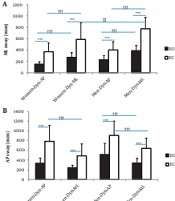
Background: Vision, vestibular sense, proprioception and muscle strength are required to maintain balance. However, gender could also play a crucial role in postural sway. Objectives: This study was used to examine (i) the impact of gender, surface type, and vision on postural sway; (ii) the effects of gender and vision on the limb symmetry of postural sway; and (iii) to understand the effects of gender, stance, surface type and vision on the alterations of dynamic postural sway alterations. Methods: This was a cross-sectional study in which young, healthy men (n = 15) and women (n = 12) underwent a balance control assessment using a force plate (SATEL, 40 Hz). Postural stances were evaluated in different conditions: Opened eyes (EO) and closed eyes (EC), on different surface foam vs. firm, a dominant leg stance (DL) vs. a non-dominant leg stance (NDL), and a mediolateral stance (ML) vs. an anteroposterior stance (AP). The mediolateral sway (ML sway), anteroposterior sway (AP sway), and sway area were calculated from the centre of pressure displacements. Results: ML sway, AP sway and sway area increased when eyes were closed (P < 0.000). Foam surface perturbs balance control more than firm surface under EO and EC conditions for both genders, as observed in the AP sway curve (P < 0.000). A functional symmetry exists between the DL and NDL for all sway parameters: The ML sway, AP sway, and sway area (P = 0.720; P = 0.292; P = 0.954). The AP stance is more stable for the ML sway than the ML stance for both genders (P < 0.001). For the AP sway, the ML stance is more stable than the AP sway AP direction stance for both genders (P < 0.001). Women were significantly more stable than men in the ML stance when vision was absent (P < 0.01). Conclusions: Postural sway was altered more significantly on a foam surface than on a firm surface and symmetry between the DL and NDL was observed. Furthermore, we concluded that women have better dynamic balance control than men.Downloads
References
1. Hansson EE, Beckman A, Hakansson A. Effect of vision,
proprioception, andthepositionof thevestibularorganonpostural
sway. Acta Otolaryngol. 2010;130(12):1358–63. [PubMed ID: 20632903].
https://doi.org/10.3109/00016489.2010.498024.
2. Patel M, Fransson PA, Lush D, Petersen H, Magnusson M, Johansson
R, et al. The effects of foam surface properties on standing body
movement. Acta Otolaryngol. 2008;128(9):952–60. [PubMed ID:
19086193]. https://doi.org/10.1080/00016480701827517.
3. van Dieen JH, van Leeuwen M, Faber GS. Learning to balance on
one leg: motor strategy and sensory weighting. J Neurophysiol.
2015;114(5):2967–82. [PubMed ID: 26400255]. [PubMed Central ID:
PMC4737414]. https://doi.org/10.1152/jn.00434.2015.
4. Faraldo-Garcia A, Santos-Perez S, Crujeiras-Casais R, Labella-Caballero
T, Soto-Varela A. Influence of age and gender in the sensory analysis
of balance control. Eur Arch Otorhinolaryngol. 2012;269(2):673–7.
[PubMedID:21789678].https://doi.org/10.1007/s00405-011-1707-7.
5. Vando S, Haddad M, Masala D, Falese L, Padulo J. Visual feedback
training in young karate athletes. Muscles Ligaments Tendons J.
2019;4(2):137–40. https://doi.org/10.32098/mltj.02.2014.08.
6. Barone R, Macaluso F, Traina M, Leonardi V, Farina F, Di
Felice V. Soccer players have a better standing balance in
nondominant one-legged stance. Open Access J Sports Med.
2010;2:1–6. [PubMed ID: 24198563]. [PubMed Central ID: PMC3781875].
https://doi.org/10.2147/OAJSM.S12593.
7. MutluC,RecepAÖ,EmreA.InfluenceofLegDominanceonSingle-Leg
Stance Performance During Dynamic Conditions: An Investigation
into the Validity of Symmetry Hypothesis for Dynamic Postural
Control inHealthyIndividuals. Turk J Phys MedRehab.2014;60:22–6.
8. Howell DR, Hanson E, Sugimoto D, Stracciolini A, Meehan 3rd
WP. Assessment of the Postural Stability of Female and Male
Athletes. Clin J Sport Med. 2017;27(5):444–9. [PubMed ID: 27428677].
https://doi.org/10.1097/JSM.0000000000000374.
9. Dallinga JM, van der Does HT, Benjaminse A, Lemmink KA. Dynamic
postural stability differences between male and female players with
and without ankle sprain. Phys Ther Sport. 2016;17:69–75. [PubMed ID:
26586042]. https://doi.org/10.1016/j.ptsp.2015.05.002.
10. Wikstrom EA, Tillman MD, Kline KJ, Borsa PA. Gender and
limb differences in dynamic postural stability during landing.
Clin J Sport Med. 2006;16(4):311–5. [PubMed ID: 16858214].
https://doi.org/10.1097/00042752-200607000-00005.
11. Cug M, Wikstrom EA, Golshaei B, Kirazci S. The Effects of Sex, Limb
Dominance, and Soccer Participation on Knee Proprioception and
DynamicPosturalControl.JSportRehabil.2016;25(1):31–9.[PubMedID:
26355541]. https://doi.org/10.1123/jsr.2014-0250.
12. Dorneles PP, Pranke GI, Mota CB. [Comparison of
postural balance between female and male adolescents].
Fisioterapia
e
Pesquisa.
2013;20(3):210–4.
https://doi.org/10.1590/s1809-29502013000300003.
Portuguese.
13. Gribble PA, Hertel J, Plisky P. Using the Star Excursion Balance
Test to assess dynamic postural-control deficits and outcomes in
lower extremity injury: a literature and systematic review. J Athl
Train. 2012;47(3):339–57. [PubMed ID: 22892416]. [PubMed Central ID:
PMC3392165]. https://doi.org/10.4085/1062-6050-47.3.08.
14. Ghram A, Damak M, Costa PB. Effect of acute contract-relax
proprioceptive
neuromuscular facilitation stretching on
static balance in healthy men. Sci Sports. 2017;32(1):e1–7.
https://doi.org/10.1016/j.scispo.2016.06.005.
15. Ghram A, Young JD, Soori R, Behm DG. Unilateral Knee and Ankle
Joint Fatigue Induce Similar Impairment to Bipedal Balance in Judo
Athletes. J Hum Kinet. 2019;66:7–18. [PubMed ID: 30988836]. [PubMed
Central ID: PMC6458584].https://doi.org/10.2478/hukin-2018-0063.
J
16. Hof AL, Gazendam MG, Sinke WE. The condition for dynamic
stability.
Biomech. 2005;38(1):1–8. [PubMed ID: 15519333].
https://doi.org/10.1016/j.jbiomech.2004.03.025.
17. GouwandaD,GopalaiAA.InvestigatingHumanBalanceandPostural
Control During Bilateral Stance on BOSU Balance Trainer. J Med Biol
Eng. 2017;37(4):484–91. https://doi.org/10.1007/s40846-017-0282-9.
18. Wu G, Chiang JH. The significance of somatosensory
stimulations to the human foot in the control of postural
reflexes. Exp Brain Res. 1997;114(1):163–9. [PubMed ID: 9125462].
https://doi.org/10.1007/pl00005616.
19. Backlund Wasling H, Norrsell U, Gothner K, Olausson
H. Tactile directional sensitivity and postural control.
Exp Brain Res. 2005;166(2):147–56. [PubMed ID: 16143860].
https://doi.org/10.1007/s00221-005-2343-5.
20. Riemann BL, Myers JB, Lephart SM. Comparison of the
ankle, knee, hip, and trunk corrective action shown during
single-leg stance on firm, foam, and multiaxial surfaces. Arch
Phys Med Rehabil. 2003;84(1):90–5. [PubMed ID: 12589627].
https://doi.org/10.1053/apmr.2003.50004.
21. Shumway-Cook A, Horak FB. Assessing the influence of
sensory interaction of balance. Suggestion from the field.
Phys
Ther.
1986;66(10):1548–50.
https://doi.org/10.1093/ptj/66.10.1548.
[PubMed ID: 3763708].
22. MacLellan MJ, Patla AE. Adaptations of walking pattern
on a compliant surface to regulate dynamic stability.
Exp Brain Res. 2006;173(3):521–30. [PubMed ID: 16491406].
https://doi.org/10.1007/s00221-006-0399-5.
23. Stefanyshyn DJ; Nurse; Hulliger; Wakeling; Nigg. Changing the
texture of footwear can alter gait patterns. J Electromyogr Kinesiol.
2005;15(5):496–506. https://doi.org/10.1016/j.jelekin.2004.12.003.
24. Perry SD, McIlroy WE, Maki BE. The role of plantar
cutaneous mechanoreceptors in the control of
compensatory stepping reactions evoked by unpredictable,
multi-directional perturbation. Brain Res. 2000;877(2):401–6.
https://doi.org/10.1016/s0006-8993(00)02712-8.
25. Horak FB, Hlavacka F. Somatosensory loss increases vestibulospinal
sensitivity. J Neurophysiol. 2001;86(2):575–85. [PubMed ID: 11495933].
https://doi.org/10.1152/jn.2001.86.2.575.
26. Alonso AC, Brech GC, Bourquin AM, Greve JM. The
influence of lower-limb dominance on postural balance.
Sao Paulo Med J. 2011;129(6):410–3. [PubMed ID: 22249797].
https://doi.org/10.1590/s1516-31802011000600007.
27. CliffordAM,Holder-PowellH.Posturalcontrolinhealthyindividuals.
ClinBiomech(Bristol,Avon).2010;25(6):546–51.[PubMedID:20462678].
https://doi.org/10.1016/j.clinbiomech.2010.03.005.
28. Ekdahl C, Jarnlo GB, Andersson SI. Standing balance in healthy
subjects.Evaluationof aquantitativetestbatteryonaforceplatform.
ScandJ Rehabil Med.1989;21(4):187–95.
29. Hahn T, Foldspang A, Vestergaard E, Ingemann-Hansen
T.
One-leg standing balance and sports activity. Scand
J
Med Sci Sports. 1999;9(1):15–8. [PubMed ID: 9974192].
https://doi.org/10.1111/j.1600-0838.1999.tb00201.x.
body
30. Farenc I, Rougier P, Berger L. The influence of gender
and
characteristics
on upright stance. Ann
Hum Biol. 2003;30(3):279–94. [PubMed ID: 12850961].
https://doi.org/10.1080/0301446031000068842.
31. Lephart SM, Ferris CM, Riemann BL, Myers JB, Fu FH. Gender
differences in strength and lower extremity kinematics during
landing.ClinOrthopRelatRes.2002;(401):162–9.[PubMedID:12151893].
https://doi.org/10.1097/00003086-200208000-00019.
32. Gugayev KV, Kruchinin PA, Formalskii AM. A model of maintaining
balancebyapersonontheseesaw.JApplMathMech.2016;80(4):316–23.
Downloads
Additional Files
Publication Timeline
Issue
Section
License

This work is licensed under a Creative Commons Attribution-NonCommercial 4.0 International License.