YouTube as a Source of Information About Physical Exercise During COVID-19 Outbreak
DOI:
https://doi.org/10.61838/kman.intjssh.4.2.1Keywords:
Coronavirus, Pandemic, SARS-CoV-2, Physical Exercise, YouTubeAbstract
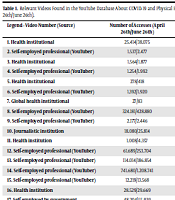
Context: Physical inactivity levels in the course of the corona virus disease 2019 (COVID-19) outbreak increased significantly. Our aim was to address how the information related to the physical exercise and COVID-19 posted on YouTube reaches the general public during COVID-19 outbreak. Evidence Acquisition: For this, research was carried out crossing the terms covid 19 and physical exercise in the YouTube database. The search was conducted only in the English language and was established/closed on April 26th (2020) to June 26th (2020) in order to observe the dynamics of video production on YouTube. Results: The main terms and concepts mentioned in the analysis of YouTube videos were COVID-19, pandemic, quarantine, social isolation and distance, physical activity, physical exercise, home-based physical exercise, physical inactivity, sedentary lifestyle, and mental health. The information was posted and supported by renowned health and physical exercise experts and entities. The recommendations for physical exercise in the current scenario focused on programs that require little equipment and space (carried out indoors and at home) and at low cost in an attempt to maintain and improve physical and mental health from different population groups. Conclusions: Information about COVID-19 and exercise was growing and progressive throughout the pandemic on YouTube. However, care and guidance are needed in using the information provided by YouTube as a source of reference for the practice of physical exercise during the COVID-19 outbreak.Downloads
References
1. Yuksel B, Cakmak K. Healthcare information on YouTube: Pregnancy
and COVID-19. Int J Gynaecol Obstet. 2020;150(2):189–93. [PubMed ID:
32471005]. https://doi.org/10.1002/ijgo.13246.
2. WHO. Coronavirus disease (COVID-2019) situation reports. World
Health Organization; 2020, [cited 17 Mar 2020]. Available from:
https://www.who.int/emergencies/diseases/novel-coronavirus
2019/situation-reports.
3. WHO. Mental health and psychosocial considerations during COVID-19
outbreak. World Health Organization; 2020. Available from:
https://www.who.int/publications/i/item/WHO-2019-nCoV
MentalHealth-2020.1.
4. CDC. How to protect yourself & other. Centers for Disease Control and
Prevention;2020.Availablefrom: https://www.cdc.gov/coronavirus/
2019-ncov/prevent-getting-sick/prevention.html.
5. CDC. Stress and coping. Centers for Disease Control and Prevention;
2020. Available from: https://www.cdc.gov/mentalhealth/stress
coping/index.html.
6. CDC. Social distancing: keep a safe distance to slow the spread. Centers
for Disease Control and Prevention; 2020. Available from: https://
stacks.cdc.gov/view/cdc/90522.
7. CDC. Physical activity. Centers for Disease Control and Prevention;
2020. Available from: https://www.cdc.gov/physicalactivity/index.
html.
8. Kocyigit BF, Akaltun MS, Sahin AR. YouTube as a source of
informationonCOVID-19andrheumaticdiseaselink.ClinRheumatol.
2020;39(7):2049–54. [PubMed ID: 32447603]. [PubMed Central ID:
PMC7245189]. https://doi.org/10.1007/s10067-020-05176-3.
9. Cao W, Fang Z, Hou G, Han M, Xu X, Dong J, et al.
The psychological impact of the COVID-19 epidemic on
college students in China. Psychiatry Res. 2020;287:112934.
[PubMed ID: 32229390]. [PubMed Central ID: PMC7102633].
https://doi.org/10.1016/j.psychres.2020.112934.
10. Haider ,I, Tiwana F, Tahir SM. Impact of the COVID-19 Pandemic on
Adult Mental Health. Pak J Med Sci. 2020;36(COVID19-S4):S90–4.
[PubMed ID: 32582321]. [PubMed Central ID: PMC7306943].
https://doi.org/10.12669/pjms.36.COVID19-S4.2756.
11. WHO. A vision for a more active world. World Health Organization;
2020. Available from: https://fitness.org.au/articles/featured/world
health-organization-who-a-vision-for-a-more-active-world/39/
1686/184.
12. PedersenBK,Saltin B. Exercise as medicine- evidence for prescribing
exercise as therapy in 26 different chronic diseases. Scand J
Med Sci Sports. 2015;25 Suppl 3:1–72. [PubMed ID: 26606383].
https://doi.org/10.1111/sms.12581.
13. Booth FW, Roberts CK, Thyfault JP, Ruegsegger GN, Toedebusch RG.
Role of Inactivity in Chronic Diseases: Evolutionary Insight and
Pathophysiological Mechanisms. Physiol Rev. 2017;97(4):1351–402.
[PubMed ID: 28814614]. [PubMed Central ID: PMC6347102].
https://doi.org/10.1152/physrev.00019.2016.
14. Zimerer C, Pereira Alves S, Rufo-Tavares W, Carletti L, Andre Barbosa
de Lira C, Andrade MS, et al. Home-Based Kettlebell Exercise and
Coronavirus Outbreak: Practical Suggestions. Strength Cond J.
2021;43(4):115–20. https://doi.org/10.1519/ssc.0000000000000615.
15. Puccinelli PJ, Costa TS, Seffrin A, de Lira CAB, Vancini RL, Knechtle
B, et al. Physical Activity Levels and Mental Health during the
COVID-19 Pandemic: Preliminary Results of a Comparative Study
betweenConvenienceSamplesfromBrazilandSwitzerland.Medicina
(Kaunas). 2021;57(1). [PubMed ID: 33429989]. [PubMed Central ID:
PMC7827202].https://doi.org/10.3390/medicina57010048.
16. Vancini RL, Camargo-Neto L, de Lira CAB, Andrade MS, Viana RB,
Nikolaidis PT, et al. Physical Activity and Sociodemographic Profile
of Brazilian People during COVID-19 Outbreak: An Online and
Cross-Sectional Survey. Int J Environ Res Public Health. 2020;17(21).
[PubMed ID: 33138270]. [PubMed Central ID: PMC7663508].
https://doi.org/10.3390/ijerph17217964.
17. VanciniRL,AndradeMS,NikolaidisPT,KnechtleB,RosemannT,Viana
RB, et al. COVID-19: It’s still time for health professionals, physical
activity enthusiasts and sportive leagues not to let guard down.
SportsMedHealthSci.2021;3(1):49–53.[PubMedID:34189488].[PubMed
Central ID: PMC7874906].https://doi.org/10.1016/j.smhs.2021.01.002.
18. Vancini RL, de Lira CAB, Gentil P, Andrade MS. Neurological features
of COVID-19 and epilepsy: Could neuromuscular assessment be
a physical and functional marker? Epilepsy Behav. 2021;114(Pt
A):107648. [PubMed ID: 33309238]. [PubMed Central ID: PMC7831858].
https://doi.org/10.1016/j.yebeh.2020.107648.
19. Vancini RL, de Lira CAB, Andrade MS, Arida RM. CoVID-19 vs. epilepsy:
It is time to move, act, and encourage physical exercise. Epilepsy
Behav. 2020;110:107154. [PubMed ID: 32451251]. [PubMed Central ID:
PMC7196429].https://doi.org/10.1016/j.yebeh.2020.107154.
20. LiHO,BaileyA,HuynhD,ChanJ.YouTubeasasourceof information
on COVID-19: a pandemic of misinformation? BMJ Glob Health.
2020;5(5). [PubMedID:32409327]. [PubMedCentralID:PMC7228483].
https://doi.org/10.1136/bmjgh-2020-002604.
21. Basch CH, Hillyer GC, Meleo-Erwin ZC, Jaime C, Mohlman J, Basch CE.
Correction: Preventive Behaviors Conveyed on YouTube to Mitigate
Transmission of COVID-19: Cross-Sectional Study. JMIR Public Health
Surveill. 2020;6(2).e19601.[PubMedID:32374718].[PubMedCentralID:
PMC7240432].https://doi.org/10.2196/19601.
22. Basch CE, Basch CH, Hillyer GC, Jaime C. The Role of YouTube
and the Entertainment Industry in Saving Lives by Educating and
Mobilizing the Public to Adopt Behaviors for CommunityMitigation
of COVID-19: Successive Sampling Design Study. JMIR Public Health
Surveill.2020;6(2).e19145.[PubMedID:32297593].[PubMedCentralID:
PMC7175786]. https://doi.org/10.2196/19145.
23. Hernandez-Garcia I, Gimenez-Julvez T. Characteristics of YouTube
Videos in Spanish on How to Prevent COVID-19. Int J Environ Res
Public Health. 2020;17(13). [PubMedID:32610523].[PubMedCentralID:
PMC7370194]. https://doi.org/10.3390/ijerph17134671.
24. Dutta A, Beriwal N, Van Breugel LM, Sachdeva S, Barman B, Saikia
H, et al. YouTube as a Source of Medical and Epidemiological
Information During COVID-19 Pandemic: A Cross-Sectional Study of
Content Across Six Languages Around the Globe. Cureus. 2020;12(6).
e8622. [PubMed ID: 32685293]. [PubMed Central ID: PMC7364420].
https://doi.org/10.7759/cureus.8622.
25. Szmuda T, Syed MT, Singh A, Ali S, Ozdemir C, Sloniewski P.
YouTube as a source of patient information for Coronavirus Disease
(COVID-19): Acontent-qualityandaudienceengagementanalysis.Rev
Med Virol. 2020;30(5). e2132. [PubMed ID: 32537771]. [PubMed Central
ID: PMC7323134]. https://doi.org/10.1002/rmv.2132.
26. AtacO,OzalpYC, KurnazR,Guler OM,InamlikM,HayranO.Youtube
as anInformationSourceDuringtheCoronavirusDisease(COVID-19)
Pandemic: Evaluation of the Turkish and English Content. Cureus.
2020;12(10). e10795. [PubMed ID: 33163299]. [PubMed Central ID:
PMC7641462].https://doi.org/10.7759/cureus.10795.
27. D’Souza RS, D’Souza S, Strand N, Anderson A, Vogt MNP,
Olatoye O. YouTube as a source of medical information on
the novel coronavirus 2019 disease (COVID-19) pandemic.
Glob Public Health. 2020;15(7):935–42. [PubMed ID: 32397870].
https://doi.org/10.1080/17441692.2020.1761426.
28. Laurent G, Guinhouya B, Whatelet M, Lamer A. Automatic
Exploitation of YouTube Data: A Study of Videos Published
by a French YouTuber During COVID-19 Quarantine in France.
Stud Health Technol Inform. 2020;275:112–6. [PubMed ID: 33227751].
https://doi.org/10.3233/SHTI200705.
29. Andika R, Kao CT, Williams C, Lee YJ, Al-Battah H, Alweis
R. YouTube as a source of information on the COVID-19
pandemic. J Community Hosp Intern Med Perspect. 2021;11(1):39–41.
[PubMed ID: 33552412]. [PubMed Central ID: PMC7850399].
https://doi.org/10.1080/20009666.2020.1837412.
30. Parker K, Uddin R, Ridgers ND, Brown H, Veitch J, Salmon J, et al. The
Useof DigitalPlatformsforAdults’andAdolescents’PhysicalActivity
During the COVID-19 Pandemic (Our Life at Home): Survey Study. J
Med Internet Res. 2021;23(2). e23389. [PubMed ID: 33481759]. [PubMed
Central ID: PMC7857525]. https://doi.org/10.2196/23389.
31. McDonough DJ, Helgeson MA, Liu W, Gao Z. Effects of a remote,
YouTube-delivered exercise intervention on young adults’ physical
activity, sedentary behavior, and sleep during the COVID-19
pandemic: Randomized controlled trial. J Sport Health Sci.
2021. [PubMed ID: 34314877]. [PubMed Central ID: PMC8487769].
https://doi.org/10.1016/j.jshs.2021.07.009.
32. Kadakia S, Stratton C, Wu Y, Feliciano J, Tuakli-Wosornu YA. The
Accessibility of YouTube Fitness Videos for Individuals Who Are
Int J Sport StudHealth. 2021;4(2):e123312.
Disabled Before and During the COVID-19 Pandemic: Preliminary
Application of a Text Analytics Approach. JMIR Form Res. 2022;6(2).
e34176. [PubMedID:35044305].https://doi.org/10.2196/34176.
33. Tripicchio GL, Jones GJ, Hart CN, Hyun M, DeSabato E, Giddings A, et
al. A digitally enhanced home-based physical activity intervention
for high-risk middle school youth during COVID-19. Transl Behav
Med.2021.[PubMedID:34850218].[PubMedCentralID:PMC8690196].
https://doi.org/10.1093/tbm/ibab151.
34. WHO.#HealthyAtHome- Physical activity. World Health Organization;
2020,[cited19Jun2020].Availablefrom: https://www.who.int/news
room/campaigns/connecting-the-world-to-combat-coronavirus/
healthyathome/healthyathome---physical-activity.
35. Thivel D, Tremblay A, Genin PM, Panahi S, Riviere D, Duclos M.
Physical Activity, Inactivity, and Sedentary Behaviors: Definitions
and Implications in Occupational Health. Front Public Health.
2018;6:288.[PubMedID:30345266].[PubMedCentralID:PMC6182813].
https://doi.org/10.3389/fpubh.2018.00288.
36. HillmanNH,LamHS.Respiratorydisordersinthenewborn.Kendig’s
Disorders of the Respiratory Tract in Children. 6th ed. Elsevier; 2019.
37. Tremblay MS, Aubert S, Barnes JD, Saunders TJ, Carson V,
Latimer-Cheung AE, et al. Sedentary Behavior Research Network
(SBRN)- Terminology Consensus Project process and outcome. Int J
Behav Nutr Phys Act. 2017;14(1):75. [PubMed ID: 28599680]. [PubMed
Central ID: PMC5466781]. https://doi.org/10.1186/s12966-017-0525-8.
38. Kotarsky CJ, Christensen BK, Miller JS, Hackney KJ. Effect of
Progressive Calisthenic Push-up Training on Muscle Strength
and Thickness. J Strength Cond Res. 2018;32(3):651–9. [PubMed ID:
29466268]. https://doi.org/10.1519/JSC.0000000000002345.
39. MarcinikEJ,HodgdonJA,MittlemanK,O’BrienJJ.Aerobic/calisthenic
and aerobic/circuit weight training programs for Navy men: a
comparative study. Med Sci Sports Exerc. 1985;17(4):482–7. [PubMed ID:
4033406]. https://doi.org/10.1249/00005768-198508000-00014.
40. Yamauchi J, Nakayama S, Ishii N. Effects of bodyweight-based
exercise training on muscle functions of leg multi-joint movement
in elderly individuals. Geriatr Gerontol Int. 2009;9(3):262–9. [PubMed
ID: 19702936]. https://doi.org/10.1111/j.1447-0594.2009.00530.x.
41. Lopez C, Jones J, Alibhai SMH, Santa Mina D. What Is the "Home"
in Home-Based Exercise? The Need to Define Independent Exercise
for Survivors of Cancer. J Clin Oncol. 2018;36(9):926–7. [PubMed ID:
29373096]. https://doi.org/10.1200/JCO.2017.76.4365.
42. Caspersen CJ, Powell KE, Christenson GM. Physical activity, exercise,
and physical fitness: definitions and distinctions for health-related
research. Public Health Rep. 1985;100(2):126–31. [PubMed ID: 3920711].
[PubMedCentralID:PMC1424733].
43. Ricciardi R. Sedentarism: Forum. 2005;40(3):79–87. a concept analysis. Nurs [PubMed
https://doi.org/10.1111/j.1744-6198.2005.00021.x. ID: 16271119].
44. Wilder RP, Greene JA, Winters KL, Long W3, Gubler K, Edlich
RF. Physical fitness assessment: an update. J Long Term Eff
Med Implants. 2006;16(2):193–204. [PubMed ID: 16700660].
https://doi.org/10.1615/jlongtermeffmedimplants.v16.i2.90.
45. Perez-Escoda A, Jimenez-Narros C, Perlado-Lamo-de-Espinosa
M, Pedrero-Esteban LM. Social Networks’ Engagement During
the COVID-19 Pandemic in Spain: Health Media vs. Healthcare
Professionals. Int J Environ Res Public Health. 2020;17(14).
[PubMed ID: 32708231]. [PubMed Central ID: PMC7400399].
https://doi.org/10.3390/ijerph17145261.
46. Ketelhut S, Ketelhut RG. Type of Exercise Training and Training
Methods. Adv Exp Med Biol. 2020;1228:25–43. [PubMed ID: 32342448].
https://doi.org/10.1007/978-981-15-1792-1_2.
47. Franklin BA, Fern A, Voytas J. Training principles for elite senior
athletes. Curr Sports Med Rep. 2004;3(3):173–9. [PubMed ID: 15122988].
https://doi.org/10.1249/00149619-200406000-00014.
48. Zaryski
issues
Med C, for Rep. Smith DJ.
ultra-endurance
2005;4(3):165–70. Training athletes. [PubMed principles Curr ID: and Sports 15907270]. https://doi.org/10.1097/01.csmr.0000306201.49315.73. training
49. Barnett A, Cerin E, Reaburn P, Hooper S. The effects of on performance and performance-related
states in individual elite athletes:
a dynamic approach. J Sports Sci. 2010;28(10):1117–26. [PubMed ID: 20686999].
https://doi.org/10.1080/02640414.2010.497817.
50. Neil-SztramkoSE,MedyskyME,CampbellKL,BlandKA,Winters-Stone
KM. Attention to the principles of exercise training in exercise
studies on prostate cancer survivors: a systematic review. BMC
Cancer. 2019;19(1):321. [PubMed ID: 30953460]. [PubMed Central ID:
PMC6451299].https://doi.org/10.1186/s12885-019-5520-9.
51. Fairman CM, Hyde PN, Focht BC. Resistance training interventions
across the cancer control continuum: a systematic review
of the implementation of resistance training principles.
Br J Sports Med. 2017;51(8):677–85. [PubMed ID: 27986761].
https://doi.org/10.1136/bjsports-2016-096537.
52. DwyerMJ,PasiniM,DeDominicisS,RighiE.Physicalactivity: Benefits
and challenges during the COVID-19 pandemic. Scand J Med Sci
Sports. 2020;30(7):1291–4. [PubMed ID: 32542719]. [PubMed Central ID:
PMC7323175]. https://doi.org/10.1111/sms.13710.
Downloads
Additional Files
Publication Timeline
Issue
Section
License

This work is licensed under a Creative Commons Attribution-NonCommercial 4.0 International License.