Surface-Dependent Adaptations in Cardiac Function, Aerobic Power, and Microrna-1 and Hand2 Expression Following Tabata Training in Elite Athletes
DOI:
https://doi.org/10.61838/kman.intjssh.4563Keywords:
sand, hard surface, high-intensity interval training, echocardiography, VO2maxAbstract
Objective: Tabata training has the potential to induce favorable adaptations in elite athletes. However, the underlying mechanisms remain incompletely understood. Furthermore, varying the training surface can contribute to improvements in athletes' fitness by introducing diversity into the training program. This study compared the effects of Tabata training conducted on an indoor hardcourt vs. sand on maximum oxygen consumption (VO2max), left ventricular morphology, and the expression of microRNA-1 (miR-1) and Hand2 in elite beach soccer players.
Methods: Sixteen players were randomly assigned to either a soft (SS) or hard (HS) surface group. The training variables were similar between the groups and only the type of training surface was different. The protocol (4-min sets of 20 s of exercise, 10 s of rest) was performed three sessions/week for six weeks. Shuttle run test and two-dimensional echocardiography were performed 48 h and 72 h, respectively, before and after the intervention. Additionally, venous blood samples were collected before and 6 h after the first and last session.
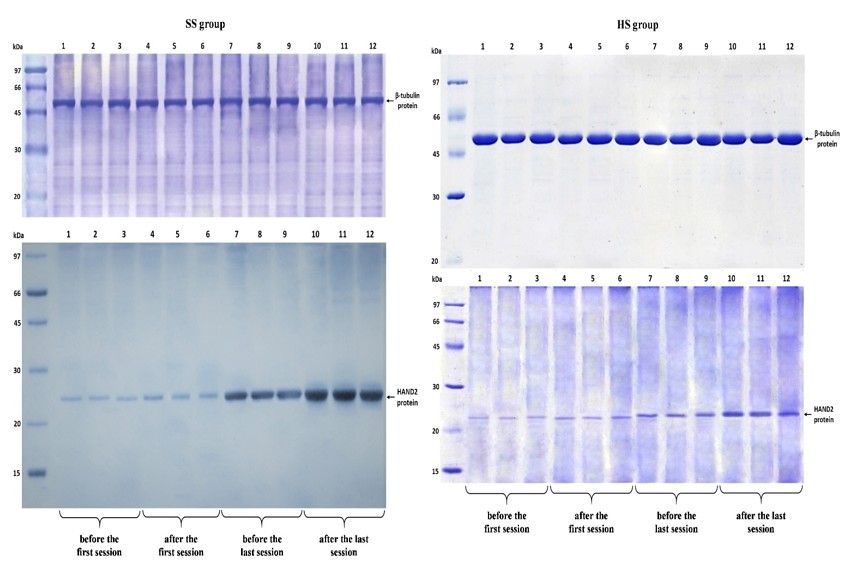
Findings: Repeated measures ANOVA revealed significant time × group interactions for increases in stroke volume (SV; P= 0.039), left ventricular end-diastolic volume (p = 0.013) and dimension (p = 0.029), ejection fraction (p = 0.017), and reductions in relative posterior wall thickness (p = 0.036). The SS group exhibited greater post-training increases in miR-1 and Hand2 protein (p < 0.0001). Moreover, both groups experienced similar increases in VO2max values (p < 0.0001).
Conclusion: Tabata training on sand can produce greater improvements in SV values compared to indoor hardcourt, despite similar improvements in relative VO2max. These cardiac improvements may partly relate to enhanced venous return, and the molecular findings suggest a potential contribution of miR-1 upregulation, whereas the role of Hand2 remains less clear due to limitations in serum-based assessment.
Downloads
References
1. Tabata I, Nishimura K, Kouzaki M, Hirai Y, Ogita F, Miyachi M, et al. Effects of moderate-intensity endurance and high-intensity intermittent training on anaerobic capacity and VO2max. Medicine and science in sports and exercise. 1996;28(10):1327-30. [PMID: 8897392]
2. Dupont G, Akakpo K, Berthoin S. The effect of in-season, high-intensity interval training in soccer players. Journal of Strength & Conditioning Research. 2004;18(3):584-9. [PMID: 15320689]
3. Howard N, Stavrianeas S. In-season high-intensity interval training improves conditioning in high school soccer players. International Journal of Exercise Science. 2017;10(5):713. [PMID: 28966710] [PMCID: PMC5609662]
4. Castellano J, Casamichana D. Heart rate and motion analysis by GPS in beach soccer. Journal of Sports Science and Medicine. 2010;9(1):98.
5. Gaeini A, Javidi M, Kordi M, Soleimani M, Fallahi A. The effect of 8 weeks of high intensity interval training on mir-29 gene family expression and cardiac hypertrophy of healthy male rats. Journal of Advances in Medical and Biomedical Research. 2015;23(99):14-24. (In Persian).
6. Impellizzeri FM, Marcora SM, Castagna C, Reilly T, Sassi A, Iaia F, et al. Physiological and performance effects of generic versus specific aerobic training in soccer players. International Journal of Sports Medicine. 2006;27(06):483-92. [PMID: 16767613]
7. Impellizzeri FM, Rampinini E, Maffiuletti NA, Castagna C, Bizzini M, Wisløff U. Effects of aerobic training on the exercise-induced decline in short-passing ability in junior soccer players. Applied Physiology, Nutrition, and Metabolism. 2008;33(6):1192-8. [PMID: 19088777]
8. Safania AM, Alizadeh R, Nourshahi M. A comparison of small-side games and interval training on same selected physical fitness factors in amateur soccer players. Journal of Social Sciences. 2011;7(3):349-53.
9. Mahjoub H, Le Blanc O, Paquette M, Imhoff S, Labrecque L, Drapeau A, et al. Cardiac remodeling after six weeks of high-intensity interval training to exhaustion in endurance-trained men. American Journal of Physiology-Heart Circulatory Physiology. 2019;317(4):H685-H94. [PMID: 31347913]
10. Esfandiari S, Sasson Z, Goodman JM. Short-term high-intensity interval and continuous moderate-intensity training improve maximal aerobic power and diastolic filling during exercise. European Journal of Applied Physiology. 2014;114:331-43. [PMID: 24281825]
11. Chen C, Ponnusamy M, Liu C, Gao J, Wang K, Li P. MicroRNA as a therapeutic target in cardiac remodeling. BioMed Research International. 2017;2017(1):1278436. [PMID: 29094041] [PMCID: PMC5637866]
12. Fathi M, Gharakhanlou R, Rezaei R. The Changes of Heart miR-1 and miR-133 Expressions following Physiological Hypertrophy Due to Endurance Training. Cell Journal (Yakhteh). 2020;22(Suppl 1):133.
13. Care A, Catalucci D, Felicetti F, Bonci D, Addario A, Gallo P, et al. MicroRNA-133 controls cardiac hypertrophy. Nature Medicine. 2007;13(5):613-8. [PMID: 17468766]
14. Soplinska A, Zareba L, Wicik Z, Eyileten C, Jakubik D, Siller-Matula JM, et al. MicroRNAs as Biomarkers of Systemic Changes in Response to Endurance Exercise—A Comprehensive Review. Diagnostics. 2020;10(10):813. [PMID: 33066215] [PMCID: PMC7602033]
15. Denham J, Prestes PR. Muscle-enriched microRNAs isolated from whole blood are regulated by exercise and are potential biomarkers of cardiorespiratory fitness. Frontiers in Genetics. 2016;7:196. [PMID: 27895662] [PMCID: PMC5108773]
16. Thattaliyath BD, Livi CB, Steinhelper ME, Toney GM, Firulli AB. HAND1 and HAND2 are expressed in the adult-rodent heart and are modulated during cardiac hypertrophy. Biochemical and Biophysical Research Communications. 2002;297(4):870-5. [PMID: 12359233]
17. Akazawa H, Komuro I. Roles of cardiac transcription factors in cardiac hypertrophy. Circulation Research. 2003;92(10):1079-88. [PMID: 12775656]
18. Zhao Y, Samal E, Srivastava D. Serum response factor regulates a muscle-specific microRNA that targets Hand2 during cardiogenesis. Nature. 2005;436(7048):214-20. [PMID: 15951802]
19. Takaya T, Nishi H, Horie T, Ono K, Hasegawa K. Roles of microRNAs and myocardial cell differentiation. Progress in Molecular Biology and Translational Science. 2012;111:139-52. [PMID: 22917229]
20. Gharaat MA, Kashef M, Jameie B, Rajabi H. Effect of endurance and high intensity interval swimming training on cardiac structure and Hand2 expression of rats. Journal of Shahid Sadoughi University of Medical Sciences. 2018;25(9):748-58. (In Persian). [PMCID: A-10-3342-1]
21. Mohamadpanah M, Hoseininejad SE, Salari Esker F. Effect of surface type on impact force, loading rate, and free moment during stance phase of running. Scientific Journal of Rehabilitation Medicine. 2021;10(2):234-45.
22. Binnie MJ, Dawson B, Arnot MA, Pinnington H, Landers G, Peeling P. Effect of sand versus grass training surfaces during an 8-week pre-season conditioning programme in team sport athletes. Journal of Sports Sciences. 2014;32(11):1001-12. [PMID: 24479768]
23. Binnie MJ, Peeling P, Pinnington H, Landers G, Dawson B. Effect of surface-specific training on 20-m sprint performance on sand and grass surfaces. Journal of Strength & Conditioning Research. 2013;27(12):3515-20. [PMID: 23478471]
24. Rokhsati S, Salimi Avansar A, Ebrahim K, Ahmadizad S. Comparing the effect of six weeks of specific volleyball training on hard and soft surfaces on anaerobic power, vertical jump, agility and fat percentage of volleyball players. Journal of Sport and Exercise Physiology. 2014;7(1):1005-12. (In Persian).
25. Zamparo P, Perini R, Orizio C, Sacher M, Ferretti G. The energy cost of walking or running on sand. European Journal of Applied Physiology and Occupational Physiology. 1992;65(2):183-7. [PMID: 1327762]
26. Gaudino P, Gaudino C, Alberti G, Minetti AE. Biomechanics and predicted energetics of sprinting on sand: hints for soccer training. Journal of Science and Medicine in Sport. 2013;16(3):271-5. [PMID: 22883597]
27. Binnie MJ, Dawson B, Pinnington H, Landers G, Peeling P. Sand training: a review of current research and practical applications. Journal of Sports Sciences. 2014;32(1):8-15. [PMID: 23968257]
28. Rago V, Rebelo AN, Pizzuto F, Barreira D. Small-sided soccer games on sand are more physically demanding but less technically specific compared to games on artificial turf. Journal of Sports Medicine and Physical Fitness. 2016;58(4):385-91. [PMID: 27627990]
29. Ramsbottom R, Brewer J, Williams C. A progressive shuttle run test to estimate maximal oxygen uptake. British Journal of Sports Medicine. 1988;22(4):141-4. [PMID: 3228681] [PMCID: PMC1478728]
30. Lang RM, Badano LP, Mor-Avi V, Afilalo J, Armstrong A, Ernande L, et al. Recommendations for cardiac chamber quantification by echocardiography in adults: an update from the American Society of Echocardiography and the European Association of Cardiovascular Imaging. European Heart Journal-Cardiovascular Imaging. 2015;16(3):233-71. [PMID: 25712077]
31. Banzet S, Chennaoui M, Girard O, Racinais S, Drogou C, Chalabi H, et al. Changes in circulating microRNAs levels with exercise modality. Journal of Applied Physiology. 2013;115(9):1237-44. [PMID: 23950168]
32. Li Q, Chen S, Huang H, Chen W, Liu L, Wang B, et al. Dilated Left Ventricular End-Diastolic Diameter Is a New Risk Factor of Acute Kidney Injury Following Coronary Angiography. Frontiers in Cardiovascular Medicine. 2022;9. [PMID: 35419430] [PMCID: PMC8996253]
33. Slankamenac J, Milovancev A, Klasnja A, Gavrilovic T, Sekulic D, Kesic MG, et al. Echocardiographic Characterization of Left Heart Morphology and Function in Highly Trained Male Judo Athletes. International Journal of Environmental Research and Public Health. 2022;19(14):8842. [PMID: 35886693] [PMCID: PMC9325159]
34. Sheykhlouvand M, Arazi H, Astorino TA, Suzuki K. Effects of a New Form of Resistance-Type High-Intensity Interval Training on Cardiac Structure, Hemodynamics, and Physiological and Performance Adaptations in Well-Trained Kayak Sprint Athletes. Frontiers in Physiology. 2022;13. [PMID: 35360225] [PMCID: PMC8960736]
35. Azali Alamdari K, Armanfar M. The effects of high intensity interval training (hiit), endurance training and resistance training on serum insulin-like growth factor-1 level, mirna-133a and mirna-1 expression and physical performance in male athletes. Sport Physiology & Management Investigations. 2020;12(1):137-50. (In Persian).
36. Ghorbani P, Kordi MR, Gaeini A, Noori R, Karbalaeifar S. Effect of high intensity interval training on mir-1, mir133-a gene expression in rats with myocardial infarction. Sport Physiology. 2018;10(37):87-98. (In Persian).
37. Vakili J, Ghalehgir S, Khani M, Azali Alamdari K. The effect of eight weeks high intensity interval training on the expression of cardiac miRNA-21 and miRNA-1 in wistar male rats. Journal of Sport and Exercise Physiology. 2022;15(4):82-92. (In Persian).
38. Arazi H, Keihaniyan A, EatemadyBoroujeni A, Oftade A, Takhsha S, Asadi A, et al. Effects of heart rate vs. speed-based high intensity interval training on aerobic and anaerobic capacity of female soccer players. Sports. 2017;5(3):57. [PMID: 29910417] [PMCID: PMC5968964]
39. Sperlich B, De Marées M, Koehler K, Linville J, Holmberg HC, Mester J. Effects of 5 weeks of high-intensity interval training vs. volume training in 14-year-old soccer players. Journal of strength and conditioning research. 2011;25(5):1271-8. [PMID: 21490513]
40. Helgerud J, Engen LC, Wisloff U, Hoff J. Aerobic endurance training improves soccer performance. Medicine and Science in Sports and Exercise. 2001;33(11):1925-31. [PMID: 11689745]
41. Schmitz B, Niehues H, Thorwesten L, Klose A, Krüger M, Brand S-M. Sex Differences in High-Intensity Interval Training–Are HIIT Protocols Interchangeable Between Females and Males? Frontiers in Physiology. 2020;11. [PMID: 32063866 ] [PMCID: PMC7000457]
Downloads
Publication Timeline
- Submitted
- Revised
- Accepted