
A Diabetes Diagnosis Approach by Feature Selection Using Group Learning Optimization (GLO) Algorithm and Apache Spark Distributed Processing Technology
Keywords:
Diabetes diagnosis, Group Learning Optimization, feature selection, Generative Adversarial Network, Apache Spark, Random Forest, machine learning, distributed processingAbstract
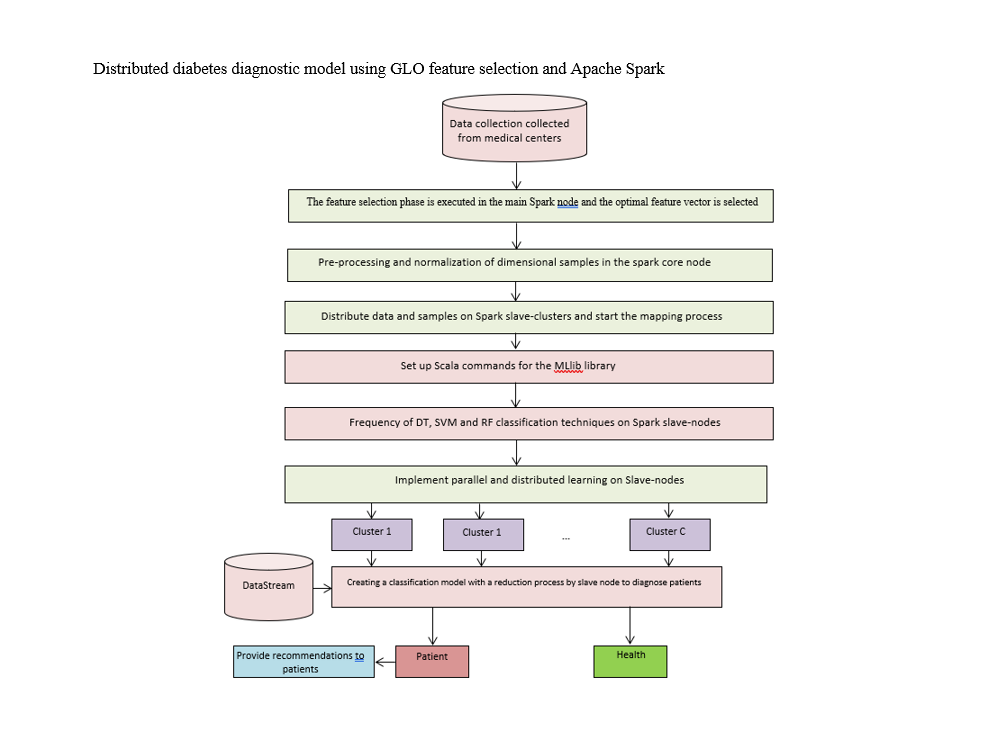
This study aimed to develop and evaluate an accurate and computationally efficient diabetes diagnosis framework integrating GAN-based class balancing, binary Group Learning Optimization (GLO) feature selection, and Apache Spark distributed machine-learning classification. The study used the Pima Indians Diabetes Dataset containing 768 records with eight diagnostic features and a binary diabetes outcome. Data were normalized to the [0,1] range, and a Generative Adversarial Network was used to balance minority and majority classes. A binary version of the GLO algorithm was developed for feature selection by minimizing a fitness function combining classification error and the number of selected features. The dataset was divided into 70% training and 30% testing subsets. A multilayer perceptron was used to evaluate candidate feature vectors during optimization. The reduced-dimensional data were subsequently processed within an Apache Spark master-worker architecture and classified using Decision Tree, Random Forest, Support Vector Machine, and majority voting. GLO was additionally evaluated against TLBO, WOA, SHO, WSA, and HHO using benchmark optimization functions. GLO achieved the best mean optimization rank of 1.86 and the lowest local-optimum entrapment rate of 7.5%. In feature-selection experiments, GLO achieved 89.76% accuracy, 88.60% sensitivity, and 88.41% precision, outperforming CSA, GWO, GOA, PSO, and GA in diagnostic accuracy. GAN balancing improved Decision Tree, Random Forest, and SVM accuracy to 93.21%, 94.62%, and 91.63%, respectively, while majority voting achieved 93.92% accuracy, 93.67% sensitivity, and 92.84% precision. In the distributed Spark implementation, Random Forest achieved the highest diagnostic performance, with 98.97% accuracy, 98.64% sensitivity, and 98.62% precision. Computational acceleration increased with the number of Spark clusters, with Decision Tree attaining a maximum speedup of 12.56. Integrating GAN-based balancing, binary GLO feature selection, and Apache Spark distributed processing provides an effective framework for improving diabetes classification accuracy while reducing dimensionality and computational burden.
Downloads
References
1. Magriplis E, Panagiotakos D, Papakonstantinou E, Mitsopoulou AV, Karageorgou D, Dimakopoulos I, et al. Prevalence Of Type 2 Diabetes Mellitus In A Representative Sample Of Greek Adults And Its Association With Modifiable Risk Factors: Results From The Hellenic National Nutrition And Health Survey. Public Health. 2021. [PMID: 33478772] [DOI]
2. Pagotto MA, Roldán ML, Molinas SM, Raices T, Pisani GB, Pignataro OP, et al. Impairment Of Renal Steroidogenesis At The Onset Of Diabetes. Molecular and Cellular Endocrinology. 2021:111170. [PMID: 33482284] [DOI]
3. Şahin A, Soylu D. Patient Perspectives On Lifestyle Changes Following A Diabetes Diagnosis. KMAN Counseling & Psychology Nexus. 2024;2(1):56-62. [DOI]
4. Tosur M. Inaccurate Diagnosis Of Diabetes Type In Youth: Prevalence, Characteristics, And Implications. Scientific Reports. 2024;14(1). [PMID: 38632329] [PMCID: PMC11024140] [DOI]
5. Padmalal S, Arumugam P, Anusha MB, Bamane KD, Yamsani N, Muppavaram K. Machine Learning For Early Detection Of Chronic Diseases: A Case Study In Diabetes Prediction. Machine Learning in Healthcare: Data-Driven Decisions, Predictive Modelling, Personalized Medicine2026. p. 171. [DOI]
6. Hossain MR, Hossain MJ, Rahman MM, Alam MM. Machine Learning-Based Prediction And Insights Of Diabetes Disease: Pima Indian And Frankfurt Datasets. Journal of Mechanics of Continua and Mathematical Sciences. 2025;20(1):99-114. [DOI]
7. Srivastava S, Sharma L, Sharma V, Kumar A, Darbari H. Prediction Of Diabetes Using Artificial Neural Network Approach. Engineering Vibration, Communication and Information Processing: ICoEVCI 2018, India: Springer Singapore; 2019. p. 679-87. [DOI]
8. Aggarwal Y, Das J, Mazumder PM, Kumar R, Sinha RK. Heart Rate Variability Features From Nonlinear Cardiac Dynamics In Identification Of Diabetes Using Artificial Neural Network And Support Vector Machine. Biocybernetics and Biomedical Engineering. 2020;40(3):1002-9. [DOI]
9. Pei D, Yang T, Zhang C. Estimation Of Diabetes In A High-Risk Adult Chinese Population Using J48 Decision Tree Model. Diabetes, Metabolic Syndrome and Obesity: Targets and Therapy. 2020;13:4621. [PMID: 33273837] [PMCID: PMC7705272] [DOI]
10. Barik S, Mohanty S, Mohanty S, Singh D. Analysis Of Prediction Accuracy Of Diabetes Using Classifier And Hybrid Machine Learning Techniques. Intelligent and Cloud Computing. Singapore: Springer; 2021. p. 399-409. [DOI]
11. Rahman M, Islam D, Mukti RJ, Saha I. A Deep Learning Approach Based On Convolutional Lstm For Detecting Diabetes. Computational Biology and Chemistry. 2020;88:107329. [PMID: 32688009] [DOI]
12. Jaiswal S, Gupta P. Diabetes Prediction Using Bi-Directional Long Short-Term Memory. SN Computer Science. 2023;4(4):373. [DOI]
13. Aslan MF, Sabanci K. A Novel Proposal For Deep Learning-Based Diabetes Prediction: Converting Clinical Data To Image Data. Diagnostics. 2023;13(4):796. [PMID: 36832284] [DOI]
14. Zhang Z, Lu Y, Ye M, Huang W, Jin L, Zhang G, et al. A Novel Evolutionary Ensemble Prediction Model Using Harmony Search And Stacking For Diabetes Diagnosis. Journal of King Saud University—Computer and Information Sciences. 2024;36(1):101873. [DOI]
15. Olabanjo O, Wusu A, Mazzara M. Deep Unsupervised Machine Learning For Early Diabetes Risk Prediction Using Ensemble Feature Selection And Deep Belief Neural Networks. 2023. [DOI]
16. Ahmad HF, Mukhtar H, Alaqail H, Seliaman M, Alhumam A. Investigating Health-Related Features And Their Impact On The Prediction Of Diabetes Using Machine Learning. Applied Sciences. 2021;11(3):1173. [DOI]
17. Awad SF, Dargham SR, Toumi AA, Dumit EM, El-Nahas KG, Al-Hamaq AO, et al. A Diabetes Risk Score For Qatar Utilizing A Novel Mathematical Modeling Approach To Identify Individuals At High Risk For Diabetes. Scientific Reports. 2021;11(1):1-10. [PMID: 33469048] [PMCID: PMC7815783] [DOI]
18. Choubey DK, Kumar P, Tripathi S, Kumar S. Performance Evaluation Of Classification Methods With Pca And Pso For Diabetes. Network Modeling Analysis in Health Informatics and Bioinformatics. 2020;9(1):1-30. [DOI]
19. Sivaranjani S, Ananya S, Aravinth J, Karthika R. Diabetes Prediction Using Machine Learning Algorithms With Feature Selection And Dimensionality Reduction. 2021 7th International Conference on Advanced Computing and Communication Systems (ICACCS): IEEE; 2021. p. 141-6. [DOI]
20. Li X, Zhang J, Safara F. Improving The Accuracy Of Diabetes Diagnosis Applications Through A Hybrid Feature Selection Algorithm. Neural Processing Letters. 2021:1-17. [PMID: 33814965] [PMCID: PMC7997791] [DOI]
21. Gupta S, Sedamkar RR. Genetic Algorithm For Feature Selection And Parameter Optimization To Enhance Learning On Framingham Heart Disease Dataset. Intelligent Computing and Networking. Singapore: Springer; 2021. p. 11-25. [DOI]
22. Chaudhuri A, Sahu TP. Feature Selection Using Binary Crow Search Algorithm With Time Varying Flight Length. Expert Systems with Applications. 2020:114288. [DOI]
23. Khurmaa RA, Aljarah I, Sharieh A. An Intelligent Feature Selection Approach Based On Moth Flame Optimization For Medical Diagnosis. Neural Computing and Applications. 2020:1-40. [DOI]
24. Algamal ZY, Qasim MK, Lee MH, Ali HTM. Improving Grasshopper Optimization Algorithm For Hyperparameters Estimation And Feature Selection In Support Vector Regression. Chemometrics and Intelligent Laboratory Systems. 2021;208:104196. [DOI]
25. Heidari AA, Mirjalili S, Faris H, Aljarah I, Mafarja M, Chen H. Harris Hawks Optimization: Algorithm And Applications. Future Generation Computer Systems. 2019;97:849-72. [PMCID: PMC7296336] [DOI]
26. Elgamal ZM, Yasin NBM, Tubishat M, Alswaitti M, Mirjalili S. An Improved Harris Hawks Optimization Algorithm With Simulated Annealing For Feature Selection In The Medical Field. IEEE Access. 2020;8:186638-52. [DOI]
27. Kaveh A, Eslamlou AD. Water Strider Algorithm: A New Metaheuristic And Applications. Structures. 2020;25:520-41. [DOI]
28. Al-Tawil M, Mahafzah BA, Al Tawil A, Aljarah I. Bio-Inspired Machine Learning Approach To Type 2 Diabetes Detection. Symmetry. 2023;15(3):764. [DOI]
29. Abousaber I. Enhanced Diabetes Prediction Through Advanced Machine Learning And Imbalance Handling Techniques. 2025 4th International Conference on Computing and Information Technology; 2025/04: IEEE; 2025. p. 708-16. [DOI]
30. Shafqat W, Byun YC. A Hybrid Gan-Based Approach To Solve Imbalanced Data Problem In Recommendation Systems. IEEE Access. 2022;10:11036-47. [DOI]
31. Rehman A, Naz S, Razzak I. Leveraging Big Data Analytics In Healthcare Enhancement: Trends, Challenges And Opportunities. Multimedia Systems. 2021:1-33. [DOI]
32. Sarangi AK, Mohapatra AG, Mishra TC, Keswani B. Healthcare 4.0: A Voyage Of Fog Computing With Iot, Cloud Computing, Big Data, And Machine Learning. Fog Computing for Healthcare 40 Environments. Cham: Springer; 2021. p. 177-210. [DOI]
33. Guevara L, Auat Cheein F. The Role Of 5G Technologies: Challenges In SMART Cities And Intelligent Transportation Systems. Sustainability. 2020;12(16):6469. [DOI]
34. Venkatachalam K, Prabu P, Alluhaidan AS, Hubálovský S, Trojovský P. Deep Belief Neural Network For 5G Diabetes Monitoring In Big Data On Edge Iot. Mobile Networks and Applications. 2022:1-10. [DOI]
35. Jha R, Bhattacharjee V, Mustafi A. Classification Of Big Data Using Spark Framework. Proceedings of the Fourth International Conference on Microelectronics, Computing and Communication Systems. Singapore: Springer; 2021. p. 847-54. [DOI]
36. Srivani B, Sandhya N, Rani BP. An Effective Model For Handling The Big Data Streams Based On The Optimization-Enabled Spark Framework. Intelligent System Design. Singapore: Springer; 2021. p. 673-96. [DOI]
37. Suneetha V, Suresh S, Jhananie V. A Novel Framework Using Apache Spark For Privacy Preservation Of Healthcare Big Data. 2020 2nd International Conference on Innovative Mechanisms for Industry Applications (ICIMIA): IEEE; 2020. p. 743-9. [DOI]
38. Ahmed H, Younis EM, Hendawi A, Ali AA. Heart Disease Identification From Patients' Social Posts, Machine Learning Solution On Spark. Future Generation Computer Systems. 2020;111:714-22. [DOI]
39. Tadist K, Mrabti F, Nikolov NS, Zahi A, Najah S. Sdpso: Spark Distributed Pso-Based Approach For Feature Selection And Cancer Disease Prognosis. Journal of Big Data. 2021;8(1):1-22. [DOI]
40. Selvi RT, Muthulakshmi I. Modelling The Map Reduce Based Optimal Gradient Boosted Tree Classification Algorithm For Diabetes Mellitus Diagnosis System. Journal of Ambient Intelligence and Humanized Computing. 2020:1-14. [DOI]
41. Neto C, Senra F, Leite J, Rei N, Rodrigues R, Ferreira D, et al. Different Scenarios For The Prediction Of Hospital Readmission Of Diabetic Patients. Journal of Medical Systems. 2021;45(1):1-9. [PMID: 33409739] [DOI]
42. Kour H, Sabharwal M, Suvanov S, Anand D. An Assessment Of Type-2 Diabetes Risk Prediction Using Machine Learning Techniques. Proceedings of International Conference on Big Data, Machine Learning and their Applications. Singapore: Springer; 2021. p. 113-22. [DOI]
43. Al-Hameli BA, Alsewari AA, Alsarem M. Prediction Of Diabetes Using Hidden Naïve Bayes: Comparative Study. Advances on Smart and Soft Computing. Singapore: Springer; 2021. p. 223-33. [DOI]
44. Kurt B, Gürlek B, Keskin S, Özdemir S, Karadeniz Ö, Kırkbir IB, et al. Prediction Of Gestational Diabetes Using Deep Learning And Bayesian Optimization And Traditional Machine Learning Techniques. Medical & Biological Engineering & Computing. 2023:1-12. [PMID: 36848010] [PMCID: PMC9969040] [DOI]
45. Tasin I, Nabil TU, Islam S, Khan R. Diabetes Prediction Using Machine Learning And Explainable Ai Techniques. Healthcare Technology Letters. 2023;10(1-2):1-10. [PMID: 37077883] [PMCID: PMC10107388] [DOI]
46. Vinoth N, Vijayakarthick M, Ramesh S, Sivaraman E. Taxonomy Of Diabetic Retinopathy Patients Using Biogeography-Based Optimization On Support Vector Machine Based On Digital Retinal Images. Sustainable Communication Networks and Application. Singapore: Springer; 2021. p. 631-42. [DOI]
47. Akbar S. A Hybrid Ensemble Feature Selection-Based Segmentation And Deep Majority Voting Framework On Large Multi-Class Diabetes Retinopathy Databases. Turkish Journal of Computer and Mathematics Education (TURCOMAT). 2021;12(12):416-28.
48. Luo X, Wang W, Xu Y, Lai Z, Jin X, Zhang B, et al. A Deep Convolutional Neural Network For Diabetic Retinopathy Detection Via Mining Local And Long-Range Dependence. CAAI Transactions on Intelligence Technology. 2023. [DOI]
49. Altobelli E, Angeletti PM, Marziliano C, Mastrodomenico M, Giuliani AR, Petrocelli R. Potential Therapeutic Effects Of Curcumin On Glycemic And Lipid Profile In Uncomplicated Type 2 Diabetes-A Meta-Analysis Of Randomized Controlled Trial. Nutrients. 2021;13(2):404. [PMID: 33514002] [PMCID: PMC7912109] [DOI]
50. Zhang Z, Ahmed KA, Hasan MR, Gedeon T, Hossain MZ. A Deep Learning Approach To Diabetes Diagnosis. Asian Conference on Intelligent Information and Database Systems; 2024/04: Springer Nature Singapore; 2024. p. 87-99. [DOI]
51. Khaleel FA, Al-Bakry AM. Diagnosis Of Diabetes Using Machine Learning Algorithms. Materials Today: Proceedings. 2023;80:3200-3. [DOI]
Downloads
Publication Timeline
- Submitted
- Revised
- Accepted