Comparison of the Effects of a Single Bout of Resistance, Endurance, and Concurrent Exercise on Circulating miRNA-221 Expression in Physically Active Healthy Women
Keywords:
miRNA-221, resistance exercise, endurance exercise, concurrent exercise, physically active healthy women, gene expression, real-time RT-qPCRAbstract
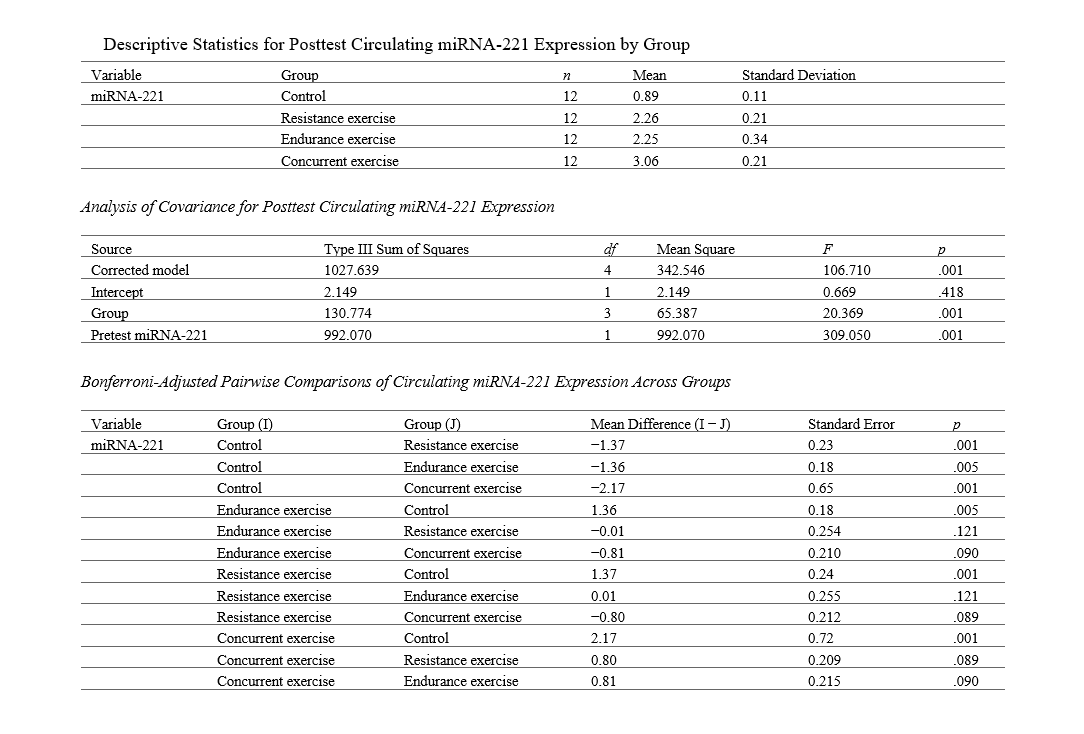
The present study aimed to compare the effects of a single bout of resistance, endurance, and concurrent exercise on circulating miRNA-221 expression in physically active healthy women. In terms of its objective, this was an applied study, and in terms of its methodology, it employed a quasi-experimental pretest–posttest design with a control group. The statistical population consisted of physically active healthy women. Accordingly, 48 participants were selected through purposive sampling and randomly assigned to four groups: control (n = 12), resistance exercise (n = 12), endurance exercise (n = 12), and concurrent exercise (n = 12). The resistance exercise protocol consisted of front squats, back squats, abdominal crunches, leg presses, and leg extensions performed at 90% of one-repetition maximum for five sets of four to six repetitions. The endurance exercise protocol consisted of running on a treadmill at a 0% incline and a speed of 8 km/h for 30 minutes, followed by cycling on a stationary bicycle at a workload of 100 W for 20 minutes. The concurrent exercise protocol consisted of performing both resistance and endurance exercise within the same session. Blood samples were collected at two time points: before the exercise session and immediately after completion of the exercise protocol. Circulating miRNA-221 expression was quantified using real-time quantitative reverse transcription polymerase chain reaction (RT-qPCR), with cel-miR-39 used as an exogenous control. Data were analyzed using descriptive statistics, mixed-design analysis of variance with repeated measures, and the Bonferroni post hoc test at a significance level of .05. The results showed that a single bout of exercise produced a significant change in circulating miRNA-221 expression in physically active healthy women (p < .05). Significant differences in changes in miRNA-221 expression were also observed between the control group and each of the resistance, endurance, and concurrent exercise groups (p < .05). Although the mean change in miRNA-221 expression was greater in the concurrent exercise group than in the endurance and resistance exercise groups, the differences among the three exercise groups were not statistically significant (p > .05). Overall, the findings indicated that a single bout of exercise, irrespective of exercise modality, significantly alters circulating miRNA-221 expression in physically active healthy women and may contribute to the activation of molecular responses associated with exercise-induced adaptations. However, exercise modality did not produce a significant difference in the magnitude of changes in miRNA-221 expression following a single exercise session.
Downloads
References
1. Febbraio MA. Health Benefits Of Exercise: More Than Meets The Eye! Nature Reviews Endocrinology. 2017;13(2):72-4. [PMID: 28051119] [DOI]
2. Hung C-H, Su C-H, Wang D. The Role Of High-Intensity Interval Training (Hiit) In Neuromuscular A Daptations: Implications For Strength And Power Development-A Review. Life (Basel, Switzerland). 2025;15(4):657. [PMID: 40283211] [PMCID: PMC12028608] [DOI]
3. Sabaghi A, Ebrahimi B, Yousofvand N, Hoseini R. Comparative Effects Of Moderate-Intensity Continuous Training And High-Intensity Interval Training On ADHD Symptoms And Behavioral Inhibition In Children. European Journal of Pediatrics. 2025;184(2):183. [PMID: 39920369] [DOI]
4. Beltrami C, Angelini TG, Emanueli C. Noncoding Rnas In Diabetes Vascular Complications. Journal of Molecular and Cellular Cardiology. 2015;89:42-50. [PMID: 25536178] [DOI]
5. Sapp RM, Hagberg JM. Circulating Micrornas: Advances In Exercise Physiology. Current Opinion in Physiology. 2019;10:1-9. [DOI]
6. Nielsen S, Åkerström T, Rinnov A, Yfanti C, Scheele C, Pedersen BK, et al. The Mirna Plasma Signature In Response To Acute Aerobic Exercise And Endurance Training. PLOS ONE. 2014;9(2):e87308. [PMID: 24586268] [PMCID: PMC3929352] [DOI]
7. Zhou Q, Shi C, Lv Y, Zhao C, Jiao Z, Wang T. Circulating Micrornas In Response To Exercise Training In Healthy Adults. Frontiers in Genetics. 2020;11:256. [PMID: 32256529] [PMCID: PMC7093586] [DOI]
8. Yektayar M, Mohammadi S, Ahmadi Deharshid K, Khodamoradpour M. Comparison Of The Effects Of Resistance, Endurance, And Combined Exercise On The Lipid Profile Of Healthy Non-Athletic Middle-Aged Men. Scientific Journal of Kurdistan University of Medical Sciences. 2012;16(4):26-36.
9. D'Souza RF, Markworth JF, Aasen KM, Zeng N, Cameron-Smith D, Mitchell CJ. Acute Resistance Exercise Modulates Microrna Expression Profiles: Combined Tissue And Circulatory Targeted Analyses. PLOS ONE. 2017;12(7):e0181594. [PMID: 28750051] [PMCID: PMC5531502] [DOI]
10. Xhuti D, Nilsson MI, Manta K, Tarnopolsky MA, Nederveen JP. Circulating Exosome-Like Vesicle And Skeletal Muscle Micrornas Are Altered With Age And Resistance Training. The Journal of Physiology. 2023;601(22):5051-73. [PMID: 36722691] [DOI]
11. Liu X, Platt C, Rosenzweig A. The Role Of Micrornas In The Cardiac Response To Exercise. Cold Spring Harbor Perspectives in Medicine. 2017;7(12):a029850. [PMID: 28389519] [PMCID: PMC5710094] [DOI]
12. Ghalaei-Ghir S, Vakili J, Khani M, Azali Alamdari K. The Effect Of Eight Weeks Of High-Intensity Interval Training On Cardiac-Tissue Expression Of Mirna-1 And Mirna-21 In Healthy Male Wistar Rats. Journal of Exercise Physiology and Physical Activity. 2022;15(4):82-92. [DOI]
13. Majidi A, Poozesh Jadidi R, Nourazar MAR, Bashiri J, Azali Alamdari K. Effects Of Aerobic Training And Curcumin Supplementation On Cardiomyocyte Apoptosis And Mirna Expression In Rats Exposed To Arsenic. Sport Physiology. 2020;12(48):39-60.
14. Pouzesh Jadidi G, Seifi-Skishahr F, Bolboli L, Azali Alamdari K, Pourrahim Ghouroghch A. Effect Of High-Intensity Interval Training And Curcumin Supplementation On Left-Ventricular Mir-133 And Mir-1 Gene Expression In An Isoproterenol-Induced Myocardial-Infarction Rat Model. Journal of Practical Studies of Biosciences in Sport. 2023;11(25):8-20. [DOI]
15. Alipour MR, Yousefzade N, Bavil FM, Naderi R, Ghiasi R. Swimming Impacts On Pancreatic Inflammatory Cytokines, Mir-146A, And Nf-Κb Expression Levels In Type 2 Diabetic Rats. Current Diabetes Reviews. 2020;16(8):889-94. [PMID: 31733638] [DOI]
16. Sari Saarraf V, Amirsasan R, Iraqi SF. Comparison Of Changes In Mir-146A Gene Expression And Serum Levels Of Tnf, Il-6, And Crp Following Interval OR Continuous Aerobic Training With Calorie Restriction In Obese Women. Journal of Practical Studies of Biosciences in Sport. 2021;9(20).
17. Ghasemipour S, Minasian V. Effects Of Different Exercise-Training Modalities On The Expression Of Obesity-Related Mirnas In The Iranian Population: A Review. Research in Medicine. 2024;48(2):81-95.
18. Olfati L, Piralaiy E, Khani M, Isabigloo R, Naddafha S. Comparative Efficacy Of High-Intensity Interval Training And Local-Indigenous Games In Enhancing Physical, Technical, And Cognitive Performance In Youth Football Players: A Multi-Dimensional Analysis. 2025. [DOI]
Downloads
Publication Timeline
- Submitted
- Revised
- Accepted