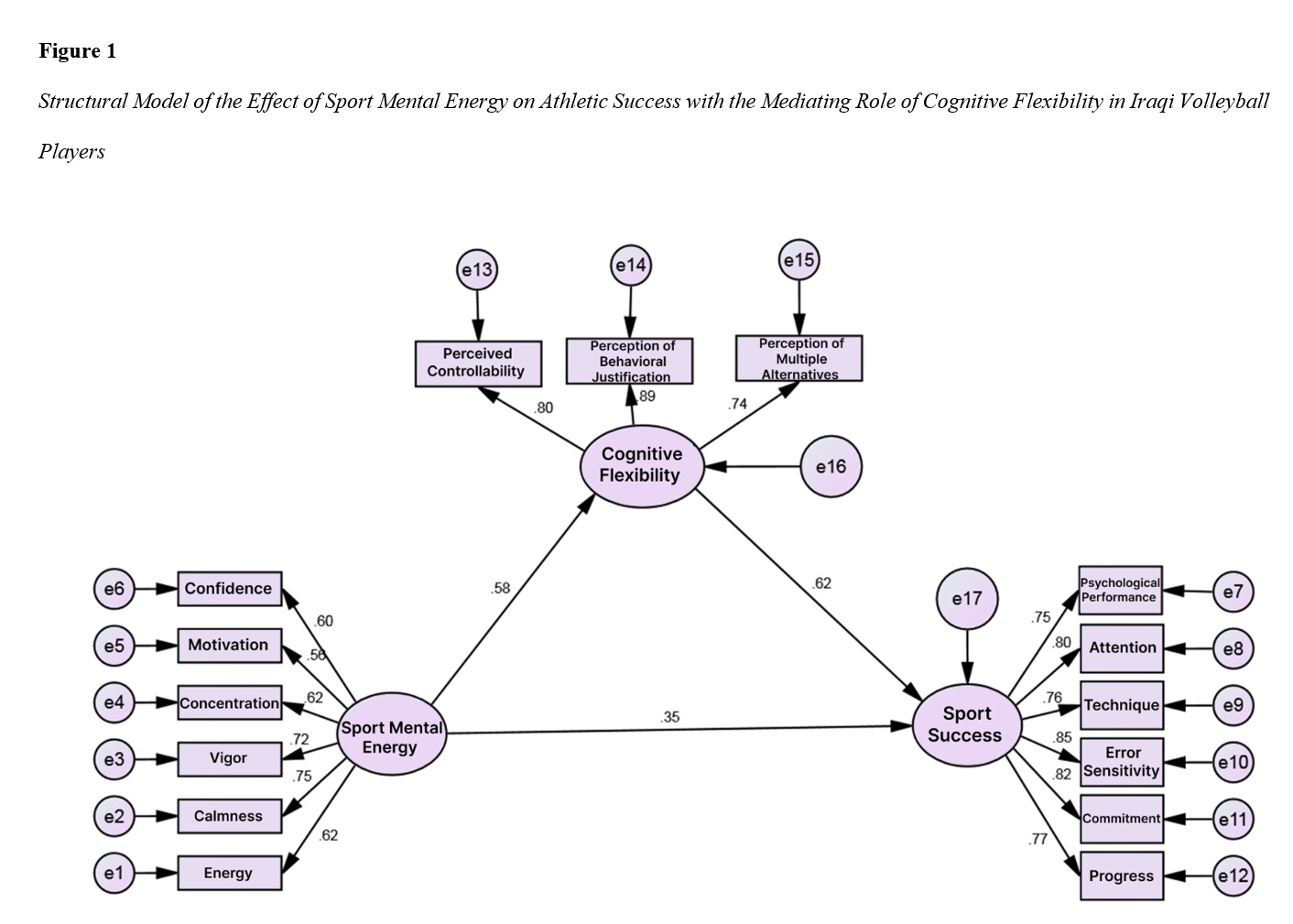
Structural Equation Modeling of the Effect of Sport Mental Energy on Athletic Success: The Mediating Role of Cognitive Flexibility in Iraqi Volleyball Players
DOI:
https://doi.org/10.61838/kman.hn.3.4.15Keywords:
sport mental energy, cognitive flexibility, athletic success, structural equation modeling, volleyballAbstract
The present study aimed to examine the structural relationships between sport mental energy, cognitive flexibility, and athletic success among volleyball players. This research employed a descriptive–correlational design of the cross-sectional type. The statistical population consisted of all male volleyball players in Diwaniyah City, Iraq. A sample of 230 participants was selected through convenience sampling. Data were collected using standardized questionnaires measuring sport mental energy, cognitive flexibility, and athletic success. Data analysis was conducted using SPSS version 26 and AMOS version 23 through the structural equation modeling (SEM) approach. The findings indicated that the proposed conceptual model demonstrated a good fit, and all main and sub-hypotheses were supported. The results showed that sport mental energy had a direct and positive effect on athletic success (path coefficient = 0.352, p < 0.001). Cognitive flexibility also exerted a significant direct effect on athletic success (path coefficient = 0.625, p < 0.001). Furthermore, the mediating role of cognitive flexibility in the relationship between mental energy and athletic success was confirmed. Path analysis revealed that the indirect effect of sport mental energy on success through cognitive flexibility was statistically significant (indirect coefficient = 0.364, p = 0.001). Overall, the results of this study highlight the simultaneous importance of psychological resources (mental energy) and cognitive abilities (flexibility) in enhancing athletes’ performance and success. These findings provide useful guidance for coaches and sport psychologists in designing effective educational and psychological interventions.
Downloads
References
1. Lu FJ, Gill DL, Yang CM, Lee PF, Chiu YH, Hsu YW, et al. Measuring athletic mental energy (AME): instrument development and validation. Frontiers in Psychology. 2018;9:2363. [PMID: 30574106] [PMCID: PMC6291473] [DOI]
2. Cook DB, Davis M. Mental energy: defining the science. Nutrition Reviews. 2006;64:S1-S7. [PMID: 16910213] [DOI]
3. Lykken DT. Mental energy. Intelligence. 2005;33(4):331-5. [DOI]
4. Noakes TD. Physiological models to understand exercise fatigue and the adaptations that predict or enhance athletic performance. Scandinavian Journal of Medicine & Science in Sports. 2000;10(3):123-45. [PMID: 10843507] [DOI]
5. Salthouse TA. Relations between cognitive abilities and measures of executive functioning. Neuropsychology. 2005;19(4):532. [PMID: 16060828]
6. Loehr JE. Leadership: full engagement for success. In: Murphy S, editor. In The Sport Psychology Handbook: Human Kinetics; 2005. p. 157-8. 3_https://doi.org/DOI}
7. Singh A, Kaur Arora M, Boruah B. The role of the six factors model of athletic mental energy in mediating athletes' well-being in competitive sports. Scientific Reports. 2024;14(1):2974. [PMID: 38316915] [PMCID: PMC10844369] [DOI]
8. Blair C. Educating executive function. Wiley Interdisciplinary Reviews: Cognitive Science. 2017;8(1-2):e1403. [PMID: 27906522] [PMCID: PMC5182118] [DOI]
9. Diamond A. The early development of executive functions. Lifespan Cognition: Mechanisms of Change. 2006:70-95. [DOI]
10. Dennis JP, Vander Wal JS. The cognitive flexibility inventory: Instrument development and estimates of reliability and validity. Cognitive Therapy and Research. 2010;34(3):241-53. [DOI]
11. Wang CH, Chang CC, Liang YM, Shih CM, Chiu WS, Tseng P, et al. Open vs. closed skill sports and the modulation of inhibitory control. PLoS One. 2013;8(2):e55773. [PMID: 23418458] [PMCID: PMC3572130] [DOI]
12. Carnevale D, Elferink-Gemser M, Filgueiras A, Huijgen B, Andrade C, Castellano J, et al. Executive Functions, Physical Abilities, and Their Relationship with Tactical Performance in Young Soccer Players. Perceptual and Motor Skills. 2022;129(5):1477-91. [PMID: 35794712] [DOI]
13. Heilmann F, Wollny R, Lautenbach F. Inhibition and calendar age explain variance in game performance of youth soccer athletes. International Journal of Environmental Research and Public Health. 2022;19(3):1138. [PMID: 35162155] [PMCID: PMC8834799] [DOI]
14. Shieh SF, Lu FJ, Gill DL, Yu CH, Tseng SP, Savardelavar M. Influence of mental energy on volleyball competition performance: a field test. PeerJ. 2023;11:e15109. [PMID: 36992946] [PMCID: PMC10042163] [DOI]
15. Kuroda Y, Ishihara T, Mizuno M. Association between perceived exertion and executive functions with serve accuracy among male university tennis players: A pilot study. Frontiers in Psychology. 2023;14:121. [PMID: 36760452] [PMCID: PMC9905140] [DOI]
16. McAuley E, Mullen SP, Szabo AN, White SM, Wójcicki TR, Mailey EL, et al. Self-regulatory processes and exercise adherence in older adults: Executive function and self-efficacy effects. American Journal of Preventive Medicine. 2011;41(3):284-90. [PMID: 21855742] [PMCID: PMC3160622] [DOI]
17. Islam A. Three Variables in the Training of Female Soccer Players: The Relationship between Psychological Skills, Mental Energy and Courage. E-International Journal of Educational Research. 2023;14(1).
18. Juezan IJI, Osorno RIM. Athletic mental energy and sports engagement as mediated by student-athlete satisfaction. European Journal of Physical Education and Sport Science. 2024;11(2). [DOI]
19. Yarayan YE, Batrakoulis A, Güngör NB, Kurtipek S, Keskin K, Çelik OB, et al. The role of athletic mental energy in the occurrence of flow state in male football (soccer) players. BMC Sports Science, Medicine and Rehabilitation. 2025;17(1):53. [PMID: 40102997] [PMCID: PMC11917021] [DOI]
20. Öner Ç. The Determinative Role of Athletic Mental Energy and Mindfulness in the Flow Experience of Football Players. International Journal of Education Technology and Scientific Researches. 2022;7(20):2052-85. [DOI]
21. Król W, Gruszka A. Is running a state of mind? Sports training as a potential method for developing cognitive flexibility. Psychology of Sport and Exercise. 2023;67:102425. [PMID: 37665878] [DOI]
22. Yongtawee A, Park J, Kim Y, Woo M. Athletes have different dominant cognitive functions depending on type of sport. International Journal of Sport and Exercise Psychology. 2022;20(1):1-15. [DOI]
23. Albaladejo-García C, García-Aguilar F, Moreno FJ. The role of inhibitory control in sport performance: Systematic review and meta-analysis in stop-signal paradigm. Neuroscience & Biobehavioral Reviews. 2023:105108. [PMID: 36828162] [DOI]
24. Logan NE, Henry DA, Hillman CH, Kramer AF. Trained athletes and cognitive function: a systematic review and meta-analysis. International Journal of Sport and Exercise Psychology. 2022:1-25.
25. Zhu H, Chen A, Guo W, Zhu F, Wang B. Which type of exercise is more beneficial for cognitive function? A meta-analysis of the effects of open-skill exercise versus closed-skill exercise among children, adults, and elderly populations. Applied Sciences. 2020;10(8):2737. [DOI]
26. Nuri L, Shadmehr A, Ghotbi N, Attarbashi Moghadam B. Reaction time and anticipatory skill of athletes in open and closed skill-dominated sport. European Journal of Sport Science. 2013;13(5):431-6. [PMID: 24050458] [DOI]
27. Koch P, Krenn B. Executive functions in elite athletes-Comparing open-skill and closed-skill sports and considering the role of athletes' past involvement in both sport categories. Psychology of Sport and Exercise. 2021;55:101925. [DOI]
28. Kara NS, Donmez A, Cetin MÇ. Relationship Between Decision-Making Styles and Cognitive Flexibility Levels of Sports Science Students. ABOUT THIS SPECIAL ISSUE. 2021:217.
29. Tomporowski PD, McCullick B, Pendleton DM, Pesce C. Exercise and children's cognition: The role of exercise characteristics and a place for metacognition. Journal of Sport and Health Science. 2015;4(1):47-55. [DOI]
30. Obidovna DZ, Sulaymonovich DS. Forming a Healthy Lifestyle for Students on the Example of the Volleyball Section in Universities. EUROPEAN JOURNAL OF INNOVATION IN NONFORMAL EDUCATION. 2023;3(3):22-5.
Downloads
Additional Files
Publication Timeline
- Submitted
- Revised
- Accepted