
The Effect of Eight Weeks of Selected Sensorimotor Exercises and Comprehensive Postural Reeducation on Lumbar Lordosis Angle and Postural Control in Women with Lower Crossed Syndrome
DOI:
https://doi.org/10.61838/kman.hn.3.4.12Keywords:
Lower crossed syndrome, lumbar lordosis, postural control, sensorimotor training, postural reeducation, dynamic balanceAbstract
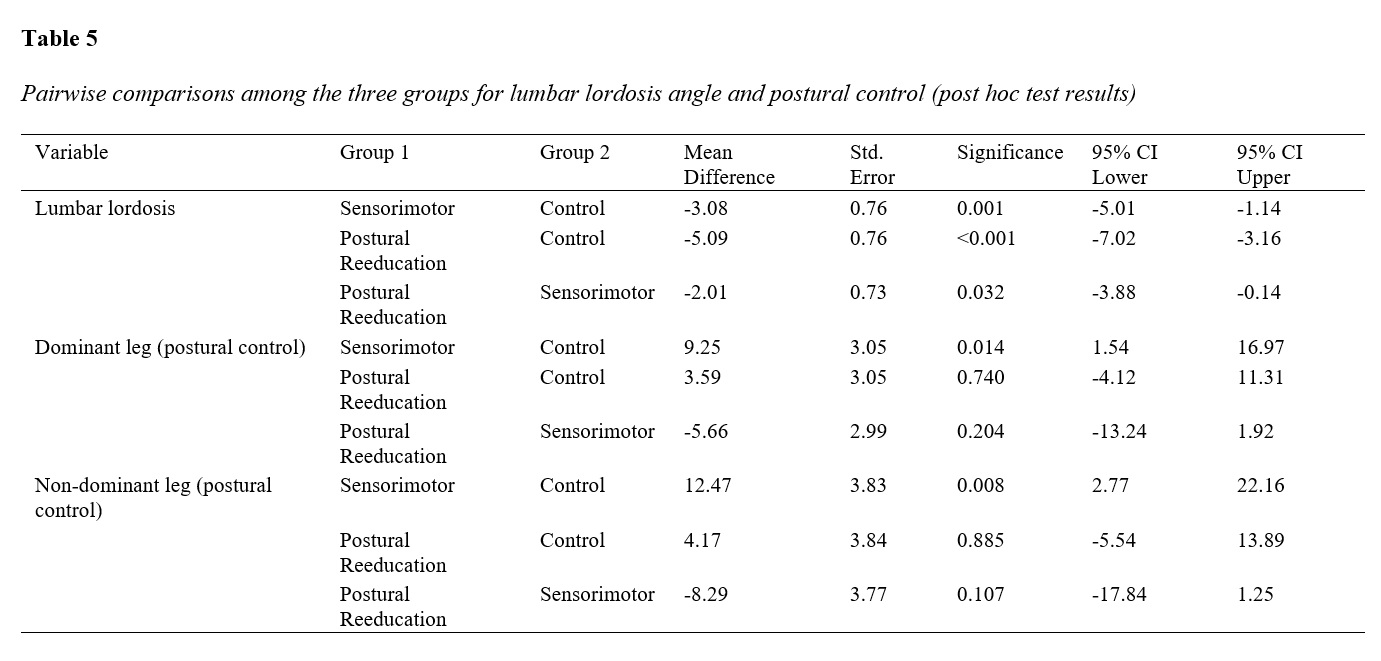
This study aimed to compare the effects of an eight-week program of selected sensorimotor exercises and a comprehensive postural reeducation protocol on lumbar lordosis angle and dynamic postural control in women with lower crossed syndrome. This applied, semi-experimental study employed a pretest–posttest design with two intervention groups and one control group. Thirty-six women aged 35–60 years diagnosed with lower crossed syndrome were recruited through purposive and convenience sampling and randomly assigned into three groups: sensorimotor training, comprehensive postural reeducation, and control. The interventions were conducted three times per week for eight weeks; each sensorimotor session lasted 40 minutes and focused on deep trunk activation and proprioceptive training, while postural reeducation sessions lasted 60 minutes and emphasized global myofascial stretching and sagittal alignment. Lumbar lordosis angle was measured using a flexible ruler, and dynamic postural control was assessed with the Star Excursion Balance Test (SEBT) for both dominant and non-dominant legs. Data were analyzed using analysis of covariance (ANCOVA) to compare post-intervention outcomes across groups. ANCOVA showed a significant group effect on lumbar lordosis angle (F = 22.45, p < 0.001, η² = 0.59), with both sensorimotor and postural reeducation groups achieving significant reductions compared to the control group, and postural reeducation outperforming sensorimotor training (mean difference = −2.01°, p = 0.032). For dynamic postural control, the sensorimotor group demonstrated significantly greater improvements than the control group in SEBT scores for both dominant (mean difference = 9.25%, p = 0.014) and non-dominant legs (mean difference = 12.47%, p = 0.008), while postural reeducation alone showed no significant advantage over control for balance outcomes. Both interventions improved spinal alignment in women with lower crossed syndrome, while sensorimotor training produced superior gains in functional balance.
Downloads
References
1. Sequeira S, Gurudut P, Kage VKV. Exploring Effects of Egoscue Versus Lumbar Stabilisation Exercises for Lower Crossed Syndrome on Postural Stability and Hyperlordotic Posture Correction. Comparative Exercise Physiology. 2023;19(3):223-34. [DOI]
2. Skundric G, Vukićević V, Lukić N. Effects of Core Stability Exercises, Lumbar Lordosis and Low-Back Pain: A Systematic Review. Journal of Anthropology of Sport and Physical Education. 2021;5(1):17-23. [DOI]
3. Patel N, Patil DD, Parmar L. Relationship Between Transversus Abdominis Strength and Lumbar Lordosis in Young Adults. Journal of Pharmaceutical Research International. 2021:62-70. [DOI]
4. Fallahasady E, Rahmanloo N, Seidi F, Rajabi R, Bayattork M. The Relationship Between Core Muscle Endurance and Functional Movement Screen Scores in Females With Lumbar Hyperlordosis: A Cross-Sectional Study. BMC Sports Science Medicine and Rehabilitation. 2022;14(1). [PMID: 36229857] [PMCID: PMC9563468] [DOI]
5. Chavan V, Anand SK, Anandh S. A Study on Correlation Between Normal Delivery and Cesarean Section Delivery on Lumbar Lordosis in Women. Indian Journal of Public Health Research & Development. 2020. [DOI]
6. Rafique S. Effects of Core Stability Training on Lumbar Flexibility in Postpartum Females With Hyperlordosis: AQuasi-Experimental Study. J Lahore Med Dent Coll. 2024;1(02). [DOI]
7. Hayat R, Salik S, Rani S, Zia A, Jamal N, Khan LN, et al. Comparing the Effectiveness of Specific Lumbar Mobilization and Core Stability Exercises in Mechanical Low Back Pain in Decreasing Pain and Disability: A Randomized Control Trial. The Therapist (Journal of Therapies & Rehabilitation Sciences). 2024:07-13. [DOI]
8. Shah D, Kubal S. Comparison of Core Strengthening Exercises and General Trunk Exercises in Patients With Chronic Low Back Pain Using Lumbo-Pelvic Stability Tests and Pelvic Radius Technique. International Journal of Physiotherapy and Research. 2020;8(5):3648-55. [DOI]
9. In TS, Jung JH, Jung KS, Cho H-y. Effects of the Multidimensional Treatment on Pain, Disability, and Sitting Posture in Patients With Low Back Pain: A Randomized Controlled Trial. Pain Research and Management. 2021;2021:1-8. [PMID: 34306274] [PMCID: PMC8263210] [DOI]
10. Ali MGM, Neveen Abdel Latif Abdel R, Sedhom MG, Helmy NA, Fawaz HE. Effect of Different Lumbar Lordotic Angles on Dynamic Postural Stability in Young Adults. Fiz Pol. 2020;20(2):142-7. [DOI]
11. Skallerud A, Brumbaugh AJ, Fudalla S, Parker T, Robertson K, Pepin M-E. Comparing Lumbar Lordosis in Functional Dance Positions in Collegiate Dancers With and Without Low Back Pain. Journal of Dance Medicine & Science. 2022;26(3):191-201. [PMID: 35697483] [DOI]
12. Chughtai MDB, Shabbir H, Basim M, Rubab Ue, Manzoor A, Ali A, et al. Impact of Core Stabilization Exercises Versus Pilates on Pain Intensity, Lumbar Range of Motion, and Daily Activity Performance in Patients With Lumbar Disc Herniation: A Randomized Controlled Trial. JHWCR. 2025:e531. [DOI]
13. Shalamzari MH, Henteh MA, Shamsoddini A, Ghanjal A. Comparison of the Effects of Core Stability and Whole-Body Electromyostimulation Exercises on Lumbar Lordosis Angle and Dynamic Balance of Sedentary People With Hyperlordosis: A Randomized Controlled Trial. BMC Sports Science Medicine and Rehabilitation. 2024;16(1). [PMID: 38654368] [PMCID: PMC11036689] [DOI]
14. Shah J, Tanwar T, Iram I, Aldabbas M, Veqar Z. Effect of Increased Lumbar Lordosis on Lumbar Multifidus and Longissimus Thoracis Activation During Quadruped Exercise in Patients With Chronic Low Back Pain: An EMG Study. Journal of Applied Biomechanics. 2020;36(6):436-43. [PMID: 32963122] [DOI]
15. Pavana, Sv A. Effectiveness of Lumbar Motor Control Exercises in Improving Lumbar Stability Among Bharatanatyam Dancers. Indian Journal of Physiotherapy and Occupational Therapy - An International Journal. 2021;15(3):160-8. [DOI]
16. Jokarborzabad A, Karimi Z, Yazdanpanah P, Roustaei N, Mohammadhossini S. Effect of Prayer-Based Movements on Pain and Endurance of Flexor Muscles in Patients With Non-Specific Chronic Low Back Pain. Journal of Clinical Care and Skills. 2021;2(2):57-61. [DOI]
17. Welling A, Patil A, Gunjal P, Naik P, Hubli R. Effectiveness of Three-Dimensional Myofascial Release on Lumbar Lordosis in Individuals With Asymptomatic Hyperlordosis: A Placebo Randomized Controlled Trial. International Journal of Therapeutic Massage & Bodywork Research Education & Practice. 2024;17(2):20-31. [PMID: 38873188] [PMCID: PMC11131939] [DOI]
18. Le J-RM, Wu WT, Chen C-W, Jaw FS, Yang S, Yeh KT. Defining a Critical Partition Zone for Sagittal Alignment in Lumbar Spine Fusion Surgery: A Systematic Review. Bioengineering. 2024;11(12):1240. [PMID: 39768058] [PMCID: PMC11673771] [DOI]
19. Doğan K, Aydincak Ö, Yiğit H, Unur E. Possible Effects of Lumbar Stabilization Surgery on Sagittal Alignment, Disability and Quality of Life. Egyptian Journal of Neurosurgery. 2024;39(1). [DOI]
20. Parashar R, Parashar N, Thakur BS. Study of Lumbar Lordosis Angle on Digital Radiographs and Its Co-Relation With Demographic Parameters and Occupation in North Indian Population. International Journal of Health Sciences. 2022:5740-8. [DOI]
21. Ferraro M, Puglia F, Valle AD, Cerbone V, Cicatelli A, Peroni D, et al. Transforaminal Lumbar Interbody Fusion With a Tantalum Cage: Lumbar Lordosis Redistribution and Sacral Slope Restoration With a Modified Posterior Technique. Journal of Orthopaedics and Traumatology. 2023;24(1). [PMID: 38091159] [PMCID: PMC10719190] [DOI]
22. Byvaltsev VA, Калинин АА, Pestryakov YY, Spiridonov AV. Analysis of Preoperative Risk Factors of Adjacent Segment Disease After Transforaminal Lumbar Interbody Fusion. Voprosy Neirokhirurgii Imeni N N Burdenko. 2023;87(2):48. [PMID: 37011328] [DOI]
23. Godzik J, Lehrman JN, Newcomb AG, Menon RK, Whiting AC, Kelly BP, et al. Tailoring Selection of Transforaminal Interbody Spacers Based on Biomechanical Characteristics and Surgical Goals: Evaluation of an Expandable Spacer. Journal of Neurosurgery Spine. 2020;32(3):383-9. [PMID: 30978679] [DOI]
24. Wänman J, Åkerstedt J, Banitalebi H, Myklebust TÅ, Weber C, Storheim K, et al. The Association Between Lumbar Lordosis Preoperatively and Changes in PROMs for Lumbar Spinal Stenosis Patients 2 years After Spinal Surgery: Radiological and Clinical Results From the NORDSTEN-spinal Stenosis Trial. European Spine Journal. 2024;33(5):1950-6. [PMID: 38386059] [DOI]
25. Ibrahim MF, Saeed FS, El-Morshidy EM, Hassan K, Hassan MG, El‐Sharkawi M, et al. Posterolateral Fusion Versus Posterior Lumbar Interbody Fusion for Adult Low-Grade Isthmic Spondylolisthesis: Analysis of Sagittal Radiographic Parameters - A Randomized Controlled Trial. Global Spine Journal. 2024;15(3):1614-24. [PMID: 38728663] [PMCID: PMC11571940] [DOI]
26. Gholipour P, Iranmehr A, Mousavi ST, Namvar M, Bahrami R, Fattahi MR, et al. The Effect of Rod Bending on Long-Term Lumbar Sagittal Parameters in Spondylolisthesis Patients Treated With Short Segment Posterior Fusion: A Randomized Clinical Trial. Iranian Journal of Neurosurgery. 2022;8(Continuous publishing):16-. [DOI]
27. Tahmasbi A, Soleimani A, Ghotbi N, Malmir K, Shadmehr A. Effects of Kinesio Taping Over Abdominal Muscles With Different Tensions on the Lumbopelvic Complex Components in Men With Increased Anterior Pelvic Tilt. Journal of Modern Rehabilitation. 2022. [DOI]
28. Hvidkær IS, Harsted S, Hadizadeh M, O’Neill S, Kawchuk GN, Nim CG. Static Palpation Ain’t Easy: Evaluating Palpation Precision Using a Topographical Map of the Lumbar Spine as a Reference. Plos One. 2024;19(5):e0304571. [PMID: 38814967] [PMCID: PMC11139336] [DOI]
29. Sun W-x, Liu H-n, Chen M-t, Lin Y, Wang H-s, Chen B-l. Meta-Analysis of the Clinical Efficacy and Safety of Oblique Lateral Interbody Fusion and Transforaminal Interbody Fusion in the Treatment of Degenerative Lumbar Spondylolisthesis. Efort Open Reviews. 2022;7(9):663-70. [PMID: 36125000] [PMCID: PMC9624480] [DOI]
Downloads
Additional Files
Publication Timeline
- Submitted
- Revised
- Accepted
License
Copyright (c) 2025 Hadi Miri (Corresponding Author); Mostafa Soltani , Maryam Nasri (Author)

This work is licensed under a Creative Commons Attribution-NonCommercial 4.0 International License.