Development and Validation of the Psychological Readiness Scale after Serious Injury (PRS-SI): A Study on Young Football Players
DOI:
https://doi.org/10.61838/kman.hn.3.4.11Keywords:
Sports Sciences, Sports Injury, Return to Play, Football, Young Athletes, Rehabilitation.Abstract
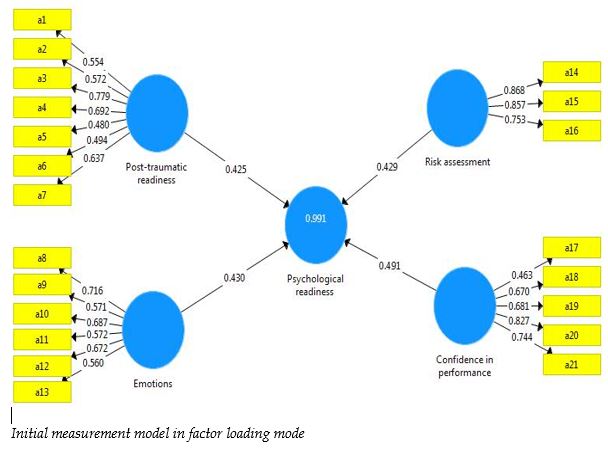
This study aimed to develop and validate a culturally adapted instrument—the Psychological Readiness Scale after Serious Injury (PRS-SI)—for assessing the psychological readiness of young football players to return to sport following a serious injury. A total of 265 male football players aged 17–25 from Mashhad, Iran, who had sustained at least one serious sports injury requiring a minimum of three months of recovery, participated in this psychometric study. The PRS-SI was constructed by integrating key elements from two established tools: the Psychological Readiness of Injured Athlete to Return to Sport (PRIA-RS), tailored to football contexts, and the Anterior Cruciate Ligament Return to Sport After Injury (ACL-RSI), which focuses on emotional, cognitive, and behavioral dimensions. Using Partial Least Squares Structural Equation Modeling (PLS-SEM), the measurement model demonstrated strong internal consistency, convergent and discriminant validity, and an excellent model fit. The final 21-item scale included four components: post-traumatic readiness, emotions, risk assessment, and confidence in performance. Structural analysis revealed that all four dimensions significantly and positively contribute to psychological readiness (R² = 0.99), with self-confidence in performance being the strongest predictor. The results underscore the importance of addressing emotional, cognitive, and confidence-related factors in rehabilitation, beyond physical recovery alone. The PRS-SI offers a reliable, valid, and contextually appropriate tool for evaluating athletes’ psychological states post-injury and can assist clinical decisions, psychological interventions, and return-to-sport protocols. Its application may enhance individualized rehabilitation strategies and promote safer, more effective returns to competition among young athletes.
Downloads
References
1. Ardern CL, Taylor NF, Feller JA, Webster KE. Return-to-sport outcomes at 2 to 7 years after anterior cruciate ligament reconstruction surgery. Am J Sports Med. 2012;40(1):41-8. [PMID: 21946441] [DOI]
2. Podlog L, Eklund RC. The psychosocial aspects of a return to sport following serious injury: a review of the literature from a self-determination perspective. Psychol Sport Exerc. 2007;8:535-66. [DOI]
3. Brewer BW. Self-identity and specific vulnerability to depressed mood. J Pers. 1993;61(3):343-64. [DOI]
4. Brewer BW. Psychology of injury rehabilitation. In: Tenenbaum G, Eklund RC, rd e, editors. Handbook of sport psychology. Hoboken (NJ): John Wiley; 2007. 3_https://doi.org/DOI}
5. Brewer BW. The role of psychological factors in sport injury rehabilitation outcomes. Int Rev Sport Exerc Psychol. 2010;3(1):40-61. [DOI]
6. Brewer BW, Cornelius AE, Van Raalte JL, Petitpas AJ, Sklar JH, Pohlman MH. Age-related differences in predictors of adherence to rehabilitation after anterior cruciate ligament reconstruction. J Athl Train. 2003;38(2):158-62.
7. Tripp DA, Stanish WD, Reardon G, Coady C, Sullivan MJL. Comparing postoperative pain experiences of the adolescent and adult athlete after anterior cruciate ligament surgery. J Athl Train. 2003;38:154-7.
8. Podlog L, Dimmock J, Miller J. A review of return to sport concerns following injury rehabilitation: practitioner strategies for enhancing recovery outcomes. Phys Ther Sport. 2011;12(1):36-42. [PMID: 21256448] [DOI]
9. Ardern CL, Österberg A, Tagesson S, Gauffin H, Webster KE, Kvist J. The impact of psychological readiness to return to sport and recreational activities after anterior cruciate ligament reconstruction. Br J Sports Med. 2014;48(22):1613-9. [PMID: 25293342] [DOI]
10. Walker N, Thatcher J, Lavallee D. A preliminary development of the Re-Injury Anxiety Inventory (RIAI). Phys Ther Sport. 2010;11(1):23-9. [PMID: 20129120] [DOI]
11. Webster KE, Feller JA, Lambros C. Development and preliminary validation of a scale to measure the psychological impact of returning to sport following anterior cruciate ligament reconstruction surgery. Phys Ther Sport. 2008;9(1):9-15. [PMID: 19083699] [DOI]
12. Zia M, Sahebalzamani M, Rouhollahi V. Effect of progressive muscle relaxation training in fear of re-injury in professional athletes after anterior cruciate ligament reconstruction. J Paramed Sci Rehabil. 2021;10(1):7-18. [DOI]
13. Kavyani M, Badie F, Khatibi A, Dehghani M. The fear of movement and anxiety caused by pain in athletes with and without musculoskeletal injury. J Sports Motor Dev Learn. 2021;13(3):313-31. [DOI]
14. Mozafarizadeh M, Ajilchi B, Salman Z, Kisely S. Effect of a mindfulness programme training to prevent the sport injury and improve the performance of semi-professional soccer players. Australas Psychiatry. 2019;27(6):589-95. [PMID: 31282193] [DOI]
15. Kashani V, Salianeh MA, Paran Davaji A. Determination of validity and reliability of the Persian version of Causes of Re-Injury Worry Scale. J Sports Motor Dev Learn. 2019;11(2):153-69. [DOI]
16. Mehrsafar AH, Sabiani M, Minounejad H. Psychometric Properties of Persian Version of Re-Injury Anxiety Inventory (RIAI) in Injured Athletes. Sport Psychology Studies. 2019;8(27):157-72. [DOI]
17. Barzegari Soltanahmadi M, Akhlaghi M, Zahedi SM, Mahmoudi M, Jamshidi A. The role of self-efficacy, pain catastrophizing, and fear of movement on chronic pain adjustment of rheumatoid arthritis patients. J Adv Pharm Educ Res. 2020;11(4):80-93.
18. Khorand MT, Latifi H. Role of Psychological Preparation in Team Cohesion and Success of Student Soccer Teams. Hum Resou Mana Spo. 2020;8(1):93-104. [DOI]
19. McPherson AL, Feller JA, Hewett TE, Webster KE. Psychological readiness to return to sport is associated with second anterior cruciate ligament injuries. Am J Sports Med. 2019;47(4):857-62. [PMID: 30753794] [DOI]
20. Rodriguez RM, Marroquin A, Cosby N. Reducing fear of reinjury and pain perception in athletes with first-time anterior cruciate ligament reconstructions by implementing imagery training. J Sport Rehabil. 2019;28(4):385-9. [PMID: 29584538] [DOI]
21. Kalatakis-Dos-Santos AE, de Paula Gomes CAF, Pontes-Silva A, Mendes LP, de Oliveira Simões G, Gonçalves MC. Fear of Return to Sport Scale (FRESS): a new instrument for use in injured professional or recreational athletes in rehabilitation. Sport Sci Health. 2022;18(4):1009-18. [PMID: 35967547] [PMCID: PMC9362635] [DOI]
22. Gomez-Espejo V, Olmedilla A, Abenza-Cano L, Garcia-Mas A, Ortega E. Psychological readiness to return to sports practice and risk of recurrence: case studies. Front Psychol. 2022;13:905816. [PMID: PMC9540195] [DOI]
23. Amiri M, Hofmeister M, Aminzadeh R, Nejat H, Azizi B, Dehghani E, et al. Psychological readiness after injury and its impact on fear of return and re-injury in young football players. Int J Sport Stud Health. 2025;8(3):1-12. [DOI]
24. Gómez-Piqueras P, Ardern C, Prieto-Ayuso A, Robles-Palazón FJ, Cejudo A, Baranda PS. Psychometric analysis and effectiveness of the Psychological Readiness of Injured Athlete to Return to Sport (PRIA-RS) Questionnaire on injured soccer players. Int J Environ Res Public Health. 2020;17(5):1536. [PMID: 32120951] [PMCID: PMC7084929] [DOI]
25. Hair JF, Hult GTM, Ringle CM, Sarstedt M, Danks NP, Ray S. Partial least squares structural equation modeling (PLS-SEM) using R: A workbook. Cham: Springer Nature; 2021. 197 p. 3_https://doi.org/DOI}
26. Rajabi M, Rasoolimanesh SM, Andam R, Abdollahnezhad F. A systematic review of PLS in sports management. Hum Resou Mana Spo. 2023;10(1):167-92. [DOI]
27. Aaghababa A, Bagiyan Kolemarzi J. Investigating the Relationship and Comparison of Sport Emotion Cognitive Regulation and Psychological Vulnerability of Individual and Group Athletes. Spo Psych Stu. 2021;10(36):217-36. [DOI]
28. Jalilishishavan A. Predicting the Psychological Vulnerability of Sports Performance Based on the Cognitive Regulation of Emotion and Social Support in Elite Student Athletes. Edu Psych. 2023;19(68):72-101. [DOI]
Downloads
Additional Files
Publication Timeline
- Submitted
- Revised
- Accepted
License
Copyright (c) 2025 Martin Hofmeister, Karolina Gołębieska Gołębieska, Reza Aminzadeh, Mojtaba Amiri, Agnieszka Sikorska-Szyplińska, Mohammad Khazaei, Katarzyna Dzioban (Author); Bahador Azizi (Corresponding Author)

This work is licensed under a Creative Commons Attribution-NonCommercial 4.0 International License.