A New Reading of Abortion in the Metropolis of Tehran: Based on the Lived Experiences of Women Born in the 1980s
DOI:
https://doi.org/10.61838/kman.hn.3.2.9Keywords:
Induced abortion, unintended pregnancy, definitive childlessness, extramarital relationships, family transformationsAbstract
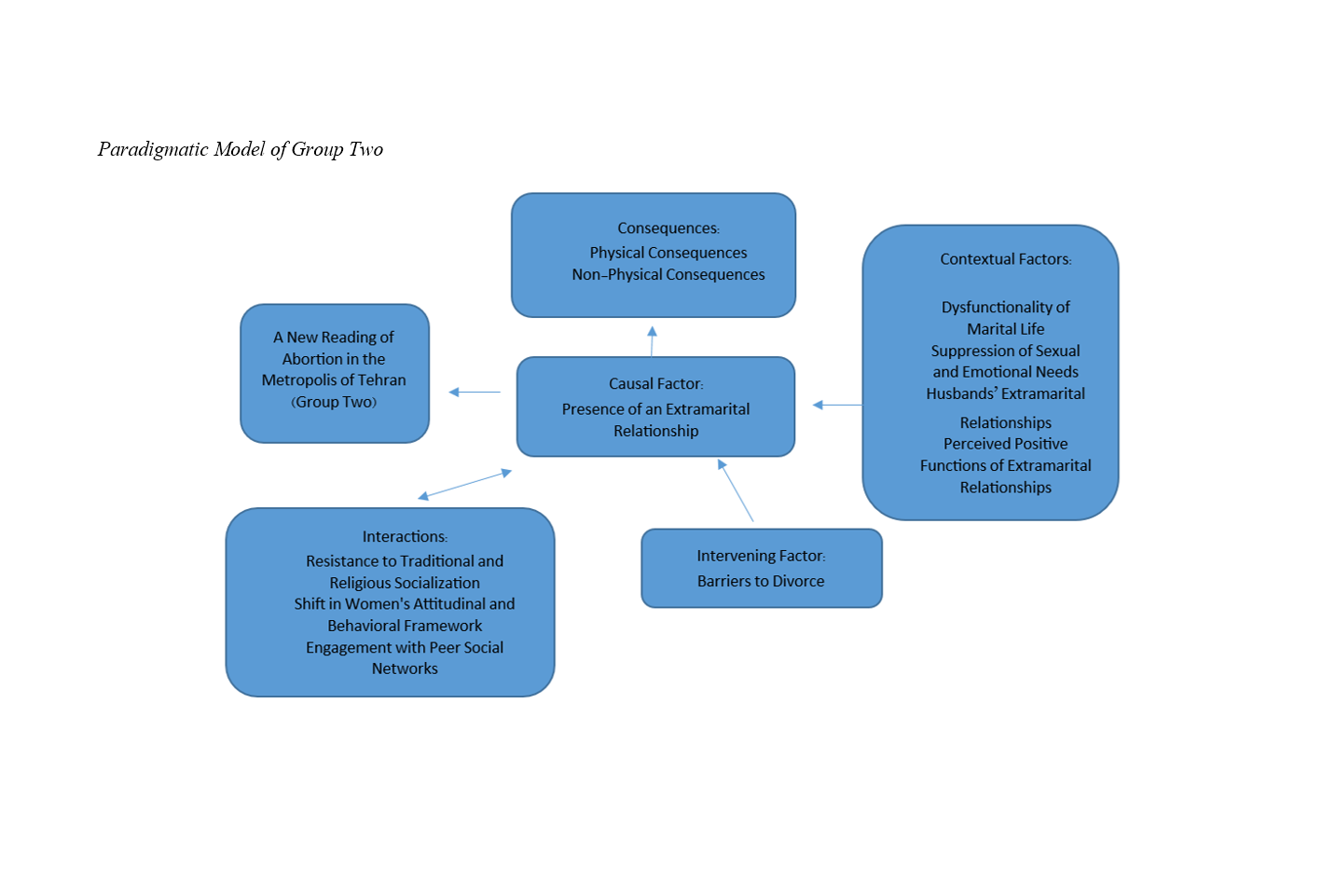
This study aims to examine abortion in the metropolis of Tehran using the grounded theory method, employing purposive and snowball sampling, and conducting semi-structured interviews with 17 women born in the 1980s who underwent at least one elective abortion in a clinic under the supervision of a specialist physician between 2021 and 2024. The data analysis, conducted using the interpretive analysis method of Strauss and Corbin, revealed two distinct pregnancy patterns among the respondents. In the first group, the causal factor was the convergence toward the discourse of definitive childlessness or low fertility. The contextual factors included the hardships of childbearing, economic difficulties, women's employment, and idealism in child-rearing. The intervening factors comprised a non-supportive environment for childbearing in society, marital life, and women's social networks. The interactions were characterized by changes in fertility behavior and a shift in women's perspective on childbearing. In the second group, the causal factor was the existence of extramarital relationships. The contextual factors included the dysfunctionality of marital life, prolonged suppression of sexual and emotional needs, husbands' extramarital affairs, and the perceived positive functions of extramarital relationships. The intervening factor was the obstacles to divorce. The interactions involved engagement with peer social networks, shifts in women's attitudinal and behavioral frameworks, and resistance to traditional and religious socialization. The core category derived from the study is "a new reading of abortion," which encompasses both the physical and non-physical consequences experienced by the actors involved.
Downloads
References
1. Shad GA. PLT Antigen Discrepancy Pattern Among Couples With Recurrent Abortion. Frontiers in Medicine. 2024;11. [PMID: 38651057 ] [PMCID: PMC11033322] [DOI]
2. Vafai S. Comparative Seropositivity of Listeria Monocytogenes in the Serum of Pregnant Women With and Without a History of Abortion by Serological and Culture Methods. Sage Open Medicine. 2024;12. [PMID: 39055278] [PMCID: PMC11271089] [DOI]
3. Del Ara Moghadessian AS, Mohammad Hossein S. Conditions of Abortion from the Perspective of Medicine, Jurisprudence, and Criminal Law in Light of Maternal Health. Comparative Criminal Jurisprudence Quarterly. 2023;3(1):101-11.
4. Azadvary E, Habibpour Gatabi K. The Act of Abortion: The Conflict Between Fear and Choice (A Study on the Contexts of Induced Abortion in the City of Mashhad). Iranian Journal of Social Issues. 2023;14(1):151-83.
5. Ganatra B, Gerdts C, Rossier C, Johnson BR, Jr., Tunçalp Ö, Assifi A, et al. Global, regional, and subregional classification of abortions by safety, 2010-14: Estimates from a Bayesian hierarchical model. The Lancet. 2017;390(10110):2372-81. [PMID: 28964589] [DOI]
6. Shojaei J, Erfani A. Trends and Patterns of Single-Child Families in Iran. Social Sciences Quarterly. 2019;26(85):89-104.
7. Rostami S, Ebrahimpour M. Examining the Aspects of the Second Demographic Transition (Case Study: Tehran). 2017.
8. van de Kaa DJ, editor The Idea of a Second Demographic Transition in Industrialized Countries. Paper presented at the Sixth Welfare Policy Seminar of the National Institute of Population and Social Security, Tokyo, Japan; 2002 29 January 2002.
9. Saifouri Toghrajardi B, Hassani Darmian G, Majdi AA, Kermani M. Fertility Behavior of Iranian Women in Line with Family Changes Over the Past Three Decades. Women and Society (Women's Sociology). 2019;10(3):255-75.
10. Chamani S, Shakarbigi A, Moshfegh M. A Sociological Study on the Determinants of Childbearing (Case Study: Married Women in Tehran). Social and Cultural Strategy. 2016;5(20):137-65.
11. Razaghi Nasrabadi HB, Sanjari E. Factors Influencing Women's Decision to Undergo Induced Abortion: Lived Experiences of Women in Tehran. Women's Social-Psychological Studies Quarterly. 2017;15(2):105-36.
12. Kazemi Pour S. Family Transformations in Contemporary Iran with an Emphasis on Marriage and Divorce. Research on Deviations and Social Issues. 2022;4(2):95-126.
13. Nejatiyan MH, Sharifi M, Ebrahimpour M, Zanjani H, Baghaei Sarabi A. Considerations in Critiquing the Second Demographic Transition with a Focus on Iran. Journal of the Iranian Population Association. 2019;14(27):85-113.
14. Saraei H, Roshan Shomal P. Assessing the Social Factors Affecting Pregnant Women's Attitudes Toward Induced Abortion. Women in Development and Politics (Women's Research). 2012;10(2):5-23.
15. Kaboudi M, Ramazankhani A, Manouchehri H, Hajizadeh E, Haghi M. Childbearing Decision-Making Model: A Qualitative Study. Payesh. 2013;12(5):505-15.
Downloads
Additional Files
Publication Timeline
- Submitted
- Revised
- Accepted
License
Copyright (c) 2025 Razieh Sadat Ghazanfari (Corresponding Author)

This work is licensed under a Creative Commons Attribution-NonCommercial 4.0 International License.