Predicting Attitudes Toward Seeking Psychological Professional Help Based on the Health Belief Model with the Mediation of Stigma in Adolescents with Depressive Symptoms
DOI:
https://doi.org/10.61838/kman.hn.3.3.4Keywords:
Depression, Health Belief Model, Perceived Susceptibility, Perceived Severity, Perceived Benefits, Self-Efficacy, Stigma, Help-Seeking AttitudesAbstract
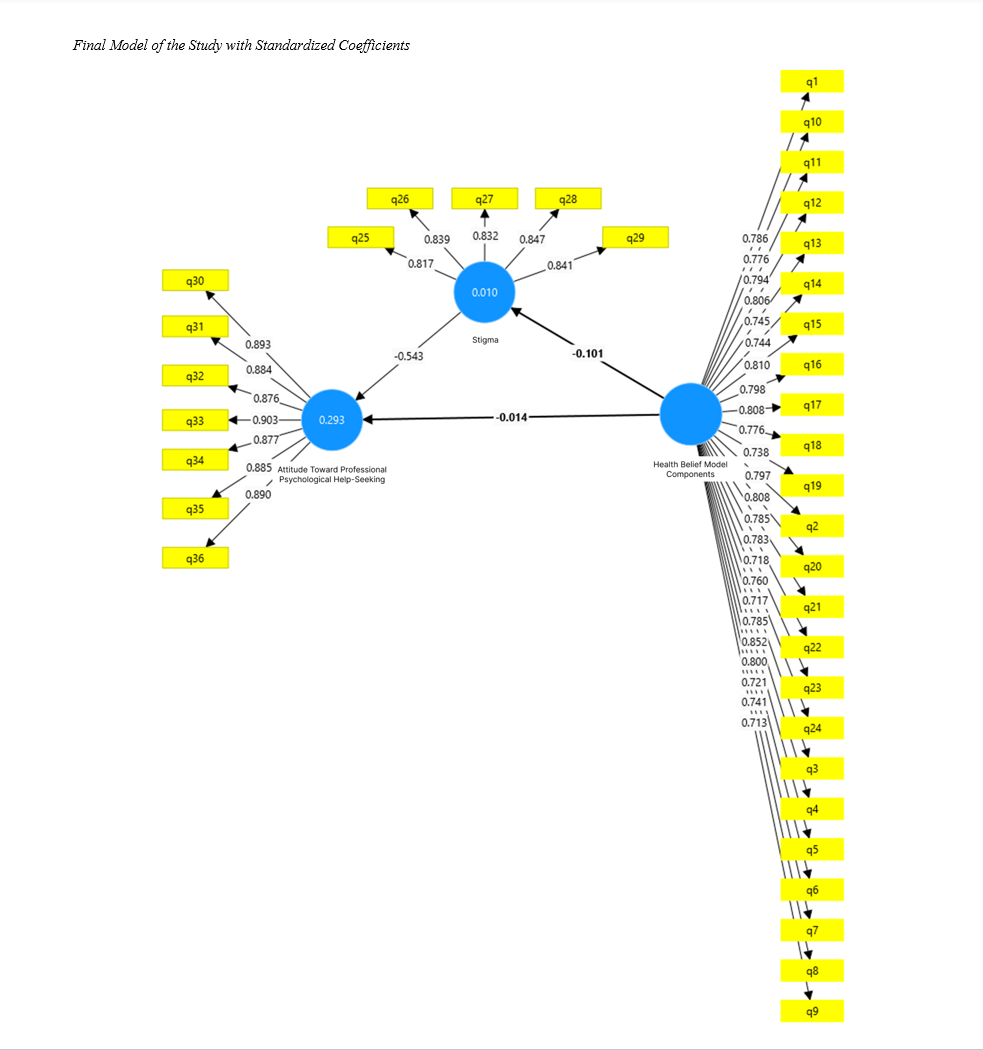
The aim of this study was to assess a model of significant antecedents of attitudes toward professional help-seeking to gain a more comprehensive understanding of this construct. This model examines the role of variables within the Health Belief Model, including perceived susceptibility, perceived severity, perceived benefits, perceived barriers, and self-efficacy, as well as stigma, in relation to attitudes toward seeking psychological professional help. The sample consisted of 200 students from Yasuj city, selected through random sampling. Research instruments included the Perceived Susceptibility Scale (HBMI), the Perceived Severity Scale (PHQ-9), the Perceived Benefits of Treatment Scale (TGM), the Perceived Barriers to Treatment Scale (PBQ), the General Self-Efficacy Scale (GSES), the Stigma Scale (STIGMA-9), the Attitudes Toward Seeking Professional Psychological Help Questionnaire (short form) (ATSPPH-SF), and the Beck Depression Inventory-II (BDI-II). The proposed model was analyzed using structural equation modeling and data were analyzed through path analysis with the bootstrapping method, employing SPSS v.24 and Smart PLS v.4 software. In this study, 56% of participants were male and 46% were female. Among the 200 statistical samples, 13 participants (6.5%) were aged 13, 51 participants (25.5%) were aged 14, 56 participants (28.0%) were aged 15, and 35 participants (17.5%) were aged 16. Only 16 participants (8.0%) were aged 17. The results indicated that all model indices were at an acceptable level, and the model showed a good fit with the data, as indicated by indices such as SMRS = 0.051 and NFI = 0.844. Moreover, the findings revealed that all correlation coefficients, except for perceived barriers, were significant. Therefore, the proposed model demonstrated that perceived susceptibility, perceived severity, perceived benefits, and self-efficacy had a positive and significant relationship with professional psychological help-seeking attitudes, mediated indirectly by stigma. The findings of this study suggest that addressing stigma can facilitate attitudes toward seeking professional psychological help. These results can draw the attention of health professionals and school teachers to the necessity of enhancing literacy and awareness about stigma, particularly among adolescent students.
Downloads
References
1. Lipson SK, Lattie EG, Eisenberg D. Increased rates of mental health service utilization by U.S. college students: 10-year population-level trends (2007-2017). Psychiatric Services. 2018;70(1):60-3. [PMID: 30394183 ] [PMCID: PMC6408297] [DOI]
2. Harris MG, Hobbs MJ, Burgess PM, Pirkis JE, Diminic S, Siskind DJ, et al. Frequency and quality of mental health treatment for affective and anxiety disorders among Australian adults. Medical Journal of Australia. 2015;202(4):185-90. [PMID: 25716600] [DOI]
3. King D, Knapp M, Patel A, Amaddeo F, Tansella M, Schene A, et al. The impact of non-adherence to medication in patients with schizophrenia on health, social care and societal costs. Analysis of the QUATRO study. Epidemiology and Psychiatric Sciences. 2014;23(1):61-70. [PMID: 23574732] [PMCID: PMC6998296] [DOI]
4. King V, Elder GH, Whitbeck LB. Religious involvement among rural youth: An ecological and life course perspective. Journal of Research on Adolescence. 2010;7:431-56. [DOI]
5. Gulliver A, Griffiths KM, Christensen H. Perceived barriers and facilitators to mental health help-seeking in young people: A systematic review. BMC Psychiatry. 2010;10. [PMID: 21192795] [PMCID: PMC3022639] [DOI]
6. Clement S, Schauman O, Graham T, Maggioni F, Evans-Lacko S, Bezborodovs N, et al. What is the impact of mental health-related stigma on help-seeking? A systematic review of quantitative and qualitative studies. Psychological Medicine. 2015;45(1):11-27. [PMID: 24569086] [DOI]
7. Nam SK, Choi SI, Lee JH, Lee MK, Kim AR, Lee SM. Psychological factors in college students' attitudes toward seeking professional psychological help: A meta-analysis. Professional Psychology: Research and Practice. 2013;44(1):37-45. [DOI]
8. Li W, Dorstyn D, Denson LA. Psychosocial correlates of college students' help-seeking intention: A meta-analysis. Professional Psychology: Research and Practice. 2014;45:163-70. [DOI]
9. Fischer EH, Farina A. Attitudes toward seeking professional psychological help: A shortened form and considerations for research. Journal of College Student Development. 1995;36(4):368-73. [DOI]
10. Fischer EH, Turner JL. Orientations to seeking professional help: Development and research utility of an attitude scale. Journal of Consulting and Clinical Psychology. 1970;35:79-90. [PMID: 5487612] [DOI]
11. Schomerus G, Matschinger H, Angermeyer MC. Preferences of the public regarding cutbacks in expenditure for patient care: Are there indications of discrimination against those with mental disorders? Social Psychiatry and Psychiatric Epidemiology. 2006;41:369-77. [PMID: 16424964] [DOI]
12. Schomerus G, Matschinger H, Angermeyer MC. The stigma of psychiatric treatment and help-seeking intentions for depression. European Archives of Psychiatry and Clinical Neuroscience. 2009;259(5):298-306. [PMID: 19224105] [DOI]
13. Schomerus G, Schwahn C, Holzinger A, Corrigan PW, Grabe HJ, Carta MG, et al. Evolution of public attitudes about mental illness: A systematic review and meta-analysis. Acta Psychiatrica Scandinavica. 2012;125(6):440-52. [PMID: 22242976] [DOI]
14. Hantzi A, Anagnostopoulos F, Alexiou E. Attitudes towards seeking psychological help: an integrative model based on contact, essentialist beliefs about mental illness, and stigma. Journal of Clinical Psychology in Medical Settings. 2019;26(2):142-57. [PMID: 29909480] [DOI]
15. Wang PS, Lane M, Olfson M, Pincus HA, Wells KB, Kessler RC. Twelve-month use of mental health services in the United States: Results from the national comorbidity survey replication. Archives of General Psychiatry. 2005;62(6):629-40. [PMID: 15939840] [DOI]
16. Amarasuriya SD, Jorm AF, Reavley NJ. Predicting intentions to seek help for depression among undergraduates in Sri Lanka. BMC Psychiatry. 2018;18(1):122. [PMID: 29728075] [PMCID: PMC5935961] [DOI]
17. Byrne P. Stigma of mental illness and ways of diminishing it. Advances in Psychiatric Treatment. 2000;6(1):65-72. [DOI]
18. Suka M, Yamauchi T, Sugimori H. Help-seeking intentions for early signs of mental illness and their associated factors: comparison across four kinds of health problems. BMC Public Health. 2016. [PMID: 27056546] [PMCID: PMC4825081] [DOI]
19. Prins M, Meadows G, Bobevski I, Graham A, Verhaak P, Van derMeer K, et al. Perceived need for mental health care and barriers to care in the Netherlands and Australia. Social Psychiatry and Psychiatric Epidemiology. 2011;46(10):1033-44. [PMID: 20686887] [PMCID: PMC3173635] [DOI]
20. Henshaw EJ, Freedman-Doan CR. Conceptualizing mental health care utilization using the health belief model. Clinical Psychology: Science and Practice. 2009;16(4):420-39. [DOI]
21. Jorm AF. Mental health literacy: Empowering the community to take action for Better mental health. American Psychologist. 2012;67:231-43. [PMID: 22040221] [DOI]
22. Goldney RD, Fisher LJ, Wilson DH. Mental health literacy: An impediment to the optimum treatment of major depression in the community. Journal of Affective Disorders. 2001;64:277-84. [PMID: 11313096] [DOI]
23. Goldney RD, Fisher LJ, Wilson DH, Cheok F. Mental health literacy of those with major depression and suicidal ideation: An impediment to help seeking. Suicide and Life-Threatening Behavior. 2002;32:394-403. [PMID: 12501964] [DOI]
24. Rosenstock I. Why people use health services. The Milbank Memorial Fund Quarterly. 1966;44(3):94-127. [DOI]
25. Rosenstock IM, Strecher VJ, Becker MH. Social learning theory and the health belief model. Health Education Behavior. 1988;15(2):175-83. [PMID: 3378902] [DOI]
26. Saleeby JR. Health beliefs about mental illness: An instrument development study. American Journal of Health Behavior. 2000;24(2):83-95. [DOI]
27. Czyz EK, Horwitz AG, Eisenberg D, Kramer A, King CA. Self-reported barriers to professional help seeking among college students at elevated risk for suicide. Journal of American College Health. 2013;61(7):398-406. [PMID: 24010494] [PMCID: PMC3788673] [DOI]
28. Komiya N, Good GE, Sherrod NB. Emotional openness as a predictor of college students' attitudes toward seeking psychological help. Journal of Counseling Psychology. 2000;47(1):138-43. [DOI]
29. Zane N, Sue S, Chang J, Huang L, Huang J, Lowe S, et al. Beyond ethnic match: Effects of client-therapist cognitive match in problem perception, coping orientation, and therapy goals on treatment outcomes. Journal of Community Psychology. 2005;33:569-85. [DOI]
30. Corrigan P. How stigma interferes with mental health care. American Psychologist. 2004;59(7):614-25. [PMID: 15491256] [DOI]
31. Corrigan P. Target-specific stigma change: A strategy for impacting mental illness stigma. Psychiatric Rehabilitation Journal. 2004;28(2):113-21. [PMID: 15605746] [DOI]
32. Corrigan PW, Bink AB, Schmidt A, Jones N, Rüsch N. What is the impact of self-stigma? Loss of self-respect and the "why try" effect. Journal of Mental Health. 2016;25(1):10-5. [PMID: 26193430] [DOI]
33. Gentle M, Harris LM, Jones MK. The barriers to seeking treatment for obsessive-compulsive disorder in an Australian population. Behaviour Change. 2014;31(4):258-78. [DOI]
34. Langley EL, Clark G, Murray C, Wootton BM. The utility of the health belief model variables in predicting help-seeking intention for depressive symptoms. Australian Psychologist. 2021;56(3):233-44. [DOI]
35. Langley EL, Wootton BM, Grieve R. The utility of the Health Belief Model (HBM) variables in predicting help-seeking intention for anxiety disorders. Australian Psychologist. 2018;53(4):291-301. [DOI]
36. Robertson L, Paparo J, Wootton BM. Understanding barriers to treatment, treatment histories and treatment preferences for hoarding disorder in Australia. Journal of Obsessive Compulsive and Related Disorders. 2020;26:100560. [DOI]
37. Abdi M, Fataneh, Kavyani H, Khagani Zadeh M, Momeni Iraqi A. Examining the relationship between job burnout and mental health: A study of 200 nurses. Journal of the Medical Faculty. 2007;65(6):65-75.
38. Janz NK, Champion VL, Stretcher VJ, Glanz K, Rimer BK, Lewis FM. The health belief model. In: rd, editor. Health behavior and health education: Theory, research, and practice. San Francisco, CA: Jossey-Bass; 2002. p. 45-66
39. O'Connor PJ, Martin B, Weeks CS, Ong L. Factors that influence young people's mental health helpseeking behaviour: A study based on the health belief model. Journal of Advanced Nursing. 2014;70(11):2577-87. [PMID: 24720449] [DOI]
40. Vázquez GH, Kapczinski F, Magalhaes PV, Córdoba R, Lopez Jaramillo C, Rosa AR, et al. Stigma and functioning in patients with bipolar disorder. Journal of Affective Disorders. 2011;130:323-7. [PMID: 21055821] [DOI]
41. Barney LJ, Griffiths KM, Jorm AF, Christensen H. Stigma about depression and its impact on help-seeking intentions. Australian and New Zealand Journal of Psychiatry. 2006;40(1):51-4. [DOI]
42. Vogel DL, Strass HA, Heath PJ, AlDarmaki FR, Armstrong PI, Baptista MN, et al. Stigma of Seeking Psychological Services: Examining College Students across Ten Countries/Regions. The Counseling Psychologist. 2017;45(2):170-92. [DOI]
43. Vogel DL, Wade NG, Haake S. Measuring the self-stigma associated with seeking psychological help. Journal of Counseling Psychology. 2006;53(3):325-37. [DOI]
44. Vogel DL, Wade NG, Wester SR, Larson L, Hackler AH. Seeking help from a mental health professional: The influence of one's social network. Journal of Clinical Psychology. 2007;63(3):233-45. [PMID: 17211874] [DOI]
45. Vogel DL, Wester SR. To seek help or not to seek help: The risks of self-disclosure. Journal of Counseling Psychology. 2003;50(3):351-61. [DOI]
46. Corrigan PW, Druss BG, Perlick DA. The impact of mental illness stigma on seeking and participating in mental health care. Psychological Science in the Public Interest. 2014;15(2):37-70. [PMID: 26171956] [DOI]
47. Schnyder N, Panczak R, Groth N, SchultzeLutter F. Association between mental health-related stigma and active help-seeking: systematic review and meta-analysis. The British Journal of Psychiatry. 2017;210(4):261-8. [PMID: 28153928] [DOI]
48. Kroenke K, Spitzer RL. The PHQ-9: A new depression diagnostic and severity measure. Psychiatric Annals. 2002;32(9):509-15. [DOI]
49. Kim JE, Zane N. Help-Seeking Intentions Among Asian American and White American Students in Psychological Distress: Application of the Health Belief Model. American Psychological Association. 2015:1099-9809.
50. Schwarzer R, Jerusalem M. Generalized self-efficacy scale Measures in health psychology: A user's portfolio. Causal and control beliefs. Windsor, England: NFER-NELSON; 1995. 35-7 p[DOI]
51. Abbasi M, Biranvand K. Personality traits (extraversion and neuroticism) as moderators of the relationship between stigma and psychological help-seeking behavior among students. Clinical Psychology and Personality. 2019;17(1):87-96.
52. Beck AT, Steer RA, Garbin MG. Psychometric properties of the Beck Depression Inventory: Twenty-five years of evaluation. Clinical Psychology Review. 1988;8. [DOI]
53. Taheri Tanjani P, Garma Roudi G, Azadbakht M, Fekrizadeh Z, Hamidi R, Fathi Zadeh S, et al. Examination of validity and reliability of the second version of the Beck Depression Inventory (BDI-II) in Iranian elderly. Journal of Sabzevar University of Medical Sciences. 2014;22(1):9.
54. Rosenberg MJ, Hovland CI, McGuire WJ, Abelson RP, Brehm JW. Attitude organization and change: an analysis of consistency among attitude components: Yale University Press; 1960.
55. Seidman AJ, Crick KA, Wade NG. Personal growth initiative, mental health stigma, and intentions to seek professional psychological help: A model extension. Stigma and Health. 2022;7(2):142-51. [DOI]
56. De Silva LED, Ponting C, Ramos G, Guevara MVC, Chavira DA. Urban Latinx parents' attitudes towards mental health: Mental health literacy and service use. Child and Youth Services Review. 2020;109:104719. [PMID: 37842164 ] [PMCID: PMC10575228] [DOI]
57. Hu J, Zheng Q, Zhang Y, Liu C, Tian X, Liu X. Help-seeking behavior of individuals with schizophrenia in the general population of Hunan, China. Scientific Reports. 2021;11:23012. [PMID: 34836983] [PMCID: PMC8626485] [DOI]
58. Sharma S, Thomas E. Avoidance factors in seeking mental health counseling among college students. J Asia Pac Couns. 2022;12(1):1-16. [DOI]
59. Demuthova S, Vaclavikova I, Selecka L, Blatny M. The problem of self-disclosure of self-harming behaviour in adolescence. Postmodern Openings. 2020;11(4):1-19. [DOI]
60. Rochelle TL, Lo CH. Predictors of attitude toward seeking Professional Psychological Help in Hong Kong. Behav Med. 2023;49(4):374-80. [PMID: 35862491] [DOI]
61. Chen J. Some people may need it, but not me, not now: Seeking professional help for mental health problems in urban China. Transcultural Psychiatry. 2018;55(6):754-74. [PMID: 30113276] [DOI]
62. Chen P, Liu XJ, Wang XQ, Yang BX, Ruan J, Liu Z. Attitude toward seeking professional psychological help among community-dwelling population in China. Frontiers in Psychiatry. 2020;11(4):1-10. [PMID: 32477190] [PMCID: PMC7240032] [DOI]
63. Ng CH. The stigma of mental illness in Asian cultures. Aust N Z J Psychiatry. 1996;31(3):382-90. [PMID: 9226084] [DOI]
64. Young DKW, Ng PYN. The prevalence and predictors of self-stigma of individuals with mental health illness in two Chinese cities. International Journal of Social Psychiatry. 2016;62(2):176-85. [PMID: 26582785] [DOI]
65. Cauce AM, Domenech-Rodríguez M, Paradise M, Cochran BN, Shea JM, Srebnik D, et al. Cultural and contextual influences in mental health help seeking: A focus on ethnic minority youth. Journal of Consulting and Clinical Psychology. 2002;70(1):44-55. [PMID: 11860055] [DOI]
66. Perlick DA, Rosenheck RA, Clarkin JF, Sirey JA, Salahi J, Struening EL, et al. Adverse effects of perceived stigma on social adaptation of persons diagnosed with bipolar affective disorder. Psychiatr Serv. 2001;52(12):1627-32. [PMID: 11726754] [DOI]
67. Abiri S, Oakley LD, Hitchcock ME, Hall A. Stigma related avoidance in people living with severe mental illness (SMI): Findings of an integrative review. Community Mental Health Journal. 2016;52:251-61. [PMID: 26668008] [DOI]
68. Corrigan PW, Penn DL. Lessons from social psychology on discrediting psychiatric stigma. American Psychologist. 1999;54(9):765-76. [PMID: 10510666] [DOI]
69. Corrigan PW, Watson AC, Miller FE. Blame, shame, and contamination: The impact of mental illness and drug dependence stigma on family members. Journal of Family Psychology. 2006;20:239-46. [PMID: 16756399] [DOI]
70. Fox AB, Smith BN, Vogt D. The relationship between anticipated stigma and work functioning for individuals with depression. Journal of Social and Clinical Psychology. 2016;35(10):883-97. [DOI]
71. Krumrei EJ, Newton FB, Kim E. A multi-institution look at college students seeking counseling: Nature and severity of concerns. Journal of College Student Psychotherapy. 2010;24:261-83. [DOI]
72. Kung WW. Cultural and practical barriers to seeking mental health treatment for Chinese Americans. Journal of Community Psychology. 2004;32:27-43. [DOI]
73. Rasmussen EE, Shannon KL, Pitchford B. Adolescents' disclosure of mental illness to parents: preferences and barriers. Health Commun. 2022;37(3):346-55. [PMID: 33106039] [DOI]
74. Bruffell H. Pride and Prejudice: The role of self-efficacy in stigma. Critical Approaches to Discourse Analysis Across Disciplines. 2017;9(2):23-40.
75. Gray AJ. Stigma in psychiatry. J R Soc Med. 2002. [PMID: 11823548] [PMCID: PMC1279314] [DOI]
76. Ruggiero KJ, Morris TL, Hopko DR, Lejuez CW. Application of behavioral activation treatment for depression to an adolescent with a history of child maltreatment. Clinical Case Studies. 2005;2:1-17.
Downloads
Additional Files
Publication Timeline
- Submitted
- Revised
- Accepted
License
Copyright (c) 2025 Mozhgan Mohsenian (Author); Abdulaziz Aflakseir (Corresponding Author); Habib Hadianfard, Changiz Rahimi (Author)

This work is licensed under a Creative Commons Attribution-NonCommercial 4.0 International License.