The Moderating Role of Perceived Social Support in the Relationship Between Professional Quality of Life, PTSD Symptoms, and Psychological Well-Being of Nurses in Karbala
DOI:
https://doi.org/10.61838/kman.hn.2.3.3Keywords:
Perceived Social Support, Professional Quality of Life, PTSD Symptoms, Psychological Well-Being, NursesAbstract
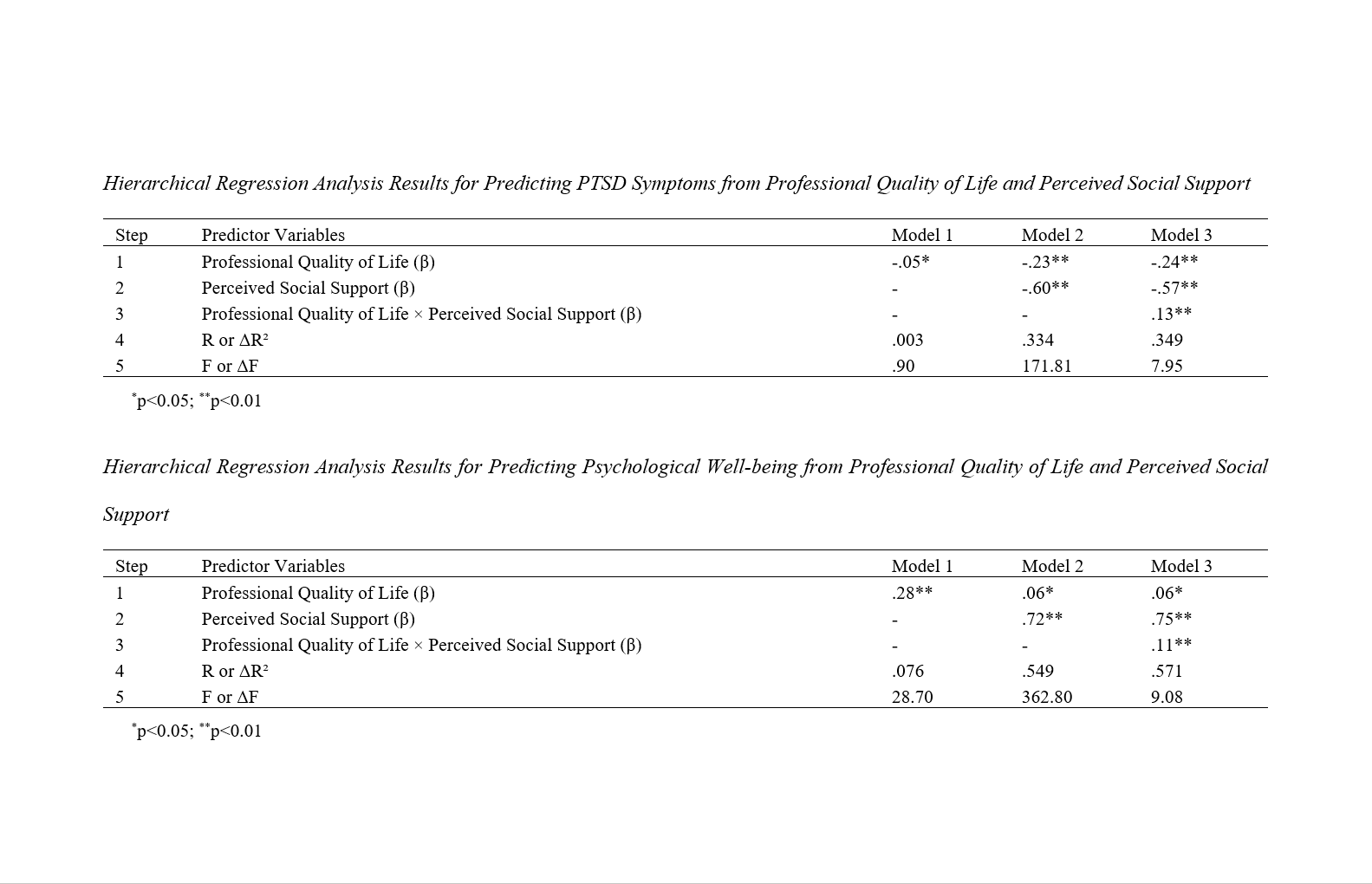
Mental health is one of the most important factors for the empowerment and optimal performance of nurses. The present study aimed to determine the moderating role of perceived social support in the relationship between professional quality of life, PTSD symptoms, and psychological well-being of nurses in Karbala. The research method is correlational with a hierarchical regression analysis. The statistical population included all nurses in the hospitals of Karbala, Iraq, with 349 individuals selected as the sample through convenience sampling. Data were collected using the Professional Quality of Life Scale (Stamm, 2010), PTSD Symptoms Scale (Wheeler et al., 1993), Psychological Well-Being Scale (Ryff & Keyes, 1983), and Perceived Social Support Scale (Zimet et al., 1988). Data analysis was conducted using Pearson correlation coefficient and hierarchical regression analysis with SPSS 26 software. Perceived social support moderates the relationship between professional quality of life and PTSD symptoms as well as psychological well-being (p < .01). When perceived social support is high, the relationship between professional quality of life and PTSD symptoms and psychological well-being is stronger (p < .01). Perceived social support and professional quality of life are essential for promoting the well-being and health of nurses in work environments.
Downloads
References
1. Jiaru J, Yanxue Z, Wennv H. Incidence of stress among emergency nurses: A systematic review and meta-analysis. Medicine. 2023;102(4). [PMID: 36705357] [PMCID: PMC9875949] [DOI]
2. Kowalczuk K, Tomaszewska K, Chilińska J, Krajewska-Kułak E, Sobolewski M, Hermanowicz JM. Subjective assessment of occupational stress and mental health of nurses during the Covid-19 pandemic period. Frontiers in Psychiatry. 2023;14:1301113. [PMID: 38076687] [PMCID: PMC10702510] [DOI]
3. Hao Q, Wang D, Xie M, Tang Y, Dou Y, Zhu L, et al. Prevalence and risk factors of mental health problems among healthcare workers during the COVID-19 pandemic: a systematic review and meta-analysis. Frontiers in psychiatry. 2021;12:567381. [PMID: 34211406] [PMCID: PMC8239157] [DOI]
4. Schuster M, Dwyer PA. Post‐traumatic stress disorder in nurses: An integrative review. Journal of Clinical Nursing. 2020;29(15-16):2769-87. [PMID: 32372541] [DOI]
5. Zalta AK, Tirone V, Orlowska D, Blais RK, Lofgreen A, Klassen B, et al. Examining moderators of the relationship between social support and self-reported PTSD symptoms: A meta-analysis. Psychological Bulletin. 2021;147(1):33. [PMID: 33271023] [PMCID: PMC8101258] [DOI]
6. Kern SM, Stacy SE, Kozina RM, Ripley AJ, Clapp JD. Exploring the relation between posttraumatic stress disorder and interpersonal outcomes: The role of social acknowledgment and trauma type. Journal of Clinical Psychology. 2019;75(1):132-45. [PMID: 30395693] [DOI]
7. Xue M, Yuan Y, Chen H, Dai M, Sun H, Qu J, et al. Analysis of Symptom Characteristics, Influencing Factors, and Their Predictive Value for Posttraumatic Stress Disorder in Nurses: A Cross-Sectional Questionnaire Study. The Journal of Nervous and Mental Disease. 2022:10.1097.
8. Xue M, Yuan Y, Chen H, Liu Y, Dai M, Sun H, et al. Perceived stress and symptoms of post-traumatic stress disorder in nurses: A moderated mediation model of maladaptive cognitive emotional regulation and psychological capital. Frontiers in Psychiatry. 2022;13:902558. [PMID: 36506450] [PMCID: PMC9727242] [DOI]
9. Mittermeier I, Merlic D, Braschl S, Sealtiel L, Weilnhammer V, Quartucci C, et al. Mental health and work-related factors in healthcare workers in a pandemic–meta-analysis. Psychology, Health & Medicine. 2023:1-47.
10. Ohue T, Togo E, Ohue Y, Mitoku K. Relationships Between Psychosocial Factors and Mental Health Among Nurses Working With COVID-19 Patients in Japan. SAGE Open Nursing. 2023;9:23779608231160919. [DOI]
11. Tran AN, To QG, Huynh V-AN, Le KM, To KG. Professional quality of life and its associated factors among Vietnamese doctors and nurses. BMC Health Services Research. 2023;23(1):924. [PMID: 37649084] [PMCID: PMC10469419] [DOI]
12. Ni W, Xia M, Jing M, Zhu S, Li L. The relationship between professional quality of life and work environment among ICU nurses in Chinese: a cross-sectional study. Frontiers in Public Health. 2023;11:1104853. [PMID: 37213646] [PMCID: PMC10192618] [DOI]
13. Yeung NCY, Tang JLT, Lau STY, Hui KH, Cheung AW-l, Wong EL-y. ‘Caring for the helpers’: factors associated with professional quality of life among Hong Kong nurses during the fifth wave of the COVID-19 pandemic. European Journal of Psychotraumatology. 2023;14(1):2183454. [PMID: 36927300] [PMCID: PMC10026750] [DOI]
14. Alonazi O, Alshowkan A, Shdaifat E. The relationship between psychological resilience and professional quality of life among mental health nurses: a cross-sectional study. BMC nursing. 2023;22(1):1-13. [PMID: 37248491] [PMCID: PMC10228012] [DOI]
15. Babapour A-R, Gahassab-Mozaffari N, Fathnezhad-Kazemi A. Nurses’ job stress and its impact on quality of life and caring behaviors: A cross-sectional study. BMC nursing. 2022;21(1):1-10. [PMID: 35361204] [PMCID: PMC8968092] [DOI]
16. Li X, Che CC, Li Y, Wang L, Chong MC. The mediating role of coping styles in the relationship between second victim experience and professional quality of life among nurses: a cross-sectional study. BMC nursing. 2023;22(1):312. [PMID: 37700282] [PMCID: PMC10496327] [DOI]
17. Huang Z-p, Huang F, Liang Q, Liao F-z, Tang C-z, Luo M-l, et al. Socioeconomic factors, perceived stress, and social support effect on neonatal nurse burnout in China: a cross-sectional study. BMC nursing. 2023;22(1):218. [PMID: 37357312] [PMCID: PMC10291763] [DOI]
18. Johansen VA, Milde AM, Nilsen RM, Breivik K, Nordanger DØ, Stormark KM, et al. The relationship between perceived social support and PTSD symptoms after exposure to physical assault: An 8 years longitudinal study. Journal of interpersonal violence. 2022;37(9-10):NP7679-NP706. [PMID: 33140665] [PMCID: PMC9092899] [DOI]
19. Price M, Pallito S, Legrand AC. Heterogeneity in the strength of the relation between social support and post-trauma psychopathology. Journal of psychopathology and behavioral assessment. 2018;40:334-43. [PMID: 30270969] [PMCID: PMC6159937] [DOI]
20. Jukić M, Lukinac AM, Požgain I, Talapko J, Jukić M, Filaković P. The role of perceived social support in assessing posttraumatic stress disorder and mental health-related quality of life in veterans. Healthcare. 2020;8(4):396. [PMID: 33053836] [PMCID: PMC7711990] [DOI]
21. Ortiz-Calvo E, Martínez-Alés G, Mediavilla R, González-Gómez E, Fernández-Jiménez E, Bravo-Ortiz M-F, et al. The role of social support and resilience in the mental health impact of the COVID-19 pandemic among healthcare workers in Spain. Journal of psychiatric research. 2022;148:181-7. [PMID: 35124398] [PMCID: PMC8668396] [DOI]
22. Ruisoto P, Ramírez MR, García PA, Paladines-Costa B, Vaca SL, Clemente-Suárez VJ. Social support mediates the effect of burnout on health in health care professionals. Frontiers in Psychology. 2021;11:623587. [PMID: 33519649] [PMCID: PMC7838123] [DOI]
23. Gök MŞ, Çiftçi B. Relationship between perceived social support and post-traumatic growth in coronavirus disease 2019 patients discharged from the hospital. World Journal of Psychiatry. 2023;13(4):171. [PMID: 37123100] [PMCID: PMC10130958] [DOI]
24. Lu J, Wang B, Dou X, Yu Y, Zhang Y, Ji H, et al. Moderating effects of perceived social support on self-efficacy and psychological well-being of Chinese nurses: a cross-sectional study. Frontiers in Public Health. 2023;11. [PMID: 37841725] [PMCID: PMC10570434] [DOI]
Downloads
Additional Files
Publication Timeline
License
Copyright (c) 2024 Abbas Adnan Kamel (Author); Ali Mahdad (Corresponding Author); Ahmed Abdulkadhim Johni, Ilnaz Sajjadian (Author)

This work is licensed under a Creative Commons Attribution-NonCommercial 4.0 International License.