
Effectiveness of Recovery-Oriented cognitive therapy on Emotion Recognition and Quality of Life in Patients with Schizophrenia
DOI:
https://doi.org/10.61838/kman.hn.2.2.9Keywords:
Recovery-oriented cognitive therapy, emotion recognition, quality of life, schizophreniaAbstract
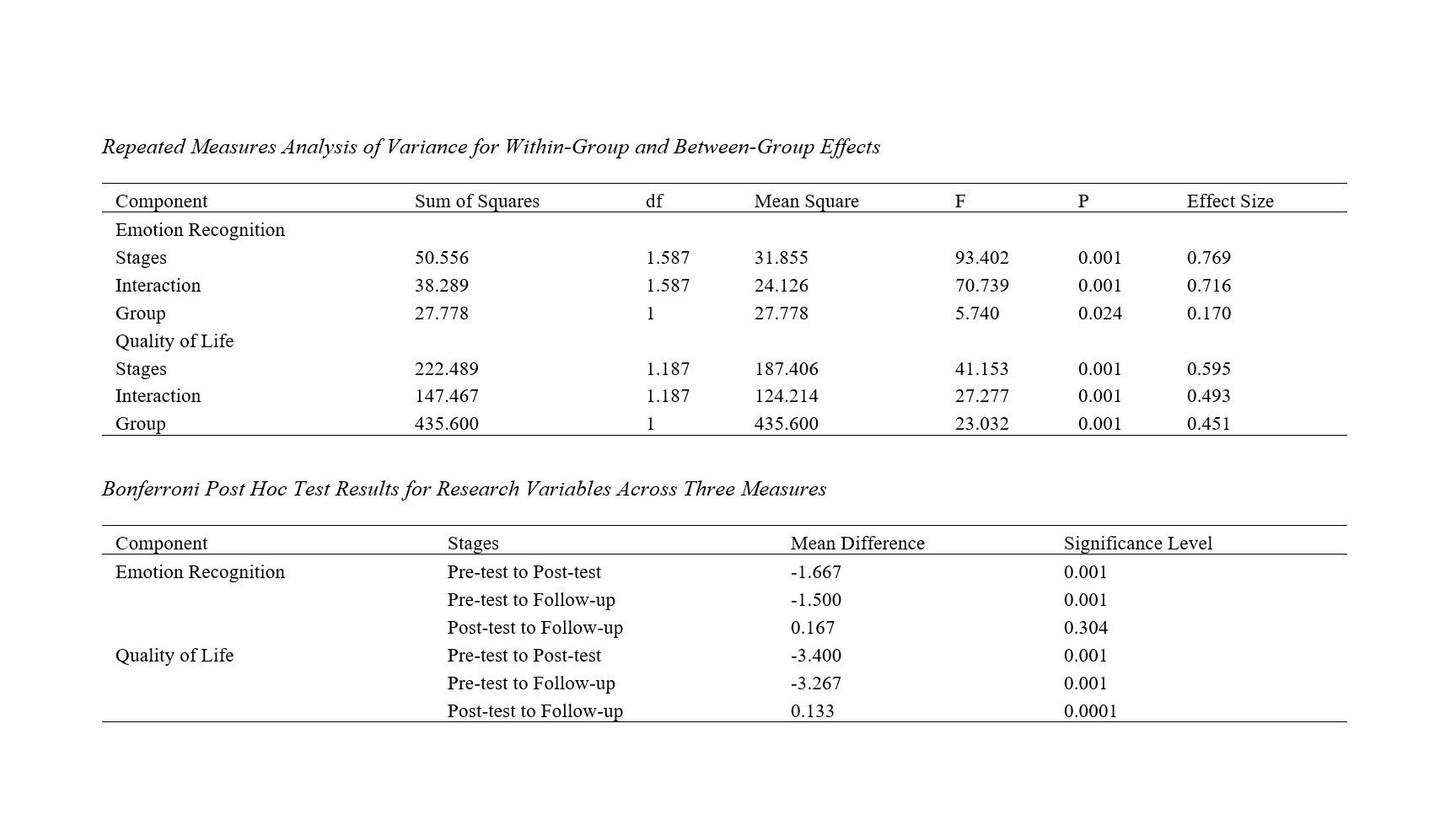
The purpose of this study was to investigate the effectiveness of recovery-oriented cognitive therapy on emotion recognition and quality of life in patients with schizophrenia. The research method was a quasi-experimental design with a pre-test, post-test, and follow-up with a control group. The study population included all schizophrenia patients hospitalized in round-the-clock neuro-psychiatric centers in Tehran in the year 2022. The sample size consisted of 30 individuals (15 in the experimental group and 15 in the control group) selected from the population using convenience sampling and were allocated to either the control or experimental groups. For the experimental group, recovery-oriented cognitive therapy was administered while the control group remained on a waiting list. The research tools included the Facial Emotion Recognition Test (Ekman & Friesen, 1976) and the Quality of Life Questionnaire (World Health Organization, 1996). The results indicated that recovery-oriented cognitive therapy had a significant impact on emotion recognition and quality of life in the post-test and follow-up stages. The findings of this research provide useful information regarding recovery-oriented cognitive therapy, and psychologists and psychiatrists can use this intervention to improve emotion recognition and quality of life in patients with schizophrenia.
Downloads
References
1. Orsolini L, Pompili S, Volpe U. Schizophrenia: A Narrative Review of Etiopathogenetic, Diagnostic and Treatment Aspects. Journal of Clinical Medicine. 2022;11(17):5040. [PMID: 36078967] [PMCID: PMC9457502] [DOI]
2. McCutcheon RA, Reis Marques T, Howes OD. Schizophrenia—An Overview. JAMA Psychiatry. 2020;77(2):201-10. [PMID: 31664453] [DOI]
3. Moura BM, Isvoranu A-M, Kovacs V, Van Rooijen G, Van Amelsvoort T, Simons CJP, et al. The Puzzle of Functional Recovery in Schizophrenia-Spectrum Disorders—Replicating a Network Analysis Study. Schizophrenia Bulletin. 2022;48(4):871-80. [PMID: 35266000] [PMCID: PMC9212097] [DOI]
4. DeLisi LE. Redefining schizophrenia through genetics: A commentary on 50 years searching for biological causes. Schizophrenia Research. 2022;242:22-4. [PMID: 34872835] [DOI]
5. Brink M, Green A, Bojesen AB, Lamberti JS, Conwell Y, Andersen K. Excess medical comorbidity and mortality across the lifespan in schizophrenia.: A nationwide Danish register study. Schizophrenia Research. 2019;206:347-54. [PMID: 30527270] [DOI]
6. Misiak B, Stańczykiewicz B, Wiśniewski M, Bartoli F, Carra G, Cavaleri D, et al. Thyroid hormones in persons with schizophrenia: A systematic review and meta-analysis. Progress in Neuro-Psychopharmacology and Biological Psychiatry. 2021;111:110402. [PMID: 34274416] [DOI]
7. Pouget JG, Consortium SWGotPG, Han B, Wu Y, Mignot E, Ollila HM, et al. Cross-disorder analysis of schizophrenia and 19 immune-mediated diseases identifies shared genetic risk. Human Molecular Genetics. 2019;28(20):3498-513. [PMID: 31211845] [PMCID: PMC6891073] [DOI]
8. Green MF, Lee J, Wynn JK. Experimental approaches to social disconnection in the general community: can we learn from schizophrenia research? World Psychiatry. 2020;19(2):177-8. [PMID: 32394575] [PMCID: PMC7215060] [DOI]
9. Badal VD, Depp CA, Hitchcock PF, Penn DL, Harvey PD, Pinkham AE. Computational methods for integrative evaluation of confidence, accuracy, and reaction time in facial affect recognition in schizophrenia. Schizophrenia Research: Cognition. 2021;25:100196. [PMID: 33996517] [PMCID: PMC8093458] [DOI]
10. Hwang HC, Kim SM, Han DH. Different facial recognition patterns in schizophrenia and bipolar disorder assessed using a computerized emotional perception test and fMRI. Journal of Affective Disorders. 2021;279:83-8. [PMID: 33039778] [DOI]
11. Xie B, Sidulova M, Park CH. Robust Multimodal Emotion Recognition from Conversation with Transformer-Based Crossmodality Fusion. Sensors. 2021;21(14):4913. [PMID: 34300651] [PMCID: PMC8309929] [DOI]
12. Comparelli A, Corigliano V, De Carolis A, Mancinelli I, Trovini G, Ottavi G, et al. Emotion recognition impairment is present early and is stable throughout the course of schizophrenia. Schizophrenia Research. 2013;143(1):65-9. [PMID: 23218561] [DOI]
13. Bulgari V, Bava M, Gamba G, Bartoli F, Ornaghi A, Candini V, et al. Facial emotion recognition in people with schizophrenia and a history of violence: a mediation analysis. European Archives of Psychiatry and Clinical Neuroscience. 2020;270(6):761-9. [PMID: 31106387] [DOI]
14. Gao Z, Zhao W, Liu S, Liu Z, Yang C, Xu Y. Facial Emotion Recognition in Schizophrenia. Frontiers in Psychiatry. 2021;12. [PMID: 34017272] [PMCID: PMC8129182] [DOI]
15. Pan Y, Wen Y, Wang Y, Schilbach L, Chen J. Interpersonal coordination in schizophrenia: a concise update on paradigms, computations, and neuroimaging findings. Psychoradiology. 2023;3:kkad002. [PMID: 38666124] [PMCID: PMC10917372] [DOI]
16. Perrotti A, Ecarnot F, Monaco F, Dorigo E, Monteleone P, Besch G, Chocron S. Quality of life 10 years after cardiac surgery in adults: a long-term follow-up study. Health and Quality of Life Outcomes. 2019;17(1):88. [PMID: 31118026] [PMCID: PMC6532216] [DOI]
17. Meesters PD, Comijs HC, de Haan L, Smit JH, Eikelenboom P, Beekman ATF, Stek ML. Subjective quality of life and its determinants in a catchment area based population of elderly schizophrenia patients. Schizophrenia Research. 2013;147(2):275-80. [PMID: 23693066] [DOI]
18. Carpiniello B, Pinna F, Tusconi M, Zaccheddu E, Fatteri F. Gender Differences in Remission and Recovery of Schizophrenic and Schizoaffective Patients: Preliminary Results of a Prospective Cohort Study. Schizophrenia Research and Treatment. 2012;2012:576369. [PMID: 22966440] [PMCID: PMC3420715] [DOI]
19. Karow A, Wittmann L, Schöttle D, Schäfer I, Lambert M. The assessment of quality of life in clinical practice in patients with schizophrenia. Dialogues in Clinical Neuroscience. 2014;16(2):185-95. [PMID: 25152657] [PMCID: PMC4140512] [DOI]
20. Melkersson K. Schizophrenia-or schizoaffective disorder diagnosis and the risk for subsequent type 1-or type 2 diabetes mellitus: a Swedish nationwide register-based cohort study. Neuroendocrinol Lett. 2020;41(5):245-54.
21. van der Gaag M, Valmaggia LR, Smit F. The effects of individually tailored formulation-based cognitive behavioural therapy in auditory hallucinations and delusions: A meta-analysis. Schizophrenia Research. 2014;156(1):30-7. [PMID: 24731619] [DOI]
22. Garety PA, Fowler DG, Freeman D, Bebbington P, Dunn G, Kuipers E. Cognitive-behavioural therapy and family intervention for relapse prevention and symptom reduction in psychosis: Randomised controlled trial. British Journal of Psychiatry. 2008;192(6):412-23. [PMID: 18515890] [DOI]
23. Davidson L, Rowe M, Tondora J, O'Connell MJ, Lawless MS. A Practical Guide to Recovery-Oriented Practice: Oxford University Press; 2008 12 Nov 2020. [DOI]
24. Beck AT, Grant P, Inverso E, Brinen AP, Perivoliotis D. Recovery-oriented cognitive therapy for serious mental health conditions: Guilford Publications; 2020.
25. Nowak I, Świtaj P, Oberhauser C, Anczewska M. Factors Predicting Response to the Recovery-Oriented Cognitive Behavioural Workshop for Persons Diagnosed with Schizophrenia. Community Mental Health Journal. 2020;56(6):1115-20. [PMID: 32239365] [PMCID: PMC7289781] [DOI]
26. Nowak I, Świtaj P, Sabariego C, Oberhauser C, Anczewska M. Development and Evaluation of a Recovery-Oriented Cognitive Behavioural Workshop for People Diagnosed with Schizophrenia. Behavioural and Cognitive Psychotherapy. 2019;47(3):400-6. [PMID: 30375308] [DOI]
27. Grant PM, Huh GA, Perivoliotis D, Stolar NM, Beck AT. Randomized Trial to Evaluate the Efficacy of Cognitive Therapy for Low-Functioning Patients With Schizophrenia. Archives of General Psychiatry. 2012;69(2):121-7. [PMID: 21969420] [DOI]
28. Grant PM, Perivoliotis D, Luther L, Bredemeier K, Beck AT. Rapid improvement in beliefs, mood, and performance following an experimental success experience in an analogue test of recovery-oriented cognitive therapy. Psychological Medicine. 2018;48(2):261-8. [PMID: 28637521] [DOI]
29. Ekman P, Friesen WV. Unmasking the face: A guide to recognizing emotions from facial clues: Ishk; 2003.
30. Amiri A, Ghasempour A, Fahimi S, Abolghasemi A, Akbari E, Agh A, Fakhari A. Recognition of Facial Expression of Emotion in Patients with Obsessive-Compulsive Disorder and Average People. Armaghane Danesh. 2012;17(1):30-9.
31. Nejat S, Montazeri A, Holakouie Naieni K, Mohammad K, Majdzadeh SR. The World Health Organization quality of Life (WHOQOL-BREF) questionnaire: Translation and validation study of the Iranian version. Journal of School of Public Health and Institute of Public Health Research. 2006;4(4):1-12.
32. Grant PM, Reisweber J, Luther L, Brinen AP, Beck AT. Successfully breaking a 20-year cycle of hospitalizations with recovery-oriented cognitive therapy for schizophrenia. Psychological Services. 2014;11(2):125-33. [PMID: 24079355] [DOI]
33. Mahmoodi K, Ghaemi F. The Relationship between the Cognitive Emotion Regulation and the Resilience among the Iranian Red Crescent Managers. Journal of Research in Educational Systems. 2017;11(37):93-110.
34. Wong DFK, Chan V, Ip P, Zhuang XY. The Effects of Recovery-Oriented Cognitive–Behavior Approach for Chinese With Severe Mental Illness. Research on Social Work Practice. 2019;29(3):311-22. [DOI]
Downloads
Additional Files
Publication Timeline
License
Copyright (c) 2024 Morteza Saeedi (Author); Parviz Sharifidaramadi (Corresponding Author); Gholamreza Sharifirad (Author)

This work is licensed under a Creative Commons Attribution-NonCommercial 4.0 International License.