Comparison of the Effectiveness of Mindfulness Training and Compassion-Based Acceptance and Commitment Therapy on Alexithymia and Suicidal Ideation in Adolescents with a Tendency Toward High-Risk Behaviors
Keywords:
mindfulness training, compassion-based Acceptance and Commitment Therapy, alexithymia, suicidal ideation, tendency toward high-risk behaviors.Abstract
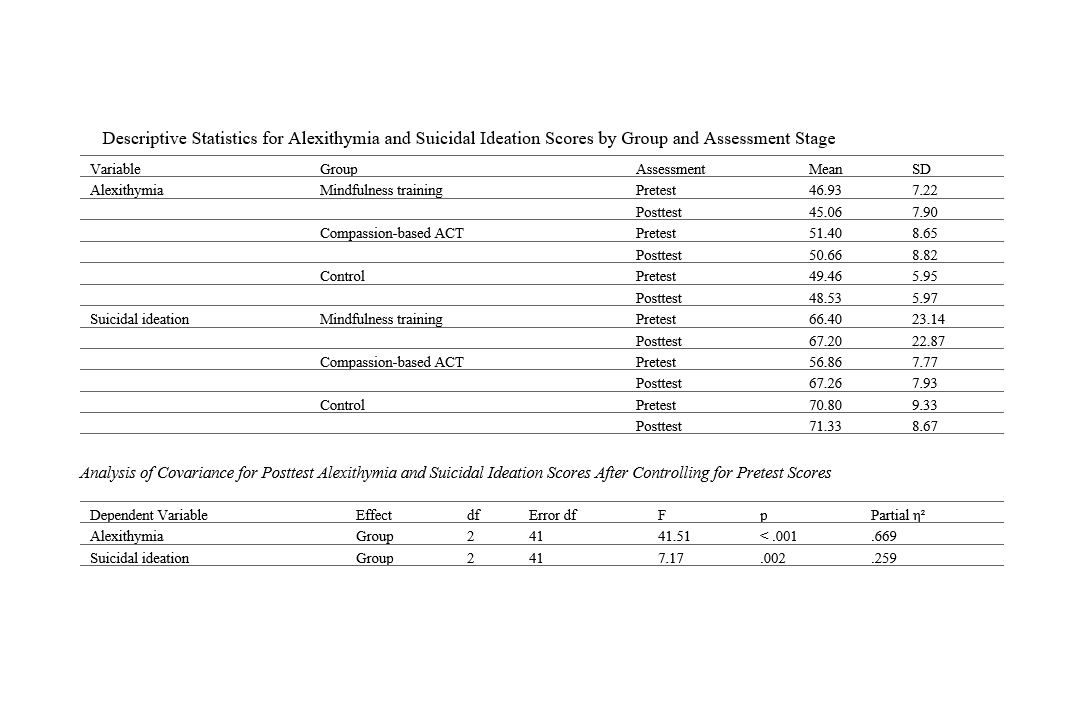
The present study aimed to compare the effectiveness of mindfulness training and compassion-based Acceptance and Commitment Therapy (ACT) on alexithymia and suicidal ideation in adolescents with a tendency toward high-risk behaviors. This study employed a quasi-experimental design. The statistical population consisted of all adolescents with a tendency toward high-risk behaviors in District 5 of Ardabil who had referred to counseling centers during the first six months of 2026 (March–September 2026). Participants were selected using convenience sampling from among adolescents who met the eligibility criteria for participation in the study. Eligible individuals were enrolled in the study after providing informed consent and were randomly assigned to Experimental Group 1 (n = 15), Experimental Group 2 (n = 15), and the control group (n = 15). The research instruments included an Alexithymia Questionnaire and a Suicidal Ideation Questionnaire. Mindfulness training and compassion-based Acceptance and Commitment Therapy interventions were administered to the respective experimental groups. Data were analyzed using multivariate analysis of variance (MANOVA). The results indicated that both mindfulness training and compassion-based Acceptance and Commitment Therapy were effective in reducing suicidal ideation and alexithymia. Specifically, both experimental groups demonstrated lower mean scores on the aforementioned variables compared with the control group, and the differences between the mean scores were statistically significant at the .05 level. Furthermore, a significant difference between mindfulness training and compassion-based Acceptance and Commitment Therapy was observed only for suicidal ideation. The mindfulness training group exhibited a lower mean suicidal ideation score than the compassion-based Acceptance and Commitment Therapy group, indicating that mindfulness training was more effective in reducing suicidal ideation.
Downloads
References
1. Ghorbanalizadeh M, editor High-Risk Behaviors Among Adolescents And Young Adults: Epidemiology. Fifth International Conference on Management and Industry; 2023.
2. Ashayeri T, Momeni H, Adel H, Jahanparvar T. A Meta-Analysis Of Factors Affecting High-Risk Behavior: Research From 1390 To 1401. Intercultural Studies. 2022;7(53):31-60.
3. Zarei A, Bagherzadeh T, Gharibi T, Ravanipour M. Tendency Toward High-Risk Behaviors And Associated Factors Among Adolescents In Bushehr In 1398. The Persian Gulf Biomedical Sciences Journal. 2020;23(6):544-68. {3_https://doi.org/10.52547/ismj.23.6.554}
4. Zibadoust B, Mardandoust Bahlouli M, Zanganeh AM, Rostami AA, editors. Adolescent High-Risk Behaviors And Their Effect On Life. 23rd International Conference on Research in Psychology, Counseling and Educational Sciences; 2025.
5. Banstola RS, Ogino T, Inoue S. Self-Esteem, Perceived Social Support, Social Capital, And Risk-Behavior Among Urban High School Adolescents In Nepal. Population Health. 2020:100570. {2_32258358} {1_PMC7115101} {3_https://doi.org/10.1016/j.ssmph.2020.100570}
6. Dash GF, Ewing SWF, Murphy C, Hudson KA, Wilson AC. Contextual Risk Among Adolescents Receiving Opioid Prescriptions For Acute Pain In Pediatric Ambulatory Care Settings. Journal of Addictive Behaviors. 2020;104:106314. {2_31962289} {1_PMC7024039} {3_https://doi.org/10.1016/j.addbeh.2020.106314}
7. Alizadeh S, Raheb G, Mirzaei Z, Hosseinzadeh S. Effectiveness Of Social Competence Training On Risk-Taking Tendencies Of Adolescent Boys In Residential Welfare Centers In Mashhad And Sabzevar. Archives of Rehabilitation. 2020;21(1):54-73. {3_https://doi.org/10.32598/RJ.21.1.2874.1}
8. Habibi Y, Kalantar Hormozi A, Farahbakhsh K, Salimi Bajestani H, Asgari M. Identifying Components Of Young People’S Tendency Toward Cigarette Smoking From Experts’ Perspectives: A Qualitative Analysis. Counseling Research. 2022;8(81):40-78. {3_https://doi.org/10.18502/qjcr.v21i81.9490}
9. Askarian S, Sanagooei G, Jenaabadi H. Comparing The Effectiveness Of Religious Coping And Cognitive-Behavioral Training On General Health And Behavioral Problems In Adolescent Girls. Islamic Studies of Women and Family. 2023;10(19):73-100.
10. Sanatkhah A, Bahreyninejad M. A Sociological Investigation Of Factors Affecting Aggression Among Students. Applied Studies in Social Sciences and Sociology. 2021;4(4):53-62.
11. Centers For Disease C, Prevention. Suicide Prevention. National Center for Injury Prevention and Control; 2021.
12. Donath C, Bergmann MC, Kliem S, Hillemacher T, Baier D. Epidemiology Of Suicidal Ideation, Suicide Attempts, And Direct Self-Injurious Behavior In Adolescents With A Migration Background: A Representative Study. BMC Pediatrics. 2019;19(1):45. {2_30709395} {1_PMC6359754} {3_https://doi.org/10.1186/s12887-019-1404-z}
13. De Cates AN, Catone G, Marwaha S, Bebbington P, Humpston CS, Broome MR. Self-Harm, Suicidal Ideation, And The Positive Symptoms Of Psychosis: Cross-Sectional And Prospective Data From A National Household Survey. Schizophrenia Research. 2021;233:80-8. {2_34246091} {1_PMC8388846} {3_https://doi.org/10.1016/j.schres.2021.06.021}
14. Devylder J, Waldman K, Hielscher E, Scott J, Oh H. Psychotic Experiences And Suicidal Behavior: Testing The Influence Of Psycho-Socioenvironmental Factors. Social Psychiatry and Psychiatric Epidemiology. 2025;55:1167-77. {2_32055899} {3_https://doi.org/10.1007/s00127-020-01841-9}
15. Costanza A, Prelati M, Pompili M. The Meaning In Life In Suicidal Patients: The Presence And The Search For Constructs. A Systematic Review. Medicina. 2024;55(8):465. {2_31405240} {1_PMC6723920} {3_https://doi.org/10.3390/medicina55080465}
16. Rostami M, Rahmati F, Salesi M. Factors Associated With Suicidal Ideation In Iranian Conscript Soldiers. Journal of Military Medicine. 2022;24(8):1539-46.
17. Muzi S, Pace CS. A Pilot Study On Alexithymia In Adopted Youths: Prevalence And Relationships With Emotional-Behavioral Problems. Mediterranean Journal of Clinical Psychology. 2020;8(3).
18. Pellerone M, Tomasello G, Migliorisi S. Relationship Between Parenting, Alexithymia And Adult Attachment Styles: A Cross-Sectional Study On A Group Of Adolescents And Young Adults. Clinical Neuropsychiatry. 2017;14(2).
19. Serafini G, De Berardis D, Valchera A, Canepa G, Geoffroy PA, Pompili M, et al. Alexithymia As A Possible Specifier Of Adverse Outcomes: Clinical Correlates In Euthymic Unipolar Individuals. Journal of Affective Disorders. 2020;263:428-36. [PMID: 31969274] [DOI]
20. Farzadnia M. The Role Of Alexithymia In Predicting Tendency Toward High-Risk Behaviors: The Mediating Role Of Perceived Social Support. Journal of Psychology. 2021;4(25):550-9.
21. Greene D, Boyes M, Hasking P. The Associations Between Alexithymia And Both Non-Suicidal Self-Injury And Risky Drinking: A Systematic Review And Meta-Analysis. Journal of Affective Disorders. 2020;260:140-66. [PMID: 31494366] [DOI]
22. Zemestani M, Fazeli Z. Effectiveness Of Mindfulness-Based Cognitive Therapy In Reducing Depressive Symptoms, Rumination, And Emotion Regulation In Pregnant Women. Applied Psychology. 2019;13(1):113-39.
23. Asi Kouch Esfahani A, Baradaran M. The Effectiveness Of Mindfulness Training On Cognitive Emotion Regulation, Experiential Avoidance, And Methadone Dose Reduction In Patients Receiving Methadone Treatment. Addiction Research. 2022;16(66):12-22. [DOI]
24. Bayır B, Aylaz R. The Effect Of Mindfulness-Based Education Given To Individuals With Substance-Use Disorder According To Self-Efficacy Theory On Self-Efficacy Perception. Applied Nursing Research. 2021;57:151354. [PMID: 32907766] [DOI]
25. Ghaffari M. The Effect Of Mindfulness Methods On Teachers’ Self-Efficacy. Psychology and Educational Sciences Studies. 2022;4(36):37-55.
26. Sharifi F, Aghajani T. The Effect Of Mindfulness Training On Self-Efficacy In Women With Substance-Dependent Spouses. New Ideas Quarterly. 2023;17(21):1-7.
27. Hajialiani V, Bahrami EH, Noforosti A. The Effect Of Mindfulness-Based Cognitive Therapy On Coping Strategies, Depression, And Suicidal Thoughts Among Students. Journal of Psychological Science. 2020;19(96):1557-68.
28. Rezavandi M, Ariapouran S, Karami J. Effectiveness Of Mindfulness-Based Cognitive Therapy On Resilience And Suicidal Thoughts In Home Caregivers Of Older Adults. Journal of Gerontology. 2023;8(1):1-9.
29. Sianturi R, Keliat BA, Wardani IY. The Effectiveness Of Acceptance And Commitment Therapy On Anxiety In Clients With Stroke. Enfermeria Clinica. 2018;28:94-7. [DOI]
30. Shao J, Yang H, Zhang Q, Du W, Lei H. Commonalities And Differences In Psychological Adjustment To Chronic Illnesses Among Older Adults: A Comparative Study Based On The Stress And Coping Paradigm. International Journal of Behavioral Medicine. 2019;26(2):143-53. [PMID: 30767149] [DOI]
31. Kratzke IM, Barnhill JL, Putnam KT, Rao S, Meyers MO, Meltzer-Brody S. Self-Compassion Training To Improve Well-Being For Surgical Residents. Explore. 2023;19(1):78-83. [PMID: 35534424] [DOI]
32. Luo X, Shen Y, Sun L, Qi X, Hong J, Wang Y. Investigating The Effects And Efficacy Of Self-Compassion Intervention On Generalized Anxiety Disorders. Journal of Affective Disorders. 2024;359:308-18. [PMID: 38795780] [DOI]
33. Lanke P. Is Compassion An Answer To The Hiding Problem? Role Of Psychological Danger And Compassion Training In Knowledge Hiding Behavior. Development and Learning in Organizations: An International Journal. 2022;37(1):18-22. [DOI]
34. Shams M. The Effectiveness Of Self-Compassion-Based Acceptance And Commitment Therapy On Rumination And Emotion Regulation In Men With A History Of Suicide Attempts. New Ideas in Psychology. 2023;18(22):32-55.
Downloads
Publication Timeline
- Submitted
- Revised
- Accepted