
Prediction of Acute Postoperative Pain Severity Based on Emotional Schemas, Self-Compassion, and Pain Catastrophizing in Patients Undergoing Head and Neck Surgery
Keywords:
acute postoperative pain, emotional schemas, self-compassion, pain catastrophizing, head and neck surgeryAbstract
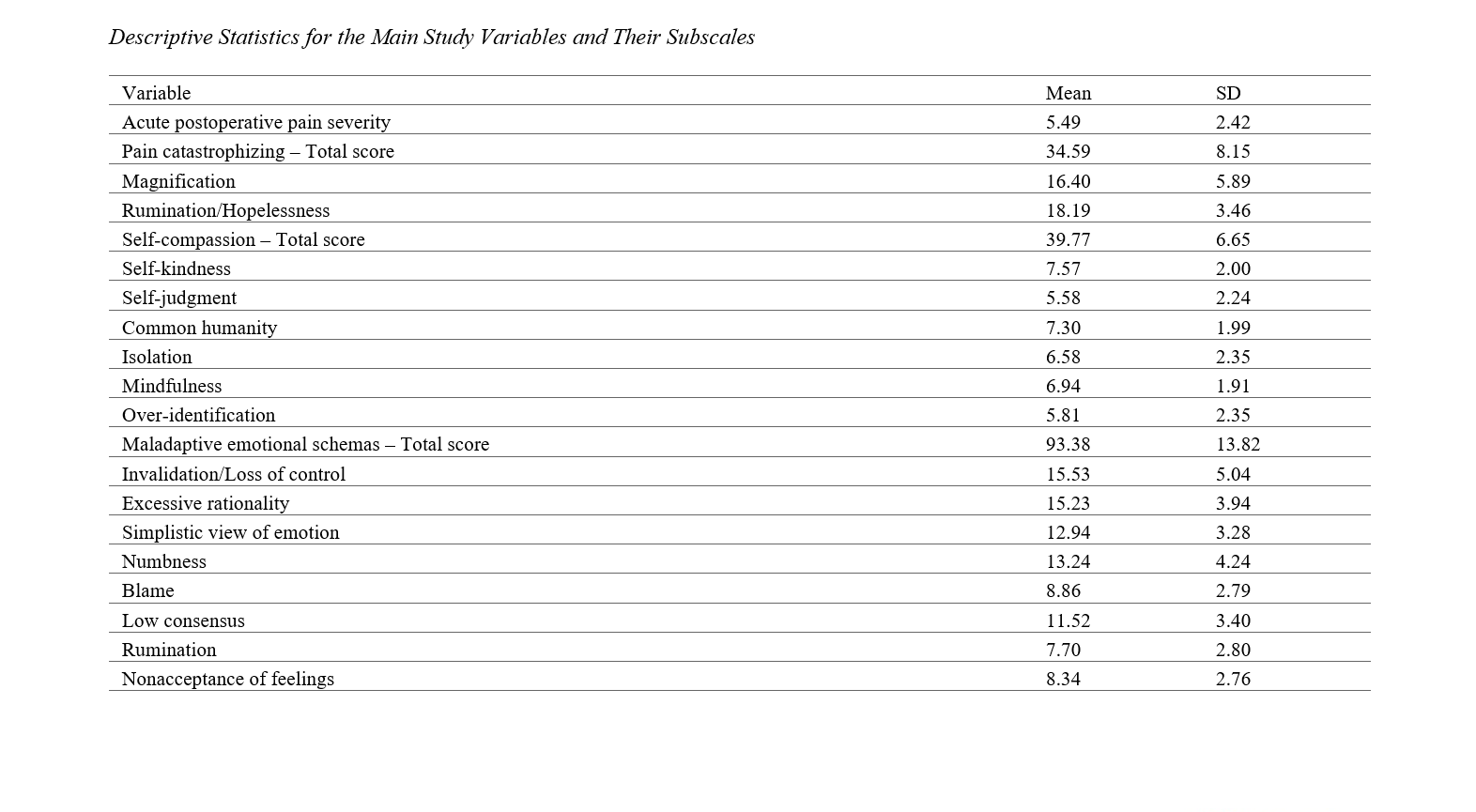
Acute postoperative pain is one of the major challenges of the postoperative period and, in addition to physiological factors, may also be influenced by patients’ cognitive and emotional characteristics. The present study aimed to predict the severity of acute postoperative pain based on pain catastrophizing, self-compassion, and emotional schemas among patients undergoing head and neck surgery at Amir A'lam Hospital. The study employed a descriptive-correlational design with a predictive approach. The statistical population consisted of patients undergoing head and neck surgery who were referred to Amir A'lam Hospital in Tehran between March and August 2026, and data from 88 patients were included in the final analysis. The research instruments included the Pain Catastrophizing Scale developed by Sullivan, Bishop, and Pivik (1995), the Short Form of the Self-Compassion Scale developed by Raes et al. (2011), the Leahy Emotional Schema Scale, and the Visual Analog Scale (VAS) for pain. The psychological questionnaires were completed before surgery, and patients’ pain intensity was measured on the first postoperative day using the VAS. Data were analyzed using Pearson’s correlation coefficient, multiple linear regression analysis, and simple linear regression analyses. The results showed that the multiple regression model including pain catastrophizing, self-compassion, and emotional schemas was statistically significant overall, F = 2.817, p = .044, and explained 9.1% of the variance in acute postoperative pain severity. However, in the simultaneous model, the independent contribution of none of the three predictor variables reached statistical significance. In the simple regression analyses, pain catastrophizing and emotional schemas significantly predicted acute postoperative pain severity, whereas self-compassion was not a significant predictor. Accordingly, the findings indicate that certain cognitive-emotional components may be associated with the severity of acute postoperative pain; however, the explanatory contribution of these factors is limited, and the findings should be interpreted alongside the physical and clinical factors affecting postoperative pain.
Downloads
References
1. Small C, Laycock H. Acute postoperative pain management. British Journal of Surgery. 2020;107(2):e70-e80. doi: 10.1002/bjs.11477.
2. Paladini A, Rawal N, Coca Martinez M, Trifa M, Montero A, Pergolizzi JV, et al. Advances in the management of acute postsurgical pain: A review. Cureus. 2023;15(8):e42974. doi: 10.7759/cureus.42974.
3. Chen X, Chu Q, Peng Y, Chen Y, Kaye AD, Liu H, et al. Clinical practice guidelines for postoperative pain management in adults (2024 edition). Journal of Anesthesia and Translational Medicine. 2025;4(3):161-85. doi: 10.1016/j.jatmed.2025.09.001.
4. Borna S, Ho OA, Gomez-Cabello CA, Haider SA, Genovese A, Prabha S, et al. Impact of demographics and psychological factors on three-day postoperative pain perception following hand surgery. Journal of Clinical Medicine. 2025;14(1):37. doi: 10.3390/jcm14010037.
5. Petrucci G, Papalia GF, Ambrosio L, Russo F, Marchetti A, De Marinis MG, et al. The influence of psychological factors on postoperative clinical outcomes in patients undergoing lumbar spine surgery: A systematic review and meta-analysis. European Spine Journal. 2025;34:1409-19. doi: 10.1007/s00586-025-08733-z.
6. Bianchini C, Malagò M, Crema L, Aimoni C, Matarazzo T, Bortolazzi S, et al. Post-operative pain management in head and neck cancer patients: Predictive factors and efficacy of therapy. Acta Otorhinolaryngologica Italica. 2016;36(2):91-6. doi: 10.14639/0392-100X-499.
7. Gould J, Leung C, McGuinness M. Efficacy of postoperative pain management in head and neck cancer patients. Journal of Otolaryngology–Head & Neck Surgery. 2018;47:40. doi: 10.1186/s40463-018-0285-3.
8. Habib DRS, Sridhar S, Suh H, Larson D, Swain BB, Vittetoe K, et al. Mental health risk factors for postoperative pain in head and neck free flap reconstruction patients. Otolaryngology–Head and Neck Surgery. 2026;175(1):86-94. doi: 10.1002/ohn.70269.
9. Rashed N, Koushanfar S, Aini P, Monadi K, Ebrahimi Y. Comparison of group schema therapy and group mindfulness-based cognitive therapy on aggression, emotional instability, and resilience in patients with acute pain in Hamadan. Anesthesiology and Pain. 2026;17(1):94-107.
10. Jouyban M, Beiglaree Kahlan M, Ahdno A, Esmakhani Akbarinejad H. Comparison of mindfulness-based cognitive therapy and solution-focused brief therapy on pain anxiety and psychological health in patients with chronic headache. Anesthesiology and Pain. 2025;16(4):65-77.
11. Zaman M, Norouzi A, Hosseini SH. The role of chronic pain acceptance, pain catastrophizing, and sleep quality in working memory performance in individuals with fibromyalgia. Anesthesiology and Pain. 2025;16(4):15-29.
12. Hajialiakbari H, Mokhtari A. Structural equation modeling of life satisfaction based on irritable bowel syndrome symptom severity and perceived stress: The mediating roles of pain catastrophizing, anxiety sensitivity, emotion regulation, and cognitive flexibility. Health Psychology. 2026;15(58):25-42. doi: 10.30473/hpj.2026.76070.6340.
13. Mirmousavi M, Homayouni A, Faezi ST, Khanekeshi A, Sadeghi J. Effectiveness of metacognitive therapy on pain catastrophizing and mental fatigue in women with lupus. Anesthesiology and Pain. 2026;17(1):108-19.
14. Usta E, Bozdemir H, Akbal S. The effect of pain catastrophizing and pain intensity on postoperative mobility in patients undergoing laparoscopic abdominal surgery: A prospective cross-sectional correlational study. Journal of PeriAnesthesia Nursing. 2026;41(3):691-8. doi: 10.1016/j.jopan.2025.09.003.
15. Wang L, Qin F, Liu H, Lu XH, Zhen L, Li GX. Pain sensitivity and acute postoperative pain in patients undergoing abdominal surgery: The mediating roles of pain self-efficacy and pain catastrophizing. Pain Management Nursing. 2024;25(2):e108-e14. doi: 10.1016/j.pmn.2023.12.001.
16. Stein AM, Hardy A, Moussa M, Bauer T, Werthel JD. Higher pain catastrophizing scale is associated with more postoperative pain within the first week after rotator cuff repair. Journal of Experimental Orthopaedics. 2025;12(3):e70359. doi: 10.1002/jeo2.70359.
17. Springborg AH, Jensen CB, Gromov K, Troelsen A, Kehlet H, Foss NB. Acute postoperative pain and catastrophizing in unicompartmental knee arthroplasty: A prospective observational cohort study. Regional Anesthesia and Pain Medicine. 2025;50(9):706-11. doi: 10.1136/rapm-2024-105503.
18. Aalders MB, van der List JP, Keijser LCM, Temmerman OPP, Benner JL. The role of pain catastrophising on subjective function and pain following total hip arthroplasty: A prospective comparative study of 531 patients with 2-year follow-up. Hip International. 2025;35(3):290-300. doi: 10.1177/11207000251325230.
19. Whitney CA, Dorfman CS, Shelby RA, Keefe FJ, Gandhi V, Somers TJ. Reminders of cancer risk and pain catastrophizing: Relationships with cancer worry and perceived risk in women with a first-degree relative with breast cancer. Families, Systems, & Health. 2019;18(1):9-18. doi: 10.1007/s10689-018-0082-6.
20. Ebrahimpour Azizi M, Hajloo N, Baghbanian M. Effectiveness of compassion-focused acceptance and commitment therapy on pain self-efficacy and pain catastrophizing in patients with multiple sclerosis: A randomized clinical trial. Iranian Journal of Psychiatry and Clinical Psychology. 2024;30(1). doi: 10.32598/ijpcp.30.1.4939.1.
21. Kamali Rouni P, Sajadian P. Effectiveness of compassion-based therapy on aging perception, self-care behaviors, and pain catastrophizing in depressed older adults. Toloo-e-Behdasht. 2024;23(5):1-17. doi: 10.18502/tbj.v23i5.17663.
22. Asadimanesh Z, Rasouli N. Effectiveness of self-compassion training on pain catastrophizing and distress tolerance in pregnant women. Rooyesh-e-Ravanshenasi. 2025;14(11):151-60.
23. Baxter R, Sirois FM. Self-compassion and psychological distress in chronic illness: A meta-analysis. British Journal of Health Psychology. 2025;30(1):e12761. doi: 10.1111/bjhp.12761.
24. Gillett JL, Rakhimov A, Karadag P, Themelis K, Ji C, Tang NKY. Self-compassion in chronic pain: Validating the Self-Compassion Scale Short-Form and exploring initial relationships with pain outcomes. British Journal of Pain. 2025;19(4):239-56. doi: 10.1177/20494637241312070.
25. Djurovic J. Psychological and physiological benefits of self-compassion for chronic illness: proposing a condition-specific self-compassion program: The Chicago School of Professional Psychology; 2020.
26. Hasanzadeh F, Aghaei Sabet SS. Self-compassion and communication skills in relation to social self-efficacy: The mediating role of self-worth in women with chronic pain. Psychological Studies. 2026;22(1):7-23. doi: 10.22051/psy.2025.49795.3100.
27. Ardalanifarsa F, Shahabizadeh F, Hashemi SM, Dadkhah P. A model of pain outcomes in patients with chronic low back pain based on mood and anxiety symptoms and emotional schemas: The mediating roles of experiential avoidance and self-compassion. Shenakht Journal of Psychology and Psychiatry. 2022;9(5):40-54.
28. Trunfio F, Berardicurti O, Bruni R, Currado D, Biticchi B, Corberi E, et al. Mapping emotional function in fibromyalgia: Integrating alexithymia, pain catastrophizing, and self-compassion. Therapeutic Advances in Musculoskeletal Disease. 2026;18:1759720X261421707. doi: 10.1177/1759720X261421707.
29. Badakhshan M, Sarafraz MR, Imani M. Effectiveness of self-compassion intervention on impulsivity in students experiencing romantic breakup. Journal of Psychology. 2022;26(4):376-85.
30. Leahy RL. Emotional schema therapy: A meta-experiential model. Australian Psychologist. 2016;51(2):82-8. doi: 10.1111/ap.12142.
31. Abdollahpour S, Dehghani Arani F, Farahani H. The relationship between emotional schemas and intolerance of uncertainty with the mediating role of experiential avoidance in women. Applied Psychological Research. 2025;16(1):99-113. doi: 10.22059/japr.2025.369882.644823.
32. Topaloğlu MS, Puşuroğlu M. The effect of metacognitive and emotional schemas on the severity of symptoms in patients with fibromyalgia. Diagnostics. 2026;16(5):696. doi: 10.3390/diagnostics16050696.
33. Dehestani F, Mirzaeian B, Hasanzadeh R, Saadat P. Effectiveness of acceptance and commitment therapy on pain coping strategies and pain self-efficacy in patients with chronic neuropathic pain. Scientific Journal of Kurdistan University of Medical Sciences. 2022;27(6):97-112. doi: 10.61186/sjku.27.6.97.
34. Gholamzadeh S, Kiani G, Jarareh J. Structural equation modeling of perceived chronic skeletal pain symptoms based on empathy and perceived social support: The mediating role of mentalization in individuals with muscular problems. Anesthesiology and Pain. 2025;16(2):51-66.
35. Razavi M, Ghazi A, Hosseini MS. Comparison of intravenous acetaminophen and ketorolac with a fentanyl pump for controlling pain after cesarean section under spinal anesthesia: A comparative study. Medical Journal of Tabriz University of Medical Sciences. 2025;47(4):401-11. doi: 10.34172/mj.025.33827.
36. Delshad MH, Hoghooghi A, Ghosouri A, Honarmand A, Nazemraaya B, Khanjani S. Comparing the preventive effect of surgical incision infiltration with bupivacaine versus bupivacaine with dexmedetomidine on postoperative pain after cesarean section. Journal of Isfahan Medical School. 2025;43(803):63-71. doi: 10.48305/jims.v43.i803.0063.
Downloads
Publication Timeline
- Submitted
- Revised
- Accepted