Structural Modeling of Functional Disability Severity Based on Health-Promoting Lifestyle and Distress Tolerance: The Mediating Role of Ego Strength in Patients with Functional Gastrointestinal Disorders
Keywords:
functional disability severity, health-promoting lifestyle, distress tolerance, ego strength, functional gastrointestinal disorders.Abstract
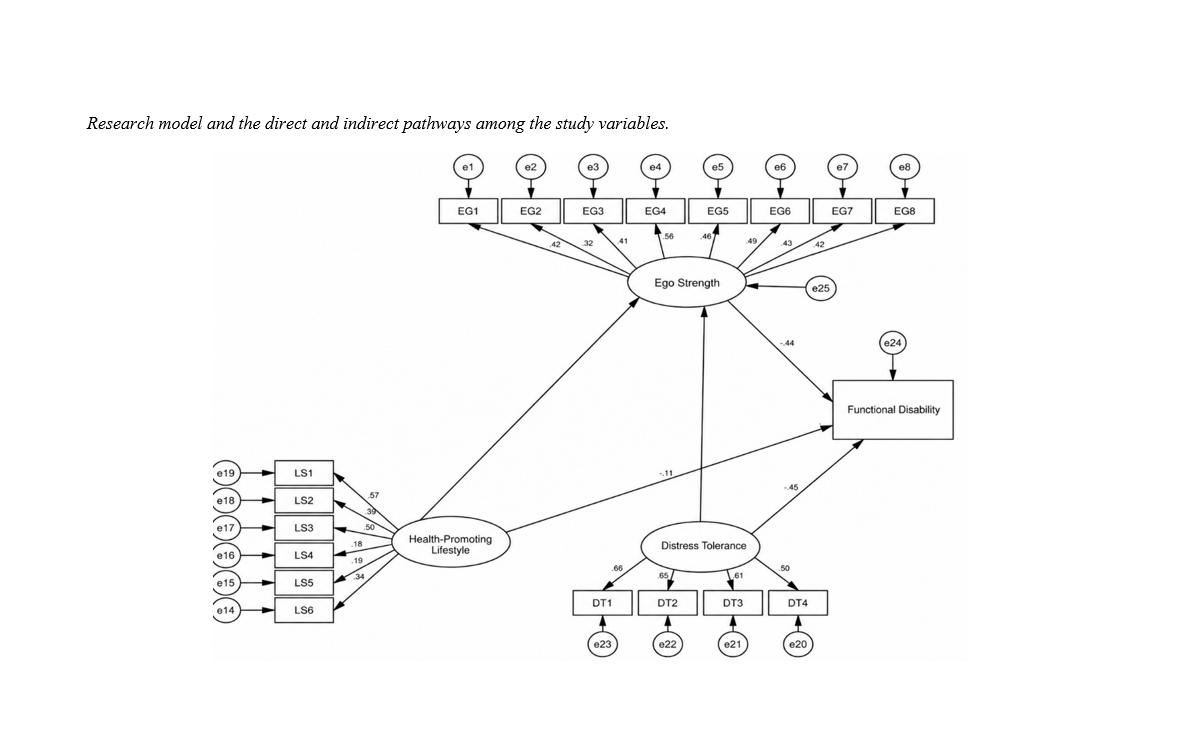
Functional gastrointestinal disorders are common, multifactorial conditions that, in addition to biological dimensions, are influenced by psychological and lifestyle factors. Therefore, examining individual and psychological factors associated with the severity of functional disability in these patients can play an important role in achieving a better understanding of these disorders and designing effective interventions. The present study aimed to examine the fit of a structural model of functional disability severity based on health-promoting lifestyle and distress tolerance, with the mediating role of ego strength, in patients with functional gastrointestinal disorders. This applied study employed a correlational design using structural equation modeling. The statistical population consisted of patients with functional gastrointestinal disorders in Tehran, from whom 350 participants were selected through convenience sampling. Data were collected using the World Health Organization Disability Assessment Schedule (2000), the Health-Promoting Lifestyle Profile developed by Walker et al. (1995), the Distress Tolerance Scale developed by Simons and Gaher (2005), and the Ego Strength Scale developed by Markstrom et al. (1997). Data were analyzed using SPSS version 27 and AMOS version 26. The structural equation modeling results indicated that the proposed model demonstrated an acceptable fit. The model fit indices were χ²/df = 1.71, RMSEA = 0.06, CFI = 0.94, NFI = 0.93, GFI = 0.94, and AGFI = 0.93, all of which indicated an adequate fit of the model to the data. Overall, the findings demonstrated that health-promoting lifestyle and distress tolerance, through the mediating role of ego strength, play important roles in explaining the severity of functional disability among patients with functional gastrointestinal disorders.
Downloads
References
1. Becker L, Schmidt K, Müller H. A Biopsychosocial Approach to Understanding Functional Gastrointestinal Disorders: Recent Advancements. Gastroenterology Review. 2026;41(2):88-104. [DOI]
2. Perry R, Adams T, Jenkins C. Biopsychosocial Models of Symptom Perception in Functional Gastrointestinal Disorders. Psychosomatic Medicine. 2022;84(7):812-20. [DOI]
3. Huang Y, Chen Z, Li X. The Spectrum of Physical Vulnerabilities in Functional Gastrointestinal Disorders: A Comprehensive Review. Gastroenterology Research and Practice. 2023;2023:987654. [DOI]
4. Timmer A. Gastrointestinal Disorders as Prevalent Non-Communicable Diseases: Family and Social Consequences. Public Health Reviews. 2023;44:160555. [DOI]
5. Yao L, Zhang H, Wang Q. Beyond Physical Damage: Predictors of Functional Disability in Chronic Pain Patients. Pain Medicine. 2022;23(8):1450-62. [DOI]
6. Kaminski M, Kowalska J, Nowak P. Dimensions of a Health-Promoting Lifestyle and Their Impact on Functional Health. Preventive Medicine Reports. 2022;28:101850. [DOI]
7. Asio JMR. Health-Promoting Lifestyle Behaviors and Psychological Empowerment Among Adults with Chronic Conditions. Health Education Research. 2024;39(2):145-58. [DOI]
8. Farahani A, Shirazi M, Karimi Y. Psychological Distress and Lifestyle Modifications in Patients with Chronic Illness. Journal of Health Psychology. 2023;28(4):512-24. [DOI]
9. Lipman S, Cohen J, Davis M. Health-Promoting Behaviors and Perceived Control in Patients with Chronic Pain and Digestive Disorders. Annals of Behavioral Medicine. 2024;58(6):405-16. [DOI]
10. Yu H, Chen X, Wang Y. Physical Activity, Subjective Well-Being, and Health Outcomes in Chronic Care: A Structural Equation Modeling Approach. Quality of Life Research. 2026;35(2):345-58. [DOI]
11. Taghiloo S, Moradi A, Hassani F. Lifestyle Adjustments and Social Embarrassment in Functional Disabilities. Social Science & Medicine. 2025;310:115200. [DOI]
12. Singh P, Sharma R, Gupta K. Psychological Resources and Health Behaviors: Moderating Effects on Chronic Illness Outcomes. Behavioral Medicine. 2023;49(3):210-22. [DOI]
13. Akbari M, Spada MM, Roshanfekr S, Ghasemi F. Distress Tolerance and Psychological Well-Being in Patients with Chronic Gastrointestinal Symptoms. Journal of Clinical Psychology in Medical Settings. 2022;29(3):415-24. [DOI]
14. Mohammadi S, Zare H, Ahmadi M. The Role of Distress Tolerance in the Treatment Process of Chronic Diseases. Iranian Journal of Health Psychology. 2022;5(1):34-45.
15. McDonald S, Young A, Lancaster J. Emotion Regulation and Distress Tolerance in the Management of Chronic Pain. Pain Management Nursing. 2022;23(1):54-61. [DOI]
16. Tang Y, Teh C, Lee K. Cognitive Appraisals and Coping Styles in Gastrointestinal Distress: A Cross-Sectional Study. Digestive Diseases and Sciences. 2023;68(5):1845-55. [DOI]
17. Tarar MA, Khan S, Ali Z. Health Anxiety and Avoidant Coping in Functional Somatic Syndromes. Journal of Psychosomatic Research. 2023;165:111142. [DOI]
18. Rafiepour A, Moradi B, Zare M. The Mediating Role of Distress Tolerance in the Relationship Between Cognitive Appraisal and Functional Disability. Iranian Journal of Psychiatry and Behavioral Sciences. 2025;19(1):e135402.
19. Wilcox G. Emotional Skills and Mental Health Preservation in Chronic Stress. Journal of Affective Disorders. 2023;320:112-20. [DOI]
20. Razzaghpour M, Ghasemi N, Shafiei Z. Self-Competence as a Predictor of Successful Coping in Chronic Medical Conditions. Journal of Psychosomatic Research. 2025;170:111300. [DOI]
21. Živković M, Petrović J, Ilić N. Self-Efficacy and Functional Disability in Chronic Illness: A Meta-Analysis. Health Psychology Review. 2023;17(4):512-30. [DOI]
22. Amayreh A, Al-Qudah A, Bani-Issa W. Self-Efficacy and Coping Strategies in Managing Chronic Illness: A Systematic Review. Journal of Health Psychology. 2025;30(1):112-28. [DOI]
23. Baidhoui M, Sghaier A, Lamine S. The Role of Self-Efficacy in Mediating the Relationship Between Illness Perception and Quality of Life in Chronic Functional Disorders. Psychology, Health & Medicine. 2024;29(4):670-82. [DOI]
24. Zhu L, Zhang Y, Liu H. Self-Efficacy and Self-Management Behaviors as Mediators Between Disease Activity and Health-Related Quality of Life in GI Disorders. Gastroenterology Nursing. 2025;48(1):45-54. [DOI]
25. Volaric M, Kovac P, Horvat L. Distress Tolerance and Ego Strength in Functional Disability of Gastrointestinal Patients. Digestive Diseases and Sciences. 2026;71(3):890-902. [DOI]
Downloads
Publication Timeline
- Submitted
- Revised
- Accepted