
Effectiveness of Cognitive-Behavioral Therapy on Perceived Pain and Sleep Quality in Patients with Fibromyalgia
DOI:
https://doi.org/10.61838/kman.pwj.4541Keywords:
cognitive-behavioral therapy, pain perception, sleep quality, fibromyalgiaAbstract
Objective: The present study aimed to evaluate the effectiveness of cognitive-behavioral therapy (CBT) on perceived pain and sleep quality among patients with fibromyalgia.
Methods and Materials: This research employed a quasi-experimental design with a pretest–posttest format, a control group, and a three-month follow-up period. The statistical population consisted of all patients with fibromyalgia who referred to the rehabilitation clinic of Modarres Hospital in Tehran during 2023–2024. Using purposive sampling, 45 participants were selected and randomly assigned to three equal groups of 15. Data were collected using the Pain Perception Questionnaire (McGill, 2009) and the Pittsburgh Sleep Quality Index (Buysse et al., 1989). The CBT intervention was conducted across 10 weekly sessions, each lasting 90 minutes. Participants in the control group did not receive any psychological intervention during this period. Data analysis was performed using descriptive statistics and mixed analysis of variance (ANOVA) with repeated measures.
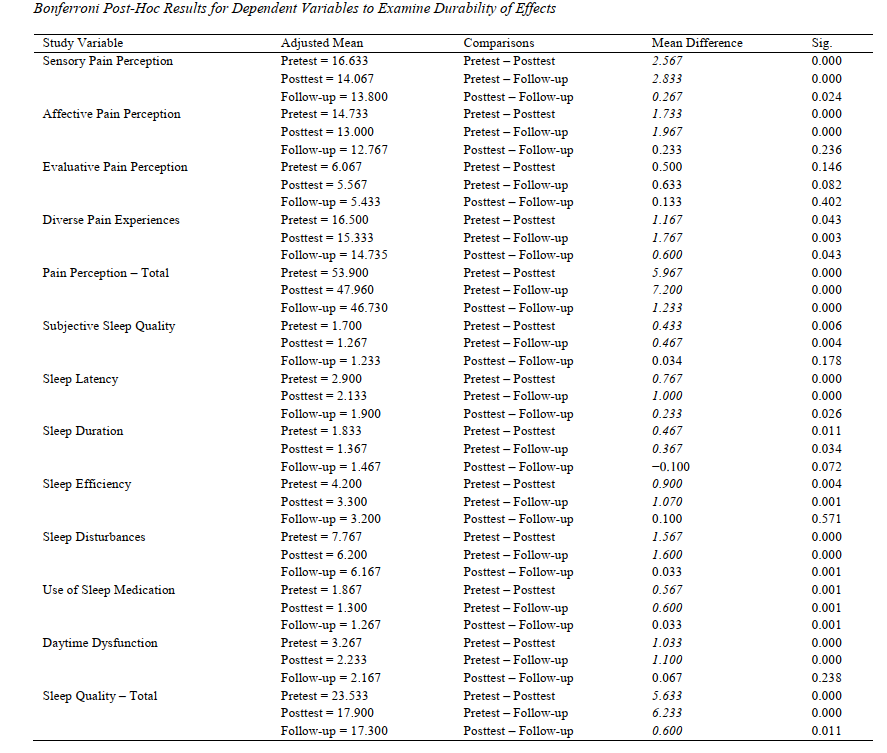
Findings: The findings indicated that CBT significantly reduced perceived pain (F = 107.539, η² = 0.349) and improved sleep quality (F = 190.376, η² = 0.427) in patients with fibromyalgia (p < .05).
Conclusion: The results support the efficacy of cognitive-behavioral therapy in alleviating perceived pain and enhancing sleep quality among individuals with fibromyalgia. These findings underscore the importance of psychological and behavioral factors in the management of fibromyalgia and highlight the potential of CBT as an effective complementary intervention to improve patients’ overall functioning and quality of life.
Downloads
References
Alaiti, R. K., Castro, J., Lee, H., Caneiro, J. P., Vlaeyen, J. W., Kamper, S. J., & Da Costa, M. F. (2022). What Are the Mechanisms of Action of Cognitive-Behavioral, Mind-Body, and Exercise-based Interventions for Pain and Disability in People With Chronic Primary Musculoskeletal Pain?: A Systematic Review of Mediation Studies From Randomized Controlled Trials. The Clinical Journal of Pain, 38(7), 502-509. https://doi.org/10.1097/AJP.0000000000001047
Aslan Çİn, N. N., Açik, M., Tertemİz, O. F., Aktan, Ç., Akçali, D. T., Çakiroğlu, F. P., & Özçelİk, A. Ö. (2024). Effect of prebiotic and probiotic supplementation on reduced pain in patients with fibromyalgia syndrome: A double-blind, placebo-controlled randomized clinical trial. Psychology, Health & Medicine, 29(3), 528-541. https://doi.org/10.1080/13548506.2023.2216464
Burns, J. W., Lumley, M. A., Vowles, K. E., Jensen, M. P., Day, M. A., Schubiner, H., Jaszczak, E., Abro, B., Addicks, S. H., Bordieri, M. J., Dow, M. M., Krohner, S., Mendoza, Z., Meyer, E. C., Miro, D. Z., Tankha, H., Tubman, D. S., Yamin, J. B., & You, D. S. (2025). Comparative main effects, mediators, and moderators of cognitive behavioral therapy, acceptance and commitment therapy, and emotional awareness and expression therapy for chronic spinal pain: Randomized controlled trial rationale and protocol. Contemporary Clinical Trials Communications, 101428. https://doi.org/10.1016/j.conctc.2025.101428
Castel, A., Salvat, M., Sala, J. M., & Rull, M. (2008). Cognitive‐behavioural Group Treatment With Hypnosis: A Randomized Pilot Trail in Fibromyalgia. Contemporary Hypnosis, 26(1), 48-59. https://doi.org/10.1002/ch.372
Climent-Sanz, C., Hamilton, K. R., Martínez-Navarro, O., Briones-Vozmediano, E., Gracia-Lasheras, M., Fernández-Lago, H., Valenzuela-Pascual, F., & Finan, P. H. (2024). Fibromyalgia pain management effectiveness from the patient perspective: a qualitative evidence synthesis. Disability and Rehabilitation, 46(20), 4595-4610. https://doi.org/10.1080/09638288.2023.2280057
Cojocaru, C. M., Popa, C. O., Schenk, A., Suciu, B. A., & Szasz, S. (2024). Cognitive-behavioral therapy and acceptance and commitment therapy for anxiety and depression in patients with fibromyalgia: a systematic review and meta-analysis. Medicine and Pharmacy Reports, 97(1), 26. https://doi.org/10.15386/mpr-2661
Delasas, G. E., Delgado, N. M., Mojica, I. K., Ragasa, S., Manlapaz, D., & Dones Iii, V. (2025). Effectiveness of cognitive behavioral therapy versus conservative pain management on occupational performance in patients with low back pain: a systematic review protocol. JBI Evidence Synthesis. https://doi.org/10.11124/JBIES-23-00480
Erdrich, S., & Harnett, J. E. (2025). Fibromyalgia severity and symptoms are associated with the disorders of gut-brain interaction. European Journal of Pain, 29(1), e4766. https://doi.org/10.1002/ejp.4766
Erickson, A. J., Rodriguez, J. C., Ravyts, S. G., Dzierzewski, J. M., Fung, C. H., Kelly, M. R., Ryden, A. M., Carlson, G. C., Josephson, K., Mitchell, M. N., Martin, J. L., & Alessi, C. A. (2024). The effectiveness of cognitive behavioral therapy for insomnia on sleep outcomes in the context of pain among older adult veterans. Journal of the American Geriatrics Society. https://doi.org/10.1111/jgs.18910
Favretti, M., Iannuccelli, C., & Di Franco, M. (2023). Pain Biomarkers in Fibromyalgia Syndrome: Current Understanding and Future Directions. International Journal of Molecular Sciences, 24(13), 10443. https://doi.org/10.3390/ijms241310443
Fors, E. A., Wensaas, K. A., & Helvik, A. S. (2024). Prevalence and characteristics of fibromyalgia according to three fibromyalgia diagnostic criteria: A secondary analysis study. Scandinavian journal of pain, 24(1), 20230143. https://doi.org/10.1515/sjpain-2023-0143
He, D., Guo, Z., McClure, M. A., Mu, Q., & Jiang, B. (2023). Cognitive-behavioral therapy for insomnia with objective short sleep duration phenotype: A systematic review with meta-analysis. Sleep Medicine Reviews, 67, 101736. https://doi.org/10.1016/j.smrv.2022.101736
Hudson, J., Imamura, M., Robertson, C., Whibley, D., Aucott, L., Gillies, K., Manson, P., Dulake, D., Abhishek, A., Tang, N. K. Y., Macfarlane, G. J., & Brazzelli, M. (2025). Effects of Pharmacologic and Nonpharmacologic Interventions for the Management of Sleep Problems in People With Fibromyalgia: Systematic Review and Network Meta‐Analysis of Randomized Controlled Trials. Arthritis care & research. https://doi.org/10.1002/acr.25505
Kalbadi Nezhad, M., Asadi, J., Pourasghar, M., & Aghaei, M. (2021). Comparing the Effectiveness of Cognitive-Behavioral Therapy and Cognitive-Behavioral Hypnotherapy on Resilience and Sleep Quality in Women with Fibromyalgia Syndrome. Ravanshenasi Journal, 10(3). https://frooyesh.ir/article-1-2762-fa.html
Kolbadinejad, M., Asadi, J., Poorasghar Arabi, M., & Aghaei, M. (2022). Comparing the Effectiveness of Cognitive Behavioral Therapy and Cognitive Behavioral Hypnotherapy on Sexual Satisfaction in Women with Fibromyalgia Syndrome: A Clinical Trial. Scientific Journal of Gorgan University of Medical Sciences, 24(1), 26-34. https://goums.ac.ir/journal/browse.php?a_id=3909&sid=1&slc_lang=en
Koulil, S. v., Lankveld, W. v., Kraaimaat, F. W., Helmond, T. v., Vedder, A., Hoorn, H. v., Donders, R., Jong, A. J. L. D., Haverman, J. F., Korff, K. J., Riel, P. L. C. M. v., Cats, H., & Evers, A. W. M. (2010). Tailored Cognitive–behavioral Therapy and Exercise Training for High‐risk Patients With Fibromyalgia. Arthritis care & research. https://doi.org/10.1002/acr.20268
Kozel, G., Leary, O. P., Losee, Y., Ma, K. L., Carayannopoulos, A. G., Morris, J., & McLaughlin, E. (2024). Trends in engagement with cognitive-behavioral therapy for chronic pain conditions after referral. Translational Behavioral Medicine, 14(3), 179-186. https://doi.org/10.1093/tbm/ibad079
Küster, O. C., Laptinskaya, D., Fissler, P., Schnack, C., Zügel, M., Nold, V., Thurm, F., Pleiner, S., Karabatsiakis, A., von Einem, B., Weydt, P., Liesener, A., Borta, A., Woll, A., Hengerer, B., Kolassa, I. T., & von Arnim, C. A. F. (2017). Novel Blood-Based Biomarkers of Cognition, Stress, and Physical or Cognitive Training in Older Adults at Risk of Dementia: Preliminary Evidence for a Role of BDNF, Irisin, and the Kynurenine Pathway. J Alzheimers Dis, 59(3), 1097-1111. https://doi.org/10.3233/jad-170447
Lumley, M. A., Schubiner, H., Lockhart, N. A., Kidwell, K. M., Harte, S. E., Clauw, D. J., & Williams, D. A. (2017). Emotional awareness and expression therapy, cognitive behavioral therapy, and education for fibromyalgia: a cluster-randomized controlled trial. Pain, 158(12). https://journals.lww.com/pain/fulltext/2017/12000/emotional_awareness_and_expression_therapy,.10.aspx
Marshall, A., Rapteas, L., Burgess, J., Riley, D., Anson, M., Matsumoto, K., Bennett, A., Kaye, S., Marshall, A., Dunham, J., Fallon, N., Zhao, S. S., Pritchard, A., Goodson, N., Malik, R. A., Goebel, A., Frank, B., & Alam, U. (2024). Small fibre pathology, small fibre symptoms and pain in fibromyalgia syndrome. Scientific reports, 14(1), 3947. https://doi.org/10.1038/s41598-024-54365-6
McCrae, C. S., Williams, J., Roditi, D., Anderson, R., Mundt, J. M., Miller, M. B., & Robinson, M. E. (2019). Cognitive behavioral treatments for insomnia and pain in adults with comorbid chronic insomnia and fibromyalgia: clinical outcomes from the SPIN randomized controlled trial. Sleep, 42(3), zsy234. https://doi.org/10.1093/sleep/zsy234
Murphy, J. L., Cordova, M. J., & Dedert, E. A. (2022). Cognitive behavioral therapy for chronic pain in veterans: Evidence for clinical effectiveness in a model program. Psychological Services, 19(1), 95. https://doi.org/10.1037/ser0000506
Nakao, M., Shirotsuki, K., & Sugaya, N. (2021). Cognitive–behavioral therapy for management of mental health and stress-related disorders: Recent advances in techniques and technologies. BioPsychoSocial Medicine, 15(1), 16. https://doi.org/10.1186/s13030-021-00219-w
Ozgunay, S. E., Kasapoglu Aksoy, M., Deniz, K. N., Onen, S., Onur, T., Kilicarslan, N., Eminoglu, S., & Karasu, D. (2024). Effect of hypnosis on pain, anxiety, and quality of life in female patients with fibromyalgia: Prospective, randomized, controlled study. International Journal of Clinical and Experimental Hypnosis, 72(1), 51-63. https://doi.org/10.1080/00207144.2023.2277853
Pathak, A., Kelleher, E. M., Brennan, I., Amarnani, R., Wall, A., Murphy, R., Lee, H., Fordham, B., & Irani, A. (2025). Treatments for enhancing sleep quality in fibromyalgia: a systematic review and meta-analysis. Rheumatology, keaf147. https://doi.org/10.1093/rheumatology/keaf147
Ribatti, R. M., Merten, T., Lanciano, T., & Curci, A. (2025). Detecting simulated symptoms in chronic pain and fibromyalgia: A two-study evaluation of the Italian version of the Self-Report Symptom Inventory. Applied Neuropsychology: Adult, 1-9. https://doi.org/10.1080/23279095.2025.2475951
Sanabria-Mazo, J. P., Colomer-Carbonell, A., Fernández-Vázquez, Ó., Noboa-Rocamora, G., Cardona-Ros, G., McCracken, L. M., Montes-Pérez, A., Castaño-Asins, J. R., Edo, S., Borràs, X., Sanz, A., Feliu-Soler, A., & Luciano, J. V. (2023). A systematic review of cognitive behavioral therapy-based interventions for comorbid chronic pain and clinically relevant psychological distress. Frontiers in psychology, 14, 1200685. https://doi.org/10.3389/fpsyg.2023.1200685
Zinchuk, M., Kustov, G., Tumurov, D., Zhuravlev, D., Bryzgalova, Y., Spryshkova, M., Yakovlev, A., & Guekht, A. (2025). Fibromyalgia in patients with non‐psychotic mental disorders: Prevalence, associated factors and validation of a brief screening instrument. European Journal of Pain, 29(2), e4730. https://doi.org/10.1002/ejp.4730
Downloads
Additional Files
Publication Timeline
- Submitted
- Revised
- Accepted