The Effectiveness of Repetitive Transcranial Magnetic Stimulation on Resilience and Negative Meta-Emotion in Infertile Women with Obsessive–Compulsive Disorder
DOI:
https://doi.org/10.61838/kman.pwj.4448Keywords:
repetitive transcranial magnetic stimulation, resilience, negative meta-emotionAbstract
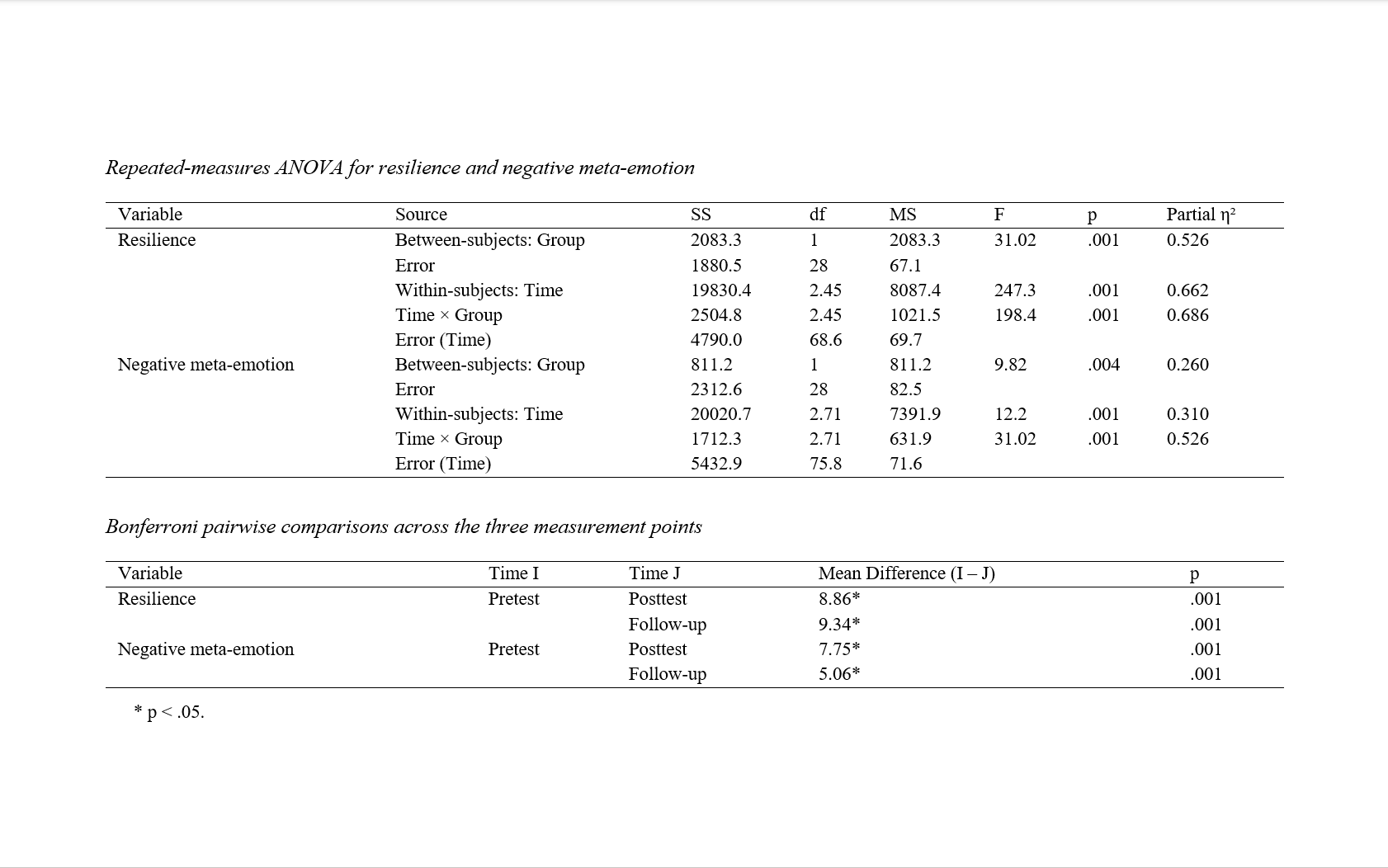
The present study aimed to determine the effectiveness of repetitive transcranial magnetic stimulation (rTMS) on resilience and negative meta-emotion in infertile women with obsessive–compulsive disorder (OCD). This quasi-experimental research employed a pretest–posttest control-group design with a three-month follow-up. The statistical population comprised all infertile women with OCD who attended treatment centers in Tehran in 2024. Participants were randomly assigned to experimental and control groups. Before the intervention, all participants completed the Connor–Davidson Resilience Scale (CD-RISC; 2003). The experimental group then received an rTMS intervention delivered in six weekly 90-minute sessions. Data were analyzed using repeated-measures ANOVA. Results indicated a significant difference between pretest and posttest across groups (p < .05). Additionally, for both resilience and negative meta-emotion, significant between-group differences were observed at posttest and at follow-up (p < .05). These findings suggest that rTMS can effectively enhance resilience and reduce negative meta-emotion in infertile women with OCD.
Downloads
References
Araya, B. M., Velez, M. P., Alemu, K., Dyer, S., Andualem, H. T., & Aldersey, H. M. (2025). The complex lived experience of women with infertility in Ethiopia: An interpretative phenomenologic analysis. International Journal of Gynecology & Obstetrics. https://doi.org/10.1002/ijgo.70001
Archetti, C. (2024). Infertility as trauma: Understanding the lived experience of involuntary childlessness. Culture, Medicine, and Psychiatry, 48(4), 940-960. https://doi.org/10.1007/s11013-024-09871-7
Arias González, V. B., Crespo Sierra, M. T., Arias Martínez, B., Martínez-Molina, A., & Ponce, F. P. (2015). An in-depth psychometric analysis of the Connor-Davidson Resilience Scale: calibration with Rasch-Andrich model. Health and Quality of Life Outcomes, 13, 1-12. https://doi.org/10.1186/s12955-015-0345-y
Asadiof, F., Safarpour, B., Barabadi, S., Karkargh, F. K., Janbozorgi, A., Khayayi, R., & Haghani, K. (2024). Exploring the comparative efficacy of reality and paradox therapy in treating post-traumatic stress disorder in traumatized adolescents: an analytical review. Contemporary Readings in Law & Social Justice, 16, 645. https://heinonline.org/hol-cgi-bin/get_pdf.cgi?handle=hein.journals/conreadlsj16§ion=51
Chen, X., Hao, X., Xie, L., & Liu, X. (2024). A bidirectional causal relationship study between mental disorders and male and female infertility. Frontiers in Psychiatry, 15, 1378224. https://doi.org/10.3389/fpsyt.2024.1378224
Feng, J., Wu, Q., Liang, Y., Liang, Y., & Bin, Q. (2025). Epidemiological characteristics of infertility, 1990-2021, and 15-year forecasts: an analysis based on the global burden of disease study 2021. Reproductive Health, 22(1), 26. https://doi.org/10.1186/s12978-025-01966-7
Kashyap, S., & Tripathi, P. (2025). 'Are you pregnant? If not, why not?': artificial reproductive technology and the trauma of infertility. Medical Humanities, 51(1), 102-111. https://doi.org/10.1136/medhum-2023-012690
Mam-Sharifi, M., Shabanian-Avval Khansari, S., Najafi, K., Farokhi, S., & Aminpour, M. (2022). The mediating role of problem-solving strategies in the relationship between metacognitive beliefs and cognitive emotion-regulation strategies with resilience during COVID-19. Ruyesh-e Ravanshenasi (Psychological Growth), 11(4), 205-216. https://frooyesh.ir/browse.php?a_id=3727&sid=1&slc_lang=en&ftxt=1
Mendonça, D. (2024). Meta-emotions. In A Deweyan Philosophical Take on Emotions: A Layered Theory (pp. 57-73). Springer Nature Switzerland. https://doi.org/10.1007/978-3-031-63199-3_4
Mitmansgruber, H., Beck, T. N., Höfer, S., & Schüßler, G. (2009). When you don't like what you feel: Experiential avoidance, mindfulness and meta-emotion in emotion regulation. Personality and individual differences, 46(4), 448-453. https://doi.org/10.1016/j.paid.2008.11.013
Naderipour, A., Tozandejani, H., Baghirzadeh-Golmakani, Z., & Zendedel, A. (2022). Effectiveness of behavioral activation therapy on distress tolerance and dimensions of negative meta-emotions in women with multiple sclerosis. Ruyesh-e Ravanshenasi (Psychological Growth), 11(11), 125-134. https://frooyesh.ir/browse.php?a_id=4191&slc_lang=fa&sid=1&printcase=1&hbnr=1&hmb=1
Najafi-Dehaghani, J., Zangeneh-Motlagh, F., & Esmaeilzadeh, Z. (2024). Effectiveness of repetitive transcranial magnetic stimulation on distress tolerance and experiential avoidance in conflicted women attending counseling centers. Ruyesh-e Ravanshenasi (Psychological Growth), 13(12), 81-90. http://ebnesina.ajaums.ac.ir/browse.php?a_id=1375&slc_lang=fa&sid=1&ftxt=1&html=1
Saeidi-Nejad, N., Forouzandeh, M. A., Besharat, N. M., & Beni-Taba, S. M. (2024). Effectiveness of repetitive transcranial magnetic stimulation on anxiety and ego strength in mothers of premature infants. Ruyesh-e Ravanshenasi (Psychological Growth), 13(7), 61-70. https://jssu.ssu.ac.ir/browse.php?a_id=6339&sid=1&slc_lang=fa&html=1
Saeidi-Nejad, N., Forouzandeh, M. A., Besharat, N. M., & Beni-Taba, S. M. (2025). Effectiveness of repetitive transcranial magnetic stimulation on depression and ruminative response in mothers of premature infants. Journal of Health Promotion Management, 14(1), 53-64. http://journal.rums.ac.ir/browse.php?a_id=4305&sid=1&slc_lang=fa&html=1
Salehi, S., Vaziri, S., & Nasri, M. (2024). Comparing Acceptance and Commitment Therapy and the paradoxical timing program for worry in social anxiety disorder. Sadra Journal of Medical Sciences, 13(1), 138-154. https://smsj.sums.ac.ir/article_50782.html?lang=en
Sharma, A., Srivastava, R., Patel, R., Saraswathy, K. N., Puri, M., Babu, N., & Mahajan, C. (2025). Kinship support and coping with infertility: A qualitative study of women struggling with infertility from Delhi-NCR, India. Women's Studies International Forum,
Sharshar, T. (2024). The paradox of post-intensive care unit physical therapy. Intensive Care Medicine, 50(8), 1388-1389. https://doi.org/10.1007/s00134-024-07539-9
Soucie, K., Scott, S. A., Partridge, T., Hakim-Larson, J., Babb, K. A., & Voelker, S. (2024). Meta-Emotion and emotion socialization by mothers of preschoolers during storytelling tasks. Journal of Child and Family Studies, 33(5), 1618-1631. https://doi.org/10.1007/s10826-023-02736-4
Straub, V. J., & Mills, M. C. (2025). The interplay between male fertility, mental health and sexual function. Nature Reviews Urology, 22(1), 1-2. https://doi.org/10.1038/s41585-024-00936-1
Taghilu, L., Azizi Ziyabari, L. S., Khvajavand-Khoshli, A., & Damghani-Mirmohalleh, M. (2023). Comparing the effectiveness of Acceptance and Commitment Therapy (ACT) and repetitive transcranial magnetic stimulation on ego strength among nurses. Nurse and Physician in Razm, 11(38), 1-12. https://ppls.ui.ac.ir/article_27118.html
Unfer, V., Dinicola, S., & Russo, M. (2023). A PCOS paradox: does inositol therapy find a rationale in all the different phenotypes? International Journal of Molecular Sciences, 24(7), 6213. https://doi.org/10.3390/ijms24076213
Wang, H., Chen, Y., Song, C., Jiang, H., Cheng, H., Zhang, L., & Chen, W. (2025). Latent profile analysis of stigma in infertile women and its influencing factors. Asian Nursing Research. https://doi.org/10.1016/j.anr.2025.01.010
Watts, J. R., Lazzareschi, N. R., Warwick, L. A., & Gaa, M. (2025). Posttraumatic stress disorder symptoms in postsecondary students exposed to childhood psychological abuse: Exploring the role of negative meta‐emotions. Journal of Counseling & Development, 103(1), 3-14. https://doi.org/10.1002/jcad.12534
Woodward, J. T., Cirino, N. H., Copland, S., & Davoudian, T. (2024). Integrated behavioral health Care in Reproductive Medicine: how and why to include mental health professionals in infertility care teams. Clinical Obstetrics and Gynecology, 67(1), 222-232. https://doi.org/10.1097/GRF.0000000000000829
Wu, D., Zhao, Y. C., Zhang, Y., & Song, S. (2024). Contextual information needs of people in life transitions struggling with obsessive-compulsive disorder. Information Research: an international electronic journal, 29(2), 669-679. https://publicera.kb.se/ir/article/view/55507
Yin, M. X. C., Chen, X. Y., Shen, X. L., Lin, H. D., Xi, H. T., & Qiu, L. (2025). Illness anxiety, infertility stress, resilience and thyroid-stimulating hormone among infertile people undergoing ART treatment in China. Psychology & Health, 40(2), 217-230. https://doi.org/10.1007/s10815-024-03308-1
Zerwas, F. K., Ford, B. Q., John, O. P., & Mauss, I. B. (2024). Unpacking the pursuit of happiness: Being concerned about happiness but not aspiring to happiness is linked with negative meta-emotions and worse well-being. Emotion. https://doi.org/10.1037/emo0001381
Downloads
Additional Files
Publication Timeline
- Submitted
- Revised
- Accepted
Issue
Section
License
Copyright (c) 2025 Saloomeh Zorrieh (Author); Mahdieh Rahmanian (Corresponding Author); Amin Rafiepoor (Author)

This work is licensed under a Creative Commons Attribution-NonCommercial 4.0 International License.