Psychological Determinants of Intimacy Avoidance in High-Achieving Women with Attachment Insecurity
DOI:
https://doi.org/10.61838/kman.pwj.4332Keywords:
Attachment insecurity, intimacy avoidance, high-achieving women, emotional suppressionAbstract
Objective: This study aimed to explore the psychological factors that contribute to intimacy avoidance in high-achieving women with attachment insecurity.
Methods and Materials: A qualitative research design was employed using semi-structured, in-depth interviews with 18 high-achieving women residing in Austria who self-identified as experiencing attachment insecurity (anxious, avoidant, or disorganized). Participants were selected via purposive sampling from professional, academic, and corporate sectors. Data collection continued until theoretical saturation was achieved. All interviews were transcribed verbatim and analyzed thematically using NVivo 14 software, following Braun and Clarke’s six-phase framework. Rigor was enhanced through peer debriefing, memo writing, and member checking.
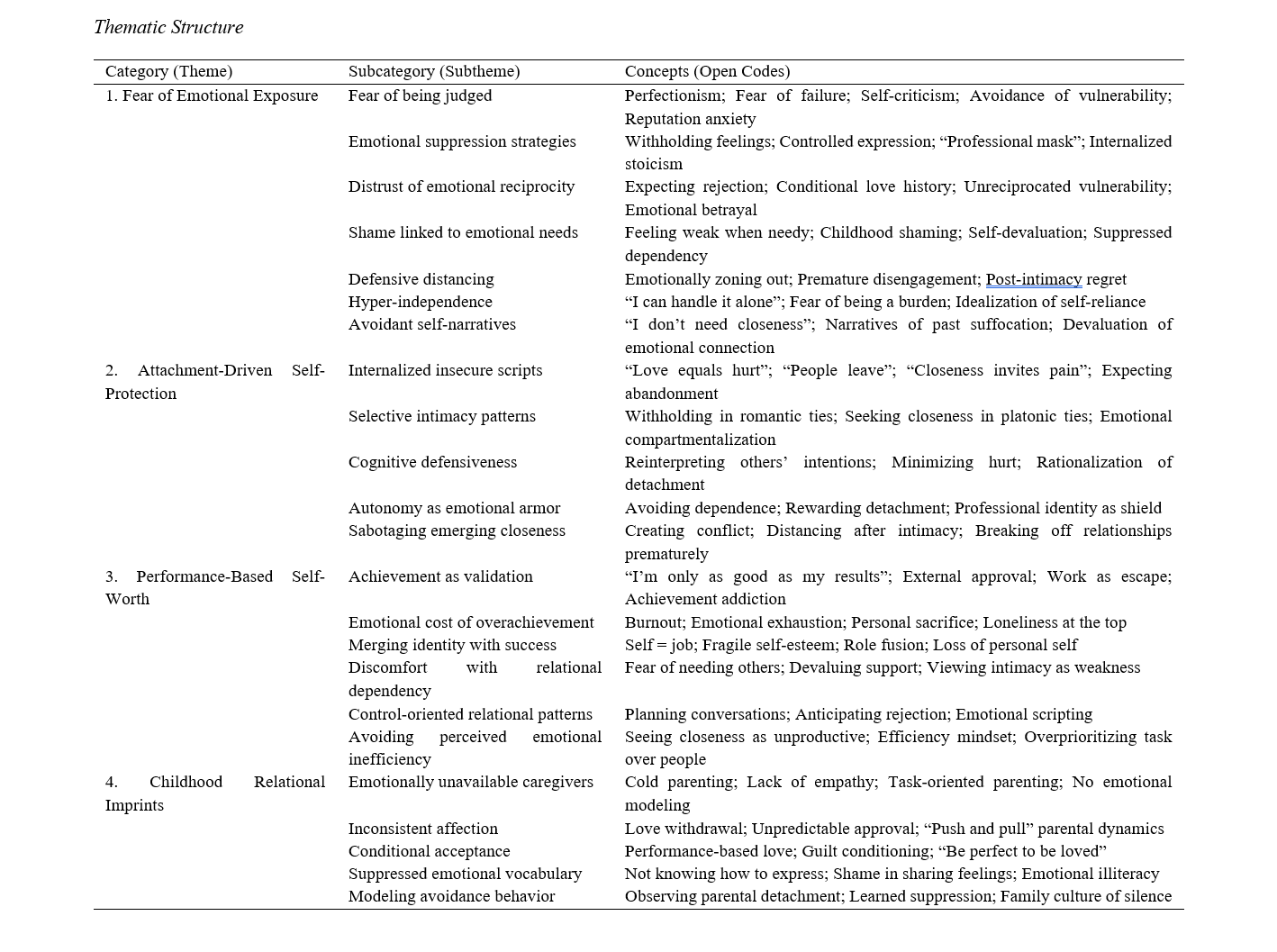
Findings: Thematic analysis revealed four overarching psychological determinants of intimacy avoidance: (1) Fear of Emotional Exposure, which included subthemes such as fear of judgment, shame linked to emotional needs, and hyper-independence; (2) Attachment-Driven Self-Protection, involving internalized insecure scripts, cognitive defensiveness, and sabotage of closeness; (3) Performance-Based Self-Worth, where participants equated emotional detachment with professional control, often prioritizing efficiency over emotional connection; and (4) Childhood Relational Imprints, characterized by emotionally unavailable caregivers, conditional affection, and suppressed emotional vocabulary.
Conclusion: This study highlights the complex interplay between attachment history, performance identity, and relational defenses in shaping intimacy avoidance in high-achieving women. Clinical interventions should address these avoidant strategies by fostering emotional literacy, challenging perfectionistic self-worth contingencies, and building secure attachment representations. The findings also underscore the need to consider gendered sociocultural factors in therapeutic work with high-functioning avoidant individuals.
Downloads
References
Bear, J. B., & Segel‐Karpas, D. (2015). Effects of Attachment Anxiety and Avoidance on Negotiation Propensity and Performance. Negotiation and Conflict Management Research, 8(3), 153-173. https://doi.org/10.1111/ncmr.12055
Cater, T., Zeigler‐Hill, V., & Besser, A. (2016). Exposure to an Infidelity Threat Manipulation. Journal of Individual Differences, 37(2), 119-127. https://doi.org/10.1027/1614-0001/a000196
Dan, O., Zreik, G., & Raz, S. (2020). The Relationship Between Individuals With Fearful-Avoidant Adult Attachment Orientation and Early Neural Responses to Emotional Content: An Event-Related Potentials (ERPs) Study. Neuropsychology, 34(2), 155-167. https://doi.org/10.1037/neu0000600
Favez, N., & Tissot, H. (2019). Fearful-Avoidant Attachment: A Specific Impact on Sexuality? Journal of sex & marital therapy, 45(6), 510-523. https://doi.org/10.1080/0092623x.2019.1566946
Gur‐Yaish, N., Cohen, D., & Shochat, T. (2019). Attachment Orientations and Sleep Patterns: The Moderating Role of Exchanges With Spouse. Journal of Social and Personal Relationships, 37(4), 1282-1295. https://doi.org/10.1177/0265407519892700
Hasim, M. J. M., Mustafa, H., & Hashim, N. H. (2023). Marital Communication During Conflict: A Study on Attachment Dimensions and Interaction Patterns. Jurnal Komunikasi Malaysian Journal of Communication, 39(1), 53-72. https://doi.org/10.17576/jkmjc-2023-3901-04
Hira, S., & Bhogal, M. S. (2020). Predicting Facebook Jealousy in Romantic Relationships: Further Support for Attachment Style and Trust. Current Psychology, 41(9), 6166-6169. https://doi.org/10.1007/s12144-020-01115-2
Leenders, M., Buunk, A. P., & Henkens, K. (2018). Attachment Avoidance and Attachment Anxiety as Individual Characteristics Affecting Job Search Behavior. Journal of Career Development, 46(5), 487-501. https://doi.org/10.1177/0894845318772091
Liu, Y., Ding, Y., Lu, L., & Chen, X. (2017). Attention Bias of Avoidant Individuals to Attachment Emotion Pictures. Scientific reports, 7(1). https://doi.org/10.1038/srep41631
Lu, S., He, Y., Li, Q., Chen, Z., & Fang, X. (2024). Dyadic Effects of Attachment Styles on Marital Satisfaction Among Chinese Couples: The Mediating Role of Perceived Partner Responsiveness. Journal of Social and Personal Relationships, 41(12), 3770-3790. https://doi.org/10.1177/02654075241277227
Maccallum, F., & Bryant, R. A. (2018). Prolonged Grief and Attachment Security: A Latent Class Analysis. Psychiatry research, 268, 297-302. https://doi.org/10.1016/j.psychres.2018.07.038
MacDonald, T. K., Wood, V. M., & Fabrigar, L. R. (2019). “Digging In” or “Giving In”: Attachment‐related Threat Moderates the Association Between Attachment Orientation and Reactions to Conflict. European Journal of Social Psychology, 49(6), 1237-1254. https://doi.org/10.1002/ejsp.2578
MacNeill, A. L., & DiTommaso, E. (2021). An Attachment Perspective on Favorite Media Figures. Psychological Reports, 125(3), 1457-1468. https://doi.org/10.1177/00332941211002142
Marks, M. J., & Vicary, A. M. (2015). The Interplay and Effectiveness of Implicit and Explicit Avoidant Defenses. Journal of Social and Personal Relationships, 33(5), 619-639. https://doi.org/10.1177/0265407515584583
Morison, M., & Benight, C. C. (2022). Trauma Coping Self-Efficacy Mediates Associations Between Adult Attachment and Posttraumatic Stress Symptoms. Frontiers in psychology, 13. https://doi.org/10.3389/fpsyg.2022.799608
Paech, J., Schindler, I., & Fagundes, C. P. (2015). Mastery Matters Most: How Mastery and Positive Relations Link Attachment Avoidance and Anxiety to Negative Emotions. Cognition & Emotion, 30(5), 1027-1036. https://doi.org/10.1080/02699931.2015.1039933
Pan, Y., Zhang, D., Liu, Y., Ran, G., & Teng, Z. (2016). The Effects of Attachment Style and Security Priming on the Perception of Others’ Pain. Journal of Social and Personal Relationships, 34(2), 184-208. https://doi.org/10.1177/0265407515627509
Park, Y., Debrot, A., Spielmann, S. S., Joel, S., Impett, E. A., & MacDonald, G. (2018). Distinguishing Dismissing From Fearful Attachment in the Association Between Closeness and Commitment. Social Psychological and Personality Science, 10(4), 563-572. https://doi.org/10.1177/1948550618768823
Quickert, R. E., & MacDonald, T. K. (2020). Being in the Moment So You Can Keep Moving Forward: Mindfulness and Rumination Mediate the Relationship Between Attachment Orientations and Negative Conflict Styles. International journal of environmental research and public health, 17(18), 6472. https://doi.org/10.3390/ijerph17186472
Rehman, U. S., Edwards, J., & McNeil, J. (2022). How Attachment Styles Predict Changes in Sexual Desire: A Study of Sexual Dynamics in COVID-19. The Canadian Journal of Human Sexuality. https://doi.org/10.3138/cjhs.2022-0026
Tammilehto, J., Kaurin, A., Bosmans, G., Kuppens, P., Flykt, M., Vänskä, M., Peltonen, K., & Lindblom, J. (2024). Everyday State Attachment: Dynamic Features and Role of Trait Attachment. Journal of personality, 93(3), 781-795. https://doi.org/10.1111/jopy.12975
Waring, A., Kernes, J. L., & Bui, N. H. (2019). The Role of Attachment Anxiety, Attachment Avoidance, and Grit on Life Satisfaction and Relationship Satisfaction. Journal of Humanistic Psychology, 63(5), 631-659. https://doi.org/10.1177/0022167819844692
Zhang, X., Ran, G., Xu, W., Ma, Y., & Chen, X. (2018). Adult Attachment Affects Neural Response to Preference-Inferring in Ambiguous Scenarios: Evidence From an fMRI Study. Frontiers in psychology, 9. https://doi.org/10.3389/fpsyg.2018.00139
Downloads
Additional Files
Publication Timeline
- Submitted
- Revised
- Accepted
Issue
Section
License
Copyright (c) 2025 Aleksandra Kowalska (Author); Lukas Gruber

This work is licensed under a Creative Commons Attribution-NonCommercial 4.0 International License.