The Effectiveness of Positive Psychotherapy on Perceived Stress, Health Anxiety, and Hope in Women with Breast Cancer
DOI:
https://doi.org/10.61838/kman.pwj.4301Keywords:
Positive psychotherapy, perceived stress, health anxiety, hope, women, breast cancerAbstract
Objective: This study aimed to investigate the effectiveness of positive psychotherapy in reducing perceived stress and health anxiety while enhancing hope among women diagnosed with breast cancer.
Methods and Materials: A randomized clinical trial with a non-equivalent group design was conducted in Tehran in 2023. The sample consisted of 30 women with breast cancer who were selected through purposive sampling and randomly assigned to one of two experimental groups receiving positive psychotherapy or a control group. The intervention consisted of ten 90-minute sessions based on Seligman’s (2006) positive psychotherapy protocol. Data were collected using the Perceived Stress Scale (PSS), the Health Anxiety Inventory (HAI), and Snyder’s Hope Scale. All assessments were performed at three stages: pretest, posttest, and a follow-up. Data analysis was performed using repeated measures ANOVA and Bonferroni post-hoc tests in SPSS v22.
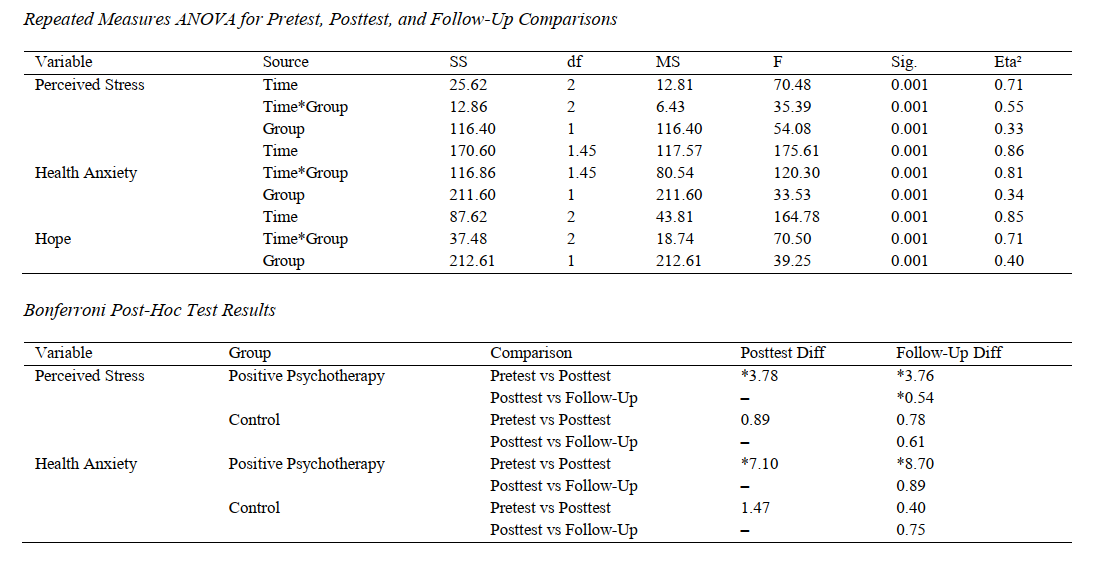
Findings: Multivariate analysis of variance indicated a significant interaction between time and group for all outcome variables (p < 0.001). Repeated measures ANOVA showed significant reductions in perceived stress (F = 70.48, p < 0.001, η² = 0.71) and health anxiety (F = 120.30, p < 0.001, η² = 0.81), and a significant increase in hope (F = 70.50, p < 0.001, η² = 0.71) in the experimental group compared to the control group. Bonferroni post-hoc tests confirmed significant improvements from pretest to both posttest and follow-up stages in all three variables for the experimental group.
Conclusion: The findings support the effectiveness of positive psychotherapy in significantly improving psychological outcomes among women with breast cancer. This intervention offers a viable therapeutic approach to mitigate stress and anxiety while fostering hope, thereby enhancing psychological well-being in this population.
Downloads
References
Alagizy, H. A., Soltan, M. R., Soliman, S. S., Hegazy, N. N., & Gohar, S. F. (2020). Anxiety, depression and perceived stress among breast cancer patients: single institute experience. Middle East Current Psychiatry, 27(1), 1-10. https://doi.org/10.1186/s43045-020-00036-x
Ali Akbari, A., Jajarmi, M., & Ghasemi Motlagh, M. (2020). The effectiveness of positive psychotherapy education on hope and psychological well-being in veterans' spouses. Nursing Education Journal, 9(4). https://jne.ir/article-1-1177-en.html
Bagheri-Shalamzari, R., & Khoshakhlagh, H. (2024). Comparison of the effectiveness of positive psychotherapy and reality therapy training on compassion fatigue and job burnout among healthcare workers during the COVID-19 pandemic. Avicenna Journal, 26(3). https://ebnesina.ajaums.ac.ir/article-1-1328-en.html
Bulut, S., Saadati, N., Al-Dossary, S. A., Coelho, O., Rostami, M., Parsakia, K., Zadhasn, Z., Seyed Ali Tabar, S. H., & Mehdi Abadi, P. (2025). Introspective Awareness and Its Predictive Power on Health Anxiety: A Cross-sectional Study. Journal of Research and Health, 15(1), 71-80. https://jrh.gmu.ac.ir/article-1-2529-fa.html
Davoodifar, F., & Esmaeilian, Z. (2024). The Effectiveness of Positive Psychotherapy on Marital Conflicts and Spiritual Wellbeing of Women With Marital Conflicts. PWJ, 5(2), 51-58. https://doi.org/10.61838/kman.pwj.5.2.8
Eskandari, M., Rezakhani, S. D., & Behboodi, M. (2021). The effectiveness of positive psychotherapy on psychological capital and emotional expression styles in women with multiple sclerosis: A pilot study. Social Health Journal, 8(2), 288-304. https://journals.sbmu.ac.ir/ch/index.php/ch/article/view/31252
Ghasemi, Z., Sajadian, E., Nadi, M. A., & Zolfaghari, S. (2021). The effectiveness of an Iranian-Islamic positive psychology therapy package on psychological well-being and distress in female high school students. Psychological Achievements Journal (Educational Sciences and Psychology), 28, 49-68. https://psychac.scu.ac.ir/article_16867.html?lang=en
Haghighi, A., Khosropour, F., & Khojasteh Chatroodi, S. (2021). The relationship between religious attitude and positivity with life expectancy in hospitalized patients in Kerman city: The mediating role of psychological hardiness and perceived stress. Rafsanjan University of Medical Sciences Journal, 20, 23-36. https://doi.org/10.52547/jrums.20.1.23
Heratirad, A., & Miri, M. (2023). The effectiveness of positive psychotherapy on hopefulness and the quality of academic life of slow-paced students: A quasi-experimental study. Journal of Rafsanjan University of Medical Sciences, 22(12), 1279EP - 1296. https://doi.org/10.61186/jrums.22.12.1279
Heydari, M., Nouri, M., & Niaei, A. M. (2023). The Effectiveness of Group Positive Psychotherapy on Psychological Well-being and Hope of Cancer Patients Undergoing Chemotherapy. Journal of Social Behavior and Community Health. https://doi.org/10.18502/jsbch.v7i1.12798
Iuso, S., Monacis, L., Nappi, L., Malerba, S., D'Andrea, G., Altamura, M., Margaglione, M., Bellomo, A., & Petito, A. (2022). Associations between personality traits, perceived stress and depressive symptoms in gynecological cancer patients characterized by the short and long allele variant of the 5-HTTLPR genotype: preliminary results. Clinical Neuropsychiatry, 19(3), 156. https://pubmed.ncbi.nlm.nih.gov/35821869/
Khorasani, A. H. (2024). Investigating the effectiveness of positive psychotherapy on cognitive flexibility and distress tolerance in divorced women. J Fam Relat Stud, 4(13), 32-39. https://doi.org/10.32598/jfrs.4.13.32
Miceli, J., Geller, D., Tsung, A., Hecht, C. L., Wang, Y., Pathak, R., Cheng, H., Marsh, W., Antoni, M., Penedo, F., Burke, L., Ell, K., Shen, S., & Steel, J. (2019). Illness perceptions and perceived stress in patients with advanced gastrointestinal cancer. Psycho-Oncology, 28(7), 1513-1519. https://doi.org/10.1002/pon.5108
Moghadam, N., Emraei, R., Asadi, F., & Amani, O. (2018). The effect of acceptance and commitment therapy on life expectancy and psychological well-being in women with breast cancer undergoing chemotherapy. Psychiatric Nursing Journal, 6(5), 1-8. https://ijpn.ir/article-1-1155-en.html
Mohammadi, R., Zebardast, A., & Rezaei, S. (2022). The Effectiveness Of Existential Psychotherapy On Psychological Capital And Affective Control In Cancer Patients Undergoing Chemotherapy. ijpn, 10(5), 82-95. https://doi.org/10.22034/IJPN.10.5.7
Mohsenabadi, H., Pirmoradi, M. R., Tajrishi, K. Z., & Gharraee, B. (2025). A Transdiagnostic Approach to Investigate of the Relationships Between Anxiety Sensitivity and Health Anxiety: The Mediated Roles of Distress Tolerance and Emotion Regulation. Frontiers in Psychiatry, 16. https://doi.org/10.3389/fpsyt.2025.1478442
MonfaredPouya, F., Malihi-Zakerini, S., Ahadi, M., Seyrafi, M. R., & Sarrafi-Foroshani, G. R. (2021). Comparing the effectiveness of metacognitive therapy and positive psychotherapy on depression symptoms, psychological well-being, and purpose in life in women with coronary artery disease. Mashhad University of Medical Sciences Journal, 64(3). https://journals.mums.ac.ir/article_19082.html
Nazemi, M., Shah Nazari, M., Ranjbaripour, T., Moshayekh, M., & Yousefi Kashi, A. S. (2023). Effectiveness of Positive Psychotherapy and Psychodrama on Resilience in Breast Cancer Patients. Mashhad University of Medical Sciences Journal, 66(4). https://mjms.mums.ac.ir/article_23696.html?lang=en
Ochoa, C., Casellas-Grau, A., Vives, J., Font, A., & Borràs, J. M. (2017). Positive psychotherapy for distressed cancer survivors: Posttraumatic growth facilitation reduces posttraumatic stress. International Journal of Clinical and Health Psychology, 17(1), 28-37. https://doi.org/10.1016/j.ijchp.2016.09.002
Peseschkian, H. (2023). Positive psychotherapy: Core principles. Current Psychiatry, 22(1), 5-9. https://doi.org/10.12788/cp.0317
Pourfaraj Emran, M., & Rezazadeh, H. (2018). The effectiveness of positive psychotherapy on happiness and life expectancy in cancer patients. Counseling and Psychotherapy Culture Quarterly, 9(33), 119-136. https://qccpc.atu.ac.ir/article_8324.html?lang=en
Salomé, G. M., de Almeida, S. A., Mendes, B., de Carvalho, M. R. F., Bueno, J. C., Massahud Jr, M. R., & Ferreira, L. M. (2017). Association of sociodemographic factors with spirituality and hope in patients with diabetic foot ulcers. Advances in skin & wound care, 30(1), 34-39. https://doi.org/10.1097/01.ASW.0000508446.58173.29
Seligman, M. E. (2019). Positive psychology: A personal history. Annual Review of Clinical Psychology, 15, 1-23. https://doi.org/10.1146/annurev-clinpsy-050718-095653
Suweni, K., Maay, J. K., Arifin, S. R., & Yousuf, A. (2023). Application of group positive psychotherapy to improve psychological well-being for people with HIV in Papua. Bali Medical Journal, 12(1), 261-266. https://doi.org/10.15562/bmj.v12i1.3960
Tavakoli, T., Rezai Dehnavi, S., & Montajabian, Z. (2020). The effectiveness of positive psychotherapy on vitality in the elderly. Aging Psychology, 6(4), 299-308. https://jap.razi.ac.ir/article_1577.html?lang=en
Walsh, S., Cassidy, M., & Priebe, S. (2017). The application of positive psychotherapy in mental health care: A systematic review. Journal of Clinical Psychology, 73(6), 638-651. https://doi.org/10.1002/jclp.22368
Downloads
Additional Files
Publication Timeline
- Submitted
- Revised
- Accepted
Issue
Section
License
Copyright (c) 2025 Hadis Karimpoorian (Author); Ezzatollah Kordmirza Nikoozadeh (Corresponding Author); Amin Rafiepoor (Author)

This work is licensed under a Creative Commons Attribution-NonCommercial 4.0 International License.