Rumination and Identity Confusion as Predictors of Emotional Exhaustion in Emerging Adult Women
DOI:
https://doi.org/10.61838/kman.pwj.6.2.18Keywords:
Emotional exhaustion, Rumination, Identity confusion, Emerging adulthood, WomenAbstract
Objective: This study aimed to investigate the predictive roles of rumination and identity confusion in emotional exhaustion among emerging adult women.
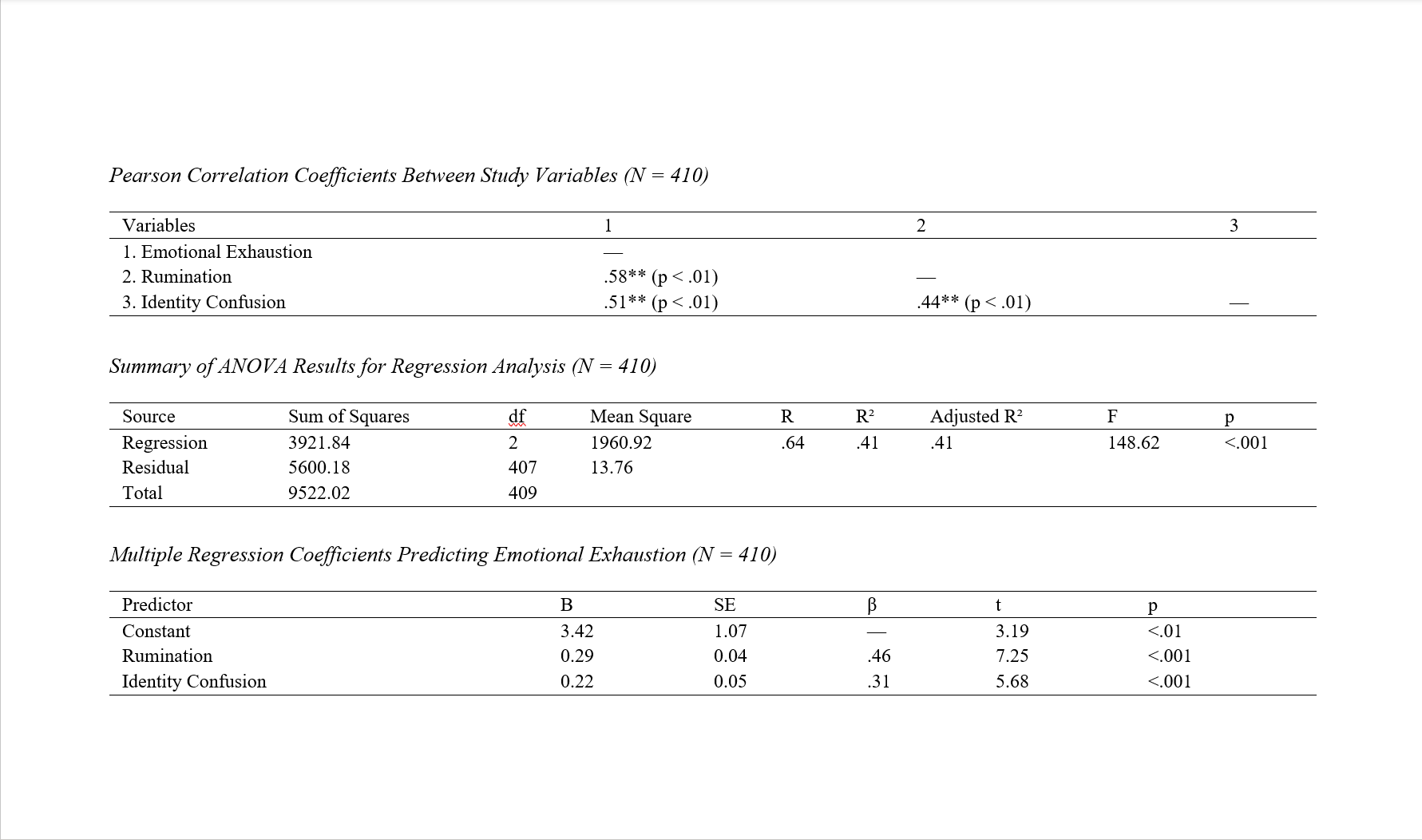
Methods and Materials: A correlational descriptive research design was employed, involving a sample of 410 emerging adult women from Egypt. The participants were selected based on Morgan and Krejcie’s sample size table to ensure adequate statistical power. Standardized self-report instruments were used to measure emotional exhaustion, rumination, and identity confusion. Data were analyzed using SPSS version 27. Descriptive statistics were calculated, and Pearson correlation coefficients were computed to examine the relationships between the dependent variable and each independent variable. A standard linear regression analysis was then conducted to assess the joint predictive value of rumination and identity confusion on emotional exhaustion, and to determine the unique contribution of each predictor.
Findings: The results indicated that both rumination (r = .58, p < .01) and identity confusion (r = .51, p < .01) were significantly and positively correlated with emotional exhaustion. Multiple regression analysis revealed a significant predictive model, F(2, 407) = 148.62, p < .001, with an R² of .41. Rumination (β = .46, p < .001) and identity confusion (β = .31, p < .001) both contributed significantly to the model, indicating that each variable uniquely predicted emotional exhaustion among the participants.
Conclusion: These findings suggest that rumination and identity confusion are critical psychological factors contributing to emotional exhaustion in emerging adult women. Interventions that target maladaptive cognitive styles and promote identity clarity may be essential in reducing emotional fatigue during this life stage.
Downloads
References
Altınay, Z., & Bicentürk, B. (2023). Constructing Sustainable Learning Ecology to Overcome Burnout of Teachers: Perspective of Organizational Identity and Locus of Control. Sustainability, 15(24), 16930. https://doi.org/10.3390/su152416930
Hsieh, K. Y., Hsiao, R. C., Yang, Y. H., Lee, K. H., & Yen, C. F. (2019). Relationship between Self-Identity Confusion and Internet Addiction among College Students: The Mediating Effects of Psychological Inflexibility and Experiential Avoidance. International journal of environmental research and public health, 3(2), 1-11. https://doi.org/10.3390/su13052680
Jain, V. (2024). Organisation Advocacy While Experiencing a Career Plateau: The Mediating Moderating Role of Emotional Exhaustion and Organisation Embeddedness. International Journal of Economics Finance and Management Sciences, 12(6), 372-380. https://doi.org/10.11648/j.ijefm.20241206.13
Jia, X., Liao, S., & Yin, W. (2022). Job Insecurity, Emotional Exhaustion, and Workplace Deviance: The Role of Corporate Social Responsibility. Frontiers in Public Health, 10. https://doi.org/10.3389/fpubh.2022.1000628
Jian-ming, W., Vo‐Thanh, T., Liu, Y.-H., Dang, V. T., & Nguyen, N. (2023). Information Confusion as a Driver Of consumer Switching Intention On social Commerce Platforms: A multi-Method Quantitative Approach. Information Technology and People, 37(1), 171-200. https://doi.org/10.1108/itp-04-2022-0284
Jiang, M., & Gu, M.-L. (2025). Influence Path of Work-Family Conflict on Primary Care Physicians’ Resignation Intention: Data From a Chinese Cross-Sectional Survey. Work, 80(1), 352-366. https://doi.org/10.3233/wor-230375
Kim, D., Park, S.-M., & Seo, J. (2024). A Study on the Determinants of Burnout Among Firefighters Using Decision Tree Analysis. National Association of Korean Local Government Studies, 26(2), 63-89. https://doi.org/10.38134/klgr.2024.26.2.063
Kim, G.-I., & Park, K. H. (2024). The Narrative on the Experience of Vicarious Trauma Experienced by Crime Victim Counselors. Korean Youth Counseling Association, 5(2), 151-174. https://doi.org/10.51613/jkyca.2024.5.2.151
Kumar, K. P. (2021). An Evaluative Study to Assess Effectiveness of Educational Package Regarding Well Being Behavior Among Adolescents in Selected Rural and Urban Areas at Aburoad in Sirohi District. International Journal of Research and Studies Publishing, 11(8), 408-411. https://doi.org/10.29322/ijsrp.11.08.2021.p11652
Li, X., Zhang, H., & Zhang, J. (2020). The Double-Edged Effects of Dual-Identity on the Emotional Exhaustion of Migrant Workers: An Existential Approach. Frontiers in psychology, 11. https://doi.org/10.3389/fpsyg.2020.01266
Li, Y., Liu, W., & Yu, G. (2022). Dancing in Shackles: The Double-Edged Sword Effect of Felt Accountability on Work Outcomes and Individual Wellbeing. Frontiers in psychology, 13. https://doi.org/10.3389/fpsyg.2022.904946
Liao, C., Li, Z., & Huang, L. (2024). How Does Psychological Contract Breach Affect Employee Silence? A Moderated Mediation Model. Sage Open, 14(4). https://doi.org/10.1177/21582440241299601
Liu, C.-E., Yuan, X., Hu, C., Liu, T., Chen, Y., & He, W. (2020). Work-Related Identity Discrepancy and Counterproductive Work Behavior: The Role of Emotional Exhaustion and Supervisor Incivility. International journal of environmental research and public health, 17(16), 5747. https://doi.org/10.3390/ijerph17165747
Nordhall, O., Knez, I., Saboonchi, F., & Willander, J. (2020). Teachers' Personal and Collective Work-Identity Predicts Exhaustion and Work Motivation: Mediating Roles of Psychological Job Demands and Resources. Frontiers in psychology, 11. https://doi.org/10.3389/fpsyg.2020.01538
Ntim, S. Y., Qin, J., Antwi, C. O., Aboagye, M. O., Chen, S., & Mensah, E. T. (2023). “I-Just-Wanna-Get-By” Hurts Teachers and Their Work: Linking Preschool Teacher Identity to Work Withdrawals in an Emerging Economy. Current Psychology, 43(3), 2783-2798. https://doi.org/10.1007/s12144-023-04494-4
Özcan, C. T., & Durukan, İ. (2011). Investigation of Various Factors Affecting Development of Identity Confusion in Male Adolescents. Taf Preventive Medicine Bulletin, 10(2), 131. https://doi.org/10.5455/pmb.20110123103101
Polat, K. (2025). Relationships Between Health Anxiety, Intolerance of Uncertainty, Rumination and Self-Compassion: A Structural Equation and Latent Profile Analysis. International Journal of Eurasia Social Sciences, 16(59), 290-313. https://doi.org/10.70736/ijoess.552
Priliyanti, S., Taujiri, M. Y., Ihsan, N. N., Khairunisa, P., & Fridayanti, F. (2024). Interethnic Marriage and Identity Confusion: a Phenomenological Study. Jurnal Psikologi Islam dan Budaya, 7(1), 69-78. https://doi.org/10.15575/jpib.v7i1.28703
Pu, B., Ji, S., & Sang, W. (2021). Customer Incivility and Employees’ Turnover Intention in China’s Hotel: A Chain Mediating Model. https://doi.org/10.21203/rs.3.rs-823478/v1
Reich, D., Mráz, P., Šída, O., & Gutermann, W. (2023). A Long History in a Short Note—identity and Typification of the Name Hippion Obtusifolium F.W. Schmidt, and Synonymy of the Species Gentianella Obtusifolia (Gentianaceae). Phytotaxa, 598(2), 157-166. https://doi.org/10.11646/phytotaxa.598.2.5
Santiago-Torner, C., Marfil, J. A. C., & Tarrats-Pons, E. (2024). Relationship Between E-Ethical Leadership and Emotional Exhaustion: A Moderated Mediation Model. https://doi.org/10.20944/preprints202408.0722.v1
Tong, Y., & Prompanyo, M. (2021). The Moderating Effect of Moral Identity on the Relationship Between Emotional Exhaustion and Budget Slack. Open Journal of Accounting, 10(03), 93-104. https://doi.org/10.4236/ojacct.2021.103008
Verschueren, M., Claes, L., Palmeroni, N., Raemen, L., Buelens, T., Moons, P., & Luyckx, K. (2021). Identity Functioning and Eating Disorder Symptomatology: The Role of Cognitive Emotion Regulation Strategies. Frontiers in psychology, 12. https://doi.org/10.3389/fpsyg.2021.667235
Wang, Y. (2023). A Study on the Effect of Emotional Exhaustion on Service Initiative Behavior of Hotel Front-Line Employees--The moderating effect of Organizational Identity. 202-211. https://doi.org/10.2991/978-94-6463-298-9_22
Wang, Y. (2025). Exploring the Relations Between Body Dissatisfaction, Rumination, Physical Activity, and Restrained Eating: A Latent Moderated Structural Equation Approach. Journal of eating disorders, 13(1). https://doi.org/10.1186/s40337-025-01229-7
Wang, Y., Xia, Q., Yue, H., & Teng, W. (2024). Chinese Rural Kindergarten Teachers’ Work–Family Conflict and Their Turnover Intention: The Role of Emotional Exhaustion and Professional Identity. Behavioral Sciences, 14(7), 597. https://doi.org/10.3390/bs14070597
Yin, J., Ni, Y., Fan, Y., & Chen, Y. H. (2023). Navigating Unpleasant Interactions: The Influence of Customer Mistreatment on Hospitality Employee Responses Employing Mindfulness as a Moderator. Sustainability, 15(19), 14288. https://doi.org/10.3390/su151914288
Yue, Y. (2024). Exploring Role of Physical Activity and Emotional Exhaustion to Improve Preventive Health Behavior Among Students of Chinese Colleges. American Journal of Health Behavior, 48(6), 1692-1701. https://doi.org/10.5993/ajhb.48.6.20
Zhang, G., Peng, K., & Chen, S. (2022). The Double‐edged Sword Effect of High‐performance Work Systems: Investigating When and Why High‐performance Work Systems Promote Versus Inhibit Employee Organizational Citizenship Behaviors. Asia Pacific Journal of Human Resources, 61(1), 168-195. https://doi.org/10.1111/1744-7941.12326
Zhang, P. (2023). “What Do I Feel? Who Am I?”: Exploring Secondary School EFL Student Teachers’ Emotion Labor in Identity Construction From a Post-Structuralist Perspective. English Language Teaching and Linguistics Studies, 5(4), p235. https://doi.org/10.22158/eltls.v5n4p235
Zhao, S. (2025). Relationship Between Purposeful Rumination and Post-Traumatic Growth of College Students Who Experienced Childhood Trauma: A Regulated Intermediary Model. https://doi.org/10.20944/preprints202501.1481.v1
Zyl-Cillié, M. v., Bührmann, J. H., Blignaut, A. J., Demirtas, D., & Coetzee, S. K. (2024). A Machine Learning Model to Predict the Risk Factors Causing Feelings of Burnout and Emotional Exhaustion Amongst Nursing Staff in South Africa. BMC Health Services Research, 24(1). https://doi.org/10.1186/s12913-024-12184-5
Downloads
Additional Files
Publication Timeline
- Submitted
- Revised
- Accepted
Issue
Section
License

This work is licensed under a Creative Commons Attribution-NonCommercial 4.0 International License.