
Cognitive Fusion as a Mediator Between Anxiety Sensitivity and Avoidant Coping in Young Women
DOI:
https://doi.org/10.61838/kman.pwj.6.2.15Keywords:
Cognitive Fusion, Anxiety Sensitivity, Avoidant CopingAbstract
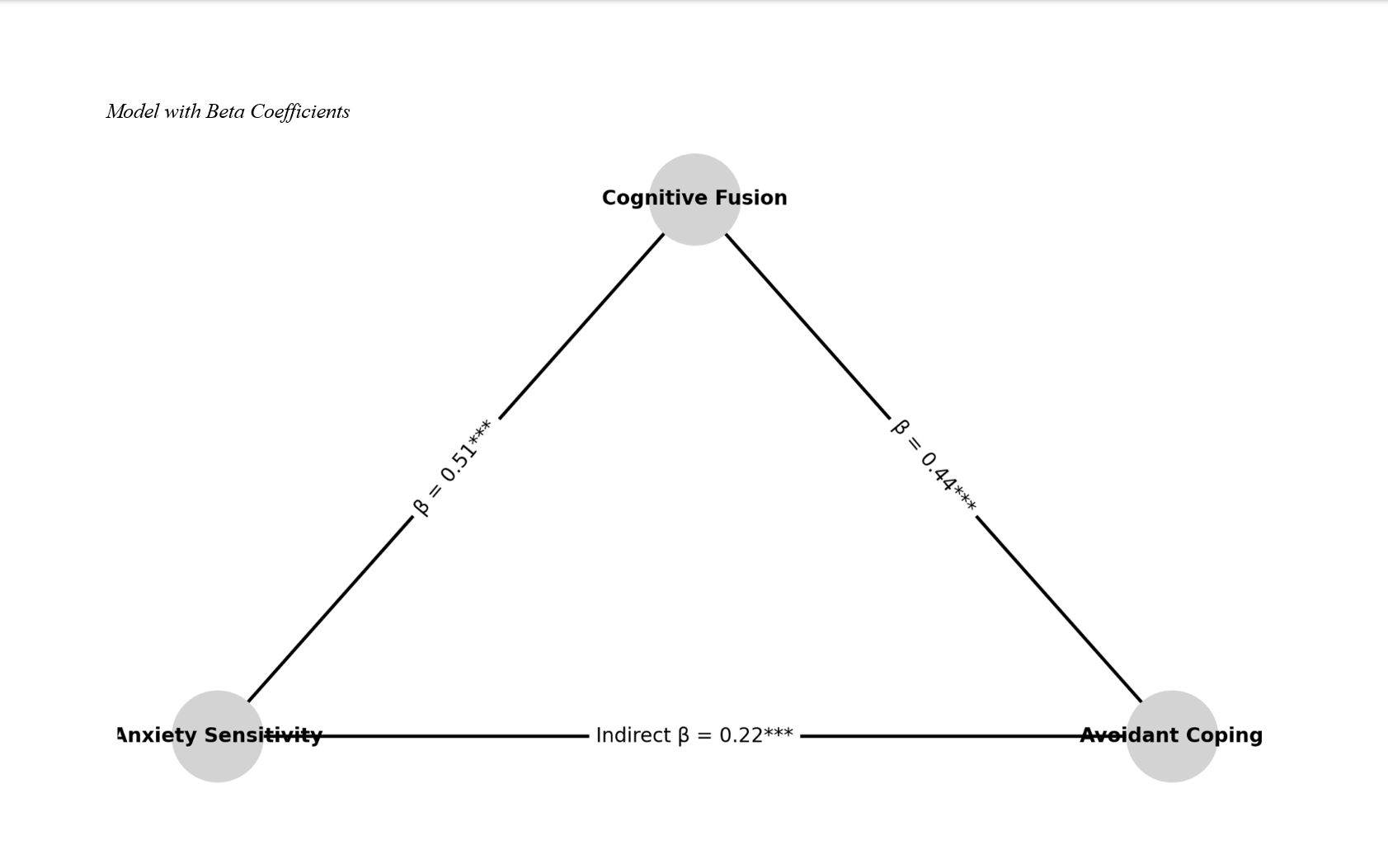
Objective: This study aimed to examine the mediating role of cognitive fusion in the relationship between anxiety sensitivity and avoidant coping in young women.
Methods and Materials: A total of 600 young women from China participated in this descriptive correlational study. The participants completed validated self-report measures for anxiety sensitivity, cognitive fusion, and avoidant coping. Descriptive statistics were calculated for all variables, and Pearson correlation analysis was used to examine the relationships between the variables. Structural equation modeling (SEM) was employed to test the hypothesized mediation model, with model fit assessed using indices such as Chi-square, CFI, and RMSEA.
Findings: Pearson correlation results revealed significant positive associations between anxiety sensitivity, cognitive fusion, and avoidant coping (p < .001). Structural equation modeling confirmed that cognitive fusion partially mediated the relationship between anxiety sensitivity and avoidant coping. Direct paths from anxiety sensitivity to avoidant coping and from cognitive fusion to avoidant coping were both significant, with an indirect effect through cognitive fusion contributing significantly to the total effect (β = 0.22, p < .001). The model fit indices indicated good model fit (χ²/df = 1.99, RMSEA = 0.041, CFI = 0.97).
Conclusion: The findings suggest that cognitive fusion plays a significant role in explaining how anxiety sensitivity contributes to avoidant coping in young women. These results highlight the importance of addressing cognitive fusion in interventions targeting maladaptive coping strategies, particularly in populations vulnerable to anxiety-related distress.
Downloads
References
Abadi, D. B. N., Badihi, M., Rabiee, Z., & Shokrolahi, M. (2024). Effectiveness of Cognitive Analytic Therapy on Anxiety Sensitivity and Pain Catastrophizing in Patients With Chronic Pain and Alexithymia. The Journal of Tolooebehdasht. https://doi.org/10.18502/tbj.v22i6.15212
Al‐Hammouri, M. M., Rababah, J. A., & Dormans, J. (2024). The Impact of Cognitive Fusion on Stress Among Nurses: Exploring Gender as a Moderator Controlling for Depressive Symptoms. International Nursing Review. https://doi.org/10.1111/inr.13027
Asghari, F., Sayadi, A. R., Jobaneh, R. G., & Baharvand, I. (2020). Mediating Role of Cognitive Fusion in the Relationship of Mindfulness and Test Anxiety Among Female Undergraduate Students of Shahid Chamran University of Ahvaz. Journal of Medical Education and Development. https://doi.org/10.18502/jmed.v14i4.2546
Ayers, C. R., Petkus, A. J., Liu, L., Patterson, T. L., & Wetherell, J. L. (2010). Negative Life Events and Avoidant Coping Are Associated With Poorer Long-Term Outcome in Older Adults Treated for Generalized Anxiety Disorder. Journal of Experimental Psychopathology, 1(1). https://doi.org/10.5127/jep.003110
Byers, E. S., Olthuis, J. V., O’Sullivan, L. F., & Connell, E. M. (2023). Anxiety Sensitivity in the Sexual Context: Links between Sexual Anxiety Sensitivity and Sexual Well-Being. Journal of sex & marital therapy, 49(5), 550-562. https://doi.org/10.1080/0092623X.2022.2156955
Chen, N., Xi, J., & Fan, X. (2023). Correlations Among Psychological Resilience, Cognitive Fusion, and Depressed Emotions in Patients With Depression. Behavioral Sciences, 13(2), 100. https://doi.org/10.3390/bs13020100
Clauss, K., & Bardeen, J. R. (2021). The Interactive Effect of Mental Contamination and Cognitive Fusion on Anxiety. Journal of Clinical Psychology, 78(4), 517-525. https://doi.org/10.1002/jclp.23224
Écija, C., Catalá, P., López‐Gómez, I., Bedmar, D., & Peñacoba, C. (2021). What Does the Psychological Flexibility Model Contribute to the Relationship Between Depression and Disability in Chronic Pain? The Role of Cognitive Fusion and Pain Acceptance. Clinical Nursing Research, 31(2), 217-229. https://doi.org/10.1177/10547738211034307
Faustino, B. (2020). Transdiagnostic Perspective on Psychological Inflexibility and Emotional Dysregulation. Behavioural and Cognitive Psychotherapy, 49(2), 233-246. https://doi.org/10.1017/s1352465820000600
Guzmán, A., Gillanders, D., Stevenson, A., & Ross, K. (2020). Psychosocial Adjustment to Mild Cognitive Impairment: The Role of Illness Perceptions, Cognitive Fusion and Cognitive Impairment. Dementia, 20(2), 464-484. https://doi.org/10.1177/1471301219893862
Hanafi, H., Hidayah, N., Atmoko, A., & Ramli, M. (2022). Cognitive Fusion on Counselor Performance : A Comparative Study of the Experienced and Novice Counselor. Pegegog, 12(1). https://doi.org/10.47750/pegegog.12.01.06
Hatami Nejad, M., Mir, F., & Sepehundi, M. A. (2024). Developing a Model of Drug Use Propensity in Students of Lorestan University Based on Anxiety Sensitivity and Sensation Seeking with the Mediating Role of Negative Affect: A Descriptive Study. Rafsanjan University of Medical Sciences Journal, 23(4), 322-336. https://doi.org/10.61186/jrums.23.4.222
Iwamoto, D. K., Liao, L., & Liu, W. M. (2010). Masculine Norms, Avoidant Coping, Asian Values, and Depression Among Asian American Men. Psychology of Men & Masculinity, 11(1), 15-24. https://doi.org/10.1037/a0017874
Jalali Farahani, M., Jadidi, M., & Mirzaian, B. (2024). The Effectiveness of Acceptance and Commitment Group Therapy on Cognitive Fusion, Mindfulness, and Body Mass Index in Women with Obesity. Journal of Adolescent and Youth Psychological Studies (JAYPS), 5(9), 34-41. https://doi.org/10.61838/kman.jayps.5.9.5
Llewellyn, A., Phung, T. H., Soares, M., Shepherd, L., Glynn, D., Harden, M., Walker, R., Duarte, A., & Dias, S. (2024). MRI Software and Cognitive Fusion Biopsies in People With Suspected Prostate Cancer: A Systematic Review, Network Meta-Analysis and Cost-Effectiveness Analysis. Health Technology Assessment, 1-310. https://doi.org/10.3310/plfg4210
Lv, J., Qiu, Q., Ye, B., & Yang, Q. (2023). The Effects of Cognitive Fusion on Depression in Primary School Principals During the COVID-19 Pandemic: The Mediating Role of Psychological Vulnerability and the Moderating Role of Self-Esteem. Psychology research and behavior management, Volume 16, 1727-1739. https://doi.org/10.2147/prbm.s404894
Musella, K., DiFonte, M., & Flannery-Schroeder, E. (2021). 39.2 The Roles of Mindfulness and Sleep Disturbance on the Relationship Between Avoidant Coping and Mental Health Symptoms During COVID-19. Journal of the American Academy of Child & Adolescent Psychiatry, 60(10), S228. https://doi.org/10.1016/j.jaac.2021.09.308
Petov, V., Bazarkin, A., Krupinov, E. S., Morozov, A., Taratkin, M., Abdusalamov, A. F., Amosov, A. V., & Enikeev, D. (2022). Retrospective Analysis of Prostate Cancer Detection Using mpMR/US-fusion and Cognitive Biopsy. Urology Herald, 10(4), 88-97. https://doi.org/10.21886/2308-6424-2022-10-4-88-97
Pux, S., Hahn, E., Bergmann, N., Hahne, I., Pauly, L., Ta, T. M. T., Pijenborg, G. H. M., & Böge, K. (2022). Cognitive Fusion and Personality Traits in the Context of Mindfulness: A Cross-Sectional Study. PLoS One, 17(9), e0273331. https://doi.org/10.1371/journal.pone.0273331
Quintero, P. S. J., Biglieri, R. R., Etchezahar, E., & Gillanders, D. (2020). The Argentinian Version of the Cognitive Fusion Questionnaire: Psychometric Properties and the Role of Cognitive Fusion as a Predictor of Pathological Worry. Current Psychology, 41(5), 2546-2557. https://doi.org/10.1007/s12144-020-00767-4
Russell, L. H., Bardeen, J. R., Clayson, K. A., Dolan, S. L., & Fergus, T. A. (2020). The Closed Response Style and Posttraumatic Stress: Examining the Interaction Between Experiential Avoidance and Cognitive Fusion Among Women Experiencing Sexual Trauma. Psychological Trauma Theory Research Practice and Policy, 12(6), 627-634. https://doi.org/10.1037/tra0000580
Samadifard, H. R., Narimani, M., Aghajani, S., & Basharpoor, S. (2021). The Relationship Between Sensation Seeking and Cognitive Fusion With Sexual Health of Married Men. Shenakht Journal of Psychology and Psychiatry, 8(5), 152-162. https://doi.org/10.32598/shenakht.8.5.152
Usubini, A. G., Bottacchi, M., Caroli, D., Castelnuovo, G., & Sartório, A. (2022). Cognitive Fusion and Emotional Eating Among Adolescents With Obesity: A Preliminary Cross-Sectional Study. International journal of environmental research and public health, 19(22), 14855. https://doi.org/10.3390/ijerph192214855
Wahyuni, E., & Amelia, G. (2020). Difusi Kognitif Remaja: Kebutuhan Video Tutorial Latihan Difusi Kognitif. Insight Jurnal Bimbingan Konseling, 9(2), 157-165. https://doi.org/10.21009/insight.092.06
Wang, D., Xie, X., Tian, H., Wu, T., Liu, C., Huang, K., Gong, R., Yu, Y., Luo, T., Jiao, R., & Zhang, L. (2022). Mental Fatigue and Negative Emotion Among Nurses During the COVID-19 Pandemic. Current Psychology, 41(11), 8123-8131. https://doi.org/10.1007/s12144-022-03468-2
Wojcik, K. D., Cox, D. W., Kealy, D., & Zumbo, B. D. (2024). The Effect of Cognitive Fusion on Change in PTSD and Depression Symptom Severity in Veterans Engaged in Group Psychotherapy. Journal of Cognitive Psychotherapy, 38(2), 169-184. https://doi.org/10.1891/jcp-2022-0035
Xu, G., Xiang, L., Wu, J., Shao, H., Liu, H., Ding, S.-S., & Wu, R. (2020). The Accuracy of Prostate Lesion Localization in Cognitive Fusion. Clinical Hemorheology and Microcirculation, 74(3), 223-229. https://doi.org/10.3233/ch-180423
Xue, J.-M., Yang, L., Sun, F., & Su, J. (2024). Family Function and Depression in Older Adults With Chronic Comorbidities: The Chain‐mediated Role of Cognitive Fusion and Coping Styles. Psychogeriatrics, 25(1). https://doi.org/10.1111/psyg.13217
Downloads
Additional Files
Publication Timeline
- Submitted
- Revised
- Accepted
Issue
Section
License

This work is licensed under a Creative Commons Attribution-NonCommercial 4.0 International License.