Effectiveness of Short-Term Intensive Dynamic Psychotherapy on Locus of Control and Achievement Motivation in Divorced Depressed Women
DOI:
https://doi.org/10.61838/kman.pwj.6.2.1Keywords:
Short-Term Intensive Dynamic Psychotherapy, Locus of Control, Achievement Motivation, Divorced Depressed WomenAbstract
Objective: The aim of this study was to determine the effectiveness of Short-Term Intensive Dynamic Psychotherapy (ISTDP) on locus of control and achievement motivation in divorced depressed women.
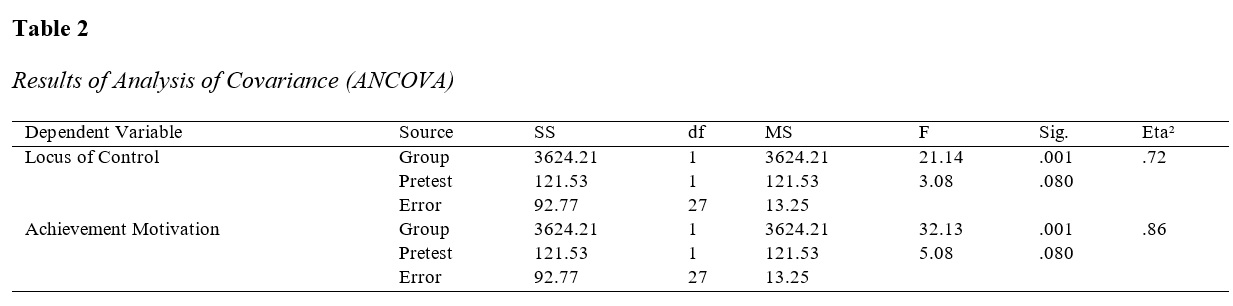
Methods and Materials: This research employed a quasi-experimental design with pretest-posttest and a control group. The study population included all divorced depressed women who referred to psychological clinics in Qom during the summer of 2024. From this population, 30 individuals were selected using cluster random sampling and randomly assigned to experimental (15 participants) and control (15 participants) groups. The experimental group received five 60-minute sessions of Short-Term Intensive Dynamic Psychotherapy. The control group did not receive any form of treatment. The research instruments included the Locus of Control Questionnaire and the Hermans Achievement Motivation Questionnaire. Data were analyzed using analysis of covariance (ANCOVA) through SPSS version 22.
Findings: The results of the analysis of covariance at a significance level of p < .05 indicated that the variables of locus of control (F = 21.14) and achievement motivation (F = 32.13) showed significant differences between the control and experimental groups.
Conclusion: Based on the findings, Short-Term Intensive Dynamic Psychotherapy appears to be effective in shifting locus of control from external to internal and enhancing achievement motivation among divorced depressed women.
Downloads
References
Abbass, A. A., & Town, J. M. (2013). Key clinical processes in intensive short-term dynamic psychotherapy. Psychotherapy, 50(3), 433. https://doi.org/10.1037/a0032166
Admon, R., & Pizzagalli, D. A. (2015). Dysfunctional reward processing in depression. Current opinion in psychology, 4, 114-118. https://doi.org/10.1016/j.copsyc.2014.12.011
Ajilchi, B., Ahadi, H., Najati, V., & Delavar, A. (2013). The Effectiveness of Intensive Short-Term Dynamic Psychotherapy in Reducing Depression Levels. European Journal of Experimental Biology, 3(2), 342-346.
Araghi, N. Z. (2025). The Effectiveness of Religious Forgiveness Therapy on Reducing Marital Conflicts and Extramarital Behaviors in Married Women Seeking Divorce. KMAN Counsel and Psych Nexus, 3, 1-8. https://doi.org/10.61838/kman.fct.psynexus.3.3
Aryanfar, N., Zamanshahr, A., Rasouli, R., & Yousefzadeh, A. (2020). Common Themes in the Divorce Transition Experience of Women Based on Their Locus of Control. Journal of Divorce and Remarriage, 61(3), 206-224. https://doi.org/10.1080/10502556.2019.1699369
Bond, M., & Perry, J. C. (2005). Long-term changes in defense styles with psychodynamic psychotherapy for depressive, anxiety, and personality disorders. Focus, 161(3), 1665-1437. https://doi.org/10.1176/foc.3.3.429
Crocker, L. D., Heller, W., Warren, S. L., O'Hare, A. J., Infantolino, Z. P., & Miller, G. A. (2013). Relationships among cognition, emotion, and motivation: implications for intervention and neuroplasticity in psychopathology. Frontiers in human neuroscience, 7, 261. https://doi.org/10.3389/fnhum.2013.00261
Ganji, H., Sharifi, H., & Mirhashmi, M. (2005). The Effect of Brainstorming Method on Increasing Creativity in Students. Journal of Education and Training, 21, 89-112.
Gladstone, W. E., Bradley, J. P., & Dolph, S. J. N. (1889). The Question of Divorce. The North American Review, 149(397), 641-652. https://mollybrown.org/women-divorce-high-society/
Hermans, H. J. (1970). A questionnaire measure of achievement motivation. Journal of Applied Psychology, 54(4), 353. https://doi.org/10.1037/h0029675
Heshmati, R., Wienicke, F. J., & Driessen, E. (2023). The effects of intensive short-term dynamic psychotherapy on depressive symptoms, negative affect, and emotional repression in single treatment-resistant depression: A randomized controlled trial. Psychotherapy, 60(4), 497. https://doi.org/10.1037/pst0000500
Jafari, S., Kazemian Moghadam, K., & Gholavand, F. (2024). The Effectiveness of Intensive Short-Term Dynamic Psychotherapy (ISTDP) on Depression, Health Anxiety, and Physical Symptoms in Patients with Coronary Artery Bypass. Research in Clinical Psychology and Counseling, 14(1), 223-242. https://tpccp.um.ac.ir/article_45804.html
Kahraman, S., & Özbay, A. (2025). Examining Mindfulness’s Mediating Role in the Relationship Between Infidelity Tendency and Divorce Anxiety. Psychological Reports. https://doi.org/10.1177/00332941241313436
Motaghi, S., Shamili, L., & Honarkar, R. (2018). The Effectiveness of Emotion-Focused Therapy on Depression, Hope for the Future, and Interpersonal Trust in Divorced Women. Psychological studies, 14(4), 107-122. https://psychstudies.alzahra.ac.ir/article_3773.html
Purnomo, T., & Suprihandari, M. D. (2025). Social dynamics of marriage (divorce) in banyuwangi city: economic and cultural perspectives in banyuwangi. Jurnal Bina Bangsa Ekonomika, 18(1), 480-489. https://jbbe.lppmbinabangsa.id/index.php/jbbe/article/view/720
Rottenberg, J., Kasch, K. L., Arnow, B. A., & Gotlib, I. H. (2002). Behavioral activation and inhibition systems and the severity and course of depression. Journal of abnormal psychology, 111(4), 589. https://doi.org/10.1037/0021-843X.111.4.589
Rutter, M., Greenfeld, D., & Lockyer, L. (1967). A five-to-fifteen-year follow-up study of infantile psychosis: II. Social and behavioural outcome. The British Journal of Psychiatry, 113(504), 1183-1199. https://doi.org/10.1192/bjp.113.504.1183
Seligman, M. E. (1972). Learned helplessness. Annual Review of Medicine, 23(1), 407-412. https://doi.org/10.1146/annurev.me.23.020172.002203
Shirali-Nia, K., Chaldavi, R., & Amanollahi, A. (2018). The Effectiveness of Compassion-Focused Therapy on Depression and Anxiety in Divorced Women. Journal of Clinical Psychology, 10(1), 9-20. https://jcp.semnan.ac.ir/article_3023.html
Zhang, J., Gu, X., Zhang, X., Lee, J., Chang, M., & Zhang, T. (2021). Longitudinal effects of motivation and physical activity on depressive symptoms among college students. International journal of environmental research and public health, 18(10), 5121. https://doi.org/10.3390/ijerph18105121
Downloads
Additional Files
Publication Timeline
- Submitted
- Revised
- Accepted
Issue
Section
License
Copyright (c) 2025 Mahsa sadat Hakami (Author); Mahshad Mosayebi (Corresponding Author); Reza Almasi , Masuod Nazari (Author)

This work is licensed under a Creative Commons Attribution-NonCommercial 4.0 International License.