Comparison of the Effectiveness of Mindfulness-Based Cognitive Therapy and Acceptance and Commitment Therapy on Intolerance of Uncertainty and Self-Efficacy in Patients with Breast Cancer
DOI:
https://doi.org/10.61838/kman.pwj.6.3.9Keywords:
Mindfulness-Based Cognitive Therapy, Acceptance and Commitment Therapy, Intolerance of Uncertainty, Self-EfficacyAbstract
Objective: This study aimed to compare the effectiveness of Mindfulness-Based Cognitive Therapy (MBCT) and Acceptance and Commitment Therapy (ACT) on pain self-efficacy and intolerance of uncertainty in women diagnosed with breast cancer.
Methods and Materials: A quasi-experimental design with a pretest–posttest format and a nonequivalent control group was employed. The statistical population consisted of women with stage 3 and grade 2 breast cancer undergoing chemotherapy at a radiotherapy and oncology center in Tehran during the second half of 2024. A total of 45 participants were selected using convenience sampling and randomly assigned to two experimental groups (MBCT and ACT, 15 each) and one control group (15 participants). The MBCT protocol was implemented over eight weekly sessions based on the Segal et al. (2013) program, while the ACT protocol was based on the model developed by Dahl et al. (2014). Instruments included the Pain Self-Efficacy Questionnaire (Nicholas, 1998) and the Intolerance of Uncertainty Scale (Freeston et al., 1994). Data were analyzed using repeated measures ANOVA and Tukey post hoc tests.
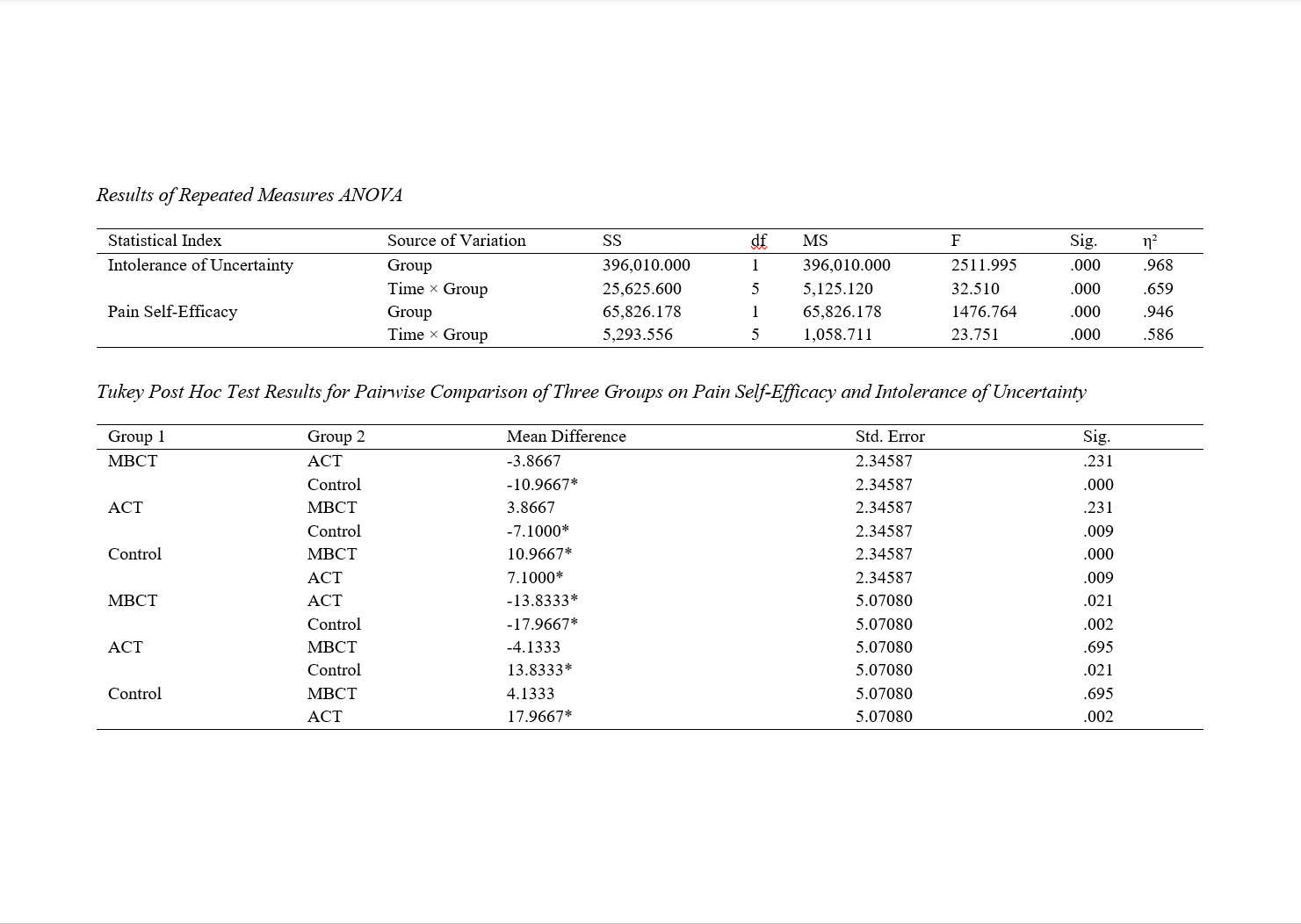
Findings: The results of repeated measures ANOVA revealed statistically significant differences among the three groups in both pain self-efficacy (F = 1476.764, p < .001, η² = .946) and intolerance of uncertainty (F = 2511.995, p < .001, η² = .968). Post hoc analyses showed that both MBCT and ACT were significantly more effective than the control group in improving pain self-efficacy and reducing intolerance of uncertainty (p < .01). Furthermore, MBCT and ACT demonstrated differing levels of effectiveness in influencing these outcomes.
Conclusion: Both interventions significantly enhance pain self-efficacy and reduce intolerance of uncertainty in women with breast cancer, and may serve as complementary interventions alongside medical treatments.
Downloads
References
Bakhtiari Zadeh, M. K., Ajeh Godari, M., Sabah, A., & Niazi Mirk, J. (2022). The effect of rational-emotional behavior therapy on impulsivity, intolerance of uncertainty, and difficulty in regulating emotions in women referring to family counseling centers with marital problems. Development of Psychology, 11(5), 135-146. https://frooyesh.ir/article-1-3595-en.html
Bauer, E. A., MacNamara, A., Sandre, A., Lonsdorf, T. B., Weinberg, A., Morriss, J., & van Reekum, C. M. (2020). Intolerance of uncertainty and threat generalization: A replication and extension. Psychophysiology, 57(5), e13546. https://doi.org/10.1111/psyp.13546
Bottesi, G., Noventa, S., Freeston, M. H., & Ghisi, M. (2019). Seeking certainty about Intolerance of Uncertainty: Addressing old and new issues through the Intolerance of Uncertainty Scale-Revised. PLoS One, 14(2), e0211929. https://doi.org/10.1371/journal.pone.0211929
Bredemeier, K., Church, L. D., Bounoua, N., Feler, B., & Spielberg, J. M. (2023). Intolerance of uncertainty, anxiety sensitivity, and health anxiety during the COVID-19 pandemic: Exploring temporal relationships using cross-lag analysis. Journal of anxiety disorders, 93, 102660. https://doi.org/10.1016/j.janxdis.2022.102660
Brown, K. W., Ryan, R. M., & Creswell, J. D. (2007). Addressing fundamental questions about mindfulness. Psychological Inquiry, 18(4), 272-281. https://doi.org/10.1080/10478400701703344
Buhr, K., & Dugas, M. J. (2002). The intolerance of uncertainty scale: Psychometric properties of the English version. Behaviour Research and Therapy, 40(8), 931-945. https://doi.org/10.1016/S0005-7967(01)00092-4
Carreiro, J. P., Cardoso, S., Teques, P., Teques, A. P., & Ribeiro, J. L. P. (2025). Satisfaction With Social Support and Quality of Life Among Portuguese Patients With Breast Cancer: Mediating Effects of Coping Styles—Cross-Sectional Study. Healthcare, 13(3), 297. https://doi.org/10.3390/healthcare13030297
Chang, Y. C., Chiu, C. F., Wang, C. K., Wu, C. T., Liu, L. C., & Wu, Y. C. (2022). Short-term effect of internet-delivered mindfulness-based stress reduction on mental health, self-efficacy, and body image among women with breast cancer during the COVID-19 pandemic. Frontiers in psychology, 13, 949446. https://doi.org/10.3389/fpsyg.2022.949446
Chen, J., Wang, Y., Zhang, H., Leng, T., Lin, X., Sun, Y., Wang, N., Wang, J., & Luo, F. (2022). The mediating effects of coping styles on the relationship between trait mindfulness and romantic relationship satisfaction. Psychology, Health & Medicine, 1-8. https://doi.org/10.1080/13548506.2022.2094426
Chiesi, F., Vizza, D., Valente, M., Bruno, R., Lau, C., Campagna, M. R., Lo Iacono, M., & Bruno, F. (2022). Positive personal resources and psychological distress during the COVID-19 pandemic: resilience, optimism, hope, courage, trait mindfulness, and self-efficacy in breast cancer patients and survivors. Supportive Care in Cancer, 30(8), 7005-7014. https://doi.org/10.1007/s00520-022-07123-1
Cinek, B. Y. (2025). Cognitive Emotion Regulation and Its Impact on Sexual Function, Body Image, and Depression in Breast Cancer Survivors. Psychiatry Investigation, 22(3), 330-339. https://doi.org/10.30773/pi.2024.0349
Cousin, L., Braithwaite, D., Anton, S. D., Zhang, Z., Lee, J. H., Leewenburgh, C., & Lyon, D. E. (2024). A Pilot Study of a Gratitude Journaling Intervention to Enhance Spiritual Well-Being and Exercise Self-Efficacy in Black Breast Cancer Survivors. https://doi.org/10.21203/rs.3.rs-4903270/v1
Ebrahimkhani, M., Norouzi, E., Hosseini, A., & Jamshidi, F. (2024). A Randomized Controlled Trial on Cognitive Therapy’s Role in Enhancing Pain Self-Efficacy and Reducing Catastrophizing in Breast Cancer Patients. Psychology of Woman Journal, 5(2), 114-123. https://doi.org/10.61838/kman.pwj.5.2.15
Fisher, H. M., Hyland, K. A., Winger, J. G., Miller, S. N., Amaden, G. H., Diachina, A. K., Kelleher, S. A., & Somers, T. J. (2023). Effect of Pain Coping Skills Training on Pain and Pain Medication Use for Women With Breast Cancer. Journal of Pain and Symptom Management, 66(1), 70-79. https://doi.org/10.1016/j.jpainsymman.2023.03.012
Freeston, M., Rhéaume, J., Letarte, H., Dugas, M. J., & Ladouceur, R. (1994). Why do people worry? Personality & Individual Differences, 17, 791-802. https://doi.org/10.1016/0191-8869(94)90048-5
Ghayour Kazemi, F., Shahhabizadeh, F., Safara, M., & Shahidsales, S. (2022). Effectiveness of Transdiagnostic Intervention and Mindfulness-Based Schema Therapy on Cancer Self-Efficacy and Resilience in Women with Breast Cancer. North Khorasan University of Medical Sciences, 14(3), 24-33. https://doi.org/10.32592/nkums.14.3.24
Ghodrati, H., Sedaghatgoo, R., & Ghodrati, S. (2024). Breast Cancer Experience and Change in Self-concept among Women: A Qualitative Study in the City of Sari, Iran. Journal of Social Continuity and Change (JSCC), -. https://doi.org/10.22034/jscc.2024.20580.1086
Givi, F., Meschi, F., Zhian Bagheri, M., & Farhood, D. (2023). Structural equation modeling of pain management based on rumination mediating resiliency and vitality in women with breast cancer. Applied Family Therapy Journal (AFTJ), 4(1), 447-465. https://doi.org/10.61838/kman.aftj.4.1.22
Günay, A., & Karahan, A. (2025). Evaluation of the Effects of Mobile Applications on the Care Outcomes of Patients Undergoing Surgery for Breast Cancer : Systematic Review. Archives of Breast Cancer, 12(1), 5-14. https://doi.org/10.32768/abc.20251215-14
Jerusalem, M., & Mittag, W. (1995). Self-efficacy in stressful life transition. In Self-efficacy in changing societies. Cambridge University Press. https://doi.org/10.1017/CBO9780511527692.008
Kelley, D. L., & Nichols, H. M. (2023). Relational mindfulness themes in descriptions of intimate encounters across six interpersonal contexts. Journal of Social and Personal Relationships, 02654075231154286. https://doi.org/10.1177/02654075231154286
Khanaghani, R., Meschi, F., Taghizadeh, A., & Karasikian Mojmbari, A. (2017). Comparison of the effectiveness of cognitive-behavioral group therapy and group therapy based on acceptance and commitment to self-efficacy in breast cancer patients. 10, 219-231. https://www.sid.ir/paper/967776/fa
Kissane, D. W., Lethborg, C., Brooker, J., Hempton, C., Burney, S., Michael, N., Staples, M., Osicka, T., Sulistio, M., Shapiro, J., & Hiscock, H. (2019). Meaning and Purpose (MaP) therapy II: feasibility and acceptability from a pilot study in advanced cancer. Palliative & Supportive Care, 17(1), 21-28. https://doi.org/10.1017/S1478951518000883
Lawrence, E., Cohn, A. S., & Allen, S. H. (2022). Acceptance and commitment therapy for couples. In Clinical Handbook of Couple Therapy (pp. 104). https://psycnet.apa.org/record/2022-86108-006
Liu, W., Lewis, F. M., Oxford, M. L., & Kantrowitz‐Gordon, I. (2024). Common Dyadic Coping and Its Congruence in Couples Facing Breast Cancer: The Impact on Couples' Psychological Distress. Psycho-Oncology, 33(3). https://doi.org/10.1002/pon.6314
McCracken, L. M., & Vowles, K. E. (2014). Acceptance and commitment therapy and mindfulness for chronic pain: Model, process, and progress. American psychologist, 69(2), 178. https://doi.org/10.1037/a0035623
Nicolescu, S., Secară, E.-C., Jiboc, N. M., & Băban, A. (2024). Oncovox: A randomised controlled trial of a web-based acceptance and commitment therapy for breast cancer patients. Journal of Contextual Behavioral Science, 32, 100729. https://doi.org/10.1016/j.jcbs.2024.100729
Panchyshyn, V., Tekok-Kilic, A., Frijters, J. C., & Tardif-Williams, C. (2023). Sensory sensitivity, intolerance of uncertainty and sex differences predicting anxiety in emerging adults. Heliyon, 9(3), 1-9. https://doi.org/10.1016/j.heliyon.2023.e14071
Park, J. H., Lee, J. S., Nam, H. S., & Kim, Y. H. (2024). Factors associated with sedentary behavior among community-dwelling breast cancer survivors aged 50 years or older. Scientific reports, 14(1), 2396. https://doi.org/10.1038/s41598-024-51172-x
Pentzien, C. (2019). A Pilot Acceptance and Commitment Therapy Intervention to Reduce the Negative Effects of Sexual Objectification among College Women Bowling Green State University]. http://rave.ohiolink.edu/etdc/view?acc_num=bgsu1560020773927712
Safar Mohammadlou, N., Mollazadeh, A. R., & Meschi, F. (2021). Comparison of the effectiveness of emotion-focused therapy and cognitive behavioral therapy on sexual self-efficacy in women with breast cancer. Middle Eastern Journal of Disability Studies, 11, 71-71. https://doi.org/10.30483/RIJM.2021.254313.1143
Safikhani, F. (2022). The effectiveness of grammatical mental imagery with cognitive processing on self-efficacy, emotional processing and spirituality in mothers of students with autism spectrum disorder. International Journal of Education and Cognitive Sciences, 3(2), 12-22. https://doi.org/10.22034/injoeas.2022.160609
Segal, Z., Williams, M., & Teasdale, J. (2018). Mindfulness-based cognitive therapy for depression. Guilford Publications. https://books.google.at/books/about/Mindfulness_Based_Cognitive_Therapy_for.html?id=QHRVDwAAQBAJ&redir_esc=y
Senai, H., Mousavi, S. A. M., Moradi, A. R., Parhoon, H., & Sanai, S. (2017). The effectiveness of mindfulness-based stress reduction therapy on self-efficacy, perceived stress, and life orientation of women with breast cancer. Journal of Thought and Behavior, 11(44), 57-90. https://www.magiran.com/paper/1707429/the-effectiveness-of-mindfulness-based-stress-reduction-on-self-efficacy-perceived-stress-and-life-orientation-of-women-with-breast-cancer?lang=en
Soto-Pérez-de-Celis, E. (2024). Mexican Breast Cancer Consensus. Multidisciplinary Care in Breast Cancer. Gaceta Mexicana De Oncolog�A. https://doi.org/10.24875/j.gamo.m24000263
Torabiyan, A., Gholipour, M., Yektaparast, S., Ghodsi, B., & Tarnas, G. (2024). Effectiveness of emotion-focused therapy on self-efficacy and posttraumatic growth in women with breast cancer. Applied Family Therapy Journal (AFTJ), 5(3), 124-132. https://doi.org/10.61838/kman.aftj.5.3.13
Vakilzadeh, P., & Nakhaee, N. (2006). The Reliability and Validity of the Persian Version of the Brief Pain Inventory in Cancer Patients. Journal of Rafsanjan University of Medical Sciences, 5(4), 253-258. https://journal.rums.ac.ir/browse.php?a_id=237&slc_lang=en&sid=1&printcase=1&hbnr=1&hmb=1
Walser, R. D., & O'Connell, M. (2023). Alliance rupture and repair in acceptance and commitment therapy. In C. F. Eubanks, L. W. Samstag, & J. C. Muran (Eds.), Rupture and repair in psychotherapy: A critical process for change (pp. 165-186). American Psychological Association. https://doi.org/10.1037/0000306-008
Wang, X., Dai, Z., Zhu, X., Li, Y., Ma, L., Cui, X., & Zhan, T. (2024). Effects of mindfulness-based stress reduction on quality of life of breast cancer patient: a systematic review and meta-analysis. PLoS One, 19(7), e0306643. https://doi.org/10.1371/journal.pone.0306643
Wilson, J. M., Weiss, A., & Shook, N. J. (2020). Mindfulness, self-compassion, and savoring: Factors that explain the relation between perceived social support and well-being. Personality and individual differences, 152, 109568. https://doi.org/10.1016/j.paid.2019.109568
Wimmer, L., Bellingrath, S., & Von Stockhausen, L. (2020). Mindfulness training for improving attention regulation in university students: Is it effective? and do yoga and homework matter? Frontiers in psychology, 11, 719. https://doi.org/10.3389/fpsyg.2020.00719
Yousefi, R., Hafezi, F., Bakhtarpour, S., & Makondi, B. (2012). Comparing the effectiveness of cognitive-behavioral hypnosis-based therapy and mindfulness-based therapy on pain perception and self-efficacy in women with breast cancer in Gorgan. Quarterly Journal of Applied Family Therapy, 3(5), 209-226. https://doi.org/10.61838/kman.aftj.3.5.13
Downloads
Additional Files
Publication Timeline
- Submitted
- Revised
- Accepted
Issue
Section
License
Copyright (c) 2025 Ghazal Ghafourian, Maryam Ghorbani Gherkhloo, Faezeh Siahbazi, Fahimeh Ozbaczaei, Fatemeh Pourjafar, Giti Shahbazi (Author); Kamran Pourmohammad Ghouchani (Corresponding Author)

This work is licensed under a Creative Commons Attribution-NonCommercial 4.0 International License.