Emotion Suppression and Peer Rejection as Predictors of Loneliness in Female Adolescents
DOI:
https://doi.org/10.61838/Keywords:
Loneliness, Emotion Suppression, Peer Rejection, Female AdolescentsAbstract
Objective: The objective of this study was to investigate the predictive roles of emotion suppression and peer rejection on loneliness in female adolescents.
Methods and Materials: A correlational descriptive design was employed, involving 385 female adolescents recruited from various secondary schools in Tunisia. Participants completed a battery of standardized self-report measures assessing loneliness, emotion suppression, and peer rejection. Stratified random sampling ensured diverse socio-economic representation and adherence to ethical guidelines. Data were analyzed using SPSS-27. Descriptive statistics were generated to summarize participant characteristics and overall scores. Pearson correlation coefficients were calculated to examine the relationships between loneliness and each predictor. Subsequently, linear regression analysis was performed to determine how emotion suppression and peer rejection simultaneously contributed to loneliness.
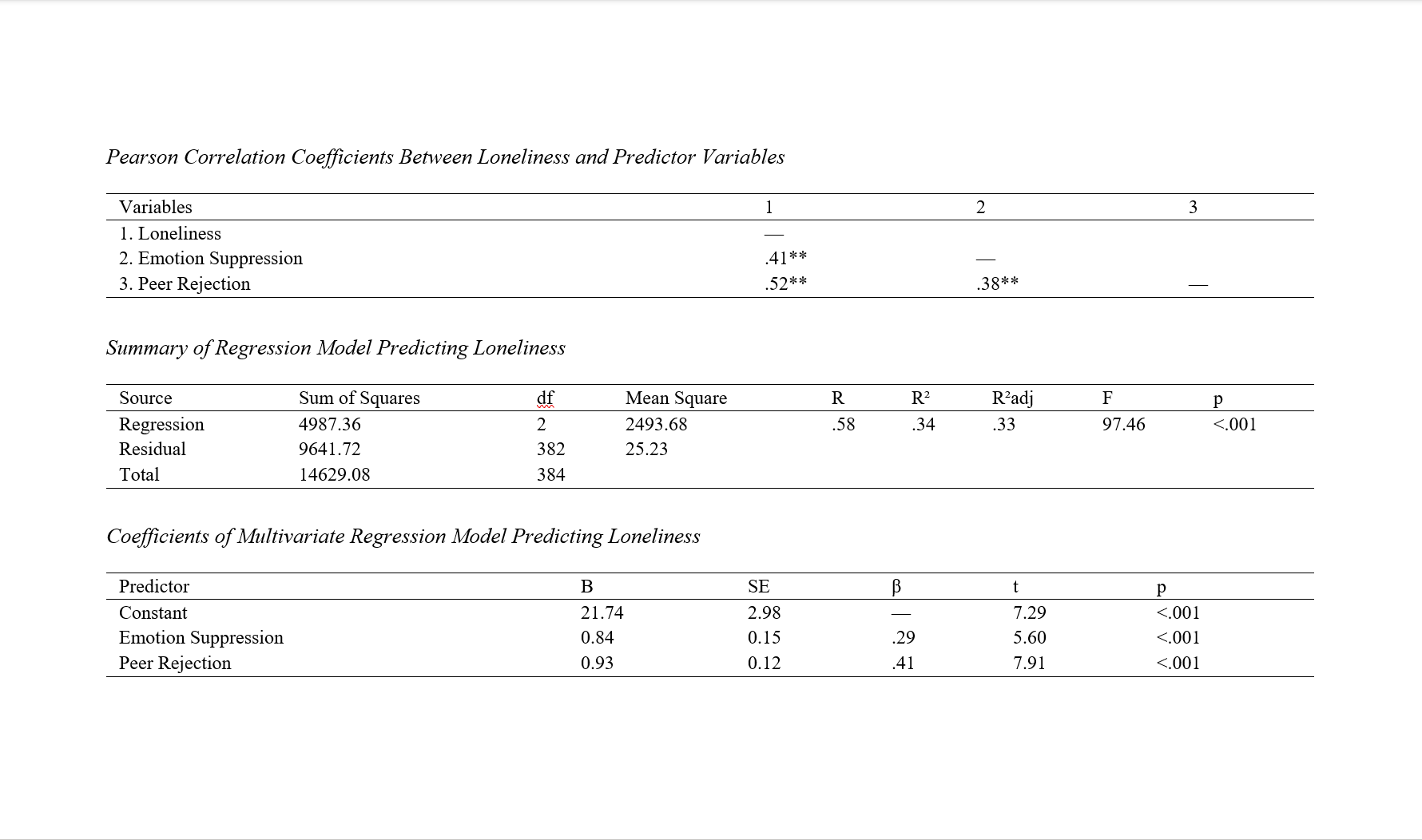
Findings: Pearson correlation showed significant positive relationships between loneliness and emotion suppression (r = .41, p < .01), as well as between loneliness and peer rejection (r = .52, p < .01). The two predictors were also significantly related to each other (r = .38, p < .01). Regression analysis indicated that the model was significant (F(2, 382) = 97.46, p < .001), accounting for 34% of the variance in loneliness (R² = .34). Both emotion suppression (β = .29, p < .001) and peer rejection (β = .41, p < .001) uniquely and significantly contributed to loneliness in female adolescents.
Conclusion: Findings highlight that both emotion regulation patterns and social experiences play crucial roles in adolescent loneliness. Adolescents who suppress their emotions or encounter persistent peer rejection appear at a higher risk for feeling isolated. Identifying and addressing these two predictors may be integral to developing targeted interventions aimed at reducing loneliness and promoting emotional well-being among female adolescents in culturally diverse settings.
Downloads
References
Aschbrenner, K. A., Naslund, J. A., Tomlinson, E. F., Kinney, A., Pratt, S. I., & Brunette, M. F. (2019). Adolescents' Use of Digital Technologies and Preferences for Mobile Health Coaching in Public Mental Health Settings. Frontiers in Public Health, 7. https://doi.org/10.3389/fpubh.2019.00178
Beristain, C. M., & Wiener, J. (2020). Finding True Friendships: The Friendship Experiences of Adolescents With Attention-Deficit/Hyperactivity Disorder. Canadian Journal of School Psychology, 35(4), 280-298. https://doi.org/10.1177/0829573520931679
Brown, E. C., Abdelmassih, E., & Hanna, F. (2024a). Evaluating the Determinants of Drug Use in LGBTQIA+ Adolescents: A Scoping Review. https://doi.org/10.20944/preprints202408.0853.v1
Brown, E. C., Abdelmassih, E., & Hanna, F. (2024b). Evaluating the Determinants of Substance Use in LGBTQIA+ Adolescents: A Scoping Review. International journal of environmental research and public health, 21(12), 1579. https://doi.org/10.3390/ijerph21121579
Chiu, K., Clark, D. M., & Leigh, E. (2021). Prospective associations between peer functioning and social anxiety in adolescents: A systematic review and meta-analysis. Journal of affective disorders, 279, 650-661. https://doi.org/10.1016/j.jad.2020.10.055
Elliott, K. J., Stacciarini, J. M. R., Jimenez, I. A., Rangel, A. P., & Fanfan, D. (2021). A Review of Psychosocial Protective and Risk Factors for the Mental Well-Being of Rural LGBTQ+ Adolescents. Youth & Society, 54(2), 312-341. https://doi.org/10.1177/0044118x211035944
Han, M., & Seo, E. (2024). The Mediating Effect of Mental Health and Sense of Community Between Parents-Children Interaction and Peer Attachment: Focusing on the Mid. Adolescents. Korean Association for Learner-Centered Curriculum and Instruction, 24(1), 435-445. https://doi.org/10.22251/jlcci.2024.24.1.435
Haniyah, F. N., Novita, A., & Ruliani, S. N. (2022). Hubungan Antara Pola Asuh Orangtua, Teman Sebaya, Lingkungan Tempat Tinggal Dan Sosial Ekonomi Dengan Kesehatan Mental Remaja. Open Access Jakarta Journal of Health Sciences, 1(7). https://doi.org/10.53801/oajjhs.v1i7.51
Herren, O. M., Agurs-Collins, T., Dwyer, L. A., Perna, F. M., & Ferrer, R. (2021). Emotion Suppression, Coping Strategies, Dietary Patterns, and BMI. Eating behaviors, 41, 101500. https://doi.org/10.1016/j.eatbeh.2021.101500
Jardas, E. J., Ladd, B. A., Maheux, A. J., Choukas‐Bradley, S., Salk, R. H., & Thoma, B. C. (2023). Testing the Minority Stress Model Across Gender Identity, Race, and Ethnicity Among U.S. Gender Minority Adolescents. Journal of Psychopathology and Clinical Science, 132(5), 542-554. https://doi.org/10.1037/abn0000834
Long, E., Zucca, C., & Sweeting, H. (2020). School Climate, Peer Relationships, and Adolescent Mental Health: A Social Ecological Perspective. Youth & Society, 53(8), 1400-1415. https://doi.org/10.1177/0044118x20970232
Macdonald, J. A., Greenwood, C., Letcher, P., Spry, E., Mansour, K. A., McIntosh, J., Thomson, K., Deane, C., Biden, E. J., Edwards, B., Hutchinson, D., Cleary, J., Toumbourou, J. W., Sanson, A., & Olsson, C. A. (2021). Parent and Peer Attachments in Adolescence and Paternal Postpartum Mental Health: Findings From the ATP Generation 3 Study. Frontiers in psychology, 12. https://doi.org/10.3389/fpsyg.2021.672174
Maula, Y. N., Lina, N., & Neni, N. (2023). Hubungan Pola Asuh Orang Tua Dan Lingkungan Teman Sebaya Dengan Kesehatan Mental Remaja Di Sma Negeri 2 Majalengka Tahun 2023. Jkki, 19(2), 104-114. https://doi.org/10.37058/jkki.v19i2.8642
Nisa, H., Aidina, W., Rahmita, N. R., Manita, E., & Auliani, F. (2023). Promosi Kesehatan Mental Remaja Melalui Virtual Boothcamp Untuk Meningkatkan Peer-Support. Transformatif Jurnal Pengabdian Masyarakat, 4(2), 125-138. https://doi.org/10.22515/tranformatif.v4i2.7361
Norrington, J. (2020). Adolescent Peer Victimization, Self-Concept, and Psychological Distress in Emerging Adulthood. Youth & Society, 53(2), 273-295. https://doi.org/10.1177/0044118x20910938
Rahayu, S. R., Fauzi, L., Zainafree, I., Merzistya, A. N. A., Affandi, M. D., Wahidah, N. R., Aulia, A., Saefurrohim, M. Z., Muflikhah, Z., & Savitri, S. (2022). Skill-Based Health Education for Adolescent Mental Health Through the HOPE. Engagement Jurnal Pengabdian Kepada Masyarakat, 6(2). https://doi.org/10.29062/engagement.v6i2.1145
S, M. A., & N.T, S. (2024). Peers, Parents and Families as Agents of Influence on Adolescents’ Perspectives Towards People With Mental Health Problems: Mental Health Professionals’ Views. Journal of Public Mental Health, 23(4), 316-329. https://doi.org/10.1108/jpmh-04-2024-0048
Sánchez-Reyes, L., Martínez, R. A., & Castro, M. J. (2024). Mental Health and Health Care for Transgender and Gender Nonconforming Adolescents: A Systematic Review. Papeles Del Psicólogo - Psychologist Papers, 45(3), 136-145. https://doi.org/10.23923/pap.psicol.3042
Schoenmakers, E. C., & ten Bruggencate, T. (2024). Navigating loneliness: the interplay of social relationships and coping skills. International Journal of Adolescence and Youth, 29(1), 2339300. https://doi.org/10.1080/02673843.2024.2339300
Sofrona, E., & Giannakopoulos, G. (2024a). The Impact of Parental Depression, Anxiety, and Stress on Adolescents’ Mental Health and Quality of Life: The Moderating Role of Parental Rejection. https://doi.org/10.20944/preprints202409.1329.v1
Sofrona, E., & Giannakopoulos, G. (2024b). The Impact of Parental Depressive, Anxiety, and Stress Symptoms on Adolescents’ Mental Health and Quality of Life: The Moderating Role of Parental Rejection. Children, 11(11), 1361. https://doi.org/10.3390/children11111361
Soleymany, E., & Sarifi, P. (2023). The Role of Self-Compassion, Emotion Regulation, and Corona Anxiety in Predicting the Self-Care Behaviors of Family Members of People with Covid-19. Health Psychology, 11(44), 121-136. https://doi.org/10.30473/hpj.2023.61062.5361
Tajabadi, Z., Dehghani, F., & Saehzadeh, M. (2020). The Role of Time Perspective and Peer Rejection in Predicting High-Risk Behaviors of Adolescents of Yazd City. Ranian Journal of Health Education and Health Promotion, 8(2), 129-141. https://doi.org/10.29252/ijhehp.8.2.129
Trekels, J., Maza, M. T., Capella, J., Jorgensen, N. A., Kwon, S. J., Lindquist, K. A., Prinstein, M. J., & Telzer, E. H. (2024). Diverse Social Media Experiences and Adolescents’ Depressive Symptoms: The Moderating Role of Neurobiological Responsivity to Rejected Peers. Social Cognitive and Affective Neuroscience, 19(1). https://doi.org/10.1093/scan/nsae070
Wang, S. (2023). The Importance of Peer Interaction in the Development of Social Skills During Adolescence: Growth During the COVID-19 Pandemic. SR Online: Showcase(Summer 2023 Pt 1). https://doi.org/10.70121/001c.121744
Weinberg, D., Gonneke, W. J. M. S., Peeters, M., Visser, K., Tigchelaar, J., & Finkenauer, C. (2020). The Social Gradient in Adolescent Mental Health: Mediated or Moderated by Belief in a Just World? https://doi.org/10.31219/osf.io/nkw4v
Williams, C. A., Doorley, J., & Esposito‐Smythers, C. (2017). Interpersonal Rejection Sensitivity Mediates the Associations Between Peer Victimization and Two High-Risk Outcomes. Clinical Child Psychology and Psychiatry, 22(4), 649-663. https://doi.org/10.1177/1359104517712041
Wright, M. F., & Wachs, S. (2019). Does Peer Rejection Moderate the Associations Among Cyberbullying Victimization, Depression, and Anxiety Among Adolescents With Autism Spectrum Disorder? Children, 6(3), 41. https://doi.org/10.3390/children6030041
Wu, S. L., Woo, P. J., Yap, C. C., & Glen Johan Ri Young, L. (2023). Parenting Practices and Adolescents’ Mental Health: The Mediating Role of Perceived Maternal and Paternal Acceptance-Rejection and Adolescents’ Self-Efficacy. International journal of environmental research and public health, 20(2), 1052. https://doi.org/10.3390/ijerph20021052
Yuan, Y., Zhu, B., Yang, Z., Wang, Y., Fu, H., Ge, Y., Chang, L., Zhao, K., & Min, X. (2023). The Association Between Loneliness and Social Avoidance Among the College Students of China: Mediation of Depression and Regulation by Self-Esteem. https://doi.org/10.21203/rs.3.rs-2677641/v1
Zagni, B., & Ryzin, M. J. V. (2024). Technology‐supported Cooperative Learning as a Universal Mental Health Intervention in Middle and High School. British Journal of Educational Psychology, 94(3), 792-808. https://doi.org/10.1111/bjep.12680
Zhou, X., & Shen, X. (2024). Unveiling the relationship between social anxiety, loneliness, motivations, and problematic smartphone use: A network approach. Comprehensive Psychiatry, 130, 152451. https://doi.org/10.1016/j.comppsych.2024.152451
Zhu, Y., Martin, A. N., Kane, H. S., & Park, J. (2023). Is Daily Emotion Suppression Associated With Poor Sleep? The Moderating Role of Culture. Emotion, 23(7), 1829-1843. https://doi.org/10.1037/emo0001206
Downloads
Additional Files
Publication Timeline
- Submitted
- Revised
- Accepted
Issue
Section
License

This work is licensed under a Creative Commons Attribution-NonCommercial 4.0 International License.