Strategies of Boundary Setting in Women Healing from Familial Emotional Abuse
DOI:
https://doi.org/10.61838/Keywords:
Emotional abuse, boundary setting, familial trauma, women’s healingAbstract
Objective: This study aimed to explore the boundary-setting strategies employed by women healing from familial emotional abuse.
Methods and Materials: Using a qualitative research design, this study recruited 31 women from various regions of Turkey who self-identified as survivors of familial emotional abuse. Participants were selected through purposive sampling, and data were collected through in-depth, semi-structured interviews. Interviews focused on participants’ experiences of emotional abuse and the specific strategies they employed to assert emotional and relational boundaries during their healing process. Data collection continued until theoretical saturation was reached. All interviews were transcribed verbatim and analyzed thematically using NVivo software, following an inductive coding approach. Ethical approval was obtained, and informed consent was provided by all participants.
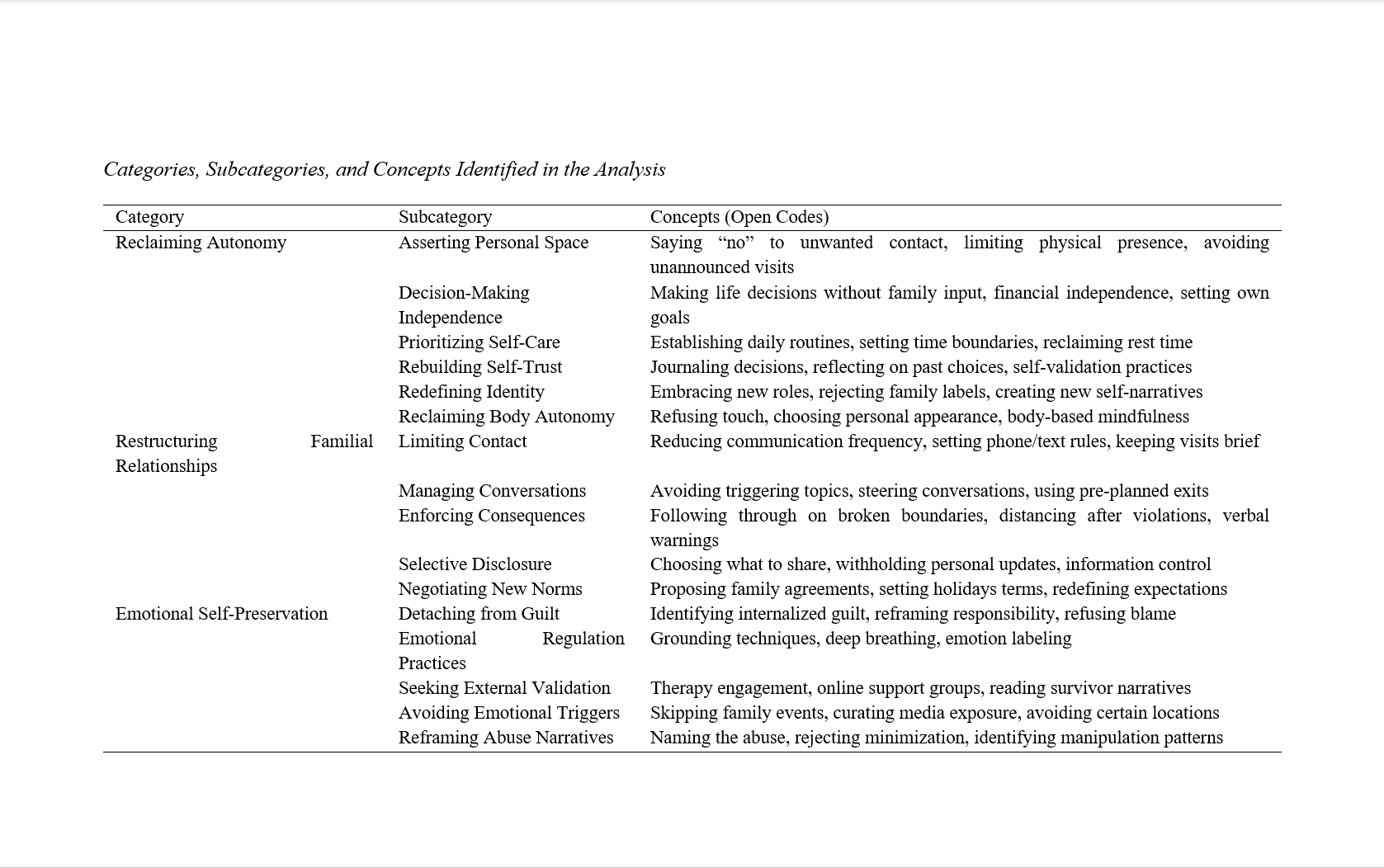
Findings: Thematic analysis revealed three overarching categories of boundary-setting strategies: Reclaiming Autonomy, Restructuring Familial Relationships, and Emotional Self-Preservation. Each category included multiple subcategories such as asserting personal space, decision-making independence, limiting contact, managing conversations, detaching from guilt, and reframing abuse narratives. Participants described boundary setting as a deeply emotional, complex process involving both external actions and internal cognitive shifts. Strategies were often enacted amidst cultural norms discouraging familial confrontation and individual autonomy. Despite these challenges, participants reported a gradual strengthening of self-worth, emotional regulation, and relational clarity as a result of these practices.
Conclusion: The findings underscore the need for trauma-informed, culturally sensitive clinical practices that validate and support women’s efforts to assert boundaries as a form of healing and empowerment.
Downloads
References
Al‐Shdayfat, N. (2017). Emotional Abuse Among Syrian Refugee Women in Jordan. Global journal of health science, 9(3), 237. https://doi.org/10.5539/gjhs.v9n3p237
Alsaggaf, R. M. (2019). Saudi Women's Identities on Facebook: Context Collapse, Judgement, and the Imagined Audience. The Electronic Journal of Information Systems in Developing Countries, 85(2). https://doi.org/10.1002/isd2.12070
Ciolfi, L., & Lockley, E. (2018). From Work to Life and Back Again: Examining the Digitally-Mediated Work/Life Practices of a Group of Knowledge Workers. Computer Supported Cooperative Work (Cscw), 27(3-6), 803-839. https://doi.org/10.1007/s10606-018-9315-3
Desai, M. (2023). Transnational and Global Feminisms. 1-5. https://doi.org/10.1002/9781405165518.wbeost045.pub2
Ellialti, T. (2015). Family Violence. 1-7. https://doi.org/10.1002/9781119085621.wbefs382
Gabriel, U., Gygax, P., & Kuhn, E. A. (2018). Neutralising Linguistic Sexism: Promising but Cumbersome? Group Processes & Intergroup Relations, 21(5), 844-858. https://doi.org/10.1177/1368430218771742
Gaitri, G., Dahiya, M., & Rana, K. (2015). Emotional Trauma as a Fearful Fact Among Rural Women of Haryana. International Journal of Home Science Extension & Communication Management, 2(2), 100-108. https://doi.org/10.15740/has/ijhsecm/2.2/100-108
Gan, C. C. R., McNamara, C., Gunasiri, H., Oliva, P., & Sebar, B. (2023). Women and Planetary Health in Asia-Pacific. Frontiers in Climate, 5. https://doi.org/10.3389/fclim.2023.1058432
Gudeta, K. H., & Engen, M. v. (2017). Work-Life Boundary Management Styles of Women Entrepreneurs in Ethiopia – “Choice” or Imposition? Journal of Small Business and Enterprise Development, 25(3), 368-386. https://doi.org/10.1108/jsbed-02-2017-0073
Hazır, I. K. (2024). Guilt and Beyond: A Class Cultural Analysis of Evolving Emotional Responses to Maternal Foodwork. Sociology, 58(6), 1399-1415. https://doi.org/10.1177/00380385241244994
Kanamori, M., Weissman, J., Rosa, M. D. L., Trepka, M. J., Rojas, P., Cano, M. Á., Melton, J., & Unterberger, A. (2015). Latino Mother/Daughter Dyadic Attachment as a Mediator for Substance Use Disorder and Emotional Abuse. Journal of Immigrant and Minority Health, 18(4), 896-903. https://doi.org/10.1007/s10903-015-0312-z
Karim, R., Rahman, S., Rahman, H., Habib, T., Arefin, S., & Swahnberg, K. (2021). Does Childhood Experience of Family Victimization Influence Adulthood Refusal of Wife Abuse? Evidence From Rural Bangladesh. PLoS One, 16(6), e0252600. https://doi.org/10.1371/journal.pone.0252600
Kocherhina, I. (2018). Types of Emotional Self-Regulation of Women Who Have Suffered From Psychological Abuse in the Family. Journal of Education Culture and Society, 9(2), 81-92. https://doi.org/10.15503/jecs20182.81.92
Liu, Y. (2021). As the Two-Child Policy Beckons: Work–Family Conflicts, Gender Strategies and Self-Worth Among Women From the First One-Child Generation in Contemporary China. Work Employment and Society, 37(1), 20-38. https://doi.org/10.1177/09500170211016944
Maliakkal, D. J., & George, T. S. (2023). Emotional Abuse and the Pandemic in India: Implications for Policy, Research, and Practice. Partner Abuse, 15(1), 95-115. https://doi.org/10.1891/pa-2023-0023
Picone, C., Fusco, R., Tonerini, M., Fanni, S. C., Neri, E., Brunese, M. C., Grassi, R., Danti, G., Petrillo, A., Scaglione, M., Gandolfo, N., Giovagnoni, A., Barile, A., Miele, V., Granata, C., & Granata, V. (2023). Dose Reduction Strategies for Pregnant Women in Emergency Settings. Journal of clinical medicine, 12(5), 1847. https://doi.org/10.3390/jcm12051847
Recalde-Esnoz, I., Tutenges, S., & Fernández, H. d. C. (2024). Strategies of Sexual Refusal in Effervescent Nightlife Settings: A Study of Spanish University Students. Sexualities. https://doi.org/10.1177/13634607241278827
Shepard, A., & Stretton, T. (2019). Women Negotiating the Boundaries of Justice in Britain, 1300–1700: An Introduction. Journal of British Studies, 58(4), 677-683. https://doi.org/10.1017/jbr.2019.84
Srivastav, B. (2021). Emotional Abuse Forms, Process, Patterns and Ways to Overcome. SSRN Electronic Journal. https://doi.org/10.2139/ssrn.3846710
Tariq, N., Zafar, S., Farhin, S., Rashid, F., & Jaffry, T. N. (2023). Domestic Violence in Married Women of Rawalpindi/Islamabad, Pakistan; A Mixed Method Study. Pakistan Armed Forces Medical Journal, 73(4), 1177-1181. https://doi.org/10.51253/pafmj.v73i4.9205
Вакуліч, Т. М. (2017). The Psychological Factors of Ukrainian Women' Victim Behavior Formation. Likarska Sprava(7), 16-21. https://doi.org/10.31640/ls-2017(7)03
Downloads
Additional Files
Publication Timeline
- Submitted
- Revised
- Accepted
Issue
Section
License

This work is licensed under a Creative Commons Attribution-NonCommercial 4.0 International License.