The Effectiveness of Emotion-Focused Therapy on Pain Self-Efficacy and Post-Traumatic Growth in Women with Breast Cancer
DOI:
https://doi.org/10.61838/Keywords:
Emotion-Focused Therapy, Pain Self-Efficacy, Post-Traumatic Growth, Women, Breast CancerAbstract
Objective: This study aimed to evaluate the effectiveness of Emotion-Focused Therapy (EFT) in improving pain self-efficacy and post-traumatic growth (PTG) in women with breast cancer.
Methods and Materials: A randomized controlled trial was conducted with 30 women diagnosed with breast cancer, recruited from oncology clinics in Tehran. Participants were randomly assigned to an intervention group (EFT) or a control group, with 15 individuals in each group. The intervention group received eight 90-minute sessions of EFT over eight weeks, while the control group received standard care. Pain self-efficacy and PTG were measured at three time points: pre-test, post-test, and a five-month follow-up, using validated self-reported tools. Data were analyzed using repeated measures analysis of variance (ANOVA) and Bonferroni post-hoc tests with SPSS-27.
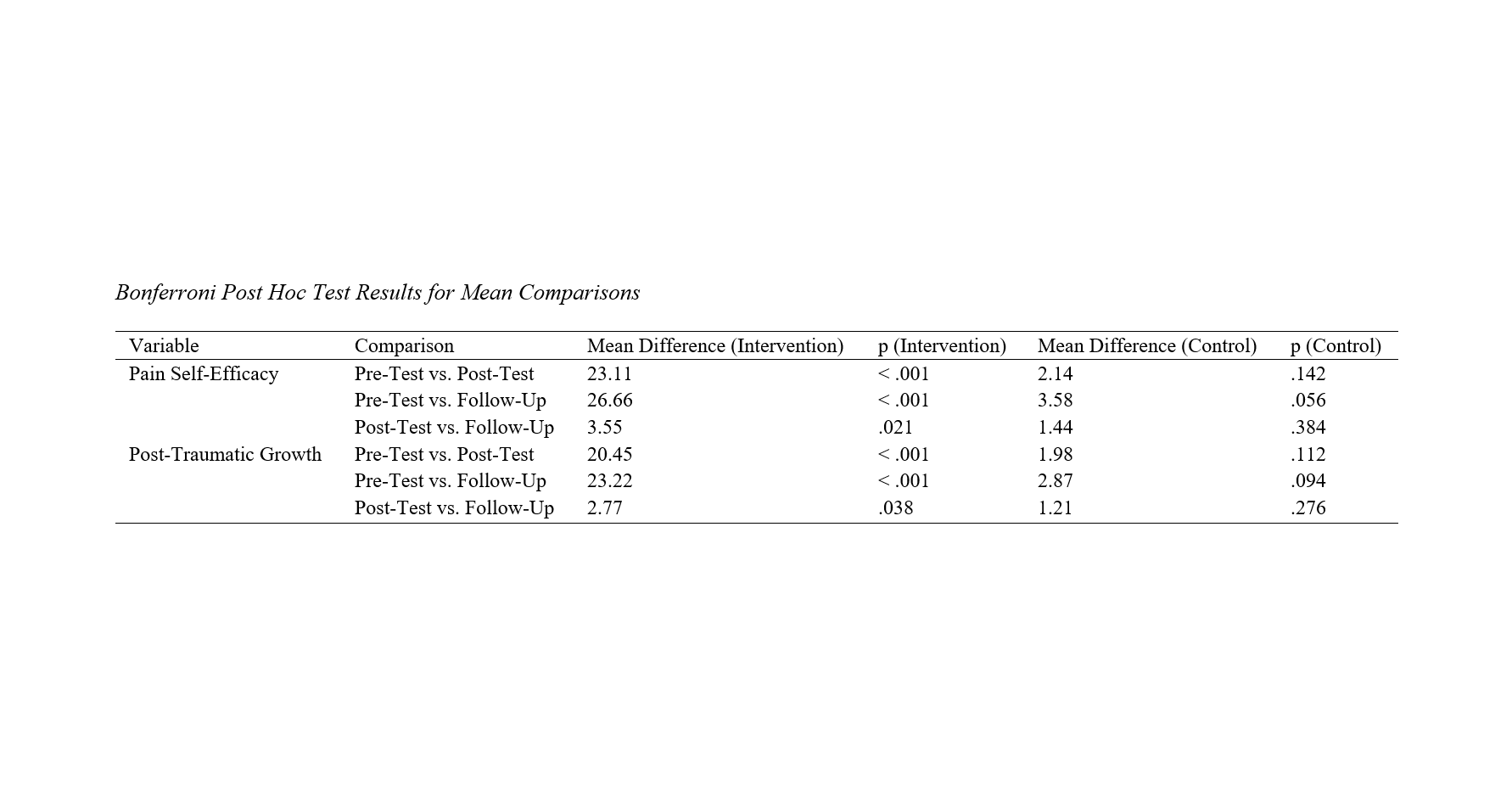
Findings: Repeated measures ANOVA revealed significant main effects of time (F(2, 54) = 40.61, p < 0.001, η² = 0.60) and group (F(1, 54) = 46.54, p < 0.001, η² = 0.46) for pain self-efficacy, as well as a significant interaction between time and group (F(2, 54) = 10.97, p < 0.001, η² = 0.21). For PTG, there were significant effects of time (F(2, 54) = 39.51, p < 0.001, η² = 0.58), group (F(1, 54) = 43.74, p < 0.001, η² = 0.42), and the interaction between time and group (F(2, 54) = 11.47, p < 0.001, η² = 0.20). Bonferroni post-hoc tests confirmed significant improvements from pre-test to post-test and follow-up in the intervention group (p < 0.001), while the control group showed no significant changes.
Conclusion: EFT effectively enhances pain self-efficacy and promotes PTG in women with breast cancer, with sustained benefits over time. These findings underscore the potential of EFT as a valuable therapeutic intervention for addressing the emotional and psychological challenges of breast cancer.
Downloads
Downloads
Additional Files
Publication Timeline
- Submitted
- Revised
- Accepted
Issue
Section
License
Copyright (c) 2025 Sepideh Haddad (Corresponding Author)

This work is licensed under a Creative Commons Attribution-NonCommercial 4.0 International License.