The Effectiveness of Cognitive Behavioral Therapy on Adherence to Treatment and Quality of Life in Hemodialysis Patients
DOI:
https://doi.org/10.61838/kman.hp.psynexus.4497Keywords:
Cognitive-behavioral therapy, treatment adherence, hemodialysis, quality of lifeAbstract
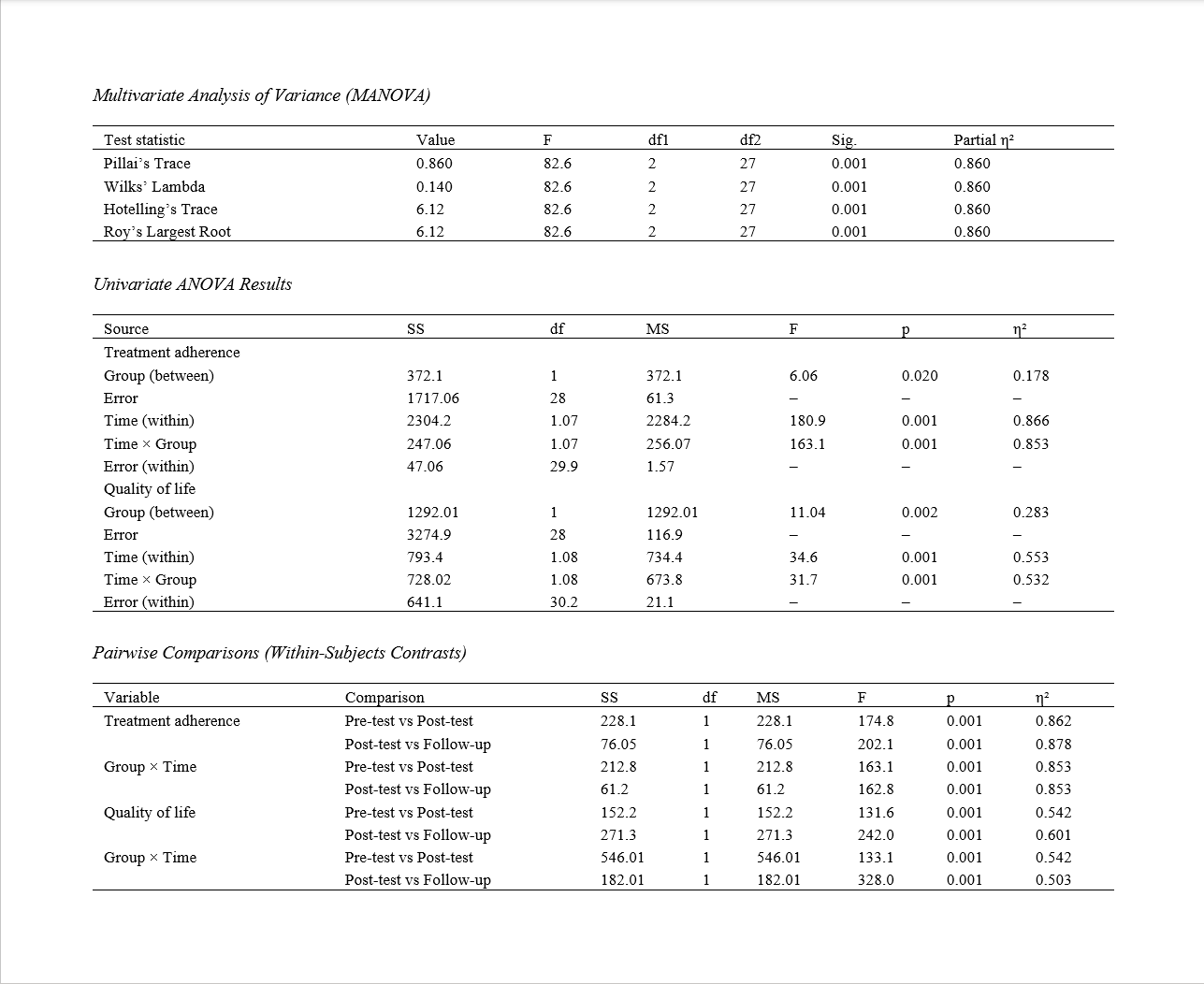
The present study aimed to investigate the effectiveness of cognitive-behavioral therapy (CBT) on treatment adherence and quality of life in hemodialysis patients. This research employed a quasi-experimental design with pre-test–post-test and a control group. The statistical population consisted of all hemodialysis patients who attended the dialysis center, from whom 30 individuals were selected through convenience sampling and randomly assigned to experimental and control groups. Research instruments included standardized questionnaires assessing treatment adherence and quality of life. The experimental group received CBT in multiple sessions, while the control group did not receive any intervention. Data were analyzed using appropriate statistical tests, and the results indicated that CBT significantly improved treatment adherence and enhanced quality of life among hemodialysis patients. These findings suggest that CBT can serve as an effective psychological intervention for improving both medical and psychosocial outcomes in this population.
Downloads
References
Amini Sadr, N., Makvandi, B., Askary, P., & Seraj Khorrami, N. (2022). Comparing the Effectiveness of Cognitive-Behavioral Therapy and Acceptance and Commitment Therapy on Pain Complaint Behavior and Pain Self-efficacy in Patients with Chronic Back Pain in Tehran. IEEPJ, 4(3), 464-477. https://doi.org/10.52547/ieepj.4.3.464
Azargoon, H. (2022). Comparison of emotion regulation, maladaptive schemas, and social health among overweight and obese female students versus those with normal weight (aged 12-18) in Semnan County
Dehghani, Y. (2016). Effectiveness of acceptance and commitment group therapy on depression and quality of life in female dialysis patients. Clinical Psychology, 8(3), 1-14.
Farahani, H. (2024). The effect of service quality on quality of life with the mediating role of perceived social responsibility
Garke, M. Å., Hentati Isacsson, N., Kolbeinsson, Ö., Hesser, H., & Månsson, K. N. (2025). Improvements in emotion regulation during cognitive behavior therapy predict subsequent social anxiety reductions. Cognitive Behaviour Therapy, 54(1), 78-95. https://doi.org/10.1080/16506073.2024.2373784
Ghaemi, R. (2018). Effectiveness of acceptance and commitment therapy on psychological well-being and health-related quality of life in adolescent hemodialysis patients
McCall, M. H., Boyd, C. T., Kerr, N. D., Daniel, S. S., & Sutfin, E. L. (2025). Dialectical Behavior Therapy Skills Training as a Brief Intervention for Cigarette Smoking by Patients with Cancer: A Scoping Review and Narrative Synthesis of Related Literature. Psycho-Oncology, 34(1), e70074. https://doi.org/10.1002/pon.70074
Naeimi, F. (2024). Study of quality of life in women of Kabudarahang County
Nasirzadeh, M. (2024). The effect of aerobic exercise during dialysis on ABI index, quality of life, and dialysis adequacy in hemodialysis patients
Norouzi, K., Norouzi, M., Mohammadi, S., Ghasemi, S., & Arzhangi, R. (2021). The relationship between health literacy and quality of life in hemodialysis patients. Rehabilitation Research in Nursing Journal, 8(2), 21-31.
Nouri-Saeid, A., Ghorban-Shiroudi, H., & Salari, A. (2022). Effectiveness of dialectical behavior therapy on perceived stress and coping skills after myocardial infarction. Gilan Medical Sciences Journal, 29(3), 2-13. https://doi.org/10.32598/JGUMS.29.3.1562.1
Rafiei Vardanjani, L., & Shafiei, Z. (2017). Investigation of treatment adherence and dialysis adequacy in hemodialysis patients. Elderly Nursing, 3(3), 78-90.
Salimi, A., Hanifi, N., & Dinmohammadi, M. R. (2017). Effectiveness of telephone counseling and follow-up on treatment adherence and dialysis adequacy in patients undergoing chronic hemodialysis. Mazandaran University of Medical Sciences Journal, 27(157), 157-170.
Särnholm, J., Skúladóttir, H., Rück, C., Axelsson, E., Bonnert, M., Bragesjö, M., & Braunschweig, F. (2023). Cognitive behavioral therapy improves quality of life in patients with symptomatic paroxysmal atrial fibrillation. Journal of the American College of Cardiology, 82(1), 46-56. https://doi.org/10.1016/j.jacc.2023.04.044
Shayanfar, D. (2023). Relationship between marital quality of life, marital commitment, and marital satisfaction among married female students in Isfahan
Yarns, B. C., Jackson, N. J., Alas, A., Melrose, R. J., Lumley, M. A., & Sultzer, D. L. (2024). Emotional Awareness and Expression Therapy vs Cognitive Behavioral Therapy for Chronic Pain in Older Veterans: A Randomized Clinical Trial. JAMA Network Open, 7(6), e2415842. https://doi.org/10.1001/jamanetworkopen.2024.15842
Downloads
Additional Files
Publication Timeline
- Submitted
- Revised
- Accepted
License
Copyright (c) 2025 Ali Ghaderi Dehpahni (Author); Lida Leilabadi (Corresponding Author); Mehrdad Sabet (Author)

This work is licensed under a Creative Commons Attribution-NonCommercial 4.0 International License.