Presenting a Structural Model of Prolonged Grief Based on Attachment Styles with the Mediating Role of Cognitive Flexibility in Survivors of the COVID-19 Pandemic
DOI:
https://doi.org/10.61838/kman.hp.psynexus.4493Keywords:
Prolonged grief disorder, Attachment styles, Cognitive flexibility, Structural equation modeling, COVID-19 survivorsAbstract
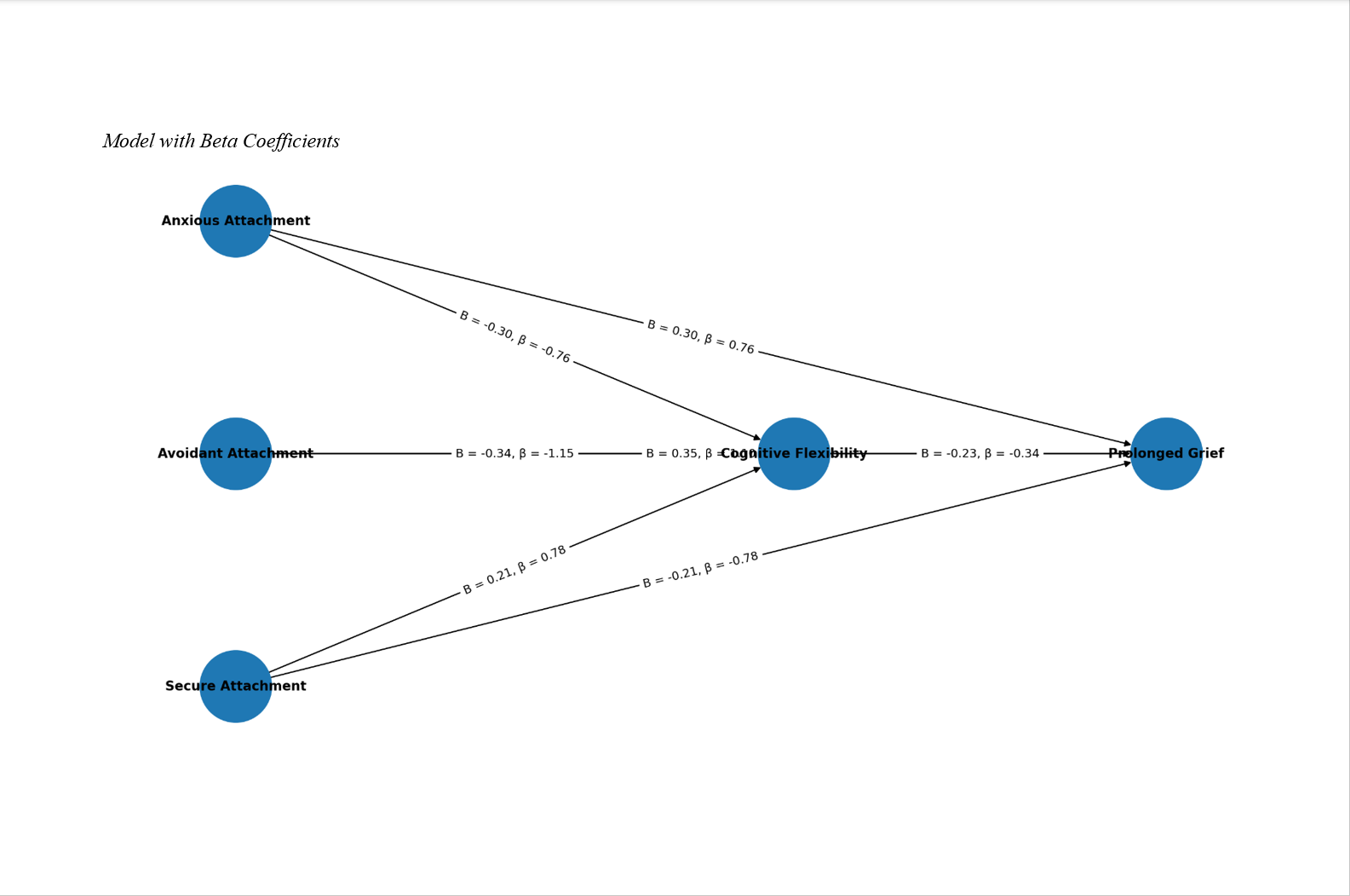
The aim of this study was to examine a structural model of prolonged grief disorder based on attachment styles, considering the mediating role of cognitive flexibility, among individuals who lost first-degree relatives during the COVID-19 pandemic. This research employed a correlational design using structural equation modeling. The study population consisted of bereaved survivors in Alborz Province who had lost a first-degree family member due to COVID-19. A total of 420 individuals participated through convenience sampling using online questionnaires, of which 361 valid responses were analyzed. Data were collected between June and December 2024. Instruments included the Prolonged Grief Disorder-13-Revised scale (PG-13-R), the Revised Adult Attachment Scale (RAAS), and the Cognitive Flexibility Inventory (CFI). Descriptive statistics, Pearson correlation, multiple regression, and SEM were used for data analysis. Results showed that anxious and avoidant attachment styles were positively associated with prolonged grief, while secure attachment negatively predicted grief symptoms. Cognitive flexibility demonstrated a significant protective role, negatively predicting prolonged grief. Regression analysis indicated that components of cognitive flexibility (perception of alternatives, perceived controllability, and justification of behavior) accounted for 51% of the variance in grief. Attachment styles together explained 33% of the variance in grief outcomes. Structural equation modeling confirmed the adequacy of the final model with acceptable fit indices (χ²/df = 2.34, CFI = 0.94, TLI = 0.92, RMSEA = 0.059, SRMR = 0.047). Bootstrap analysis further supported the significant mediating role of cognitive flexibility in the relationships between attachment styles and prolonged grief. The study highlights that insecure attachment styles increase vulnerability to prolonged grief, whereas secure attachment and cognitive flexibility serve as protective factors. Cognitive flexibility functions as a mediator, offering a promising target for interventions aimed at reducing prolonged grief among COVID-19 bereaved survivors.
Downloads
References
Abtahi Foroshani, N., & Rakhshan, P. (2022). Effectiveness of Acceptance and Commitment Therapy on Long-Term Grief Disorder and Reduction of Distress in Coronary Women Nurses. Psychology of Woman Journal, 3(4), 64-83. https://doi.org/10.61838/
Aghaei, A., & Mousavi, S. M. (2020). The Relationship Between Attachment Styles and Self-Differentiation, Cognitive Flexibility, and Marital Intimacy in University Students. https://frooyesh.ir/browse.php?a_id=1798&slc_lang=en&sid=1&printcase=1&hbnr=1&hmb=1
Boelen, P. A., Spuij, M., & Lenferink, L. I. M. (2019). Comparison of DSM-5 criteria for persistent complex bereavement disorder and ICD-11 criteria for prolonged grief disorder in help-seeking bereaved children. Journal of affective disorders, 250, 71-78. https://doi.org/10.1016/j.jad.2019.02.046
Bryant, R. A. (2024). Cognitive Behavior Therapy vs Mindfulness in Treatment of Prolonged Grief Disorder. JAMA Psychiatry, 81(7), 646. https://doi.org/10.1001/jamapsychiatry.2024.0432
Eisma, M., & Lenferink, L. (2023). Co-occurrence of approach and avoidance in prolonged grief: a latent class analysis. European Journal of Psychotraumatology, 14(2). https://doi.org/10.1080/20008066.2023.2190544
Eisma, M. C., Bernemann, K., Aehlig, L., Janshen, A., & Doering, B. K. (2023). Adult attachment and prolonged grief: A systematic review and meta-analysis. Personality and individual differences, 214, 112315. https://doi.org/10.1016/j.paid.2023.112315
Eisma, M. C., Boelen, P. A., & Lenferink, L. I. M. (2020). Prolonged grief disorder following the Coronavirus (COVID-19) pandemic. Psychiatry research, 288, 113031. https://doi.org/10.1016/j.psychres.2020.113031
Fathi-Ashtiani, M., & Sheikholeslami, R. (2019). Relationship between attachment style and psychological well-being: The mediating role of cognitive flexibility. Journal of Psychology, 23(2), 134-147. http://iranapsy.ir/en/Article/21522
Friedland, H., Stripling, A. M., & Crocker, J. (2024). Prolonged Grief Disorder in Adults Over 65: A Review in Light of Post-Covid-19 Losses. Innovation in Aging, 8(Supplement_1), 950-950. https://doi.org/10.1093/geroni/igae098.3062
Glickman, K. (2021). Prolonged grief disorder in a diverse college student sample. Frontiers in psychology, 11, 604573. https://doi.org/10.3389/fpsyg.2020.604573
Kaiser, J., Nagl, M., Hoffmann, R., Linde, K., & Kersting, A. (2022). Therapist-Assisted Web-Based Intervention for Prolonged Grief Disorder After Cancer Bereavement: Randomized Controlled Trial. Jmir Mental Health, 9(2), e27642. https://doi.org/10.2196/27642
Maccallum, F., & Bryant, R. A. (2018). Prolonged Grief and Attachment Security: A Latent Class Analysis. Psychiatry research, 268, 297-302. https://doi.org/10.1016/j.psychres.2018.07.038
Martínez-Medina, C. B., & Rodríguez-Orozco, A. R. (2023). Prolonged Grief Disorder Treatment: an Approach to COVID-19 Grief. Salud mental, 46(3), 165-175. https://doi.org/10.17711/sm.0185-3325.2023.021
Mauro, C., Reynolds, C. F., Maercker, A., Skritskaya, N., Simon, N., Zisook, S., & Shear, M. K. (2019). Prolonged grief disorder: Clinical utility of ICD-11 diagnostic guidelines. Psychological medicine, 49(5), 861-867. https://doi.org/10.1017/S0033291718001563
Roshan Chesli, R., Farahani, H., & Morvaridi, M. (2023). Structural model fitting of the relationship between attachment styles and emotional schemas considering the mediating variables of emotional regulation and cognitive flexibility with marriage willingness. Clinical Psychology and Personality, 21(1), 57-72. https://cpap.shahed.ac.ir
Rosner, R., Rimane, E., Vogel, A., Rau, J., & Hagl, M. (2018). Treating prolonged grief disorder with prolonged grief-specific cognitive behavioral therapy: study protocol for a randomized controlled trial. Trials, 19, 1-12. https://doi.org/10.1186/s13063-018-2618-3
Rueger, M. S., Lechner‐Meichsner, F., Kirschbaum, L., Lubik, S., Roll, S. C., & Steil, R. (2024). Prolonged Grief Disorder in an Inpatient Psychiatric Sample: Psychometric Properties of a New Clinical Interview and Preliminary Prevalence. BMC psychiatry, 24(1). https://doi.org/10.1186/s12888-024-05784-2
Sękowski, M., & Prigerson, H. G. (2022). Disorganized Attachment and Prolonged Grief. Journal of Clinical Psychology, 78(9), 1806-1823. https://doi.org/10.1002/jclp.23325
Trivedi, G. Y., & Thakore, P. (2025). A Case Study on Post-Traumatic Stress Disorder, Prolonged Grief Disorder, and Adjustment Disorder. Cureus. https://doi.org/10.7759/cureus.80595
Wenn, J. A., O’Connor, M., Kane, R. T., Rees, C. S., & Breen, L. J. (2019). A pilot randomised controlled trial of metacognitive therapy for prolonged grief. BMJ open, 9(1), e021409. https://bmjopen.bmj.com/content/9/1/e021409.abstract
Williams, J. L., Hardt, M. M., Henschel, A. V., & Eddinger, J. R. (2019). Experiential Avoidance Moderates the Association Between Motivational Sensitivity and Prolonged Grief but Not Posttraumatic Stress Symptoms. Psychiatry research, 273, 336-342. https://doi.org/10.1016/j.psychres.2019.01.020
Yoshiike, T. (2025). Prolonged Grief and Related Health Factors Modify the Relationship Between Bedroom Light Exposure and Sleep Fragmentation. Sleep, 48(Supplement_1), A541-A541. https://doi.org/10.1093/sleep/zsaf090.1256
Downloads
Additional Files
Publication Timeline
- Submitted
- Revised
- Accepted
License
Copyright (c) 2025 Parvaneh Nikkhah (Author); Beheshteh Niusha (Corresponding Author); Elaheh Haghighat-Manesh (Author)

This work is licensed under a Creative Commons Attribution-NonCommercial 4.0 International License.