Investigating the Effect of Occupational Well-Being on Job Boredom among Iraqi Physical Education Teachers: The Mediating Role of Motivational Beliefs
DOI:
https://doi.org/10.61838/kman.ooc.psynexus.3.10Keywords:
Job well-being, job boredom, job plateau, Iraqi sports teachersAbstract
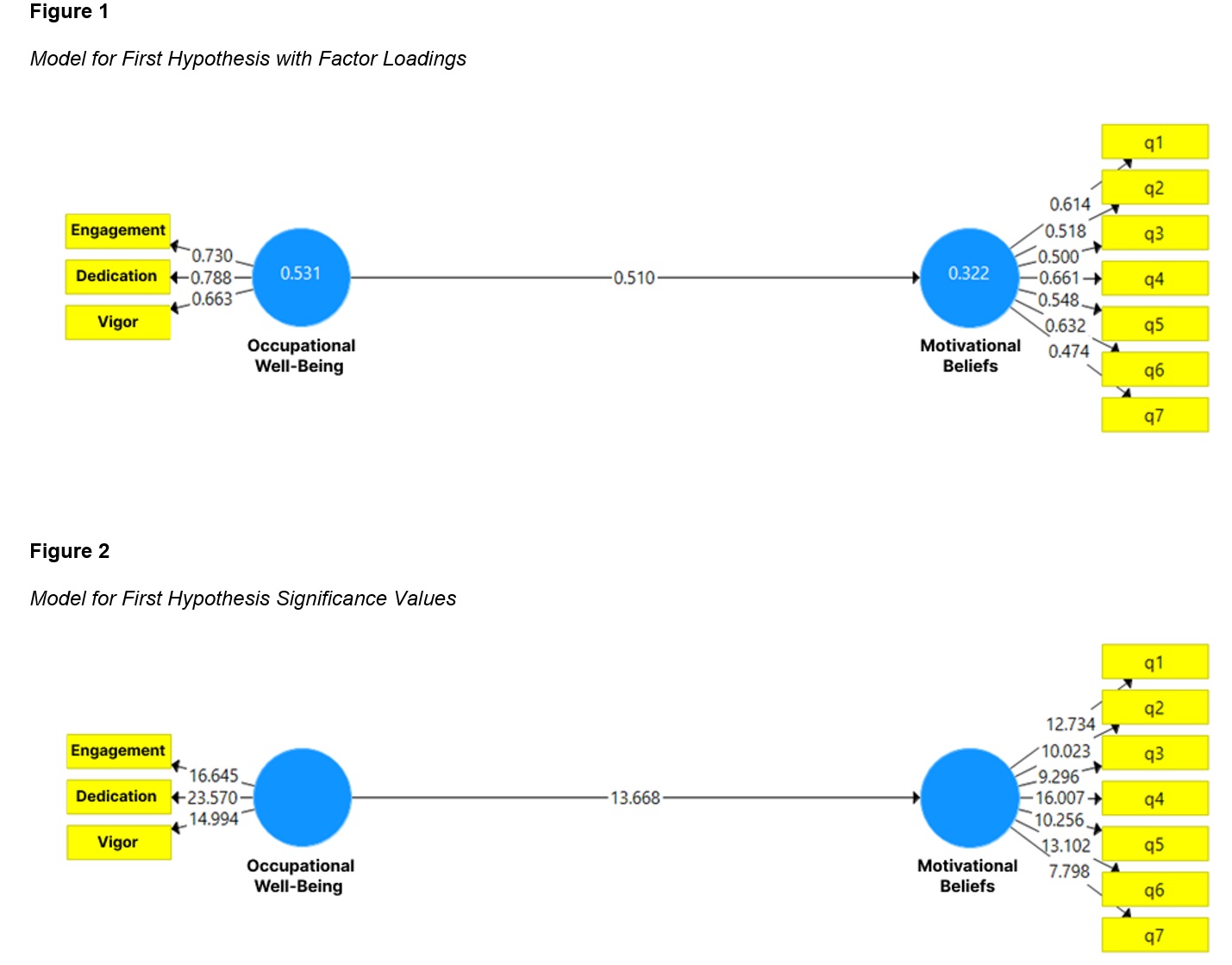
The purpose of this study was to investigate the effect of occupational well-being on job boredom among physical education teachers in Iraq, with the mediating role of motivational beliefs. This research is descriptive-correlational in nature and applied in purpose. The statistical population consisted of all physical education teachers in Iraq, totaling 25,642 individuals. Given the geographical dispersion of physical education teachers across the country, a sample of 384 teachers was selected using a multi-stage cluster sampling method. Data collection tools included the Occupational Well-Being Questionnaire by Salanova et al. (2015), the Job Boredom Questionnaire by Falman et al. (2013), and the Motivational Beliefs Questionnaire by Wang, Khoo, and Su (2010). Face and content validity of the questionnaires were confirmed by the academic supervisor, and their reliability was assessed using Cronbach’s alpha, yielding coefficients of 0.95, 0.92, and 0.91 for occupational well-being, job boredom, and motivational beliefs, respectively. Data were analyzed using correlation coefficients, multiple regression analysis, and structural equation modeling (SEM). All statistical analyses were conducted using PLS and SPSS software. The findings indicated that occupational well-being significantly affects the motivational beliefs of Iraqi physical education teachers, explaining 26.01% of the variance in motivational beliefs. Furthermore, motivational beliefs had a significant negative effect on job boredom, accounting for 18.31% of its variance. Additionally, occupational well-being showed a significant negative impact on job boredom, explaining 12.04% of the variance in job boredom.
Downloads
References
Abdoli, M., & Zarei, S. (2024). The mediating role of mindfulness in the relationship between job boredom with job satisfaction and turnover intention. Ravanshenasi-ye Ruyesh, 13(1), 63-72. https://frooyesh.ir/browse.php?a_id=4873&slc_lang=en&sid=1&printcase=1&hbnr=1&hmb=1
Abedi, H., Lotfi, M., & Ghomi, F. (2023). Investigating the relationship between motivational beliefs and academic performance in students with the mediation of learning strategies. Educational Research Quarterly, 8(3), 87-105.
Abkhiz, S., & Mikaeli Manie, F. (2020). Structural relationships between cognitive self-regulation and occupational well-being with the mediation of job burnout and job satisfaction among high school teachers in Urmia during the 2017-2018 academic year. Career and Organizational Counseling, 12(44), 71-86. https://jcoc.sbu.ac.ir/article_100097.html
Alonso, C., Fernández-Salinero, S., & Topa, G. (2019). The impact of both individual and collaborative job crafting on Spanish teachers' well-being. Education Sciences, 9(2), 74-85. https://doi.org/10.3390/educsci9020074
Chan, S. W., Pöysä, S., Lerkkanen, M. K., & Pakarinen, E. (2023). Teachers' occupational well-being in relation to teacher-student interactions at the lower secondary school level. Scandinavian Journal of Educational Research, 1-18. https://doi.org/10.1080/00313831.2023.2204114
Collie, R. J., Shapka, J. D., Perry, N. E., & Martin, A. J. (2015). Teacher well-being: Exploring its components and a practice-oriented scale. Journal of Psychoeducational Assessment, 33(14), 744-756. https://doi.org/10.1177/0734282915587990
Duong, A. C., Nguyen, H. N., Tran, A., & Trinh, T. M. (2023). An investigation into teachers' occupational well-being and education leadership during the COVID-19 pandemic. Frontiers in Education, 8, 1112577. https://doi.org/10.3389/feduc.2023.1112577
Harju, L. K., Schaufeli, W. B., & Hakanen, J. J. (2018). A multilevel study on servant leadership, job boredom and job crafting. Journal of managerial psychology, 33(1), 2-14. https://doi.org/10.1108/JMP-08-2016-0237
Hoy, A. W., Hoy, W. K., & Davis, H. A. (2019). Teachers' self-efficacy beliefs. In Handbook of motivation at school (pp. 627-653). Routledge. https://psycnet.apa.org/record/2009-24219-028
Karimianpour, G., Zahed Babolan, A., Khaleghkhah, A., & Rezaei Sharif, A. (2022). The relationship between individual characteristics and organizational laziness among primary school teachers: The mediating role of job stagnation. School Management Quarterly, 5(2), 41-56.
Kidger, J., Brockman, R., Tilling, K., Campbell, R., Ford, T., Araya, R., King, M., & Gunnell, D. (2022). Teachers' wellbeing and depressive symptoms, and associated risk factors: A large cross sectional study in English secondary schools. Journal of affective disorders, 192, 76-82. https://doi.org/10.1016/j.jad.2015.11.054
Leka, S., & Houdmont, J. (2020). An Introduction to Occupational Health Psychology. In Occupational Health Psychology (pp. 1-31). BlackWell Publishing LTD. https://psycnet.apa.org/record/2010-10988-001
Mattern, J., & Bauer, J. (2022). Does teacher's cognition self-regulation increase their occupational well-being? The structure and role of self-regulation in the teaching context. Teaching and Teacher Education, 43, 58-68. https://doi.org/10.1016/j.tate.2014.05.004
Mohammadi, F., & Karimi, R. (2018). The role of organizational support in improving occupational well-being of physical education teachers. Human Resource Development Journal, 12(2), 54-69.
Monjezi, A., Latkhan, F., Mousavi, M., & Pakdel, M. H. (2023). Structural equation modeling of the mediating role of occupational well-being in the relationship between psychological capital and work engagement among primary school teachers. Journal of Modern Advances in Behavioral Sciences, 8(56), 366-375. https://ijndibs.com/article-1-876-fa.html
Moradi, K., & Esmaeili, R. (2020). The impact of work-family conflict on job boredom among physical education teachers. Industrial Psychology Journal, 10(1), 90-108.
Parker, G. B., & Hyett, M. P. (2011). Measurement of well-being in the workplace: The development of the Work Well-Being Questionnaire. The Journal of Nervous and Mental Disease, 199(6), 394-397. https://doi.org/10.1097/NMD.0b013e31821cd3b9
Rezaei, M., & Norouzi, P. (2020). The role of motivational beliefs in reducing job boredom among physical education teachers. Social psychology quarterly, 7(2), 142-159.
Rostamzadeh, F., Mazhabi, Z., & Asadi, S. (2024). The relationship between transformational leadership style and technological literacy with effective classroom management and occupational well-being of primary school teachers in District 1 of Urmia during the 2022-2023 academic year. Proceedings of the International Conference on Management and Industry (5th International Conference on Management and Industry),
Sahranavard Mafi, R., & Ranjbar Nowshari, F. (2023). The relationship between psychological capital and occupational well-being in teachers: The mediating role of organizational commitment Payame Noor University of Guilan Province, Astaneh Ashrafieh Center].
Schaufeli, W. B., & Bakker, A. B. (2022). Job demands, job resources, and their relationship with burnout and engagement: A multi-sample study. Journal of Organizational Behavior, 43(6), 861-880. https://onlinelibrary.wiley.com/doi/10.1002/job.248
Sepehvand, A., Shamsi Biranvand, S., Mousavi, S. K., & Ghasemzadeh Dehabadi, Z. (2024). Comparing the effectiveness of education based on the domains of the Fundamental Transformation Document and self-determination training on improving teachers' occupational well-being. Modern Advances, 57(19), 384-393. https://ijndibs.com/article-1-1030-fa.html
Seyed Alitabar, S. H., Abedi, M. R., & Nilforoushan, P. (2022). Comparing the effectiveness of career path well-being counseling with career construction theory on employees' occupational well-being and adaptability. Career and Organizational Counseling, 14(1), 27-46. https://jcoc.sbu.ac.ir/article_100616.html
Shultz, M. (2008). Occupational Well-being: The development of a theory and a measure Kansas State University]. Manhattan. https://krex.k-state.edu/items/6101b4f9-9fb1-4920-99d5-726b9ec266b3
Skaalvik, E. M., & Skaalvik, S. (2023). Teacher stress and job satisfaction: The role of self-efficacy and motivation. Teaching and Teacher Education, 116, 103724.
Soleimani, Z., & Rafiei, M. (2017). The impact of occupational well-being on teacher performance: The mediating role of motivation and job commitment. Educational Management Quarterly, 5(3), 47-63.
Yazdi, H., & Moradi, M. (2017). The impact of occupational well-being on teaching quality: The mediating role of job burnout. Educational Sciences Quarterly, 8(1), 98-115.
Downloads
Additional Files
Publication Timeline
- Submitted
- Revised
- Accepted
Issue
Section
Categories
License
Copyright (c) 2025 Mamoon Hamid Hadi (Author); Mohammad Nasiri (Corresponding Author); Maher Abdulhamza Hardan Al-Wani, Davood Nasr Esfahani (Author)

This work is licensed under a Creative Commons Attribution-NonCommercial 4.0 International License.