Modeling the Propensity for Extramarital Relationships Based on Narcissism and Communication Skills with the Mediating Role of Marital Burnout
DOI:
https://doi.org/10.61838/kman.fct.psynexus.3.21Keywords:
Marital Infidelity, Narcissism, Communication Skills, Marital Burnout, Structural Equation ModelingAbstract
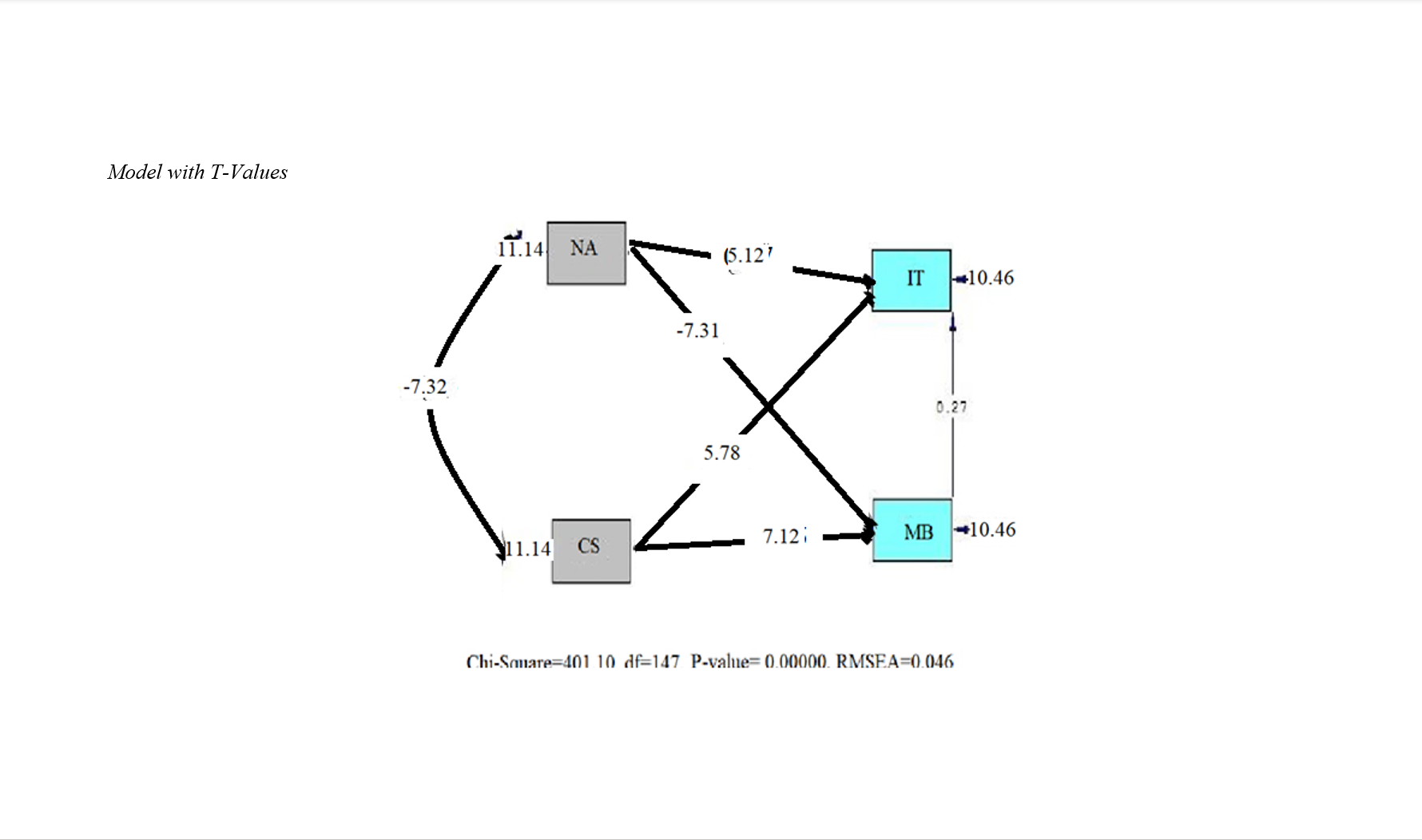
This study aimed to propose a predictive model of the propensity for marital infidelity based on the roles of narcissism and communication skills as predictor variables, and marital burnout as a mediating variable. The significance of this research lies in identifying psychological factors influencing marital infidelity, which is one of the major threats to family stability and the mental health of couples. The research method was descriptive-correlational, utilizing structural equation modeling. The statistical population included married women residing in Shahriar County who had a minimum of five years of shared marital life. Among them, 240 participants were selected through multi-stage cluster sampling. Data were collected using validated psychological questionnaires and analyzed accordingly. The results revealed that narcissism and deficiencies in life skills significantly increased the propensity for marital infidelity. Moreover, marital burnout played a significant mediating role in the relationship between the predictor variables and the tendency toward infidelity. Specifically, narcissism and inadequate communication skills were shown to elevate the risk of infidelity through an increase in marital burnout. These findings can contribute to the development of preventive and therapeutic interventions in the field of family health.
Downloads
References
Anderson, J. C., Håkansson, H., & Johanson, J. (1994). Dyadic business relationships within a business network context. Journal of Marketing, 58, 1-15. https://doi.org/10.1177/002224299405800401
Choopani, M., Fatehizadeh, M., Asanjrani, F., & De Castro Correa, A. M. (2021). Existential Phenomena in Marital Infidelity Among Men. Family Research, 17(3), 483-513. https://doi.org/10.52547/JFR.17.3.483
Choopani, M., Sohrabi Fard, M. M., Mohammadi, F., Esmaili, N., & Samadi Fard, A. (2019). Unfaithful Men's Perception of the Causes and Inhibiting Factors of Extramarital Relationships: A Qualitative Study. Counseling Research (New Developments in Counseling Research), 18(69), 79-105. https://doi.org/10.29252/jcr.18.69.79
Farajpour Niri, S., Ahmadi, Z., & Bakhshesh Boroujeni, M. (2021). The Mediating Role of Vulnerable and Grandiose Narcissism in the Relationship Between Attachment Styles and Impulsivity Among Students. nursing development in health, 12(2), 8-19. https://www.researchgate.net/publication/365368771_The_mediating_role_of_vulnerable_and_grandiose_narcissism_in_the_relation_between_attachment_styles_and_impulsivity_among_university_students
Farivar, M. (2020). A Causal Modeling of Marital Infidelity Propensity Based on Domestic Violence, Narcissism, and Forgiveness with the Mediating Role of Disinhibition [Master's Thesis, University of Mohaghegh Ardabili.
Fasihi Permehr, F. (2023). The Role of Sexual Excitation/Inhibition, Marital Conflicts, and Marital Communication Skills in Predicting Married Men's Propensity for Marital Infidelity [Master's Thesis, Islamic Azad University, Ardabil Branch.
Feizi, T., Kheirandish, M., & Latifi Jaliseh, S. (2019). Individual, Organizational, and Managerial Antecedents and Consequences of Managers' Narcissism: Application of Documentary Analysis and Shannon Entropy. Organizational Behavior Studies, 8(2), 171-188. https://www.magiran.com/paper/2035847/individual-organizational-and-managerial-antecedents-and-consequences-of-managers-narcissism-using-document-analysis-and-shannon-entropy?lang=en
Ghiasi, N., Haseli, A., & Feli, R. (2023). The interplay of attachment styles and marital infidelity: A systematic review and meta-analysis. Heliyon. https://doi.org/10.2139/ssrn.4521053
Hashemieh, C., Azgoli, G., Abolmaali, K., & Nasiri, M. (2017). The Relationship Between Personality Traits and Marital Satisfaction Based on the Big Five Personality Model: A Systematic Review. Scientific Journal of Kurdistan University of Medical Sciences, 22, 121-132. https://www.magiran.com/paper/1768814/the-relationship-between-personality-traits-and-marital-satisfaction-based-on-five-factors-model-of-personality-a-systematic-review?lang=en
Khavasi, L. (2013). The Meaning of Marital Boundaries in Successful Marriages (Marital Boundaries in the Face of a Third Party). Ghoghnos Publications.
Khodabandehlow, S., & Rahimian Bougar, I. (2018). Etiology and Development of Narcissism from a Psychodynamic Perspective. Ravanshenasi-ye Rooyesh, 7(25), 195-212. https://frooyesh.ir/browse.php?a_id=1114&slc_lang=en&sid=1&printcase=1&hbnr=1&hmb=1
Mohseni Tabrizi, A., Koldi, A., & Javadian Zadeh, M. (2012). Investigating Domestic Violence Among Married Women Referred to Forensic Medicine and Welfare Centers in Yazd (2009). Toloo-e Behdasht Yazd, 11(3), 11-24. https://tbj.ssu.ac.ir/article-1-321-en.html
Najjar, Z., Motabi, F., & Sadeghi, M. (2024). The Lived Experience of the Third Party in Marital Infidelity: A Phenomenological Study. Family Research, 20(4), 91-118. https://scj.sbu.ac.ir/article_105336.html
Paulinus, C. E. (2022). A PHILOSOPHICAL EXAMINATION OF THE CONCEPT AND NATURE OF INFIDELITY IN MARRIAGE AS A SOCIO-ETHICAL ISSUE IN CONTEMPORARY SOCIETY. GPH-International Journal of Social Science and Humanities Research, 5(07), 36-42. https://gphjournal.org/index.php/ssh/article/view/662
Pines, A. M. (2004). Couple burnout: Causes and cures. Routledge. https://books.google.nl/books/about/Couple_Burnout.html?id=3p41UVU1RxsC&redir_esc=y
Rajabi, G., Liaqat, H., & Abbas Pour, Z. (2021). Investigating the Model of Marital Communication Skills and Marital Conflict as Mediators Between Family of Origin and Marital Satisfaction. Journal of Nursing and Midwifery, 19(4), 275-286. https://unmf.umsu.ac.ir/article-1-4092-en.html
Sarmadi, Y., & Ahmadi, K. (2021). The Extent of Damages Caused by Marital Infidelity Among Couples. Family Research, 17(1), 81-98. https://doi.org/10.52547/jfr.17.1.81
Schimberg, L. R. N., Grant, J. E., & Odlaug, B. L. (2016). Emotion regulation and impulsivity in young adults. Psychiatric Research, 46(5), 651-658. https://doi.org/10.1016/j.jpsychires.2012.02.005
Shakeri, S. S., Shabani, J., Aghamohammadian Sharbaf, H. R., & Aghili, S. M. (2019). The Mediating Role of Attitudes Toward Infidelity and Marital Conflicts in the Relationship Between Social Media Use and Emotional Divorce Among Married Teachers in Mashhad. Health Research Journal, 8(4), 220-227. https://doi.org/10.18502/jchr.v8i4.2077
Downloads
Additional Files
Publication Timeline
- Submitted
- Revised
- Accepted
Issue
Section
Categories
License
Copyright (c) 2025 Maryam Shahrabadi (Author); Reza Khakpour (Corresponding Author); Simindokht Rezakhani (Author)

This work is licensed under a Creative Commons Attribution-NonCommercial 4.0 International License.