The Role of Life Stressful Events, Emotional Distress Tolerance, and Perceived Gender Discrimination in Predicting Suicidal Thoughts Among Women with Experiences of Domestic Violence
DOI:
https://doi.org/10.61838/kman.psynexus.2.1.30Keywords:
Suicidal Ideation, Domestic Violence, Life Stressful Events, Distress Tolerance, Gender Discrimination, Women’s Mental HealthAbstract
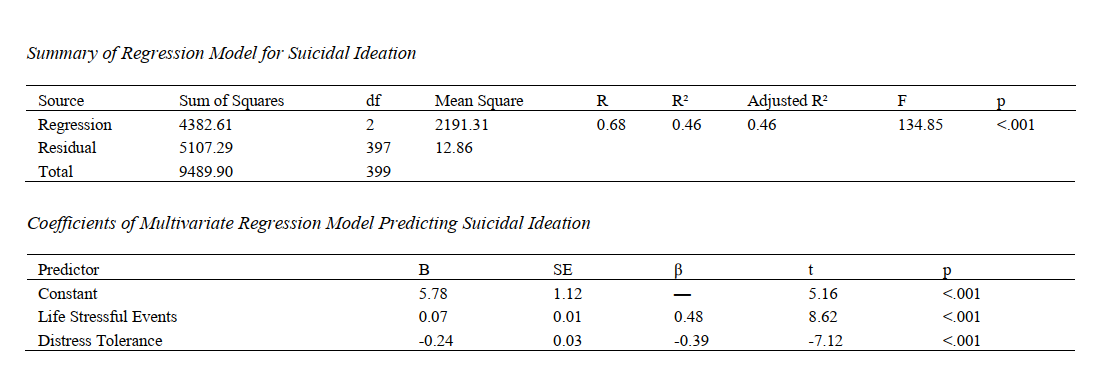
The objective of this study was to investigate the predictive roles of life stressful events, distress tolerance, and perceived gender discrimination in suicidal ideation among women with experiences of domestic violence in Tehran. This research employed a correlational descriptive design with a sample of 400 women selected based on Krejcie and Morgan’s table through convenience sampling from social service centers and shelters in Tehran. Data were collected using standardized instruments: the Beck Scale for Suicidal Ideation, Holmes and Rahe Stress Scale, Distress Tolerance Scale, and the Perceived Gender Discrimination Scale. Pearson correlation coefficients were computed to examine the bivariate relationships, and multiple linear regression analysis was used to identify the predictive power of the independent variables on suicidal ideation. Data analysis was conducted using SPSS version 27. Pearson correlation results indicated that suicidal ideation had a significant positive correlation with life stressful events (r = 0.62, p < .001) and perceived gender discrimination (r = 0.49, p < .001), and a significant negative correlation with distress tolerance (r = -0.55, p < .001). The multiple regression model including life stressful events and distress tolerance was significant, F(2, 397) = 134.85, p < .001, explaining 46% of the variance in suicidal ideation (R² = 0.46). Life stressful events (β = 0.48, p < .001) and distress tolerance (β = -0.39, p < .001) were both significant predictors. The findings highlight the significant role of life stress and emotional resilience in predicting suicidal ideation among women experiencing domestic violence. These results underscore the importance of targeted interventions focusing on stress reduction and distress tolerance to mitigate suicide risk in this vulnerable population.
Downloads
References
Alvarado, G., Fenny, A. P., Dakey, S., Mueller, J., O’Brien-Milne, L., Crentsil, A. O., Duvvury, N., Scriver, S., & Schwenke, C. (2018). The Health-Related Impacts and Costs of Violence Against Women and Girls on Survivors, Households and Communities in Ghana. Journal of Public Health in Africa. https://doi.org/10.4081/jphia.2018.860
Asaei, S., Naziryy, G., & Zarenezhad, M. (2020). Comparing the Tendency to Addiction and Suicide in Physically and Sexually Abused Women Referred to Forensic Medicine with Non-Abused Women; Case study of Fars Province. Iran-J-Forensic-Med, 26(1), 79-84. http://sjfm.ir/article-1-1076-en.html
Asha, A. A. (2025). Inclusive Justice and Sustainable Legal Protections Against Domestic Violence: A Comparative Study of UK, Canada, and Australia. Jier, 5(2). https://doi.org/10.52783/jier.v5i2.2465
Azizmohammadi, F. (2023). The Role of Safe Housing in Empowering Survivors of Domestic Violence in Iran. Ejhr, 1(1), 89-102. https://doi.org/10.59871//brxz6481
Bonganciso, J. G., & Kumari, B. (2022). Impact of Gender Based Violence on Developing Children’s Personalities. Technoarete Transactions on Advances in Social Sciences and Humanities, 1(2). https://doi.org/10.36647/ttassh/01.02.a004
Cabral, J., & Pinto, T. M. (2023). Gender, Shame, and Social Support in LGBTQI+ Exposed to Discrimination: A Model for Understanding the Impact on Mental Health. Social Sciences, 12(8), 454. https://doi.org/10.3390/socsci12080454
Fahim, A. U., Liza, S. J., Lina, S. J., & Salim, M. A. A. (2022). Study of Mental Stress Related with Lifestyle During COVID-19: A Case Study of Bangladesh. International Journal of Education and Cognitive Sciences, 3(2), 30-41. https://doi.org/10.22034/injoeas.2022.160611
Hafeez, S. (2024). Exploring the Depths of Scars: The Connection Between Domestic Violence and Mental Health in Married Women From Faisalabad, Pakistan- Insights Into Depression, Anxiety, Stress, and Anger. Pakistan Social Sciences Review, 8(I). https://doi.org/10.35484/pssr.2024(8-i)35
Haji Heidari, B., & Sajadian, E. (2023). The Role of Resilience, Emotion Regulation, and Spiritual Health in Predicting Suicidal Ideation in Women Victims of Violence During the COVID-19 Pandemic. Iranian-Islamic Family Studies, 3(3), 52-75. https://sanad.iau.ir/en/Journal/iifsj/Article/921430/FullText
Hegarty, K., Andrews, S., & Tarzia, L. (2022). Transforming Health Settings to Address Gender‐based Violence in Australia. The Medical Journal of Australia, 217(3), 159-166. https://doi.org/10.5694/mja2.51638
Ilmi, N. (2023). Mental Health and Coping Strategies in Women Experiencing Domestic Violence in Indonesia. Gaceta Médica De Caracas, 131(1). https://doi.org/10.47307/gmc.2023.131.1.12
Jyothsna, K. A., Shetty, K. V., Kumar, S., Baruah, U., Jyothi, H. P., Amritha, K. S., & Sachetha, G. M. (2023). Psychosocial Distress, Perceived Social Support, and Coping in Women Survivors of Domestic Violence Seeking Help From a Women's Helpline in Urban India. Journal of education and health promotion, 12(1). https://doi.org/10.4103/jehp.jehp_163_23
K., S., & Tripathi, K. N. (2024). Study of Mental Health,Self Esteem and Domestic Violence in Relation to Type of Family and Tenure of Marriage. Mind and Society, 13(02), 1-9. https://doi.org/10.56011/mind-mri-132-20241
Kaul, A., Saboor, L., Ahmad, A., Mannell, J., Paphitis, S. A., & Devakumar, D. (2024). What Are the Experiences and Psychosocial Needs of Female Survivors of Domestic Violence in Afghanistan? A Qualitative Interview Study in Three Afghan Provinces. BMJ open, 14(6), e079615. https://doi.org/10.1136/bmjopen-2023-079615
Kay, M., Mainah, M., & Masiga, C. (2024). Gender Disparities in Accessing Psychosocial Support Services Among Survivors of Gender-Based Violence in Kenya. International Journal of Research and Innovation in Social Science, VIII(XII), 588-594. https://doi.org/10.47772/ijriss.2024.8120046
Keli, H. (2022). ‘There Is Always a Reason for the Beatings’: Interrogating the Reproduction of Gender-Based Violence Within Private and Public Spaces. 200-212. https://doi.org/10.1332/policypress/9781529214499.003.0013
Lacey, K. K., Parnell, R., Drummond-Lewis, S. R., Wood, M., & Sears, K. P. (2021). Physical Intimate Partner Violence, Childhood Physical Abuse and Mental Health of U.S. Caribbean Women: The Interrelationship of Social, Contextual, and Migratory Influences. International journal of environmental research and public health, 19(1), 150. https://doi.org/10.3390/ijerph19010150
Leat, S. R., Ravi, K. E., Rai, A., Obenauf, C., & Bryant, S. M. (2023). Do I Belong Here? Experiences of Transgender Survivors of Intimate Partner Violence in Domestic Violence Shelters. Families in Society the Journal of Contemporary Social Services, 106(1), 245-255. https://doi.org/10.1177/10443894231196929
Liu, H. (2024). Impact of Domestic Violence on Women’s Mental Health and Coping Strategies: A Survey Study in Mexico. Journal of Research in Social Science and Humanities, 3(2), 22-28. https://doi.org/10.56397/jrssh.2024.02.04
Martin, M., & Kotian, A. (2023). The Broken Promises of the Lesbian Utopia: Woman to Woman Intimate Partner Abuse. HPHR(49). https://doi.org/10.54111/0001/xx1
Mootz, J., Stabb, S. D., Carlson, C., Helpman, L., Mangen, P. O., & Wainberg, M. L. (2020). Why Place and Space Matter for Intimate Partner Violence Survivors’ Mental Wellbeing and Communities in Northeastern Uganda. Women & Health, 60(9), 975-986. https://doi.org/10.1080/03630242.2020.1784366
Nooshabadi, S. S. (2021). Predicting Suicide Ideation and Psychological Helplessness Based on Domestic Violence in Women. Jarac, 3(2), 60-71. https://doi.org/10.61838/kman.jarac.3.2.6
Nur, N. (2023). Suicidal Thoughts and Attempts Among Married Women Who Experience Intimate Partner Violence in Türkiye. Eastern Mediterranean Health Journal, 29(9). https://doi.org/10.26719/emhj.23.097
Pathak, J., & Upadhyay, M. (2021). Improving Social Outcomes of Mental Distress Survivors of Domestic Violence: Using the Capability Approach. Journal of Social and Economic Development, 23(S1), 212-227. https://doi.org/10.1007/s40847-020-00139-5
Rodgers, S. T. (2020). Womanism and Domestic Violence. https://doi.org/10.1093/acrefore/9780199975839.013.1073
Stoever, J. K. (2020). The Politicization of Safety. https://doi.org/10.18574/nyu/9781479805648.001.0001
Waters, A. R., Warner, E. L., Wilson, J., Rosenstein, D. L., Hall, W. J., & Kent, E. E. (2025). Differences in Discrimination, Violence, Mental Health, and Substance Use Outcomes by Cancer History Among LGBTQ+ Individuals in North Carolina. North Carolina Medical Journal, 86(1). https://doi.org/10.18043/001c.127405
Williams, K. P., Harb, M., Satyen, L., & Davies, M. (2024). S-Cape Trauma Recovery Program: The Need for a Holistic, Trauma- And Violence-Informed Domestic Violence Framework. Frontiers in Global Women S Health, 5. https://doi.org/10.3389/fgwh.2024.1404599
Wu, Y. (2023). Urbanization and Women’s Social Status: Progress and Challenges in China. Highlights in Business Economics and Management, 21, 529-536. https://doi.org/10.54097/hbem.v21i.14546
Yustika, N., Yuhastina, Y., & Rahman, A. (2022). Analisis Gender Terhadap Kdrt: Studi Kasus Perempuan Penyintas KDRT Yayasan Spek-Ham Surakarta. Sosiologi Jurnal Ilmiah Kajian Ilmu Sosial Dan Budaya, 24(2), 237-269. https://doi.org/10.23960/sosiologi.v24i2.356
Downloads
Additional Files
Publication Timeline
- Submitted
- Revised
- Accepted
Issue
Section
Categories
License
Copyright (c) 2024 Amin Allah Gholami, Zahra Davoodvandi , Souraya Abbasgholipoor , Zahra Karami, Forud Gholami (Author)

This work is licensed under a Creative Commons Attribution-NonCommercial 4.0 International License.