The Effectiveness of Cognitive-Behavioral Couple Therapy on Marital Intimacy and Marital Satisfaction
DOI:
https://doi.org/10.61838/kman.psynexus.2.1.29Keywords:
marital intimacy, marital satisfaction, cognitive-behavioral couple therapyAbstract
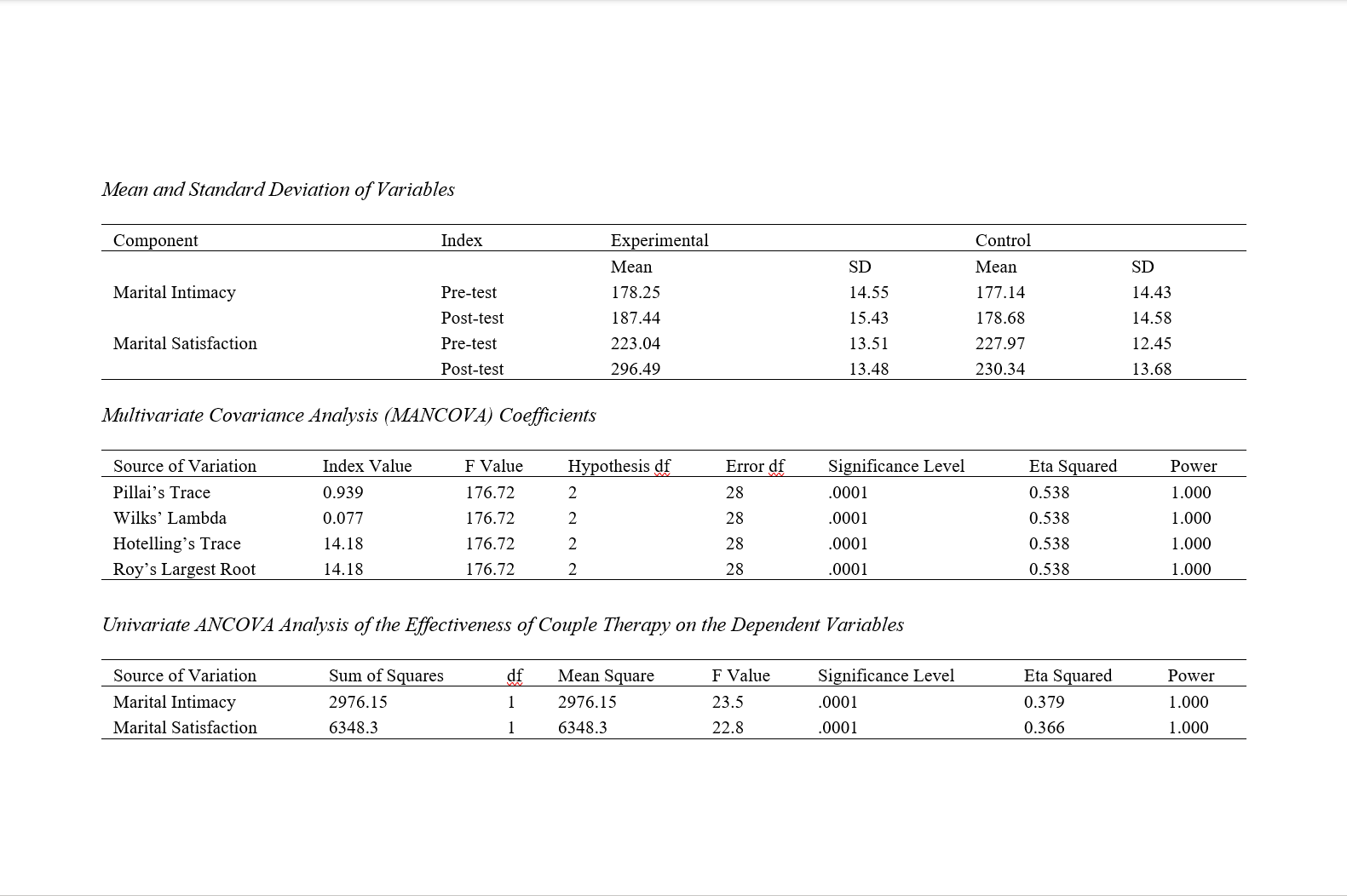
The present study was conducted to examine the effectiveness of cognitive-behavioral couple therapy on marital intimacy and marital satisfaction among couples referring to counseling centers in Shahreza. This research utilized a quasi-experimental design with a pre-test–post-test and control group. The statistical population included all couples who referred to counseling centers in Shahreza, among whom 30 couples were selected as the sample through convenience sampling. Data were collected using the Marital Intimacy Questionnaire by Olia et al. (2006) and the ENRICH Marital Satisfaction Questionnaire by Olson (1998). The intervention employed Michael Free’s (2015) group-based cognitive-behavioral therapy protocol. The results indicated that cognitive-behavioral couple therapy had a significant effect on increasing marital intimacy and marital satisfaction among the couples referring to counseling centers in Shahreza. The effect size showed that 37.9% of the changes in marital intimacy and 36.6% of the changes in marital satisfaction were attributable to the cognitive-behavioral couple therapy intervention. Therefore, cognitive-behavioral couple therapy can be utilized to enhance marital intimacy and marital satisfaction.
Downloads
References
Ali, P. A., McGarry, J., & Maqsood, A. (2022). Spousal role expectations and marital conflict: Perspectives of men and women. Journal of interpersonal violence, 37(9-10), NP7082-NP7108. https://doi.org/10.1177/0886260520966667
Alizadeh, M., Turkestani, N. A., Oohadi, B., & Rezveh, F. M. (2019). Effectiveness of cognitive behavioral counseling-based film therapy on the communication skills of females with low sexual desire. Journal of Nursing and Midwifery Sciences, 6(1), 8-14. https://doi.org/10.4103/JNMS.JNMS_48_18
Ariapooran, S., & Raziani, S. (2019). Sexual satisfaction, marital intimacy, and depression in married Iranian nurses with and without symptoms of secondary traumatic stress. Psychological Reports, 122(3), 809-825. https://doi.org/10.1177/0033294118776927
Azizi, A. (2016). The effectiveness of cognitive-behavioral couple therapy using the reconstruction of maladaptive cognitive schemas on marital conflicts.
Bayrami, M., Hashemi, T., & Azhdeh, L. (2024). Comparing the effectiveness of cognitive-behavioral couple therapy and integrative therapy on improving marital satisfaction and intimacy in incompatible couples. Iranian Journal of Psychiatry and Clinical Psychology, 30([issue not provided]). https://doi.org/10.32598/ijpcp.30.4942.1
Cheung, A. K. L., Chiu, T. Y., & Choi, S. Y. P. (2022). Couples' self-control and marital conflict: Does similarity, complementarity, or totality matter more? Social science research, 102, 102638. https://doi.org/10.1016/j.ssresearch.2021.102638
Dildar, S., Sitwat, A., & Yasin, S. (2013). Intimate enemies: Marital conflicts and conflict resolution styles in dissatisfied married couples. Middle east journal of scientific research, 15(10), 1433-1439. https://www.researchgate.net/publication/281752391_Intimate_Enemies_Marital_Conflicts_and_Conflict_Resolution_Styles_in_Dissatisfied_Married_Couples
Epstein, N. B., & Zheng, L. (2017). Cognitive-behavioral couple therapy. Current opinion in psychology, 13, 142-147. https://doi.org/10.1016/j.copsyc.2016.09.004
Farhadi, A., Salehin, S., Aghayan, S., Keramat, A., & Talebi, S. (2020). The effectiveness of reality therapy based on choice theory on marital intimacy and sexual satisfaction of newly married women. Avicenna Journal of Nursing and Midwifery Care, 28(2), 83-92. https://doi.org/10.30699/ajnmc.28.2.83
Forouzani, S., Norbakhsh Amiri, M., Abbasi, F., Akbarzadeh, N., & Jafari, Z. (2024). Effectiveness of Cognitive Behavioral Therapy on Psychological Hardiness and Marital Relationship Quality in Couples with Marital Conflicts. Journal of Assessment and Research in Applied Counseling, 6(2), 105-112. https://doi.org/10.61838/kman.jarac.6.2.13
Goldberg, A. E., Allen, K. R., & Smith, J. Z. (2021). Divorced and separated parents during the COVID-19 pandemic. Family Process, 60, 866-887. https://doi.org/10.1111/famp.12693
Hajimoradi, R., Nabizadeh, A., & Narimani, M. (2021). Prediction of marital intimacy based on the quality of thematic relationships and expression of positive emotion in women. Journal of Human Relations Studies, 1(2), 49-55. https://jhrs.uma.ac.ir/article_1280.html
Kamali, Z., Allahyar, N., Ostovar, S., Alhabshi, S. M., & Griffiths, M. D. (2020). Factors that influence marital intimacy: A qualitative analysis of Iranian married couples. Cogent Psychology, 7(1), 1771118. https://doi.org/10.1080/23311908.2020.1771118
Kavitha, C., Rangan, U., & Nirmalan, P. K. (2014). Quality of life and marital adjustment after cognitive behavioral therapy and behavioral marital therapy in couples with anxiety disorders. JOURNAL of CLINICAL and DIAGNOSTIC RESEARCH, 8(8), 1-4. https://pmc.ncbi.nlm.nih.gov/articles/PMC4190776/
Lee, M., Kim, Y. S., & Lee, M. K. (2021). The mediating effect of marital intimacy on the relationship between spouse-related stress and prenatal depression in pregnant couples: An actor-partner interdependent model test. International journal of environmental research and public health, 18(2), 487-498. https://doi.org/10.3390/ijerph18020487
Najafi, Y., Ahmadi, S., & Zahrakar, K. (2020). The effectiveness of integrative behavioral couple therapy-based training on cognitive emotion regulation and marital intimacy in married women. Woman and family studies, 13(5), 49-62. https://www.magiran.com/paper/2549843/the-effect-of-educating-integrative-behavioral-couple-therapy-on-the-cognitive-emotion-regulation-and-marital-intimacy-of-married-women?lang=en
Olya, N., Fatehizadeh, M., & Bahrami, F. (2006). The effect of marital life enrichment training on increasing couples' intimacy. Family Research Journal, 2(6), 119-135. https://jfr.sbu.ac.ir/article_97493.html?lang=en
Quintard, V., Jouffe, S., Hommel, B., & Bouquet, C. A. (2021). Embodied self-other overlap in romantic love: A review and integrative perspective. Psychological Research, 85(3), 899-914. https://doi.org/10.1007/s00426-020-01301-8
Rezaei, J. (2010). The role of Islamic lifestyle (with an emphasis on the family system) and its strategies for increasing marital intimacy Master's thesis in Family Counseling, University of Isfahan]. https://elmnet.ir/doc/10491978-42152
Vafaeinezhad, F., Koraei, A., & Pasha, R. (2023). Comparison of the effect of premarital education with the selection method and Knapp and Vangelisti's approach on communication beliefs and fear of marriage in students. Razi Journal of Medical Sciences, 29(10), 193-202. https://www.magiran.com/paper/2551461/comparison-of-the-effect-of-premarital-education-with-selection-method-and-knowledge-and-el-sun-s-approach-on-communication-beliefs-of-students-fear-of-marriage?lang=en
Yazar, R., & Tolan, Ö. (2021). Cognitive-behavioral approach in marital therapy. Current Approaches in Psychiatry, 13(1), 1-22. https://doi.org/10.18863/pgy.708061
Ying, L., Wang, Y., & Yu, S. (2023). Marital conflict, family socioeconomic status, and depressive symptoms in migrant children: A moderating mediational model. Behavioral Sciences, 13(6), 441. https://doi.org/10.3390/bs13060441
Zakhirehdari, N., Navabinejad, S., & Koraei, A. (2019). Comparison of the effectiveness of cognitive-behavioral and emotion-focused couple therapies on marital intimacy of couples. International Journal of Behavioral Sciences, 13(3), [pages not provided].
Zamani, S. T., & Eisa Nezhad, O. (2022). A meta-analysis of studies on the effectiveness of cognitive-behavioral couple therapy in reducing marital problems. Applied Counseling Journal, 12(1). https://jac.scu.ac.ir/article_17791.html?lang=en
Zamanifar, M., Arshadi, F. K., Hassani, F., & Emamipour, S. (2022). Comparing the effectiveness of cognitive-behavioral couple therapy with systemic-behavioral couple therapy on intimacy and differentiation of self in couples with marital conflict. Journal of Psychological Science, 21(117), 1779-1798. https://doi.org/10.52547/JPS.21.117.1779
Downloads
Additional Files
Publication Timeline
- Submitted
- Revised
- Accepted
License
Copyright (c) 2024 Fatemeh Saberi (Corresponding Author); Ahmad Ghazanfari (Author)

This work is licensed under a Creative Commons Attribution-NonCommercial 4.0 International License.