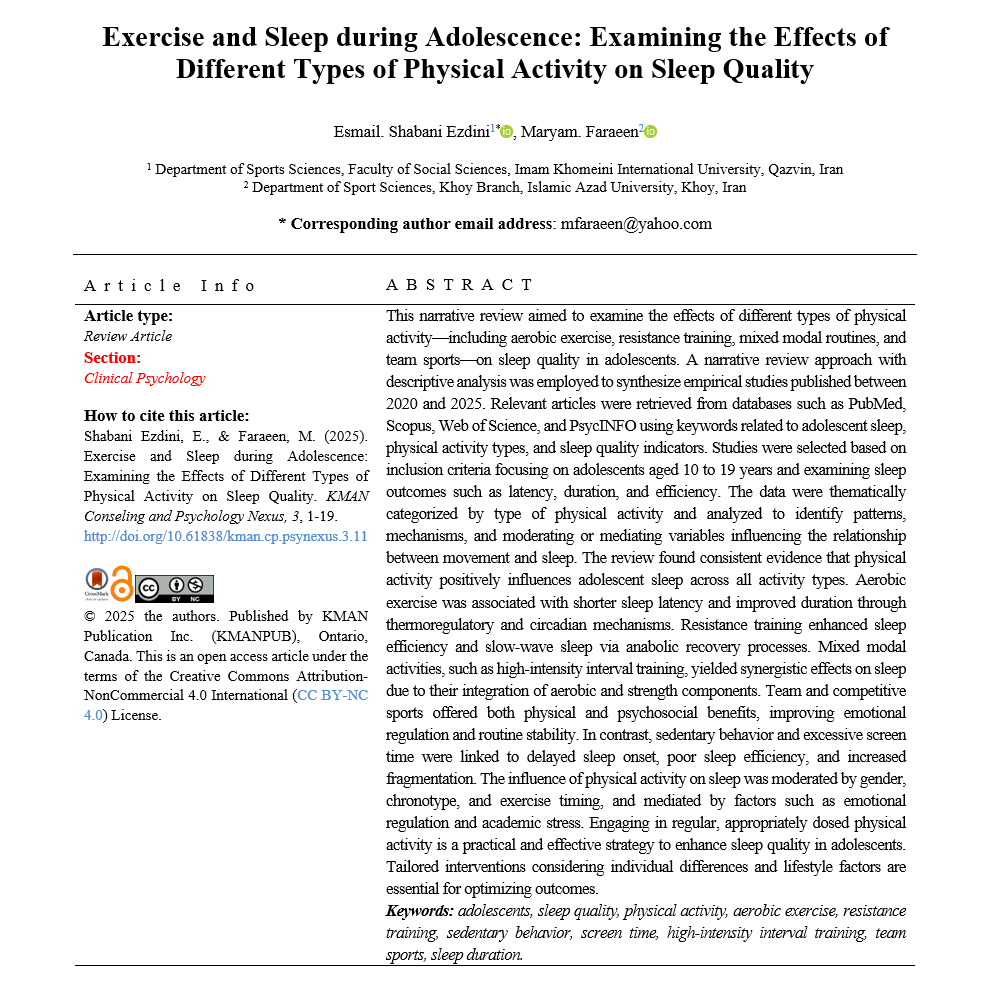
Exercise and Sleep during Adolescence: Examining the Effects of Different Types of Physical Activity on Sleep Quality
DOI:
https://doi.org/10.61838/kman.cp.psynexus.3.11Keywords:
adolescents, sleep quality, physical activity, aerobic exercise, resistance training, sedentary behavior, screen time, high-intensity interval training, team sports, sleep durationAbstract
This narrative review aimed to examine the effects of different types of physical activity—including aerobic exercise, resistance training, mixed modal routines, and team sports—on sleep quality in adolescents. A narrative review approach with descriptive analysis was employed to synthesize empirical studies published between 2020 and 2025. Relevant articles were retrieved from databases such as PubMed, Scopus, Web of Science, and PsycINFO using keywords related to adolescent sleep, physical activity types, and sleep quality indicators. Studies were selected based on inclusion criteria focusing on adolescents aged 10 to 19 years and examining sleep outcomes such as latency, duration, and efficiency. The data were thematically categorized by type of physical activity and analyzed to identify patterns, mechanisms, and moderating or mediating variables influencing the relationship between movement and sleep. The review found consistent evidence that physical activity positively influences adolescent sleep across all activity types. Aerobic exercise was associated with shorter sleep latency and improved duration through thermoregulatory and circadian mechanisms. Resistance training enhanced sleep efficiency and slow-wave sleep via anabolic recovery processes. Mixed modal activities, such as high-intensity interval training, yielded synergistic effects on sleep due to their integration of aerobic and strength components. Team and competitive sports offered both physical and psychosocial benefits, improving emotional regulation and routine stability. In contrast, sedentary behavior and excessive screen time were linked to delayed sleep onset, poor sleep efficiency, and increased fragmentation. The influence of physical activity on sleep was moderated by gender, chronotype, and exercise timing, and mediated by factors such as emotional regulation and academic stress. Engaging in regular, appropriately dosed physical activity is a practical and effective strategy to enhance sleep quality in adolescents. Tailored interventions considering individual differences and lifestyle factors are essential for optimizing outcomes.
Downloads
References
Bharali, B., & Mahapatro, M. (2020). A Study on Depression and Sleep Disturbance Among Youth in the Age Group of 20-25 Years in Raipur, Noida. International Journal of Research and Studies Publishing, 10(2), p9827. https://doi.org/10.29322/ijsrp.10.02.2020.p9827
Brown, D. M. Y., Porter, C. D., Hamilton, F., Almanza, F., Narvid, C., Pish, M., & Arizabalo, D. (2022). Interactive Associations Between Physical Activity and Sleep Duration in Relation to Adolescent Academic Achievement. International journal of environmental research and public health, 19(23), 15604. https://doi.org/10.3390/ijerph192315604
Duraccio, K. M., Krietsch, K. N., Zhang, N., Whitacre, C., Howarth, T., Pfeiffer, M., & Beebe, D. W. (2020). The Impact of Short Sleep on Food Reward Processes in Adolescents. Journal of Sleep Research, 30(2). https://doi.org/10.1111/jsr.13054
Eisenmann, J. C., Howard, R., & Moreno, T. (2020). Long-Term Athletic Development as a Framework to Influence Wellness During Childhood and Adolescence. Acsmʼs Health & Fitness Journal, 24(5), 24-31. https://doi.org/10.1249/fit.0000000000000604
Field, T. (2023). Sleep Problems in Youth During COVID-19: A Narrative Review. American Journal of Psychiatric Research and Reviews. https://doi.org/10.28933/ajprr-2023-03-1006tf2
Gallant, F., Thibault, V., Hébert, J. J., Gunnell, K. E., & Bélanger, M. (2020). One Size Does Not Fit All: Identifying Clusters of Physical Activity, Screen Time, and Sleep Behaviour Co-Development From Childhood to Adolescence. International Journal of Behavioral Nutrition and Physical Activity, 17(1). https://doi.org/10.1186/s12966-020-00964-1
Gillis, B. T., Hinnant, J. B., Erath, S. A., & El‐Sheikh, M. (2022). Relationship between Family Income and Trajectories of Adjustment in Adolescence: Sleep and Physical Activity as Moderators. Journal of adolescence, 95(3), 494-508. https://doi.org/10.1002/jad.12131
Gillis, B. T., Shimizu, M., Philbrook, L. E., & El‐Sheikh, M. (2021). Racial Disparities in Adolescent Sleep Duration: Physical Activity as a Protective Factor. Cultural Diversity and Ethnic Minority Psychology, 27(1), 118-122. https://doi.org/10.1037/cdp0000422
Grant, V., Tomayko, E. J., & Kingfisher, R. D. (2020). Sleep and Physical Activity Patterns in Urban American Indian Children. American Journal of Health Behavior, 44(1), 67-75. https://doi.org/10.5993/ajhb.44.1.7
Hadith Shiite Information, C. http://hadith.net/post/
Hamilton, J. L., Hutchinson, E., Evankovich, M. R., Ladouceur, C. D., & Silk, J. S. (2022). Daily and Average Associations of Physical Activity, Social Media Use, and Sleep Among Adolescent Girls During the COVID‐19 Pandemic. Journal of Sleep Research, 32(1). https://doi.org/10.1111/jsr.13611
Hu, X., Zhao, G., Fu, J., Sun, S., Jiang, T., Li, Y., & Shen, F. (2024). Isochronic Substitution Relationships Between Physical Activity, Sedentary Behavior and Sleep Patterns in Young Children -- An Objective Assessment Based on Accelerometers and Sleep Recorders. https://doi.org/10.21203/rs.3.rs-4655956/v1
Khazaie, H., Najafi, F., Chehri, A., Rahimi‐Movaghar, A., Amin‐Esmaeili, M., Moradinazar, M., Zakiei, A., Pasdar, Y., Brühl, A. B., Brand, S., & Bahmani, D. S. (2023). Physical Activity Patterns, Circadian Rhythms, and Aggressive and Suicidal Behavior Among a Larger Sample of the General Population Aged 15 to 34 Years. Journal of clinical medicine, 12(8), 2821. https://doi.org/10.3390/jcm12082821
Kushwaha, U., Khadgi, S., Kafle, S., & Khadgi, S. (2024). Technology on Sleeping Patterns of Youths. NPRC J. Multidis. Res., 1(9), 125-134. https://doi.org/10.3126/nprcjmr.v1i9.74169
Liu, G., & Liu, D. (2023). Association Between Screen Time, Physical Activity and Sleep Quality Among Youths. International Journal of Public Health Science (Ijphs), 12(3), 1311. https://doi.org/10.11591/ijphs.v12i3.23098
Liu, S., Ahemaitijiang, N., Xu, J., Liu, Y., Chen, L., & Han, Z. R. (2023). Patterns of Childhood Maltreatment Influence Sleep Quality: The Role of Emotion Regulation. Development and Psychopathology, 36(3), 1388-1398. https://doi.org/10.1017/s0954579423000597
Mallick, A. (2025). Unravelling the Role of Health-Promoting and Health-Abusive Lifestyle Behaviours on Health-Related Quality of Life Among the Urban Community-Dwelling Youths: A Cross-Sectional Study in the Balasore District of Odisha, India. https://doi.org/10.21203/rs.3.rs-6087073/v1
Mello, G. T. d., Minatto, G., Costa, R. M. d., Leech, R. M., Cao, Y., Lee, R. E., & Silva, K. S. d. (2024). Clusters of 24-Hour Movement Behavior and Diet and Their Relationship With Health Indicators Among Youth: A Systematic Review. BMC public health, 24(1). https://doi.org/10.1186/s12889-024-18364-6
Okkenhaug, I. (2025). Movement Behaviors in Youth on the Autism Spectrum: The HUNT Study, Norway. Journal of Autism and Developmental Disorders. https://doi.org/10.1007/s10803-025-06835-7
Paterson, D. C., Ramage, K., Moore, S. A., Riazi, N. A., Tremblay, M. S., & Faulkner, G. (2021). Exploring the Impact of COVID-19 on the Movement Behaviors of Children and Youth: A Scoping Review of Evidence After the First Year. Journal of sport and health science, 10(6), 675-689. https://doi.org/10.1016/j.jshs.2021.07.001
Roberts, D. K., Sarver, D. E., Cash, A. R., Walker, B., & Lim, C. S. (2024). Understanding Health Behaviors That Modify the Risk for Obesity in ADHD. Journal of Pediatric Psychology, 49(5), 372-381. https://doi.org/10.1093/jpepsy/jsae018
Sanguino, H., Brunton, L., Condliffe, E. G., Kopala‐Sibley, D. C., Noel, M., Mish, S., & McMorris, C. A. (2024). Sleep Characteristics of Children and Youth With Cerebral Palsy. Journal of Child Neurology, 40(2), 123-131. https://doi.org/10.1177/08830738241285074
Vedøy, I. B., Skulberg, K. R., Anderssen, S. A., Tjomsland, H. E., & Thurston, M. (2021). Physical Activity and Academic Achievement Among Norwegian Adolescents: Findings From a Longitudinal Study. Preventive Medicine Reports, 21, 101312. https://doi.org/10.1016/j.pmedr.2021.101312
Woodward, K., Bistline, L., Vermette, E., Carlucci, M., Crowley, S. J., Jackson, D. B., & Wolfson, A. R. (2024). A Descriptive Study of Sleep Patterns and Knowledge Among Department of Juvenile Services Staff. Sleep Advances, 5(1). https://doi.org/10.1093/sleepadvances/zpae030
Zhao, L., & Wu, L. (2022). The Relationship Between Digital Activity and Bedtime, Sleep Duration, and Sleep Quality in Chinese Working Youth. Nature and science of sleep, Volume 14, 419-432. https://doi.org/10.2147/nss.s348929
Downloads
Additional Files
Publication Timeline
- Submitted
- Revised
- Accepted
License
Copyright (c) 2025 Esmail Shabani Ezdini (Author); Maryam Faraeen (Corresponding Author)

This work is licensed under a Creative Commons Attribution-NonCommercial 4.0 International License.