Parenting Through Conflict: Lived Experiences of Couples in High-Stress Family Systems
DOI:
https://doi.org/10.61838/kman.fct.psynexus.3.11Keywords:
High-conflict families, parenting, emotional strain, co-parenting, qualitative research, family systemsAbstract
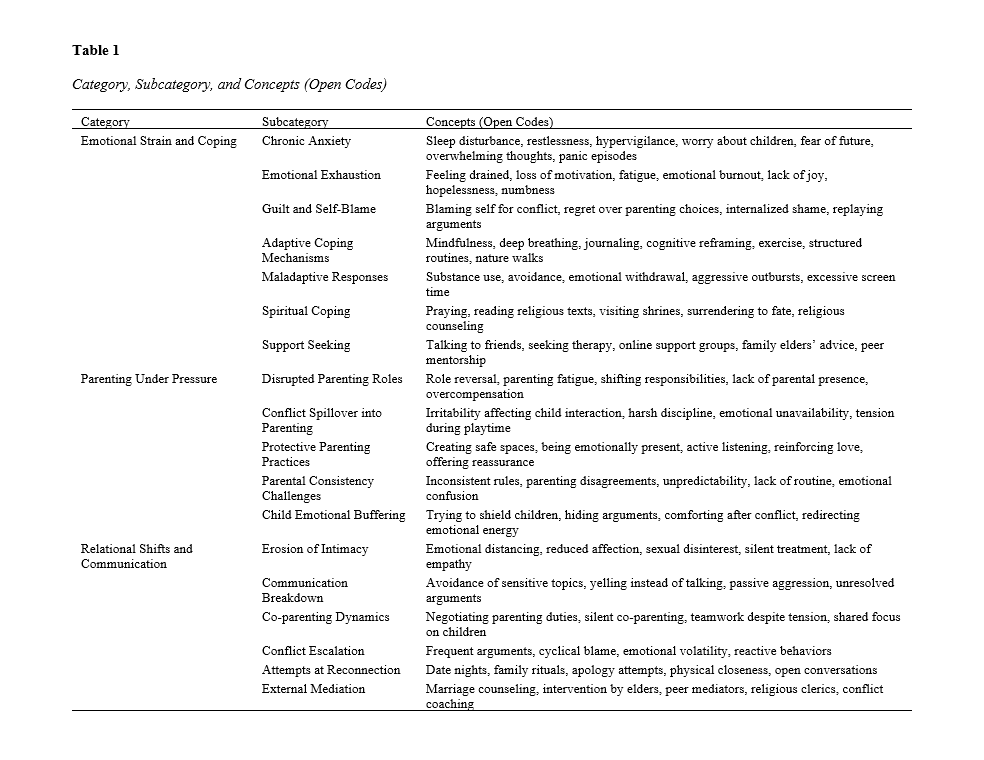
This study aimed to explore the lived experiences of couples parenting within high-stress, high-conflict family systems. A qualitative research design using a phenomenological approach was employed to investigate how couples navigate parenting amid ongoing relational conflict. Data were collected through semi-structured, in-depth interviews with 29 participants from Pakistan who were actively parenting in the context of sustained familial or interpersonal stress. Participants were selected through purposive sampling to ensure relevance and diversity in marital duration, number of children, and socioeconomic background. Interviews were conducted until theoretical saturation was reached and were transcribed verbatim for analysis. Data were analyzed thematically using NVivo software, following a multi-stage coding process that included open coding, axial coding, and theme development. Thematic analysis revealed three overarching categories: Emotional Strain and Coping, Parenting Under Pressure, and Relational Shifts and Communication. Participants reported high levels of anxiety, emotional exhaustion, and self-blame, along with a mixture of adaptive and maladaptive coping strategies. Parenting roles were often disrupted by conflict, leading to inconsistency, irritability, and attempts at protective parenting. Couples also experienced relational distancing, communication breakdowns, and intermittent efforts at reconnection. Some participants engaged in spiritual practices or sought external mediation through community or religious figures to manage conflict. Despite high levels of strain, a number of parents maintained functional co-parenting practices centered on their children's well-being. Parenting in high-conflict family systems is marked by emotional distress, role ambiguity, and compromised communication, yet many couples exhibit resilience through culturally embedded coping strategies and intentional parenting efforts. These findings highlight the need for culturally sensitive interventions and support systems tailored to parents navigating chronic relational stress.
Downloads
References
Accoe, D., & Pennings, G. (2024). Navigating Conflicts of Reproductive Rights: Unbundling Parenthood and Balancing Competing Interests. Bioethics, 38(5), 425-430. https://doi.org/10.1111/bioe.13282
Adams, A. (2024). Coparenting and Conflicts Between Work and Family: Between-Within Analysis of German Mothers and Fathers. Journal of Family Research, 36, 262-282. https://doi.org/10.20377/jfr-1013
Anitta, M., & Ramshida, A. P. (2024). An Exploration Into Parallel Stories of Co-Parenting. International Journal for Multidisciplinary Research, 6(6). https://doi.org/10.36948/ijfmr.2024.v06i06.29956
Ballantyne, J. (2021). Supporting Parents to Enhance Children's Mental Health and Longer-Term Outcomes: An Example of Innovation in UK Government Policy Development - The Reducing Parental Conflict Programme (RPC) — Jenny Ballantyne. https://doi.org/10.33774/coe-2021-l5fj4
Boor, B. B., Khodabakhshi-Koolaee, A., & Falsafinezhad, M. R. (2021). Communication Challenges of Parents and Their Adolescent Daughters With an Emphasis on Social Media Use: A Content Analysis Study. Journal of Research and Health, 11(4), 235-244. https://doi.org/10.32598/jrh.11.4.1804.1
Carranza, P. R., & Simpkins, S. D. (2023). Benefits and Challenges of Adolescents’ Participation in Organized Activities for Mexican-Origin Families. Journal of Adolescent Research. https://doi.org/10.1177/07435584231217332
Casaleiro, P., Branco, P., & Sotero, L. (2023). Parental Responsibilities and Health Issues: An Exploratory Study of Legal Disputes. Law Technology and Humans, 5(1), 178-191. https://doi.org/10.5204/lthj.2681
Cox, K. (2023). Invoking Uncertainty: Parents’ Accounts for Intrusions on Medical Authority in Pediatric Neurology. Journal of Health and Social Behavior, 64(4), 537-554. https://doi.org/10.1177/00221465231194052
Dittmann, S., Larsen, L., & Holt, T. (2021). Foreldre Underrapporterer Om Konflikter Og Utfordringer I Forkant Av Mekling. TNPF, 58(9), 766-775. https://doi.org/10.52734/3wfr437s
Garlick, M. (2021). Supporting Parents to Enhance Children's Mental Health and Longer-Term Outcomes: An Example of Innovation in UK Government Policy Development - The Reducing Parental Conflict Programme (RPC) — Matthew Garlick. https://doi.org/10.33774/coe-2021-3mssk
Kim, H., Epstein, N. B., Hancock, G. R., Hurtado, G. A., Svetaz, M. V., & Allen, M. (2022). Latent Change Modeling of Latino Parent–child Conflict and Pathways to Mental Health. Journal of marriage and family, 85(2), 518-538. https://doi.org/10.1111/jomf.12880
Liang, J. (2025). Parents’ Work–family Conflict and Parent‒child Relationship: The Mediating Role of Parenting Burnout and the Moderating Role of Self-Compassion. PLoS One, 20(3), e0319675. https://doi.org/10.1371/journal.pone.0319675
McNamara, K. (2023). Lowering the Age of Consent: Legal, Ethical, and Clinical Implications of Adolescent‐directed Therapy. Family Court Review, 61(3), 472-477. https://doi.org/10.1111/fcre.12722
Neijs, L. D., Boeke, D. B., Berckelaer‐Onnes, I. A. v., Swaab, H., & Ester, W. A. (2024). Parental Stress and Quality of Life in Parents of Young Children With Autism. Child Psychiatry & Human Development. https://doi.org/10.1007/s10578-024-01693-3
O’Hara, K. L., & Cohen, B. R. (2023). A Call for Early, Effective, and Scalable Parent Education Programs for High‐conflict Separated/Divorcing Parents: A Synthesized Perspective From Prevention Science and Family Law. Family Court Review, 62(1), 160-175. https://doi.org/10.1111/fcre.12771
Papp, L. M., Drastal, K. C., Lorang, E., & Hartley, S. L. (2020). Mother-Father Physiological Synchrony During Conflict and Moderation by Parenting Challenges: Findings From Parents of Children With Autism Spectrum Disorder. Families Systems & Health, 38(4), 476-481. https://doi.org/10.1037/fsh0000525
Ramadhani, A. I., & Setiawan, J. L. (2020). Peran Agreeableness Dan Resolusi Konflik Terhadap Co-Parenting Pada Pasangan Dual- Earner. Psychopreneur Journal, 4(1), 11-20. https://doi.org/10.37715/psy.v4i1.1746
Riahi, F., & Izadi-Mazidi, M. (2024). Difficulties of Families With Children and Adolescents With Psychiatric Disorders During the COVID-19 Outbreak: A Cross-Sectional Study. Journal of Comprehensive Pediatrics, 15(4). https://doi.org/10.5812/jcp-144416
Smyth, B., & Moloney, L. J. (2019). Post‐Separation Parenting Disputes and the Many Faces of High Conflict: Theory and Research. Australian and New Zealand Journal of Family Therapy, 40(1), 74-84. https://doi.org/10.1002/anzf.1346
Tang, S. (2024). The Influence of Parental Conflict on Primary School Students' Academic Self-Efficacy. Journal of Education Humanities and Social Sciences, 26, 838-844. https://doi.org/10.54097/0x4vc959
Treloar, R. (2019). Parents Making Meaning of High‐Conflict Divorce. Australian and New Zealand Journal of Family Therapy, 40(1), 85-97. https://doi.org/10.1002/anzf.1347
Wang, C., Cheong, Y., Zhu, Q., Havewala, M., & Ye, Y. (2022). Parent Work–life Conflict and Adolescent Adjustment During COVID-19: Mental Health and Parenting as Mediators. Journal of Family Psychology, 36(3), 325-336. https://doi.org/10.1037/fam0000948
Wang, H. (2025). Spillover of Daily Parenting Experiences Into Interparental Relationships in Chinese Families of Children With Autism: Mediated by Daily Affect and Moderated by Trait Mindfulness. Family Process, 64(1). https://doi.org/10.1111/famp.70016
Wang, X., Liu, S., Wu, X., Ren, Y., & Zou, S. (2023). Work–family Conflict, Educational Involvement, and Adolescent Academic Engagement DuringCOVID‐19: An Investigation of Developmental Differences. Family Relations, 72(4), 1491-1510. https://doi.org/10.1111/fare.12852
Zahedi, F., Kadivar, M., Mojen, L. K., Asadabadi, M., Tajalli, S., Ilkhani, M., Barasteh, S., Elahikhah, M., & Larijani, B. (2022). The Ethical Challenges of Palliative Care From the Perspectives of Pediatricians: A Qualitative Study in Iran. Frontiers in Pediatrics, 10. https://doi.org/10.3389/fped.2022.928476
Żak, M. (2022). Remote Work and Family Duties. Sociological Analysis of Selected Problems in the Functioning of Families With Minor Children During COVID-19. Ws(23), 18-30. https://doi.org/10.18778/2300-1690.23.02
Downloads
Additional Files
Publication Timeline
- Submitted
- Revised
- Accepted
Issue
Section
Categories
License

This work is licensed under a Creative Commons Attribution-NonCommercial 4.0 International License.