How Perceived Independence Affects Life Satisfaction Through Motivation in Individuals with Acquired Disabilities
DOI:
https://doi.org/10.61838/kman.rc.psynexus.3.6Keywords:
Perceived independence, Motivation, Life satisfaction, Acquired disabilitiesAbstract
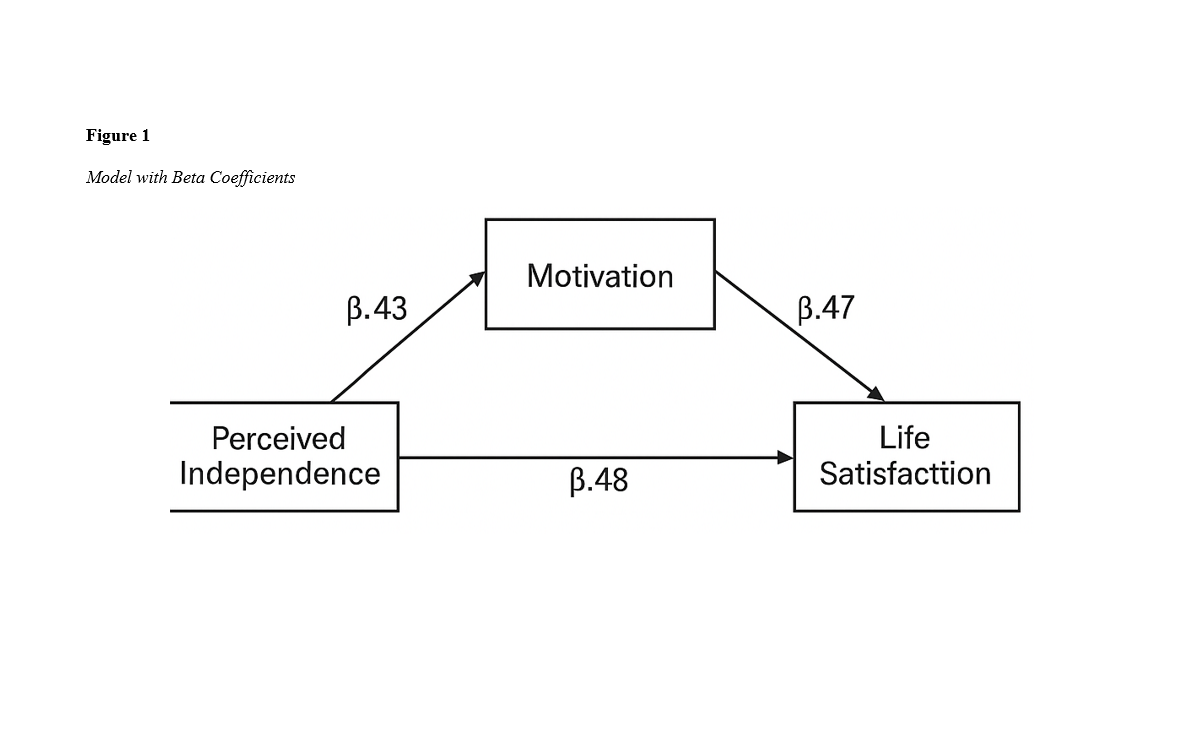
This study aimed to examine how perceived independence affects life satisfaction through the mediating role of motivation in individuals with acquired disabilities. The research employed a descriptive correlational design with a sample of 400 individuals with acquired disabilities from the United States. Participants were selected based on the Morgan and Krejcie sample size determination table and completed three standardized instruments: the Perceived Independence Scale (PIS), the Behavioral Regulation in Exercise Questionnaire-2 (BREQ-2) adapted for general motivation, and the Satisfaction With Life Scale (SWLS). Data were analyzed using SPSS-27 for descriptive statistics and Pearson correlations, and AMOS-21 for Structural Equation Modeling (SEM). Assumptions of normality, linearity, multicollinearity, and homoscedasticity were confirmed prior to analysis. Descriptive results indicated moderately high levels of perceived independence (M = 43.26, SD = 6.87), motivation (M = 58.74, SD = 9.42), and life satisfaction (M = 24.51, SD = 5.63). Pearson correlation showed that perceived independence was positively associated with both motivation (r = .58, p < .001) and life satisfaction (r = .52, p < .001), and motivation was strongly correlated with life satisfaction (r = .61, p < .001). SEM analysis confirmed the model’s good fit (χ²/df = 2.34, CFI = 0.97, RMSEA = 0.058) and demonstrated that motivation significantly mediated the relationship between perceived independence and life satisfaction. The total effect of perceived independence on life satisfaction was β = .58, including both direct (β = .31) and indirect (β = .27) effects through motivation. Perceived independence significantly contributes to life satisfaction in individuals with acquired disabilities, both directly and indirectly through enhanced motivation. These findings underscore the importance of fostering autonomy and self-determined motivation in rehabilitation and psychosocial interventions to improve the well-being of this population.
Downloads
References
Adamove, J. (2017). Subjective Health, Life Satisfaction and Attachment in Young Adults With Physical Disability and in General Population. E-Pedagogium, 17(3), 88-99. https://doi.org/10.5507/epd.2017.039
Ahn, H.-Y., Lee, K., & So, Y.-H. (2021). The Mediating Effect of Disability Acceptance in Individuals With Spinal Cord Injury Participating in Sport for All. International journal of environmental research and public health, 18(20), 10883. https://doi.org/10.3390/ijerph182010883
Bibi, Z., Shahzadi, M., Arshad, A., Ayyaz, S., & Ayoub, I. (2024). Depression, Anxiety and Stress as a Predictor of Low Life Satisfaction in Physically Handicapped People. Pakistan Journal of Humanities and Social Sciences, 3221-3229. https://doi.org/10.52131/pjhss.2024.v12i4.2558
Chen, X., Muller, V., Lee, B., Wu, J.-R., Iwanaga, K., & Lee, D. (2020). Community Participation as Both a Mediator and Moderator for the Relationship Between Functional Disability and Life Satisfaction of Individuals With Fibromyalgia. Journal of Applied Rehabilitation Counseling, 51(1), 31-41. https://doi.org/10.1891/jarc-d-19-00010
Choi, H., Kim, Y., Lee, M., & Seo, Y. (2023). Reciprocal Causal Relationships Between Self-Esteem and Life Satisfaction in Elderly With Disabilities by Age Group. The Society for Cognitive Enhancement and Intervention, 14(4), 165-192. https://doi.org/10.21197/jcei.14.4.9
Fan, H., Qi, R., Peng, Z., Zhang, X., & Coyte, P. C. (2022). The Contribution of Alternative Types of Care on Life Satisfaction Among Disabled Older Persons in China. Ageing and Society, 44(1), 122-138. https://doi.org/10.1017/s0144686x22000101
Fekih‐Romdhane, F., Sawma, T., Obeïd, S., & Hallit, S. (2023). Self-Critical Perfectionism Mediates the Relationship Between Self-Esteem and Satisfaction With Life in Lebanese University Students. BMC psychology, 11(1). https://doi.org/10.1186/s40359-023-01040-6
Grabowska, I., & Antczak, R. (2023). Life Satisfaction of People With Disabilities and Public Policy in EU Countries. https://doi.org/10.21203/rs.3.rs-3507750/v1
Infurna, F. J., & Wiest, M. (2016). The Effect of Disability Onset Across the Adult Life Span. The Journals of Gerontology Series B, 73(5), 755-766. https://doi.org/10.1093/geronb/gbw055
Ji, Y., & Han, J.-H. (2023). The Effects of Job Satisfaction on the Life Satisfaction of Individuals With Disabilities. The Institute of Management and Economy Research, 14(1), 427-437. https://doi.org/10.32599/apjb.14.1.202303.427
Karaman, M. A., & Watson, J. C. (2017). Examining associations among achievement motivation, locus of control, academic stress, and life satisfaction: A comparison of U.S. and International undergraduate students. Personality and individual differences, 111, 106-110. https://doi.org/10.1016/j.paid.2017.02.006
Kesselmayer, R. F., Mainella, A. M. K., Smedema, S. M., & Villanueva, P. C. (2025). The Mediating Effects of Disability Impact, Job Satisfaction, and Social Support in the Relationship Between Core Self-Evaluations and Life Satisfaction in Employed People With Disabilities. Journal of Applied Rehabilitation Counseling, 56(1), 42-56. https://doi.org/10.1891/jarc-2024-0024
Kim, A.-S., & Kim, H. (2024). The Effect of Communication With Healthcare Professionals on the Life Satisfaction of Individuals With Disabilities: Focused on the Mediating Effect of Family Strength. Korean Academy Welfare Counseling, 13(1), 269-288. https://doi.org/10.20497/jwce.2024.13.1.269
Kim, J., Kim, J., & Han, A. (2020). Leisure-Time Physical Activity, Coping and Life Satisfaction Among Korean Individuals With Physical Disabilities. Health Promotion International, 36(3), 774-783. https://doi.org/10.1093/heapro/daaa080
Kim, J., Kim, M., & Han, A. (2018). Exploring the Relationship Between Types of Leisure Activities and Life Satisfaction, Health Perception, and Social Support Among Korean Individuals With Physical Disabilities. American Journal of Health Behavior, 42(4), 34-44. https://doi.org/10.5993/ajhb.42.4.4
Kim, Y. T., & Park, D. B. (2022). Analysis of Factors Affecting Life Satisfaction of Retired Disabled People - Comparison Following Non-Disabled Group and Disability Characteristics. Korean Society of Educational Gerontology, 8(2), 131-154. https://doi.org/10.31748/kseg.2022.8.2.131
Lee, B., Reyes, A., Rumrill, S., & Bishop, M. (2022). The Intermediary Role of Optimism and Mental Health in the Relationship Between Disability-Related Stress and Life Satisfaction: A Serial Mediation Model. Rehabilitation Counseling Bulletin, 67(1), 3-11. https://doi.org/10.1177/00343552221080434
Li, A., Wang, D., Lin, S., Chu, M., Huang, S., Lee, C. Y., & Chiang, Y. C. (2021). Depression and Life Satisfaction Among Middle-Aged and Older Adults: Mediation Effect of Functional Disability. Frontiers in psychology, 12. https://doi.org/10.3389/fpsyg.2021.755220
Mainella, A. M. K., & Smedema, S. M. (2021). Sexual Health Education and Life Satisfaction for People With Congenital Neurological Disabilities. Rehabilitation Counseling Bulletin, 66(1), 46-57. https://doi.org/10.1177/00343552211031870
Moser, C. (2025). Correlates of Self-Reported Life Satisfaction Among Autistic Youth With and Without Intellectual Disability. Autism. https://doi.org/10.1177/13623613251327347
Özer, Ö., Özkan, O., Özmen, S., & Ercoban, N. (2023). Investigation of the effect of COVID-19 perceived risk on death anxiety, satisfaction with life, and psychological well-being. OMEGA-Journal of Death and Dying, 87(2), 572-590. https://doi.org/10.1177/00302228211026169
Park, E. Y. (2021). Internet Use and Life Satisfaction in Individuals With Physical Disabilities. Journal of Developmental and Physical Disabilities, 34(3), 529-546. https://doi.org/10.1007/s10882-021-09813-w
Purhossein, R., Ehsani, S., Ensanimehr, N., & Nabizadeh, R. (2018). Investigating the relationship between the satisfaction of basic psychological needs and satisfaction with life: the mediating role of motivation and psychological capital. Educational Psychology, 14(50), 71-87. https://doi.org/10.22054/jep.2019.38898.2548
Serdiuk, L., & Kuprieieva, O. (2022). Relationship Between Life Satisfaction With Fundamental Assumption. 189-193. https://doi.org/10.31108/7.2022.38
Shim, H., Lee, W. S., & Moon, J. (2023). The Relationships Between Food, Recreation Expense, Subjective Health, and Life Satisfaction: Case of Korean People With Disability. Sustainability, 15(11), 9099. https://doi.org/10.3390/su15119099
Shin, Y. I. (2022). The Effects of Economic Characteristics and Health Characteristics on Life Satisfaction of Employed Persons With Developmental Disabilities: Mediating Effect of Self-Esteem. Forum of Public Safety and Culture, 17, 299-315. https://doi.org/10.52902/kjsc.2022.17.299
Smedema, S. M., Lee, D., & Bhattarai, M. (2021). An Examination of the Relationship of Core Self-Evaluations and Life Satisfaction in College Students With Disabilities. Rehabilitation Counseling Bulletin, 65(2), 129-139. https://doi.org/10.1177/0034355221993569
Supervía, P. U., Bordás, C. S., Robres, A. Q., Blasco, R. L., & Cosculluela, C. L. (2023). Empathy, self-esteem and satisfaction with life in adolescent. Children and Youth Services Review, 144, 106755. https://doi.org/10.1016/j.childyouth.2022.106755
Türkçapar, Ü. (2016). Examination of Swimming Exercises' Effects on Disabled Individuals' Life Satisfaction Levels. International Journal of Sport Culture and Science, 4(18), 631-631. https://doi.org/10.14486/intjscs586
Wang, M.-H., Brooks, J., Iwanaga, K., Wu, J.-R., Chen, X., Lee, B., Rumrill, S., & Chan, F. (2020). Reducing the Effect of Functional Disability on Life Satisfaction Among Persons With a Lived Experience of an Infectious Viral Disease in Taiwan: A Tri-Mediation Model. Rehabilitation Counseling Bulletin, 65(3), 238-248. https://doi.org/10.1177/0034355220980826
Yoo, H. J., & Lee, H. (2023). Influence of Family Strength on Life Satisfaction of Individuals Who Have a Sibling With Disability: Mediating Effect of Disability Acceptance. Nursing and Health Sciences, 25(3), 424-433. https://doi.org/10.1111/nhs.13040
Downloads
Additional Files
Publication Timeline
- Submitted
- Revised
- Accepted
Issue
Section
Categories
License

This work is licensed under a Creative Commons Attribution-NonCommercial 4.0 International License.