Vocational Identity Reconstruction in Individuals with Spinal Cord Injury: A Narrative Approach
DOI:
https://doi.org/10.61838/kman.rc.psynexus.3.4Keywords:
spinal cord injury, vocational rehabilitation, narrative identity, qualitative research, identity reconstruction, employment, disability studiesAbstract
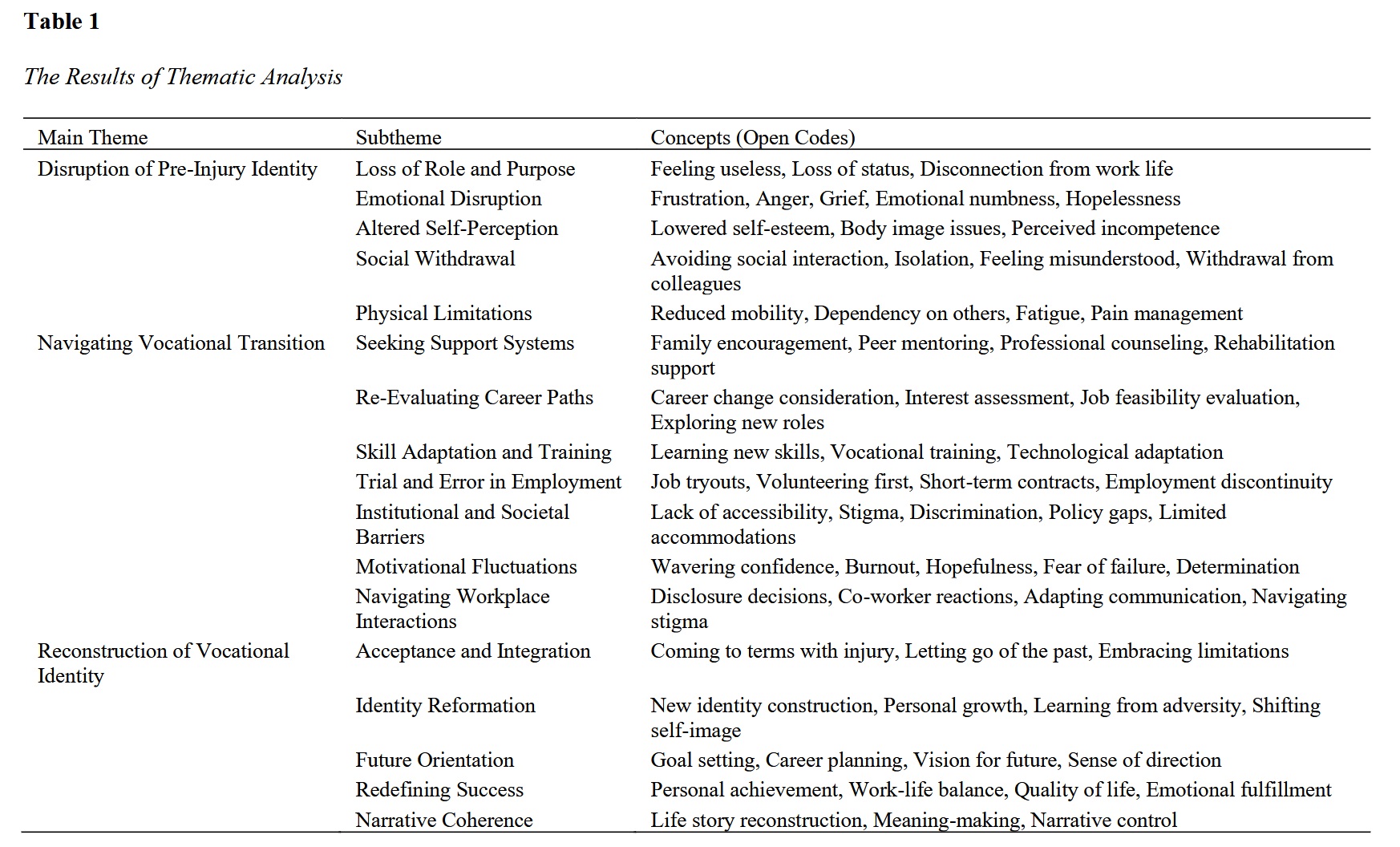
This study aimed to explore how individuals with spinal cord injury reconstruct their vocational identities through personal narratives following their injury. This research employed a qualitative narrative methodology to examine the lived experiences of 22 participants with spinal cord injury residing in Turkey. Participants were selected through purposive sampling to ensure diversity in age, gender, and pre-injury occupational backgrounds. Data were collected through semi-structured interviews, which allowed participants to articulate their vocational journeys in detail. Interviews were conducted either face-to-face or via secure video conferencing, recorded with consent, and transcribed verbatim. Thematic narrative analysis was applied using NVivo software to identify recurring patterns, story arcs, and identity-related shifts across participants’ accounts. Data saturation was achieved at 22 participants, ensuring a comprehensive representation of shared and divergent experiences. Three overarching themes emerged from the analysis: disruption of pre-injury identity, navigating vocational transition, and reconstruction of vocational identity. Participants described initial experiences of emotional disorientation, loss of purpose, and altered self-perception. As they moved through recovery, they sought support systems, reevaluated career paths, engaged in skill development, and encountered motivational fluctuations. Reconstruction of vocational identity involved processes of acceptance, narrative meaning-making, and redefinition of success. Institutional and societal barriers, such as limited accessibility and workplace stigma, were significant obstacles, while family encouragement, personal resilience, and community engagement facilitated identity renewal. Vocational identity reconstruction following spinal cord injury is a complex, narrative-driven process shaped by emotional, social, and structural factors. Narrative-informed, person-centered vocational rehabilitation practices that emphasize meaning-making and identity support are essential for holistic recovery and reintegration.
Downloads
References
Akande, A. O., & Long, A. C. (2024). Using Narratives of Immigrant Clients to Confront Grief: Supporting Autonomy in Vocational Rehabilitation. Journal of Applied Rehabilitation Counseling, 55(1), 62-75. https://doi.org/10.1891/jarc-2023-0012
Bloom, J., Dorsett, P., & McLennan, V. (2017). Integrated Services and Early Intervention in the Vocational Rehabilitation of People With Spinal Cord Injuries. Spinal Cord Series and Cases, 3(1). https://doi.org/10.1038/scsandc.2016.42
Bloom, J., McLennan, V., & Dorsett, P. (2019). Occupational Bonding After Spinal Cord Injury: A Review and Narrative Synthesis. Journal of Vocational Rehabilitation, 50(1), 109-120. https://doi.org/10.3233/jvr-180992
Borozinets, N., Vodolazhskaya, M. G., Salnikova, O. D., Solovyova, O., & Shekhovtsova, T. S. (2023). The Concept of Professional Psychological Rehabilitation of Persons With Disabilities Acquired During Combats and Special Military Operations as a Resource for Organizations of Higher Education. Psychological Science and Education, 28(6), 53-61. https://doi.org/10.17759/pse.2023280605
Dorsett, P., & McLennan, V. (2019). Exploring the ‘Status Quo’ in Vocational Rehabilitation and Employment Outcomes Following Spinal Cord Injury. Journal of Vocational Rehabilitation, 50(2), 131-139. https://doi.org/10.3233/jvr-180995
Dunn, J., Martin, R., Hackney, J. J., Nunnerley, J. L., Snell, D. L., Bourke, J. A., Hall, A., & Derrett, S. (2021). Early Vocational Rehabilitation for People With Spinal Cord Injury: A Research Protocol Using Realist Synthesis and Interviews to Understand How and Why It Works. BMJ open, 11(5), e048753. https://doi.org/10.1136/bmjopen-2021-048753
Evans, C. (2022). Commentary on “Vocational Training for Livelihood and Rehabilitation of Persons With Intellectual Disabilities”. Tizard Learning Disability Review, 27(3/4), 139-143. https://doi.org/10.1108/tldr-10-2022-0019
Hermanoff, A., Määttä, K., & Uusiautti, S. (2017). The Opportunities and Obstacles of School Paths of Finnish Young People With Intellectual Disability (Id). Problems of Education in the 21st Century, 75(1), 19-33. https://doi.org/10.33225/pec/17.75.19
Hwan, N. W. (2022). A Study on the Vocational Rehabilitation Policy and Delivery System of Local Governments. Korean Society of Vocational Rehabilitation, 32(1), 129-148. https://doi.org/10.24226/jvr.2022.4.32.1.127
Hyun-Uk, S. (2024). Analysis of Research Trends in the Journal of Vocational Rehabilitation Using Text Mining-Based Topic Modeling: 2004∼2023. Korean Soc Vocational Rehabilit, 34(3), 27-45. https://doi.org/10.24226/jvr.2024.12.34.3.27
Lanyon, L., Shiggins, C., Baker, C., Alves-Stein, S., O’Keefe, S., Schneider, E., Godecke, E., Radford, K., & Lannin, N. A. (2024). ‛Until You're in the Chair and Executing Your Role, You Don't Know’: A Qualitative Study of the Needs and Perspectives of People With Stroke‐related Communication Disabilities When Returning to Vocational Activity. International Journal of Language & Communication Disorders, 59(6), 2655-2670. https://doi.org/10.1111/1460-6984.13106
Lippi, L., Turco, A., Moalli, S., Gallo, M., Curci, C., Maconi, A., Sire, A. d., & Invernizzi, M. (2023). Role of Prehabilitation and Rehabilitation on Functional Recovery and Quality of Life in Thyroid Cancer Patients: A Comprehensive Review. Cancers, 15(18), 4502. https://doi.org/10.3390/cancers15184502
Longoria, D. C., & Degeneffe, C. E. (2023). Vocational Rehabilitation for Seasonal and Migrant Farmworkers in California: A Personal Narrative. Rehabilitation Research Policy and Education, 37(3), 233-245. https://doi.org/10.1891/re-22-19
McDonnall, M. C., & Cmar, J. L. (2019). Services for Consumers Who Are Deafblind: Vocational Rehabilitation Agency Service Models Utilized and Their Effectiveness. Journal of Visual Impairment & Blindness, 113(1), 19-31. https://doi.org/10.1177/0145482x19828033
McLennan, V., & Ludvik, D. (2020). Early Vocational Rehabilitation After Serious Injury or Illness: A Systematic Review. Rehabilitation Counseling Bulletin, 64(4), 235-243. https://doi.org/10.1177/0034355220962218
McLennan, V., Taylor, N., Rachow, A., South, G., & Chapman, K. (2016). Creating Culturally Safe Vocational Rehabilitation Services for Indigenous Australians: A Brief Review of the Literature. Australian Journal of Rehabilitation Counselling, 22(2), 93-103. https://doi.org/10.1017/jrc.2016.8
Miethlich, B., & Šlahor, Ľ. (2018). Creating Shared Value Through Implementing Vocational Rehabilitation in the Corporate Social Responsibility Strategy: A Literature Review. 1444-1460. https://doi.org/10.33543/16001.14441460
Ogden, L. P. (2017). “To Fill the Emptiness”: The Importance of Work in Life History Narratives of Older Adults With Schizophrenia-Spectrum Diagnoses. Qualitative Social Work, 17(4), 556-576. https://doi.org/10.1177/1473325016688368
Ramakrishnan, K., Murphy, G., Middleton, J., & Cameron, I. D. (2018). Early Vocational Rehabilitation for Patients With Spinal Injury: A Qualitative Research Study of Service Providers. International Journal of Therapy and Rehabilitation, 25(10), 505-515. https://doi.org/10.12968/ijtr.2018.25.10.505
Sallinen, M., & Mengshoel, A. M. (2017). “I Just Want My Life Back!” - Men’s Narratives About Living With Fibromyalgia. Disability and Rehabilitation, 41(4), 422-429. https://doi.org/10.1080/09638288.2017.1395085
Samiee, F., & Naghavi, A. (2021). Vocational Rehabilitation Resources From the Perspective of People With Spinal Cord Injury and Service Providers. Journal of Vocational Rehabilitation, 55(1), 61-71. https://doi.org/10.3233/jvr-211146
Starobina, E. M., Gordievskaya, E. O., & Ryabokon, A. (2022). Professional Rehabilitation of Persons With Disabilities: Status and Directions of Development. https://doi.org/10.12737/1863105
Tophoven, S., Reims, N., & Tisch, A. (2018). Vocational Rehabilitation of Young Adults With Psychological Disabilities. Journal of Occupational Rehabilitation, 29(1), 150-162. https://doi.org/10.1007/s10926-018-9773-y
Vijayan, T. V. (2021). Psychiatric Rehabilitation: A Few Recovery Narratives. ASEAN Journal of Psychiatry, 22(9). https://doi.org/10.54615/2231-7805.47215
Wallentin, Å., Kinberg, E., Strand, J., & Sand, P. (2021). Psychiatrists’ Experience of Vocational Rehabilitation for Patients With Mental Illness. Psychiatric Quarterly, 92(3), 1217-1229. https://doi.org/10.1007/s11126-021-09896-w
Zaidi, S. Z., & Baveja, D. (2018). Vocational Rehabilitation of Persons With Hearing Impairment. 305-320. https://doi.org/10.4018/978-1-5225-4955-0.ch016
Downloads
Additional Files
Publication Timeline
- Submitted
- Revised
- Accepted
Issue
Section
Categories
License

This work is licensed under a Creative Commons Attribution-NonCommercial 4.0 International License.