Exploring How Parental Encouragement Affects Self-Esteem Through Self-Advocacy in Adolescents with Disabilities
DOI:
https://doi.org/10.61838/kman.isn.psynexus.3.5Keywords:
Parental encouragement, self-advocacy, self-esteem, adolescents with disabilitiesAbstract
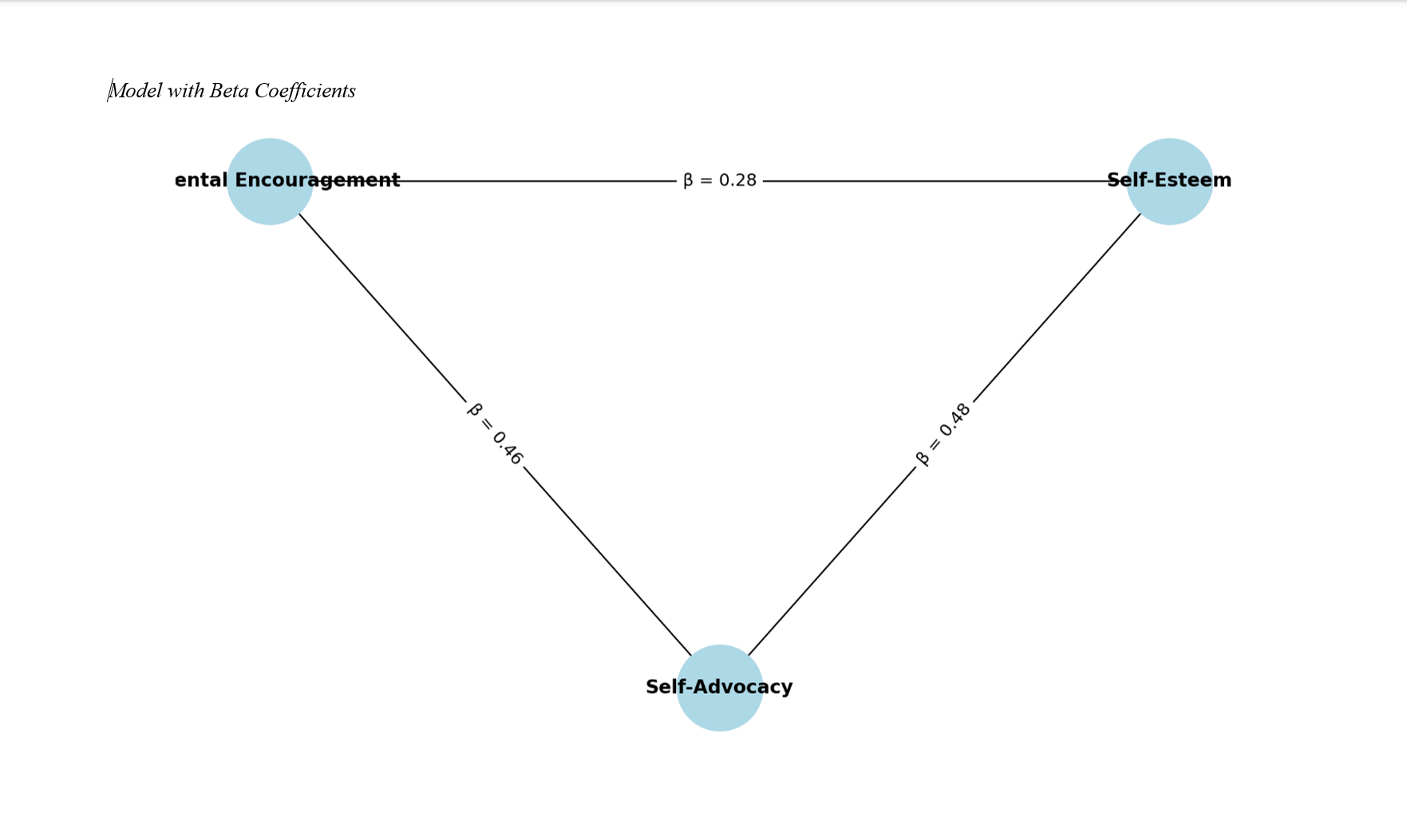
This study aimed to investigate the relationship between parental encouragement and self-esteem in adolescents with disabilities, with a particular focus on the mediating role of self-advocacy. The study employed a descriptive correlational design involving 421 adolescents with disabilities in Germany, selected based on the Morgan and Krejcie sample size table. Standardized instruments were used to assess the key variables: the Perceptions of Parents Scale (POPS) for parental encouragement, the Self-Advocacy Scale for Youth with Disabilities (SAS-YD), and the Rosenberg Self-Esteem Scale (RSES). Data were analyzed using SPSS-27 for descriptive statistics and Pearson correlation, and AMOS-21 was utilized for Structural Equation Modeling (SEM) to test the mediation model. Assumptions of normality, linearity, and multicollinearity were confirmed prior to analysis. Descriptive statistics indicated relatively high levels of perceived parental encouragement (M = 5.74, SD = 0.63), moderate self-advocacy (M = 4.31, SD = 0.71), and high self-esteem (M = 3.28, SD = 0.62). Pearson correlation analysis revealed significant positive relationships between parental encouragement and self-advocacy (r = .46, p < .001), parental encouragement and self-esteem (r = .39, p < .001), and self-advocacy and self-esteem (r = .52, p < .001). The structural model showed good fit indices (χ² = 94.78, df = 48, CFI = 0.97, RMSEA = 0.047), and self-advocacy was found to partially mediate the relationship between parental encouragement and self-esteem. The total effect of parental encouragement on self-esteem was β = 0.50 (p < .001), with a direct effect of β = 0.28 and an indirect effect of β = 0.22 through self-advocacy. The findings highlight the crucial role of parental encouragement in fostering self-esteem among adolescents with disabilities, both directly and through the development of self-advocacy skills, suggesting the need for family-centered interventions to enhance youth empowerment.
Downloads
References
Almurumudhe, L. K. A., Mahdad, A., Abdulkadhim Johni, A., & Yousefi, Z. (2024). The Mediating Role of Self-Esteem in the Relationship between Psychological Capital, Academic Engagement, and Academic Procrastination with Academic Performance among Students in Al-Diwaniyah, Iraq [Research Article]. Iranian Journal of Educational Sociology, 7(3), 1-9. https://doi.org/10.61838/kman.ijes.7.3.1
Andriani, A., & Lengkong, F. (2021). Correlation Analysis of Parental Support and Confidence in Adolescents With Defense Youth. Psikoislamedia Jurnal Psikologi, 6(2). https://doi.org/10.22373/psikoislamedia.v6i2.10389
Chernova, E. A. (2022). Pedagogical Conditions for Social Success Formation Among Adolescents With Disabilities. Psychological-Pedagogical Journal Gaudeamus(3), 98-108. https://doi.org/10.20310/1810-231x-2022-21-3-98-108
Dutta, R. A., & Salamon, K. S. (2020). Risk and Resilience Factors Impacting Treatment Compliance and Functional Impairment Among Adolescents Participating in an Outpatient Interdisciplinary Pediatric Chronic Pain Management Program. Children, 7(11), 247. https://doi.org/10.3390/children7110247
Emerson, E., Totsika, V., Hatton, C., & Hastings, R. P. (2023). The Mental Health and Well-Being of Adolescents With/Without Intellectual Disability in the UK. Epidemiology and Psychiatric Sciences, 32. https://doi.org/10.1017/s204579602300080x
Ericson, S., Hesla, M. W., & Stadskleiv, K. (2021). Gaining Super Control: Psychoeducational Group Intervention for Adolescents With Mild Intellectual Disability and Their Parents. Journal of Intellectual Disabilities, 26(2), 350-364. https://doi.org/10.1177/1744629521995373
Grigoryeva, M. V., Shamionov, R. М., Grinina, E. S., & Sosonnik, A. V. (2022). Types of Academic Adaptation of Adolescents With Limited Health Capacities. Perspectives of Science and Education, 60(6), 319-336. https://doi.org/10.32744/pse.2022.6.18
Hamilton, V., May, F., Wade, C., & Brealey, K. (2024). “To Show That There Is Hope”: A Mixed Methods Exploration of Parent Perspectives About an Online, Co-Facilitated Parenting Program for Carers of Adolescents With Disability. Youth, 4(4), 1437-1452. https://doi.org/10.3390/youth4040091
Koroleva, Y. P. (2023). The Role of Parenting Styles in Maintaining and Reducing Adolescent Self-Regulation. Journal of Modern Foreign Psychology, 12(2), 137-147. https://doi.org/10.17759/jmfp.2023120213
Kusumaningrum, T. A. I., Suci, D. L., & Wulandari, D. (2022). Parents Behavior for Delivering Adolescent Reproductive Health Education. International Journal of Public Health Science (Ijphs), 11(4), 1202. https://doi.org/10.11591/ijphs.v11i4.21440
Lee, S.-H. (2023). The Experiences of Students With Intellectual and Developmental Disabilities, Parents, and Teachers Regarding Health Self-Advocacy Program With School-Home Connection: A Qualitative Study. Frontiers in Psychiatry, 14. https://doi.org/10.3389/fpsyt.2023.1273324
Lim, S., Bang, H., & Ark, A. (2021). Using Q Methodology to Explore American Adolescents’ Self-Images and Images of Their Parents. The Family Journal, 30(1), 67-84. https://doi.org/10.1177/1066480720986501
Lönnfjord, V., Bergh, D., Sundh, M., & Hagquist, C. (2023). The Association Between Disability, School Achievement Expectations, Self‐efficacy and Psychosomatic Problems Among Swedish Adolescents Attending Compulsory Regular School. Children & Society, 37(4), 1294-1313. https://doi.org/10.1111/chso.12685
McMahon, S. M., Wilson, C., & MacSharry, J. (2023). Parents Plus Parenting Programme for Parents of Adolescents With Intellectual Disabilities: A Cluster Randomised Controlled Trial. Journal of Applied Research in Intellectual Disabilities, 36(4), 871-880. https://doi.org/10.1111/jar.13105
Nagar, M. P., & Ahmed, A. (2024). Exploring the Relationship Between Self-Concept, Adjustment and Parenting Styles in Adolescents. The Bioscan, 19(Special Issue-1), 877-881. https://doi.org/10.63001/tbs.2024.v19.i02.s.i(1).pp877-881
Ouyang, Y., Xu, X., & Ouyang, Z. (2023). Confidence in the Future and Adolescent Problem Behavior. Sustainability, 15(6), 5191. https://doi.org/10.3390/su15065191
Paat, Y. F., Srinivasan, S., & Lin, M. L. (2024). A Socio-Ecological Approach to Understanding Self-Regulation Among Adolescents With Developmental Challenges and Delays. International Journal of Adolescent Medicine and Health, 36(6), 541-550. https://doi.org/10.1515/ijamh-2024-0050
Plackowski, E. F., & Bogart, K. R. (2022). “If Not Me, Who?”: Awareness- And Self-Advocacy-Related Experiences of Adults With Diverse Rare Disorders. Qualitative Health Research, 33(1-2), 63-80. https://doi.org/10.1177/10497323221135974
Ramirez, J., & Kwon, A. (2024). Predicting Self-Esteem through Self-Advocacy and Assistive Technology Use among Adults with Physical Disabilities. Psychological Research in Individuals with Exceptional Needs, 2(4), 29-36. https://doi.org/10.61838/kman.prien.2.4.5
Ren, Y., Zhang, S., Huang, C., Zhang, J., Jiang, T., & Fang, Y. (2024). Perceived Parental Rearing Styles and Depression in Chinese Adolescents: The Mediating Role of Self-Compassion. Frontiers in Psychiatry, 15. https://doi.org/10.3389/fpsyt.2024.1417355
Shodiq, S. F. (2023). How Do Parenting Patterns and Level of Religiosity Affect Adolescent Confidence? Multidisciplinary Science Journal, 5(3), 2023035. https://doi.org/10.31893/multiscience.2023035
Silvani, D., Solina, E., & Syafitri, R. (2022). Peran Orang Tua Dalam Membentuk Rasa Percaya Diri Pada Anak Berkebutuhan Khusus Di Tanjungpinang Timur. Jishum, 1(2), 217-226. https://doi.org/10.57248/jishum.v1i2.61
Suman, S., & Ballhara, A. (2018). Relationship of Parental Encouragement With Self-Confidence of XII Class Students. Shikshan Anveshika, 8(1), 54. https://doi.org/10.5958/2348-7534.2018.00008.9
Tikhomirova, L. F., & Volosova, S. A. (2021). Social Interaction of Teachers With Parent’s Students With Disabilities as a Prerequisite for Professional Self-Determination of Adolescents. 136-143. https://doi.org/10.20323/978-5-00089-532-0-2021-136-143
Ustilaitė, S., & Petrauskienė, A. (2018). Sexual Education of Adolescents With Moderate Intellectual Disability in Family: Experience of Mothers. Pedagogika, 129(1), 94-111. https://doi.org/10.15823/p.2018.07
Virgiana, M. K. B., Azizah, I. N., Aula, S. T., Masfia, I., & Fahmy, Z. (2024). Dukungan Keluarga Sebagai Faktor Penentu Prestasi Akademik Anak Disabilitas Netra. Observasi, 2(2), 112-138. https://doi.org/10.61132/observasi.v2i3.415
Wahyuni, S. (2024). The Relationship Between the Role of Parent and Self-Esteem to Acceptance Parents With Mentally Retarded Children in Extraordinary School Bf Mandara Kendari Indonesia. JHRT, 2(1), 101-109. https://doi.org/10.58439/jhrt.v2i1.201
Wahyuni, S., Purnamasari, A., Said, F. M., Nambiar, N., & Rusba, K. (2024). The Relationship Between the Role of Parents and Self-Esteem to Acceptance Parents With Mentally Retarded Children in Extraordinary School BF Mandara Kendari Indonesia. The Malaysian Journal of Nursing, 15(03), 106-112. https://doi.org/10.31674/mjn.2024.v15i03.013
Yusuf, R. N., Sudarman, S., & Fitriani, A. (2020). Hubungan Antara Pola Asuh Permisif Dengan Kepercayaan Diri Remaja. Anfusina Journal of Psychology, 3(2), 191-200. https://doi.org/10.24042/ajp.v3i2.13128
Downloads
Additional Files
Publication Timeline
- Submitted
- Revised
- Accepted
Issue
Section
License

This work is licensed under a Creative Commons Attribution-NonCommercial 4.0 International License.