
Mindfulness and Health Behavior Change: Insights from Individuals Managing Hypertension
DOI:
https://doi.org/10.61838/kman.hp.psynexus.3.15Keywords:
Mindfulness, Health Behavior Change, Hypertension, Qualitative Study, Self-Regulation, Motivation, Lifestyle AdaptationAbstract
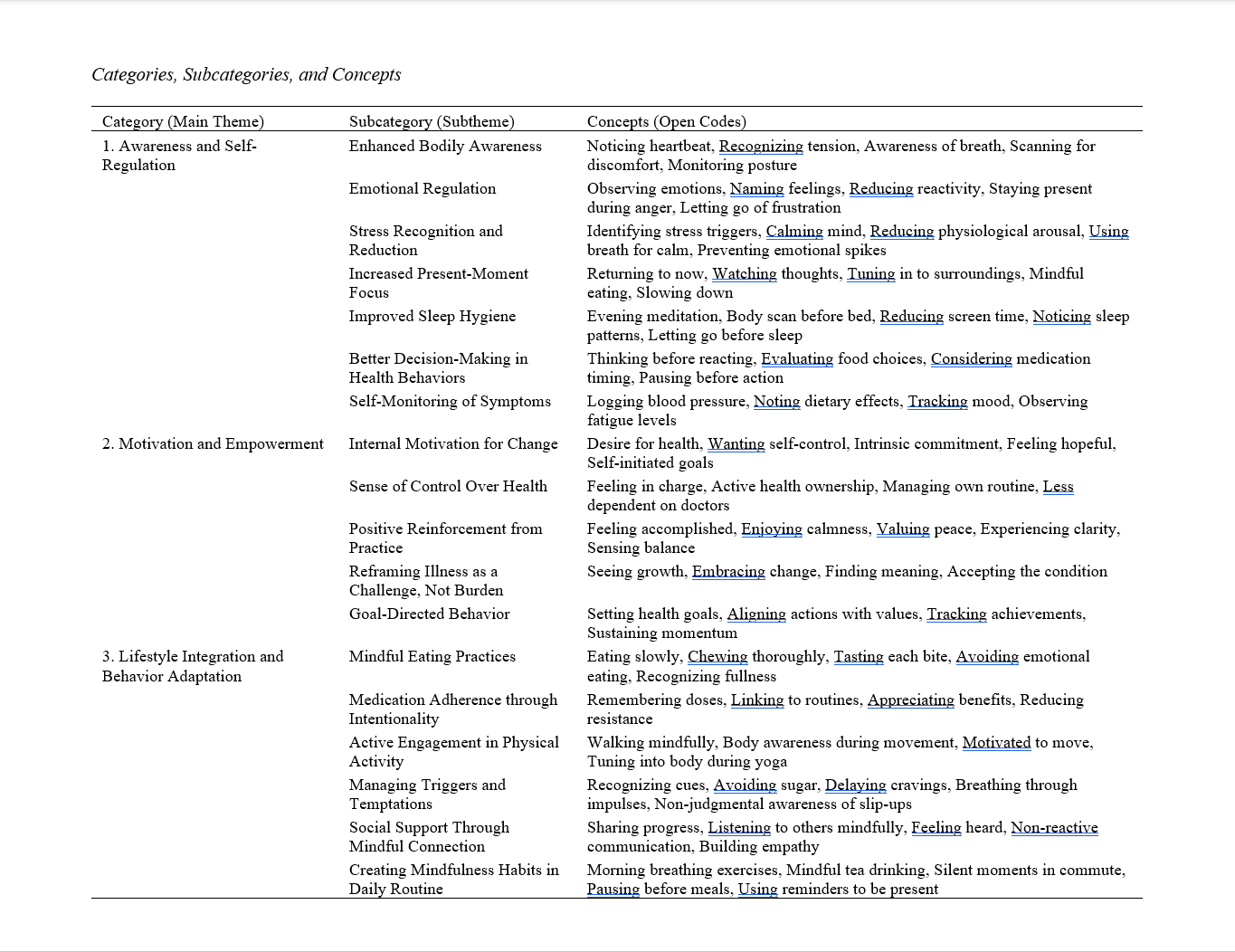
This study aimed to explore the lived experiences of individuals with hypertension who engage in mindfulness practices to understand how mindfulness supports health behavior change. This qualitative study utilized a descriptive phenomenological design to investigate the role of mindfulness in health behavior change among adults diagnosed with hypertension. Sixteen participants (9 females, 7 males) from Canada, all of whom had practiced mindfulness for at least three months, were recruited through purposive sampling. Data were collected through semi-structured interviews focused on participants' experiences with mindfulness in managing hypertension-related behaviors such as stress reduction, medication adherence, diet, and physical activity. Interviews were transcribed verbatim and analyzed thematically using NVivo software. Thematic saturation was reached after the 16th interview. Three main themes emerged from the data: Awareness and Self-Regulation, Motivation and Empowerment, and Lifestyle Integration and Behavior Adaptation. Participants reported enhanced bodily awareness, improved emotional regulation, and reduced reactivity to stress through mindfulness practice. They also described a heightened sense of control and internal motivation to make healthier choices, as well as the successful integration of mindfulness into daily behaviors such as eating, exercising, and medication adherence. Many participants reframed their hypertension as an opportunity for growth and reported improved relationships and communication through mindful connection with others. The findings suggest that mindfulness supports meaningful and sustainable health behavior changes in individuals with hypertension by fostering self-awareness, intrinsic motivation, and daily behavioral adaptation. Integrating mindfulness into hypertension care may enhance patient self-efficacy and support long-term lifestyle management.
Downloads
References
Aufauvre-Poupon, C., Martin‐Krumm, C., Duffaud, A. M., Lafontaine, A., Gibert, L., Roynard, F., Rouquet, C., Bouillon‐Minois, J. B., Dutheil, F., Canini, F., Pontis, J., Leclerq, F., Vannier, A., & Trousselard, M. (2021). Subsurface Confinement: Evidence From Submariners of the Benefits of Mindfulness. Mindfulness, 12(9), 2218-2228. https://doi.org/10.1007/s12671-021-01677-7
Chokshi, D. A. (2019). Changing Minds in Health Policy. JAMA, 322(14), 1341. https://doi.org/10.1001/jama.2019.15311
Esmaeilzadeh, P. (2020). The Role of Information Technology Mindfulness in the Postadoption Stage of Using Personal Health Devices: Cross-Sectional Questionnaire Study in Mobile Health (Preprint). https://doi.org/10.2196/preprints.18122
Gawande, R., Smith, L., Comeau, A., Creedon, T. B., Wilson, C. L., Griswold, T., Cook, B. L., Loucks, E. B., & Schuman‐Olivier, Z. (2023). Impact of Warm Mindfulness on Emotion Regulation: A Randomized Controlled Effectiveness Trial. Health Psychology. https://doi.org/10.1037/hea0001303
Geiger, S. M., Otto, S., & Schrader, U. (2018). Mindfully Green and Healthy: An Indirect Path From Mindfulness to Ecological Behavior. Frontiers in psychology, 8. https://doi.org/10.3389/fpsyg.2017.02306
Huff, S. (2020). Mindfulness Meditation Through a Mobile Appr. Arsenal Augusta University’s Undergraduate Research Journal, 3(2), 18-18. https://doi.org/10.21633/issn.2380.5064/s.2020.03.02.18
Ibrahim, A. T., Lee, V., Vashi, N., Roudbarani, F., Tablon, P., Pouyandeh, A., Sellitto, T., Ameis, S. H., Elkader, A., Gray, K. M., Kerns, C. M., Lai, M. C., Lake, J., Thomson, K., & Weiss, J. A. (2025). Parent Outcomes Following Participation in Cognitive Behavior Therapy for Autistic Children in a Community Setting: Parent Mental Health, Mindful Parenting, and Parenting Practices. Autism Research, 18(3), 570-582. https://doi.org/10.1002/aur.70001
Irawan, A., Janmabhumi, A., Wulandari, Z. A., Putri, A. P., & Santoso, A. P. A. (2023). Effect of Mindfulness Based Cognitive Therapy (MBCT) on Anxiety and Blood Pressure for Hypertension: A Scoping Review. Citra Delima Scientific Journal of Citra Internasional Institute, 7(2), 120-127. https://doi.org/10.33862/citradelima.v7i2.379
Kennedy, A. B., & Resnick, P. B. (2015). Mindfulness and Physical Activity. American Journal of Lifestyle Medicine, 9(3), 221-223. https://doi.org/10.1177/1559827614564546
Ku, X., Jyung, M., Kim, J. H., & Choi, I. (2024). Sound Mind, Sound Body, or Vice Versa? Mind–body Beliefs Shape Health Behaviors. Applied Psychology Health and Well-Being, 17(1). https://doi.org/10.1111/aphw.12617
Li, A., Nie, Y., Chi, M., Wang, N., Ji, S., Zhu, Z., Li, S., & Hou, Y. (2024). Mediating Effect of Perceived Health Competence on the Association Between Mindfulness and Adherence to Health Behaviors in Patients With Acute Coronary Syndrome: A Cross-Sectional Study. Patient Preference and Adherence, Volume 18, 2203-2215. https://doi.org/10.2147/ppa.s487100
Miles, E., Matcham, F., Strauss, C., & Cavanagh, K. (2023). Making Mindfulness Meditation a Healthy Habit. Mindfulness, 14(12), 2988-3005. https://doi.org/10.1007/s12671-023-02258-6
Mitchell, A. D., Martin, L. E., Baldwin, A. S., & Levens, S. M. (2021). Mindfulness-Informed Guided Imagery to Target Physical Activity: A Mixed Method Feasibility and Acceptability Pilot Study. Frontiers in psychology, 12. https://doi.org/10.3389/fpsyg.2021.742989
Parra, D. C., Wetherell, J. L., Zandt, A. V., Brownson, R. C., Abhishek, J., & Lenze, E. J. (2019). A Qualitative Study of Older Adults’ Perspectives on Initiating Exercise and Mindfulness Practice. https://doi.org/10.21203/rs.2.15394/v3
Qiu, Y., Zhang, Y., & Liu, M. (2022). Dual Process Model of Farmers’ Mindfulness and Sustainable Economic Behavior: Mediating Role of Mental Health and Emotional Labor. Frontiers in Psychiatry, 13. https://doi.org/10.3389/fpsyt.2022.979979
Salmoirago‐Blotcher, E., Hunsinger, M., Morgan, L., Fischer, D., & Carmody, J. (2013). Mindfulness-Based Stress Reduction and Change in Health-Related Behaviors. Journal of Evidence-Based Complementary & Alternative Medicine, 18(4), 243-247. https://doi.org/10.1177/2156587213488600
Saunders, R., Cogburn, B., & Nguyen, N. (2024). Promoting Students’ Mental Wellness: Implementing Mindfulness-Based Interventions Within Multitiered Systems of Support. Professional School Counseling, 28(1b). https://doi.org/10.1177/2156759x241247166
Schuman‐Olivier, Z., Trombka, M., Lovas, D., Brewer, J. A., Vago, D. R., Gawande, R., Dunne, J. P., Lazar, S. W., Loucks, E. B., & Fulwiler, C. (2020). Mindfulness and Behavior Change. Harvard Review of Psychiatry, 28(6), 371-394. https://doi.org/10.1097/hrp.0000000000000277
Tang, Y. Y. (2017). Mindfulness Meditation and Behavior Change. 35-44. https://doi.org/10.1007/978-3-319-46322-3_5
Tang, Y. Y., & Tang, R. (2024). Health Neuroscience—How the Brain/Mind and Body Affect Our Health Behavior and Outcomes. Journal of Integrative Neuroscience, 23(4). https://doi.org/10.31083/j.jin2304069
Teufer, B., & Grabner‐Kräuter, S. (2023). How Consumer Networks Contribute to Sustainable Mindful Consumption and Well‐being. Journal of Consumer Affairs, 57(2), 757-784. https://doi.org/10.1111/joca.12536
Torske, A., Bremer, B., Hölzel, B. K., Maczka, A., & Koch, K. (2024). Mindfulness Meditation Modulates Stress-Eating and Its Neural Correlates. Scientific reports, 14(1). https://doi.org/10.1038/s41598-024-57687-7
Valley, M., & Stallones, L. (2018). A Thematic Analysis of Health Care Workers’ Adoption of Mindfulness Practices. Workplace Health & Safety, 66(11), 538-544. https://doi.org/10.1177/2165079918771991
Downloads
Additional Files
Publication Timeline
- Submitted
- Revised
- Accepted
Issue
Section
License

This work is licensed under a Creative Commons Attribution-NonCommercial 4.0 International License.