Perceived Support and Emotional Well-being in First-Generation College Students
DOI:
https://doi.org/10.61838/kman.ec.psynexus.3.6Keywords:
First-generation college students, emotional well-being, perceived support, qualitative research, academic resilience, student identityAbstract
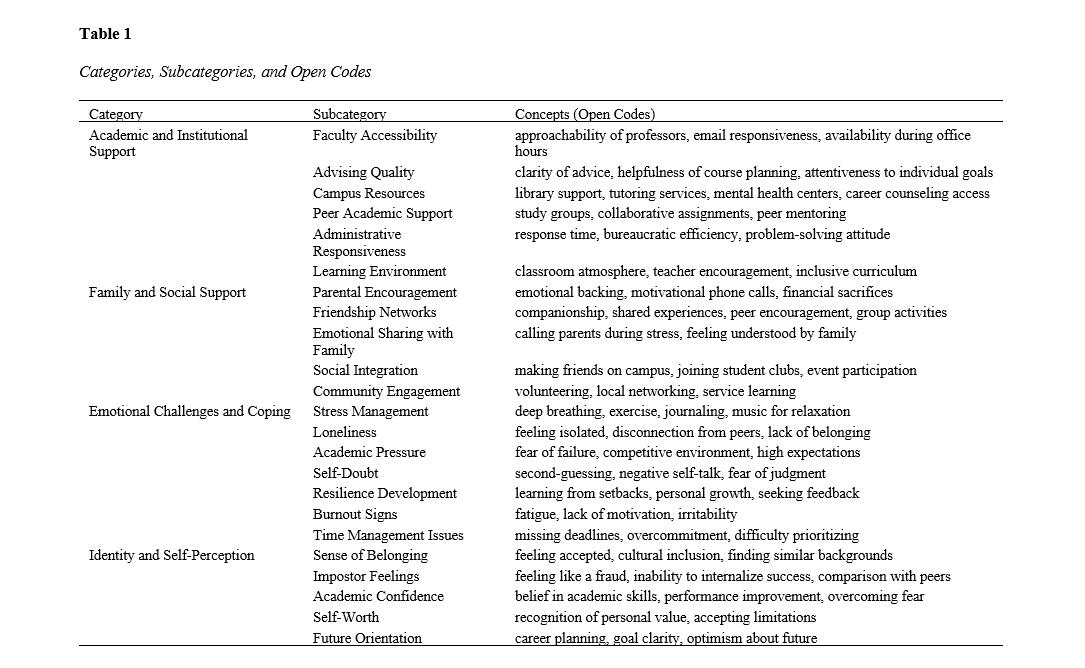
This study aimed to explore the perceived sources of support and their influence on the emotional well-being of first-generation college students in China. This research employed a qualitative design grounded in a constructivist paradigm. Semi-structured interviews were conducted with 30 first-generation undergraduate students from various universities across China, selected through purposive sampling. Participants ranged in age from 18 to 24 and represented diverse academic disciplines and geographical backgrounds. Data collection continued until theoretical saturation was reached. All interviews were transcribed verbatim and analyzed thematically using NVivo software. The analysis focused on identifying recurring patterns and meanings associated with participants’ perceptions of support and emotional experiences. Thematic analysis revealed four overarching categories: academic and institutional support, family and social support, emotional challenges and coping, and identity and self-perception. Participants emphasized the importance of faculty accessibility, effective advising, peer academic collaboration, and resource availability in shaping their emotional security. Emotional encouragement from family, friendship networks, and campus social integration were also critical to well-being. Despite experiencing stress, self-doubt, and impostor feelings, many participants employed adaptive coping strategies such as journaling, exercise, and time management. A strong sense of belonging, academic confidence, and future orientation contributed positively to emotional resilience. The development of self-worth and meaning-making emerged as central to sustaining motivation and psychological well-being. Perceived support plays a vital role in fostering emotional well-being among first-generation college students. The findings underscore the need for culturally responsive, student-centered interventions that address academic, emotional, and identity-related needs. Institutions should enhance inclusive support systems, promote emotional regulation strategies, and validate the lived experiences of first-generation students to support their long-term success and mental health.
Downloads
References
Abbas, N. (2023). College Students' Strategies to Cope With Stress and Its Impact on Their Emotional Resilience: Teacher’s Perspective. Journal of Development and Social Sciences, 4(II). https://doi.org/10.47205/jdss.2023(4-ii)49
Bing, Y., Du, Y., & Li, Z. (2023). Probe Into the Positive Factors of College Students' Subjective Well-Being. BCP Education & Psychology, 9, 287-297. https://doi.org/10.54691/bcpep.v9i.4698
Cheng, S. (2024). Meta-Analysis of the Relationship Between Social Support and Subjective Well-Being of Chinese College Students. Frontiers in Humanities and Social Sciences, 4(4), 7-18. https://doi.org/10.54691/wgc61h89
Deepa, R. (2024). Impact of Emotional Intelligence on the Well-Being of Teachers and Students. Qeios. https://doi.org/10.32388/5ry3yw
DeVitre, Z., Castellanos, J., Gloria, A. M., & Dosaj, S. P. (2022). Indian American Undergraduates’ Well-Being: A Psychosociocultural Understanding of a Culture-Specific Approach to Congruity of Values. Journal of Diversity in Higher Education, 15(3), 288-299. https://doi.org/10.1037/dhe0000302
Farias, K., & Cameron, L. D. (2023). Metaphors Impact on First-Generation College Students Experiencing Imposter Syndrome. Uc Merced Undergraduate Research Journal, 15(1). https://doi.org/10.5070/m415160814
He, Y. Q., & Tang, F. (2024). The Impact of College Students' Achievement Motivation on Subjective Well-Being: Self-Efficacy as a Mediating Variable. Nurture, 18(2), 498-507. https://doi.org/10.55951/nurture.v18i2.657
Homoroc, C., Lauta, M. E., & Ciabal, L. (2022). Emotional Abuse and Psychological Well-Being of College Students. International Review of Social Sciences Research, 2(3). https://doi.org/10.53378/352924
Lawrie, S. I., & Kim, H. S. (2024). The Role of Emotional Similarity and Emotional Accuracy in Belonging and Stress Among First-Generation and Continuing-Generation Students. Frontiers in psychology, 15. https://doi.org/10.3389/fpsyg.2024.1355526
Martínez, L., Valenzuela, L. S., & Soto, V. E. (2022). Well-Being Amongst College Students During COVID-19 Pandemic: Evidence From a Developing Country. International journal of environmental research and public health, 19(24), 16745. https://doi.org/10.3390/ijerph192416745
Nebhinani, N., Nebhinani, M., Modi, S., Rajpurohit, S. S., & Soni, P. K. (2023). Correlates of Psychological Well-Being Among First-Year Medical Students: An Exploratory Study. Medical Journal of Dr D Y Patil Vidyapeeth, 17(2), 439-442. https://doi.org/10.4103/mjdrdypu.mjdrdypu_1006_22
Nguyen, Q. C., Madison, S. J., Ekas, N. V., & Kouros, C. D. (2024). Helicopter Parenting Behaviors and Emerging Adult Mental Health: The Mediating Role of Emotion Dysregulation. Emerging Adulthood, 12(5), 820-837. https://doi.org/10.1177/21676968241254565
Rausch, Z. M., Redden, C., & Geher, G. (2023). The Value Gap: How Gender, Generation, Personality, and Politics Shape the Values of American University Students. Journal of Open Inquiry in the Behavioral Sciences, 2(1). https://doi.org/10.58408/issn.2992-9253.2023.01.01.00000001
Rehr, T. I., Regan, E. P., Abukar, Z., & Meshelemiah, J. C. (2022). Financial Wellness of First-Generation College Students. College Student Affairs Journal, 40(1), 90-105. https://doi.org/10.1353/csj.2022.0007
Rombaoa, J. P., Heshmati, S., Owen, T., & Rodriguez, M. A. (2023). Prioritizing Lifestyle Factors for Effective Emotion Regulation: a Daily Study on First-Year College Students’ Well-Being During COVID-19. https://doi.org/10.31234/osf.io/7gxta
Santos, J. C., & Sagas, M. (2022). Effects of Time Utilization on the Well-Being of College Athletes. The Open Sports Sciences Journal, 15(1). https://doi.org/10.2174/1875399x-v15-e2208101
Trang, D. T., Anh, H. K., Thị, T. N., & Huy, T. Q. (2023). Impact of Emotional Intelligence on the Cognitive Subjective Well-Being of Vietnamese College Students. European Journal of Education and Pedagogy, 4(4), 40-46. https://doi.org/10.24018/ejedu.2023.4.4.708
Vienrich, A. B., & Stone, R. A. T. (2022). The Educational Trajectories of Latinx Undocumented Students: Illegality and Threats to Emotional Well-Being. Socius Sociological Research for a Dynamic World, 8. https://doi.org/10.1177/23780231221135966
Wang, K., Li, Y., Zhang, T., & Luo, J. (2022). The Relationship Among College Students’ Physical Exercise, Self-Efficacy, Emotional Intelligence, and Subjective Well-Being. International journal of environmental research and public health, 19(18), 11596. https://doi.org/10.3390/ijerph191811596
Wang, L., & Sheibani, S. (2024). The Relationships Between the Myers-Briggs Type Indicator (MBTI), Job Satisfaction and Well-Being Among Working College Students in China. Journal of Ecohumanism, 3(7), 3620-3638. https://doi.org/10.62754/joe.v3i7.4489
Wong, W. l. L., & Cheung, S. H. (2024). The Role of Hope in College Transition: Its Cross‐lagged Relationships With Psychosocial Resources and Emotional Well‐being in First‐year College Students. Journal of adolescence, 96(4), 771-788. https://doi.org/10.1002/jad.12297
Yangqiong, X. (2024). Development, Delivery, and Evaluation of Mental and Emotional Well-Being of College Health Education for Physical Education Students. International Journal of Social Science and Human Research, 07(03). https://doi.org/10.47191/ijsshr/v7-i03-49
Yin, S., & Zhao, W. (2024). The Impact of COVID-19 Risk Perception on College Students’ Subjective Well-Being as Moderated by Parenting Style. Scientific reports, 14(1). https://doi.org/10.1038/s41598-024-77622-0
Zang, W., & Zhang, C. (2024). The Influence of College Students' Sense of Life Meaning on Psychological Well-Being: The Mediating Roles of Positive Emotions and Life Adaptation. Nurture, 18(2), 302-314. https://doi.org/10.55951/nurture.v18i2.613
Downloads
Additional Files
Publication Timeline
- Submitted
- Revised
- Accepted
Issue
Section
Categories
License

This work is licensed under a Creative Commons Attribution-NonCommercial 4.0 International License.