Structural Modeling of the Relationship Between Neuropsychological Functioning and Quality of Life with the Mediating Role of Anxiety Sensitivity in Patients with Multiple Sclerosis
DOI:
https://doi.org/10.61838/kman.hp.psynexus.3.11Keywords:
Neuropsychological Functioning, Quality of Life, Anxiety Sensitivity, Multiple Sclerosis PatientsAbstract
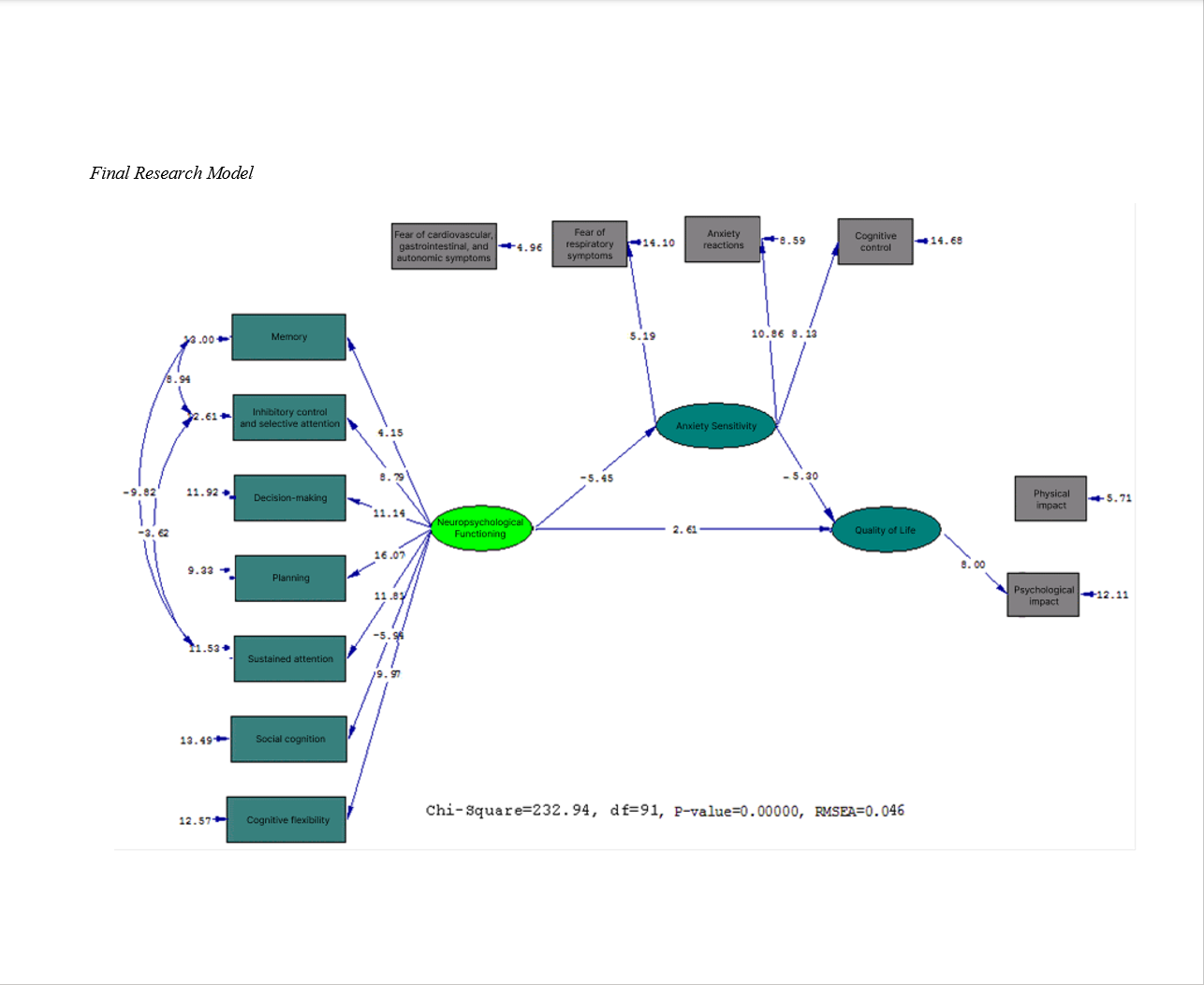
Multiple sclerosis (MS) is characterized by sensory-motor, visual, bladder, and cerebellar impairments, along with emotional difficulties, which lead to functional disability and a lower quality of life. The present study aimed to determine the structural relationships between neuropsychological functioning and quality of life in patients with MS, with anxiety sensitivity as a mediator. This study employed a descriptive-correlational design based on structural equation modeling (SEM). To achieve the research objective, 390 patients diagnosed with MS and registered in the MS Association of Sari were selected through purposive sampling. Participants completed the Neuropsychological Functioning Questionnaire (Nejati, 2013), the Multiple Sclerosis Impact Scale (MSIS-29) (McGuigan & Hutchinson, 2004), and the Anxiety Sensitivity Index-Revised (ASI-R) (Taylor & Cox, 1998). Data were analyzed using structural equation regression modeling in SPSS 24 and Amos 22. The results indicated a significant positive direct relationship between neuropsychological functioning and anxiety sensitivity with the quality of life of patients with MS. Both variables significantly predicted the quality of life of individuals with MS. Additionally, findings revealed that anxiety sensitivity mediated the relationship between neuropsychological functioning and quality of life. Overall, the calculation and analysis of goodness-of-fit indices demonstrated that the proposed model exhibited an acceptable fit. Given the significant role of neuropsychological functioning and anxiety sensitivity in the quality of life of patients with MS, physicians, psychiatrists, counselors, and psychologists can consider these factors in their treatment approaches to enhance and improve patients' quality of life.
Downloads
Downloads
Additional Files
Publication Timeline
- Submitted
- Revised
- Accepted
License
Copyright (c) 2025 Naghmeh Naderi Asrami (Author); Sadegh Taghiloo (Corresponding Author); Parvaneh Ghodsi, Parvaneh Mohammadhkani (Author)

This work is licensed under a Creative Commons Attribution-NonCommercial 4.0 International License.