Proposing a Model for Predicting Self-Efficacy Based on Early Maladaptive Schemas Mediated by the Meaning of Life in Remarried Couples
DOI:
https://doi.org/10.61838/kman.fct.psynexus.3.22Keywords:
self-efficacy, early maladaptive schemas, meaning of life, remarried couplesAbstract
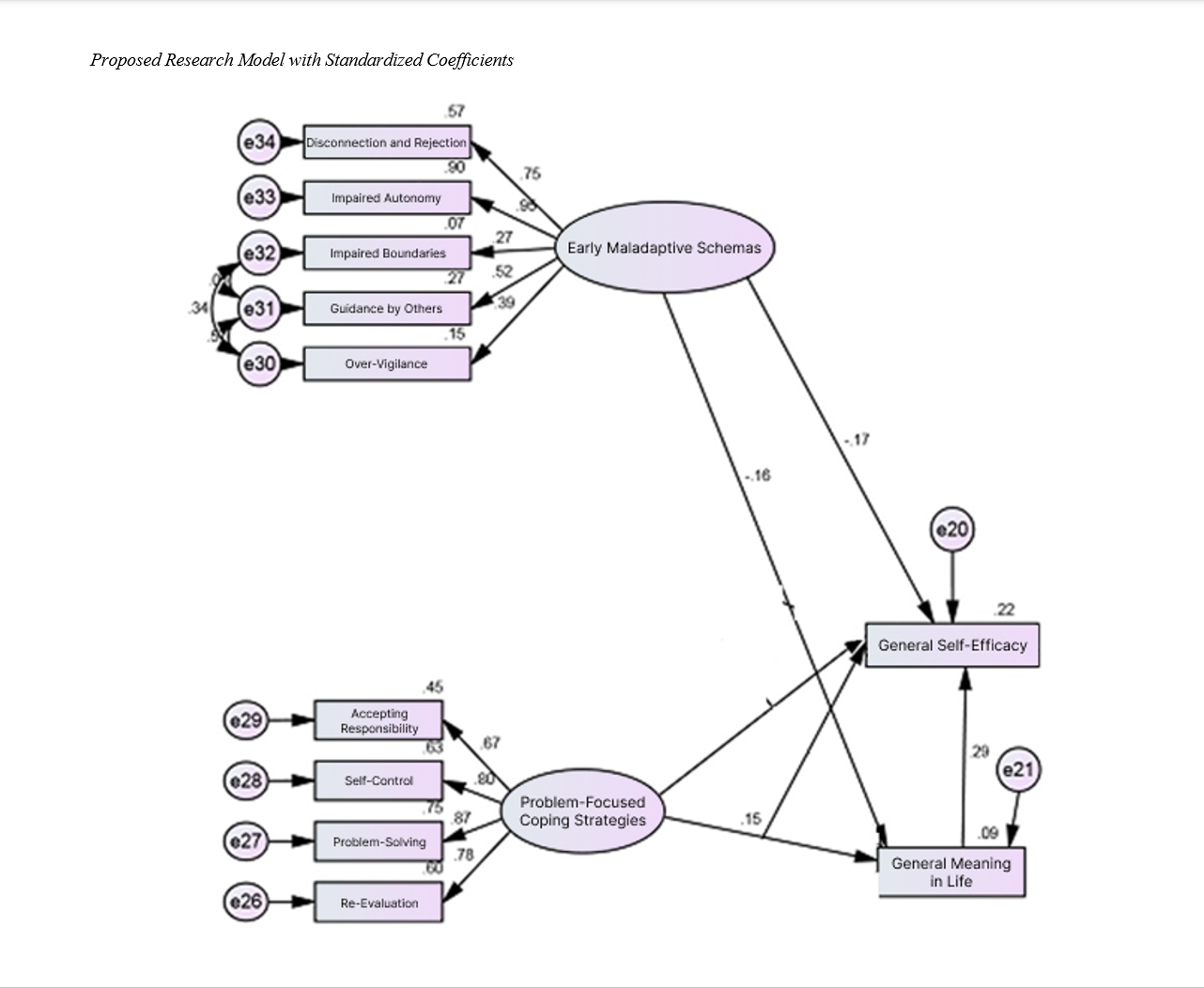
The aim of this study was to propose a model for predicting self-efficacy based on early maladaptive schemas, coping strategies, and differentiation, mediated by the meaning of life in remarried couples. This study is classified as basic-applied research in terms of purpose and descriptive-correlational in terms of methodology. The statistical population of the present study included all remarried couples who visited counseling centers in District 3 of Tehran. The sampling method in this study was voluntary and convenience-based. The sample size, based on Cochran's formula and the nature of the research, and considering potential attrition among participants, was at least 400 individuals, who were selected using the convenience and voluntary sampling method. For data analysis, statistical tests, including multivariate regression and path analysis, were conducted using SPSS software version 24. The results indicated that the proposed model for predicting general self-efficacy based on early maladaptive schemas mediated by the meaning of life in remarried couples fits the empirical data.
Downloads
References
Abdiniya, M. (1998). The relationship between self-efficacy, goal orientations, self-regulated learning, and academic achievement of third-grade middle school students in Tehran University of Tehran]. https://civilica.com/doc/169002/
Adadıoğlu, Ö., & Oğuz, S. (2021). Factors associated with self-efficacy among patients with epilepsy in Turkey. Epilepsy & Behavior, 8(5), 393-397. https://doi.org/10.1016/j.yebeh.2021.107802
Ahi, G. (2005). Standardization of the short form of Young's Schema Questionnaire (SQ-SF) among students of Tehran universities Allameh Tabataba'i University]. https://www.sid.ir/paper/175203/fa
Alessandri, G., Filosa, L., Eisenberg, N., & Caprara, G. V. (2021). Within-individual relations of emotional, social, and work self-efficacy beliefs to organizational citizenship behaviors. Journal of research in personality, 91(1), 104073. https://doi.org/10.1016/j.jrp.2021.104073
Altgelt, D. (2019). Not materialistic, just neurotic. The mediating effect of neuroticism on the relationship between attitudes to material assets and well-being. Journal of Personality and Individual Differences, 23(17), 27-33. https://doi.org/10.1016/j.paid.2017.10.040
Arabiyan, A. (2004). The relationship between self-efficacy beliefs and mental health and academic success of students. Journal of Psychology, 8(4), 51-62. https://www.sid.ir/paper/54548/fa
Askari Zadeh, G., & Pouladi, F. (2016). Predicting music preference based on components of meaning in life and sensation-seeking. Positive Psychology Research Journal, 2(4), 51-63. https://civilica.com/doc/1207756/
Bach, B., Lockwood, G., & Young, J. E. (2018). A new look at the schema therapy model: organization and role of early maladaptive schemas. Cognitive behaviour therapy, 47(4), 328-349. https://doi.org/10.1080/16506073.2017.1410566
Bapiri, O., Kalantari, M., Neshat Doost, H., & Arizzi, H. (2020). Developing a model of meaning in life and comparing the effectiveness of model-based training with Frankl's concepts of meaningfulness on hopelessness and suicidal thoughts in female high school students. Journal of Psychological Sciences, 19(94), 1243-1256. https://www.sid.ir/paper/398137/fa
Brown, C. (2019). The Influence of Premarital Counseling on Marital Satisfaction for African-American Couples Abilene Christian University]. https://digitalcommons.acu.edu/cgi/viewcontent.cgi?article=1141&context=etd
Deal, R. L., & Olson, D. H. (2015). The Smart Stepfamily Marriage: Keys to Success in the Blended Family. Baker Publishing Group. https://books.google.com/books/about/The_Smart_Stepfamily_Marriage.html?id=s5gQBgAAQBAJ
Diamond, R. M., Brimhall, A. S., & Bramesfeld, K. D. (2017). Got Trust? A Mixed-Method Consideration of How Past Relationships Influence Perceptions of Trust. Journal of Divorce & Remarriage, 58(1), 64-81. https://doi.org/10.1080/10502556.2016.1268012
Esfandabad, S., & Haseli, H. (2015). Comparison of the effectiveness of schema therapy and cognitive-behavioral therapy on self-efficacy and lifestyle related to weight loss. Research Quarterly, Research in Psychological Health, 9(4), 12-36. https://rph.khu.ac.ir/article-1-2619-fa.html
Eshtad, E. (2009). The effectiveness of group cognitive therapy on the subjective well-being of students Tehran Institute of Psychiatry]. https://www.sid.ir/paper/152621/fa
Eskandari, E., & Jalali, A. (2020). Predicting psychological resilience based on social support and attachment style with the mediating role of self-efficacy and meaning in life. Positive Psychology Research Journal, 5(2), 17-30. https://www.sid.ir/paper/257757/fa
Evraire, L. E., Dozois, D. J. A., & Wilde, J. (2022). The contribution of attachment styles and reassurance seeking to trust in romantic couples. Europe's journal of psychology, 18(14), 19-39. https://doi.org/10.5964/ejop.3059
Faustino, B., & Vasco, A. B. (2019). Early maladaptive schemas and cognitive fusion on the regulation of psychological needs. Journal of Contemporary Psychotherapy, 50(2), 105-112. https://doi.org/10.1007/s10879-019-09446-3
Fox, W., & Shriner, M. (2014). Remarried Couples in Premarital Education: Does the Content Match Participant Needs? Journal of Divorce & Remarriage, 55(4), 276-299. https://doi.org/10.1080/10502556.2014.901841
Ganji Arjanghi, M., & Farahani, M. T. (2009). The relationship between job stress and self-efficacy with life satisfaction in emergency responders of gas incidents in Isfahan province. Research in Psychological Health, 2(3), 15-24. https://www.sid.ir/paper/450476/en
Hebdon, M. C. T., Coombs, L. A., Reed, P., Crane, T. E., & Badger, T. A. (2021). Self-efficacy in caregivers of adults diagnosed with cancer: An integrative review. European Journal of Oncology Nursing, 52(3), 101-133. https://doi.org/10.1016/j.ejon.2021.101933
Heidari, M., Mami, S., Ahmadi, V., & Khamoushian, K. (2023). The effectiveness of schema therapy combined with cognitive-behavioral therapy on self-efficacy and quality of life in women with multiple sclerosis. Applied Family Therapy, 4(1), 554-570. https://doi.org/10.61838/kman.aftj.4.1.27
Hemphill, K. (2015). Man's search for meaning: Viktor Frankl's psychotherapy. Journal of Biblical Counseling, 29(3), 59-68. https://www.ccef.org/jbc-article/mans-search-for-meaning-viktor-frankls-psychotherapy/
Ho, M. Y., Cheung, F. M., & Cheung, S. (2010). The role of meaning in life and optimism in promoting well-being. Personality and individual differences, 48(1), 658-663. https://doi.org/10.1016/j.paid.2010.01.008
Jarvis, M. A., Padmanabhanunni, A., & Chipps, J. (2019). An Evaluation of a Low-Intensity Cognitive Behavioral Therapy mHealth-Supported Intervention to Reduce Loneliness in Older People. International journal of environmental research and public health, 16(7), 1305-1312. https://doi.org/10.3390/ijerph16071305
Karimpoor, S., Tourani, F., & Khalatbari, J. (2023). The effectiveness of sex therapy on sexual self-efficacy and marital intimacy in couples with sexual dysfunction. Journal of Consulting Excellence and Psychotherapy, 44(11), 33-45. https://www.semanticscholar.org/paper/The-Effectiveness-of-Sex-therapy-on-Sexual-and-of-Hajinia-Khalatbari/d8d53776489286cf5cef24e54dcd0123865e4f8d
Khaldi, B., Akbari, M., Jadidi, H., & Karimi, K. (2020). The relationship between academic vitality based on academic meaning and emotional exhaustion with the mediating role of emotional self-efficacy in students. Journal of Educational Development of Jundishapur Ahvaz, 11(3), 271-283. https://www.sid.ir/paper/415318/
Khodadadi Sangdeh, J., Kolaei, A., & Goharipour, M. (2020). Developing a conceptual model of marital satisfaction in the context of a healthy family: Based on cultural context. Culture of Counseling and Psychotherapy, 11(41), 27-60. https://www.sid.ir/paper/214032/fa
Koochi, S., Mami, S., & Ahmadi, V. (2021). The mediating role of cognitive emotion regulation strategies and social self-efficacy in the relationship between early maladaptive schemas and social anxiety in adolescent girls. Journal of Psychological Sciences, 20(102), 953-966. https://psychologicalscience.ir/article-1-1156-fa.html
Körük, S., & Kurt, A. A. (2019). The predictive role of early maladaptive schemas in the evaluation of pre-marital romantic relationships among university students. Yaşam Becerileri Psikoloji Dergisi, 3(5), 73-83. https://doi.org/10.31461/ybpd.556424
Kunst, H., Lobbestael, J., Candel, I., & Batink, T. (2020). Early maladaptive schemas and their relation to personality disorders: A correlational examination in a clinical population. Clinical Psychology & Psychotherapy, 27(6), 837-846. https://doi.org/10.1002/cpp.2467
Maleki, H. (2016). Education and counseling for remarriage. Avaye Noor.
Mazzuca, S., Kafetsios, K., Livi, S., & Presaghi, F. (2019). Emotion regulation and satisfaction in long-term marital relationships: The role of emotional contagion. Journal of Social and Personal Relationships, 36(9), 2880-2895. https://doi.org/10.1177/0265407518804452
Mohammadi, R., & Mohammadi, Z. (2019). Challenges of remarriage for women with children: A qualitative study. Women in Development and Politics(63), 97-119. https://www.sid.ir/paper/408386/fa
Odero, M. E. A. (2019). Pre-Marital Counseling and Its Influence on Marital Quality Among Seventh Day Adventist Members in Kibra Division of Nairobi County, Kenya Doctoral dissertation]. https://journals.indexcopernicus.com/publication/2914135
Phillips, A. (2018). Survey of African marriage and family life. Routledge. https://doi.org/10.4324/9780429486920
Pintrich, P. R., & Schunk, D. H. (2002). Motivation in education: Theory, research, and applications. Elm Publications. https://www.scirp.org/reference/referencespapers?referenceid=1701699
Purnomo, T., & Suprihandari, M. D. (2025). Social dynamics of marriage (divorce) in banyuwangi city: economic and cultural perspectives in banyuwangi. Jurnal Bina Bangsa Ekonomika, 18(1), 480-489. https://jbbe.lppmbinabangsa.id/index.php/jbbe/article/view/720
Qashqai, M., Emadian, S. O., & Ghanadzadegan, H. (2023). Effectiveness of Schema-based Parenting Training on Mothers' Parental Self-Efficacy, Self-Concept, and Parental Acceptance Children with Internalized disorders. Journal of Family Relations Studies. 3 (11), 31-40. https://journal.uma.ac.ir/article_2170_288d29c9db0eebe066650e0b55343646.pdf
Razazan, S. (2025). The Role of Psychological Flexibility, Resilience, Self-Efficacy, and Hope in Predicting Marital Satisfaction of Married Women. Ijbmc, 12(1), 78-89. https://doi.org/10.61838/ijbmc.v12i1.741
Ridwan, F. H. (2025). The Role of Notary Towards the Implications of Recording a Post-Marriage Marriage Agreement Based on the Decision of the Constitutional Court of the Republic of Indonesia Number 69/Puu-/Xiii/2015. Ajesh, 4(2), 321-330. https://doi.org/10.46799/ajesh.v4i2.534
Samakoush, A. N. (2023). Effectiveness of Schema Therapy on Marital Exhaustion, Sexual Self-Efficacy and Women's Feeling of Loneliness in the Family. PWJ, 4(3), 19-27. https://doi.org/10.61838/kman.pwj.4.3.3
Santos, C. E., Costa, M., Pedro, J. J., Higginbotham, B. V., & Martins, M. (2024). Marital adjustment in remarriage: A systematic review. Family Transitions, 1-32. https://doi.org/10.1080/28375300.2024.2355001
Sari Rahmaini, I., Valendra Granitha Shandika, P., & Mutia, A. (2024). Factors Associated with the Experience of Remarriage: Indonesian Family Life Survey Study. Asketik: Jurnal Agama Dan Perubahan Sosial, 8(1), 83-99. https://doi.org/10.30762/asketik.v8i1.1427
Sarkhosh, A., & Javidi, H. (2015). The relationship between early maladaptive schemas and self-efficacy of students.
Schmidt, N. B., Joiner, T. E., Young, J. E., & Telch, M. J. (1995). The schema questionnaire: Investigation of psychometric properties and the hierarchical structure of a measure of maladaptive schemas. Journal of Cognitive Therapy and Research, 19(2), 295-321. https://doi.org/10.1007/BF02230402
Schramm, D. G., & Becher, E. H. (2020). Common practices for divorce education. Family Relations, 69(3), 543-558. https://doi.org/10.1111/fare.12444
Stavrova, O., & Luhmann, M. (2016). Social connectedness as a source and consequence of meaning in life. The Journal of Positive Psychology, 11(5), 470-479. https://doi.org/10.1080/17439760.2015.1117127
Steger, M. F., Frazier, P., Oishi, S., & Kaler, M. (2006). The Meaning in Life Questionnaire: Assessing the presence of and search for meaning in life. Journal of counseling psychology, 53(4), 80-93. https://doi.org/10.1037/0022-0167.53.1.80
Steger, M. F., & Shin, J. Y. (2010). The relevance of the Meaning in Life Questionnaire to therapeutic practice: A look at the initial evidence. International Forum for Logo therapy, 33(1), 95-104. https://www.scirp.org/reference/referencespapers?referenceid=1907667
Sumari, M., Baharudin, D. F., Aman, N. S., & Razak, N. A. A. (2024). From Divorce to Remarriage: Understanding the Experience of Remarried Women in a Collectivist Society. Family Transitions, 1-31. https://doi.org/10.1080/28375300.2024.2362109
Tabatabaeifar, S. M., Azemati, M., & Najafalizadeh, A. (2022). Investigating the relationship between early maladaptive schemas in self-efficacy and work enthusiasm of employees. International Journal of Innovation Management and Organizational Behavior (IJIMOB), 2(4), Serial Number 8. https://doi.org/10.61838/kman.ijimob.2.4.2
Talebzadeh Shoushtari, L., Monadi, M., Khademi Ashkezari, M., & Khamsan, A. (2016). Identifying the meaning of life in students: A phenomenological study. Applied Counseling, 6(1), 59-76. https://www.sid.ir/paper/218203/fa
Tosi, M., & van den Broek, T. (2020). Gray divorce and mental health in the United Kingdom. Social Science & Medicine, 25(6), 113-130. https://doi.org/10.1016/j.socscimed.2020.113030
Vohs, K. D., Aaker, J. L., & Catapano, R. (2019). It's not going to be that fun: negative experiences can add meaning to life. Current opinion in psychology, 26(4), 11-14. https://doi.org/10.1016/j.copsyc.2018.04.014
Volkert, J., Härter, M., Dehoust, M. C., Ausín, B., Canuto, A., Da Ronch, C., Suling, A., Grassi, L., Munoz, M., Santos-Olmo, M., Sehner, S., Weber, K., Wegscheider, K., Wittchen, H. U., Schulz, H., & Sehner, S. (2019). The role of meaning in life in community-dwelling older adults with depression and relationship to other risk factors. Aging & mental health, 23(1), 100-106. https://doi.org/10.1080/13607863.2017.1396576
Walsh, F. (2012). Normal Family Processes: Growing Diversity and Complexity. Guilford Publications. https://www.guilford.com/books/Normal-Family-Processes/Froma-Walsh/9781462525485?srsltid=AfmBOoosGWFhQmZEJZG3G162LnleFzWqt00pLjHa0ztNeeM0uY0EuwM3
Yılmaz, C. D., Lajunen, T., & Sullman, M. J. M. (2023). Trust in relationships: a preliminary investigation of the influence of parental divorce, breakup experiences, adult attachment style, and close relationship beliefs on dyadic trust. Frontiers in psychology, 14(2), 1260480. https://doi.org/10.3389/fpsyg.2023.1260480
Young, J., Klosko, J., & Weishaar, M. (2016). Schema therapy: A practitioner's guide. Arjmand Publications. https://books.google.com/books/about/Schema_Therapy.html?id=vScjGGgJEZgC
Zhao, S. P., & Mansor, S. (2025). The Study on the Discussion of Women’s Marriage Issues Under the Marriage and Family Concepts of the Republic of China. Salud Ciencia Y Tecnología, 5, 1059. https://doi.org/10.56294/saludcyt20251059
Zohreh, M., Armin, M., & Ali, T. (2023). Modeling the Relationship between Early Maladaptive Schemas, Personality Traits and Suicidal Tendency with Mediating roles of Self-Efficacy and Meaning of Life in Teenagers of Gachsaran City. Islamic Lifestyle Centered on Health, 7(2), 317-328. https://www.magiran.com/paper/2712744
Zolfaghari, M., Fatehizadeh, M., & Abedi, M. R. (2008). The relationship between early maladaptive schemas and dimensions of marital intimacy in couples. Family Research Quarterly, 4(3), 247-261. https://www.sid.ir/paper/122237/fa
Downloads
Additional Files
Publication Timeline
- Submitted
- Revised
- Accepted
Issue
Section
Categories
License
Copyright (c) 2025 Esmail Firouzi (Author); Farideh Dokaneifard (Corresponding Author); Afsaneh Bostan (Author)

This work is licensed under a Creative Commons Attribution-NonCommercial 4.0 International License.